July 19, 2026
When Trade Protection Collides With Infrastructure Ambition
The global energy transition has quietly created a new category of industrial vulnerability: the bottleneck material. These are inputs so specialised, so technically demanding to produce, and so deeply embedded in critical infrastructure that even modest supply disruptions or price shocks ripple outward across entire economies. Cold-rolled grain-oriented electrical steel sits squarely in this category, and India's current trade remedy proceedings around this material expose a tension that goes far beyond a routine anti-dumping duty on electrical steel investigation.
When big ASX news breaks, our subscribers know first
The Material That Powers Every Transformer You Have Never Heard Of
Why CRGO Is Technically Irreplaceable
At the heart of every power transformer and distribution transformer operating on India's grid sits a magnetic core built from cold-rolled grain-oriented (CRGO) electrical steel. The material's defining characteristic is its crystalline structure: during production, precise cold-rolling and annealing processes under controlled atmospheric conditions align the iron grains along a single axis, creating what metallurgists call directional magnetic permeability.
In practical terms, this means electromagnetic energy flows through the core with dramatically reduced resistance compared to conventional silicon steel. The result is lower hysteresis loss (energy lost as heat during each magnetic cycle) and reduced eddy current loss (energy dissipated through circulating currents within the steel itself). For a utility operating thousands of transformers around the clock, these efficiency advantages compound into enormous energy savings across the grid's lifetime.
No commercially scalable substitute currently exists for utility-grade transformer manufacturing. Amorphous metal cores offer competitive loss profiles in smaller distribution transformers, but their brittleness and cost make them impractical at the scale required for high-voltage power transmission equipment.
CRGO vs. CRNO: Two Products, Two Separate Trade Battles
India's electrical steel trade remedy landscape now encompasses two distinct products, each serving different corners of the electrical equipment manufacturing ecosystem.
| Property | CRGO (Grain-Oriented) | CRNO (Non-Oriented) |
|---|---|---|
| Primary Application | Power and distribution transformers | Motors, generators, small transformers |
| Magnetic Directionality | Unidirectional (along rolling direction) | Isotropic (uniform in all directions) |
| Core Loss Performance | Ultra-low | Moderate |
| Manufacturing Complexity | Very high | Moderate |
| India's Import Dependency | ~90% | Significant |
| Current Trade Remedy Status | Investigation initiated June 2026 | Anti-dumping duty already imposed |
"The simultaneous trade remedy actions covering both CRGO and CRNO electrical steel represent the most comprehensive challenge to India's electrical steel import framework in the country's history. Together, they place cost pressure across transformers, motors, and generators simultaneously."
India's Structural Dependence on Imported Electrical Steel
The Supply Gap in Numbers
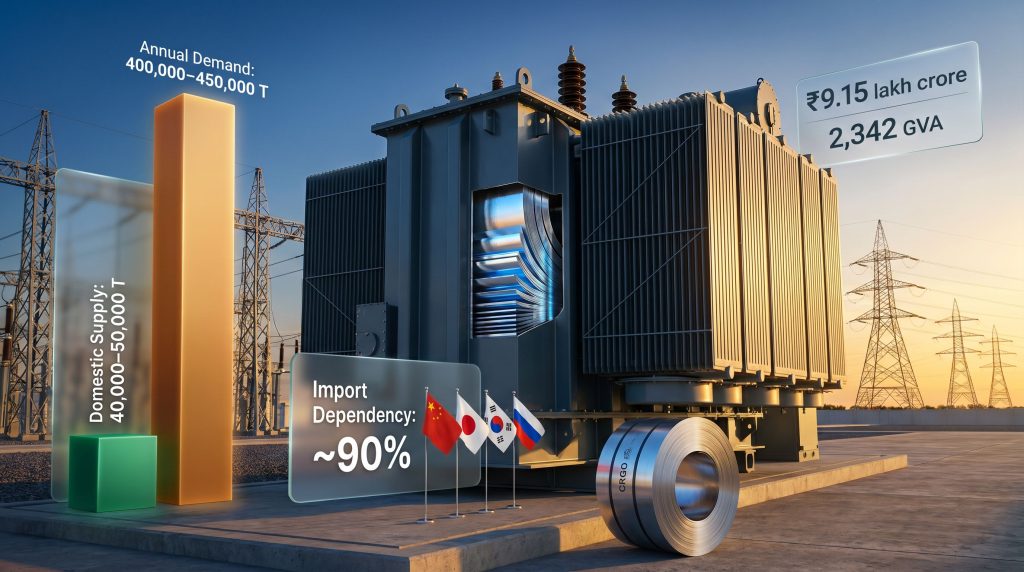
India's CRGO supply situation is, by any conventional measure, a structural vulnerability. Annual domestic consumption sits between 400,000 and 450,000 tonnes, while domestic production capacity remains confined to roughly 40,000 to 50,000 tonnes per year. This means the country sources approximately 90% of its CRGO requirements through imports, primarily from China, Japan, South Korea, and Russia.
| Metric | Volume |
|---|---|
| Annual CRGO Demand | 400,000–450,000 tonnes |
| Domestic Production Capacity | 40,000–50,000 tonnes |
| Annual Import Requirement | ~360,000–400,000 tonnes |
| Effective Self-Sufficiency Rate | Less than 10% |
The concentration of imports across four source countries adds a geopolitical dimension to the supply risk. Furthermore, any deterioration in trade relations with one or more of these nations, independently of anti-dumping duties, could compress supply availability and inflate prices.
Why Domestic CRGO Production Has Never Scaled
The reasons India has never developed meaningful domestic CRGO capacity are partly technical and partly economic. CRGO manufacturing requires highly specialised cold-rolling mills capable of precise thickness control, followed by high-temperature annealing in hydrogen-rich atmospheres to develop the grain-oriented microstructure. This equipment is expensive, technically demanding, and concentrated in a small number of globally advanced facilities.
Capital expenditure requirements for a greenfield CRGO plant are substantial, with long gestation periods before a facility reaches commercially viable production quality. Technology licensing has historically been tightly controlled by established producers in Japan, Germany, and South Korea, consequently limiting knowledge transfer to emerging market manufacturers.
India's only significant domestic CRGO manufacturer, JSW JFE Electrical Steel, operates through its subsidiary Jsquare Electrical Steel Nashik Pvt Ltd, which acquired the Nashik facility previously operated by thyssenkrupp Electrical Steel India. Even with this facility operational, domestic supply covers less than one-tenth of national demand.
The Anti-Dumping Investigation: What the DGTR Is Actually Examining
Dual-Track Proceedings: CRGO Investigation and CRNO Duty Already Live
The Directorate General of Trade Remedies (DGTR), the trade remedy arm of India's Ministry of Commerce, formally launched an anti-dumping investigation into CRGO imports on 22 June 2026. The complaint was filed by JSW JFE Electrical Steel Nashik Pvt Ltd, positioning the country's sole significant domestic producer as the petitioner against imports from China, Japan, South Korea, and Russia.
Key investigation parameters:
- Dumping analysis period: 1 April 2025 to 31 March 2026
- Injury analysis period: Financial years 2022-23, 2023-24, and 2024-25
- Scope: Cold-rolled grain-oriented electrical steel and amorphous metals
- Countries under scrutiny: China, Japan, South Korea, and Russia
Separately, the Finance Ministry has already imposed a five-year anti-dumping duty on cold-rolled non-oriented (CRNO) electrical steel from China, with duty rates ranging from USD 223.82 to USD 414.92 per tonne depending on the specific exporting entity. Crucially, cold-rolled full-hard silicon electrical steel, which serves as the upstream input material for CRNO production, was explicitly excluded from the duty scope to protect downstream manufacturers' supply chains.
"The CRNO duty is active and enforceable. The CRGO investigation is newly initiated. Together, they represent a sweeping dual-track trade remedy action covering India's entire electrical steel import portfolio."
BIS Certification: Pricing, Not Quality, Is the Real Issue
Every coil of CRGO imported into India must comply with mandatory Bureau of Indian Standards (BIS) certification before it can enter the domestic market. This quality gate means that all imported material already meets Indian technical standards. The DGTR investigation is therefore not a product safety or quality dispute. It is fundamentally a pricing dispute, examining whether foreign producers have sold CRGO at prices below normal market value in their home countries.
This distinction matters for policy assessment. CRGO was previously excluded from safeguard duties specifically because of India's acknowledged dependence on imports. The current anti-dumping investigation reopens that question under a different legal framework, however the underlying supply dependency remains unchanged.
The Grid Expansion Equation: What Is Actually at Stake
₹9.15 Lakh Crore and the CRGO Connection
India's power infrastructure investment programme through 2032 is among the most ambitious grid expansion projects anywhere in the world. The plan encompasses:
- Total planned investment: ₹9.15 lakh crore
- Transmission line additions: 1,91,000 circuit kilometres
- Transformer capacity target: 2,342 GVA, more than double current installed capacity
Every transformer procured under this programme requires CRGO electrical steel for its magnetic core. Given that CRGO typically accounts for 25 to 40% of total transformer material costs, any significant price increase in CRGO directly translates into higher transformer procurement costs across the entire programme. State electricity boards, private transmission developers, and public utilities all purchase transformers through competitive tender processes, leaving limited room to absorb material cost inflation without project delays or budget overruns.
Modelling Three Duty Scenarios
The policy question is not simply whether dumping occurred, but whether the remedy will achieve its intended purpose given India's structural supply dependency.
| Scenario | Duty Level | Estimated Transformer Cost Impact | Grid Expansion Risk |
|---|---|---|---|
| No Duty Imposed | 0% | Neutral | Low |
| Moderate Duty (15–25%) | Moderate | Cost increase of 5–12% per transformer unit | Manageable with procurement adjustments |
| High Duty (>30%) | Significant | Cost increase of 15–25% per transformer unit | Material risk to project timelines and budgets |
Note: These estimates are illustrative projections based on CRGO's proportional share of transformer material costs and are subject to variation based on transformer specifications, contract structures, and import volumes.
The Global Trade Research Initiative (GTRI) has assessed that with domestic output covering less than one-tenth of national demand, higher duties would raise prices without materially reducing import dependence. The practical outcome would be cost inflation across transformer procurement without any corresponding shift toward domestic sourcing, since the domestic supply simply does not exist to substitute for imports at scale.
The Policy Paradox at the Centre of This Debate
The Domestic Industry Case: Legitimate but Structurally Limited
JSW JFE Electrical Steel has made a genuine commercial investment in Indian CRGO manufacturing, having acquired the Nashik facility and committed to operating it at scale. Under WTO Anti-Dumping Agreement provisions, a domestic industry suffering material injury from below-cost imports has a legitimate legal basis to seek trade remedies, regardless of its market share.
The theoretical logic is straightforward: if imports are priced below fair market value, the price signal discourages domestic investment, perpetuating the import dependency indefinitely. Protecting nascent capacity through temporary trade remedies is a recognised industrial policy instrument, employed by economies at every level of development. This dynamic also intersects with broader debates around critical raw materials transition strategies as nations seek greater supply chain resilience.
The Counterargument: Protection Without Supply Substitution
The problem in India's case is one of arithmetic. With domestic capacity covering less than 10% of demand, even a 100% anti-dumping duty would not redirect transformer manufacturers toward Indian suppliers. The supply simply does not exist. What the duty would accomplish, in the near term at least, is raising the cost of imported CRGO without providing any alternative supply source.
Trade policy researchers have noted that this dynamic creates a rare and uncomfortable scenario: the domestic industry seeking protection is structurally too small to fill the supply gap that protection would create. The resulting cost burden falls on grid developers, power utilities, and ultimately electricity consumers, without delivering the industrial development benefit that typically justifies such trade remedies.
"This is the central paradox: a protective measure designed to build domestic industry may instead tax the infrastructure expansion that domestic industry ultimately depends on for long-term demand."
The next major ASX story will hit our subscribers first
How Global Peers Handle Electrical Steel Trade Remedies
The European Union's Minimum Import Price Model
Rather than imposing flat tariff-style duties, the EU has deployed a minimum import price mechanism for grain-oriented electrical steel from China, Japan, South Korea, Russia, and the United States. The MIP sets a floor price below which imports cannot be sold into the EU market. This approach constrains the most aggressive below-cost pricing without eliminating import supply or inflicting prohibitive cost increases on downstream manufacturers.
EU measures have been periodically extended through five-year sunset reviews, reflecting the ongoing competitive dynamics of global electrical steel trade. The MIP model is particularly relevant for India because it addresses the pricing distortion without the supply disruption risk that a high flat duty would create given India's 90% import dependency.
The United States Dual-Track Approach
The US maintains active anti-dumping and countervailing duty orders on non-oriented electrical steel from multiple countries including China, Sweden, and Germany. The dual-track system simultaneously addresses below-cost pricing through anti-dumping duties and government subsidisation through countervailing duties, providing more comprehensive protection against trade distortions. In addition, US steel and aluminum tariffs have further reshaped global trade flows across multiple metal categories, adding complexity to how nations calibrate their own protective measures.
Importantly, the US domestic electrical steel manufacturing base is substantially more developed than India's, making the protective rationale more structurally coherent. American duties reinforce an existing industry; Indian duties, if imposed at high levels, would protect a manufacturing capacity that cannot currently serve the market it seeks to protect.
| Jurisdiction | Instrument | Target Product | Key Feature |
|---|---|---|---|
| India (CRNO) | Fixed anti-dumping duty | Non-oriented electrical steel | USD 223–414/tonne; already active |
| India (CRGO) | Investigation underway | Grain-oriented electrical steel | Outcome pending; high import dependency complicates case |
| European Union | Minimum import price | Grain-oriented electrical steel | Price floor preserves supply while limiting dumping |
| United States | AD plus CVD orders | Non-oriented electrical steel | Dual-track remedy; stronger domestic industrial base |
The Seven-Step Investigation Process and What Comes Next
How the DGTR Reaches Its Determination
- Initiation — Formal investigation launched 22 June 2026; statutory notices issued to all identified exporters and importers
- Questionnaire Phase — Exporters from China, Japan, South Korea, and Russia submit detailed pricing, cost, and sales data
- Domestic Industry Verification — DGTR field teams verify the injury claims submitted by the petitioner
- Oral Hearing — All interested parties, including importers, transformer manufacturers, and power utilities, present arguments for and against duty imposition
- Preliminary Findings — The DGTR may recommend provisional duties pending the final determination if injury appears likely
- Final Recommendation — The DGTR submits its duty recommendation to the Finance Ministry
- Finance Ministry Notification — Any final duty is gazetted and becomes legally enforceable from that date
Three Realistic Outcomes
- Duties imposed at significant levels: Transformer procurement costs rise materially; grid expansion faces budget pressure; domestic CRGO investment may accelerate over a 5-10 year horizon but provides no near-term supply relief
- Investigation finds insufficient evidence: Import flows continue uninterrupted; domestic manufacturer faces continued pricing pressure from foreign competitors; grid expansion proceeds on existing cost assumptions
- Minimum import price mechanism adopted: The most pragmatic resolution given India's supply constraints, limiting the most aggressive below-cost pricing without triggering the full cost shock of prohibitive tariffs
Building Toward Self-Sufficiency: The Long-Term Industrial Policy Imperative
Why Trade Barriers Alone Cannot Solve the CRGO Problem
The deeper lesson from India's electrical steel situation is that trade remedies are, at best, a short-term instrument for a structural challenge that requires long-term industrial investment. Protection can shield existing domestic capacity from below-cost competition, but it cannot substitute for the capital investment, technology acquisition, and manufacturing expertise needed to build meaningful domestic CRGO production.
A credible pathway toward reduced import dependency would likely combine several policy instruments simultaneously:
- Production-linked incentive schemes targeting electrical steel manufacturing, similar to PLI programmes deployed in semiconductors and specialty chemicals
- Technology transfer partnerships with established Japanese and South Korean CRGO producers, potentially facilitated through bilateral trade agreements
- Concessional financing mechanisms from development finance institutions for greenfield CRGO facility construction
- Strategic joint ventures between domestic steel majors and global electrical steel specialists with proven manufacturing technology
| Policy Lever | Short-Term Impact | Long-Term Impact |
|---|---|---|
| High anti-dumping duties | Cost inflation for grid developers | Uncertain capacity stimulus without supply substitution |
| Minimum import price mechanism | Moderate cost containment | Preserves supply continuity while limiting dumping |
| PLI scheme for CRGO manufacturing | Minimal immediate effect | Builds domestic capacity over 5-10 years |
| Technology transfer partnerships | Moderate capacity acceleration | Reduces import dependency structurally over time |
The Renewable Energy Integration Risk
Every gigawatt of solar and wind capacity added to India's grid requires corresponding investment in transmission and distribution infrastructure, including the transformers that step up and step down voltage across the network. The growth of renewable energy in mining and broader industrial sectors further amplifies demand for transformer-grade electrical steel, making supply chain stability even more consequential.
Disrupting CRGO supply chains or inflating transformer costs through poorly calibrated trade remedies does not just affect transformer manufacturers. It directly impedes the pace at which renewable energy can be integrated into the national grid, with downstream consequences for carbon reduction commitments and rural electrification targets.
The anti-dumping duty on electrical steel debate is, ultimately, about much more than steel pricing. It is a test of whether India's trade policy architecture can accommodate the industrial development ambitions of domestic manufacturers without undermining the infrastructure investment ambitions of the broader economy. How the DGTR resolves this tension — and whether the Finance Ministry adopts a nuanced pricing-floor approach or a blunt tariff — will have consequences measured not in tonnes of steel but in gigawatts of clean energy and kilometres of transmission line. Indeed, broader critical minerals demand pressures reinforce why getting this balance right matters so profoundly for India's long-term energy future. The global steel outlook for 2025 and beyond further underscores that these trade remedy decisions do not occur in isolation but within a rapidly shifting international market.
This article contains forward-looking estimates and scenario projections for illustrative purposes. Actual outcomes will depend on DGTR findings, Finance Ministry decisions, and market developments that cannot be predicted with certainty. Nothing in this article constitutes financial or investment advice.
Want to Track ASX Mineral Discoveries Before the Broader Market Does?
Discovery Alert's proprietary Discovery IQ model delivers real-time alerts on significant ASX mineral discoveries — instantly translating complex data across more than 30 commodities into clear, actionable insights for both traders and long-term investors. Explore historic discovery returns on Discovery Alert's dedicated discoveries page and begin a 14-day free trial to position yourself ahead of the market.