July 19, 2026
The Fragility Beneath the Surface: How Global Energy Systems Leave Africa Exposed
Every major geopolitical rupture in the global energy system eventually finds its way into the daily lives of ordinary Africans, not through direct political connection, but through the invisible architecture of commodity pricing, shipping logistics, and supply chain dependencies that most governments never fully map until a crisis forces them to. The Hormuz closure exposes Africa's energy dependence on Iran and China in ways that are both more nuanced and more alarming than the headline narrative suggests, and understanding the distinction matters enormously for policymakers, investors, and energy planners across the continent.
When big ASX news breaks, our subscribers know first
Why the Common Narrative Gets Africa's Exposure Wrong
When analysts describe Africa's vulnerability to the Strait of Hormuz closure, a common misconception frames the problem as a direct dependence on Iranian crude or Chinese energy exports. The reality is structurally different and strategically more important to understand.
Iran directs over 90% of its crude oil exports to China, with Chinese absorption of Iranian oil estimated at approximately 0.84 million barrels per day in 2025, escalating to between 1.5 and 2.16 million barrels per day by early 2026. African nations are largely peripheral to that bilateral relationship. What Africa actually depends on is not Iranian oil directly, but the stability of the global systems that Iran, China, and the Gulf states collectively anchor.
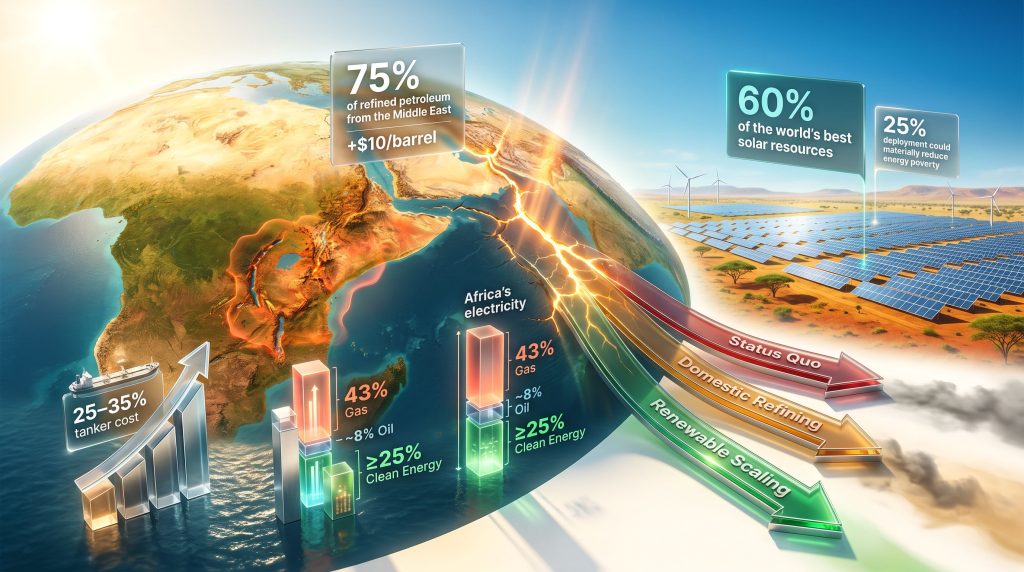
East and Southern African nations source approximately 75% of their refined petroleum products from Middle Eastern producers including Saudi Arabia, the UAE, and Qatar. Nations including Kenya, Ethiopia, Tanzania, and Uganda operate with near-total dependence on imported refined fuel and possess minimal domestic processing infrastructure. The Hormuz crisis severs the supply chains feeding those imports, irrespective of whether Africa has any direct commercial relationship with Tehran.
Furthermore, the broader implications for energy transition and security are increasingly difficult for African policymakers to ignore. As one leading analyst framed it:
"Africa's exposure to the Hormuz crisis is not bilateral. It is systemic, operating through global price transmission, fertiliser supply chain fractures, and shipping cost escalation rather than through any direct dependence on Iran or China as energy suppliers."
The Four Channels Through Which Economic Harm Reaches Africa
Understanding how a closure thousands of kilometres away translates into fuel queues and food price spikes across sub-Saharan Africa requires mapping the specific transmission mechanisms at work.
| Impact Channel | Mechanism | Estimated Magnitude |
|---|---|---|
| Crude Price Surge | Global benchmark repricing from supply shock | Goldman Sachs projects +$10/barrel uplift |
| Refined Fuel Shortages | Gulf refinery disruption cuts East African supply | Jet fuel (40.9%) and diesel (23.4%) most exposed |
| Fertiliser Supply Fracture | Gulf ammonia and urea exports blocked via Hormuz | Threatens food security across agricultural economies |
| Shipping Cost Escalation | Tanker rerouting via Cape of Good Hope adds time and cost | Tanker rates to East Africa rose 25-35% during 2024 Red Sea tensions |
| Currency and Debt Stress | Rising import bills pressure forex reserves | Amplifies existing fiscal fragility across low-income economies |
Each of these channels operates independently of whether Africa imports from Iran. When the strait closes, global crude benchmarks reprice upward. Gulf refineries that supply East Africa reduce output or divert supply. Fertiliser produced in Gulf petrochemical complexes and transported through Hormuz becomes unavailable. Tankers rerouting around the Cape of Good Hope add voyage time, fuel consumption, and charter cost to every cargo that eventually reaches Mombasa, Dar es Salaam, or Djibouti.
The Refining Capacity Gap: Africa's Most Dangerous Structural Weakness
One of the least discussed but most consequential structural vulnerabilities underlying all of this is Africa's near-total absence of meaningful refining infrastructure relative to its crude production volumes. Nigeria and Angola rank among the continent's largest crude producers, yet both nations import substantial quantities of refined petroleum products.
The mechanics of this paradox are worth spelling out clearly:
- African crude is extracted and exported in unprocessed form, typically sold at a discount to international benchmarks.
- That crude is refined elsewhere, predominantly in Asian and Middle Eastern facilities.
- The resulting petroleum products are then sold back to African importers at a price that includes refining margins, transport costs, and international markup.
- Every global supply disruption amplifies this cost penalty, because Africa pays twice: once through higher crude benchmarks, and again through higher refined product import premiums.
Expanding domestic refining capacity in Nigeria and Angola would allow these nations to capture value-added margins currently exported with their crude. Regional refining hubs could also serve landlocked nations that currently absorb the highest transport cost premiums of any consumers on the continent.
Fertiliser Dependency and the Food Security Cascade
A dimension of the Hormuz crisis that receives far less attention than fuel shortages is the compound threat to agricultural inputs. Gulf producers supply substantial volumes of ammonia and urea, the fundamental building blocks of nitrogen-based fertilisers, that transit the Strait of Hormuz before reaching African farming markets.
When Hormuz closes, this supply fractures simultaneously with fuel supply chains, creating a compounding crisis in which:
- Fuel prices rise, increasing planting, harvesting, and transport costs for farmers.
- Fertiliser availability contracts, threatening application rates and crop yields.
- Food prices escalate as both input costs and logistics costs increase simultaneously.
- Foreign exchange reserves deplete faster as import bills expand across multiple categories at once.
For nations with already fragile food security, this sequence is not hypothetical. It is a documented pattern that played out during the 2022 Black Sea disruptions and that the Hormuz closure is now amplifying across entirely different supply corridors. Indeed, as UNCTAD has documented, Strait of Hormuz disruptions carry profound implications for global trade and development that extend well beyond immediate energy costs.
China as a Crisis Amplifier, Not a Direct African Supplier
China's role in Africa's Hormuz vulnerability is frequently mischaracterised. The popular framing positions China as Africa's primary energy patron, whose disruption creates Africa's energy shortage. The actual mechanism is more indirect but no less significant.
China routes approximately 40% of its crude oil imports and 30% of its LNG through the Strait of Hormuz, sourcing heavily from Saudi Arabia, Iraq, Kuwait, and the UAE in addition to Iran. When the strait closes, China loses access to a volume of Gulf crude that dwarfs Iranian supply volumes, triggering a contraction in Chinese refinery throughput estimated at 50-70% of normal operational levels.
This contraction propagates into African markets through reduced availability of:
- Asia-manufactured petrochemicals and processed fuels that African traders source from Chinese exporters.
- Manufactured goods embedded in African supply chains that depend on Chinese industrial output.
- Chinese construction and infrastructure investment activity, which contracts when domestic energy costs surge.
The practical result is that Africa does not need to import directly from China or Iran to feel the consequences of their collective disruption. The interconnection is systemic, and the growing critical minerals demand required for alternative energy technologies makes resolving these dependencies even more urgent.
Russia, Turkey, and the Strategic Vacuum
A prolonged Hormuz disruption creates a geopolitical opening that Moscow and Ankara are structurally positioned to exploit. Both powers have spent years building diplomatic, defence, and military footholds across multiple African nations, and both possess energy assets that could theoretically serve African markets under alternative bilateral arrangements.
Russia demonstrated its ability to redirect crude flows rapidly following its post-2022 pivot to Asian markets, offering price discounts that attracted buyers willing to navigate sanctions complexity. That same commercial model, applied to African refining partners, becomes more attractive the longer Gulf supply chains remain disrupted.
Turkey's role is less about crude supply and more about logistics, shipping, and the kind of transactional diplomacy that fills vacuums left by Western disengagement. Both powers benefit from an Africa that grows more dependent on non-Western energy frameworks, and the Hormuz crisis accelerates the conditions that make such dependency more likely.
"A sustained Strait of Hormuz closure could function as a geopolitical accelerant, deepening Africa's alignment with non-Western energy partners and reshaping trade and diplomatic architecture in ways that outlast the immediate crisis."
Africa's Renewable Energy Paradox: 60% of Global Solar Resources, Minimal Deployment
The International Energy Agency identifies Africa as home to 60% of the world's highest-quality solar resources, a statistic that sits in stark contrast to the continent's actual energy mix. In 2024, natural gas contributed approximately 43% of Africa's electricity generation, according to Ember Energy data, with oil combustion adding a further ~8%, meaning the dominant portion of Africa's electricity supply is directly exposed to the kind of price volatility the Hormuz crisis generates.
Clean energy sources, including wind, solar, and hydropower, collectively supply at least 25% of continental electricity output, with a substantial project pipeline under development. A 2025 peer-reviewed study modelling the impact of deploying just 25% of Africa's renewable energy potential concluded it could materially reduce energy poverty while establishing a foundation for a low-carbon economic trajectory. Investing in renewable energy solutions at this scale could fundamentally alter Africa's exposure to global supply shocks.
The gap between potential and deployment reflects three primary barriers:
- Financing constraints — risk perception among institutional investors elevates the cost of capital for African renewable projects relative to comparable assets in OECD markets.
- Grid infrastructure deficits — transmission networks in many African nations are insufficient to absorb large-scale variable renewable generation without significant upgrade investment.
- Absence of long-term offtake agreements — without revenue certainty, project finance structures cannot be assembled at the scale needed to move major wind or solar developments from feasibility to construction.
None of these barriers reflect a shortage of the underlying resource. Africa's renewable endowment is not the constraint. The policy, financial, and infrastructure architecture around it is.
The next major ASX story will hit our subscribers first
Three Strategic Pathways: Scenario Modelling Africa's Energy Future
| Scenario | Core Strategy | Key Risk | Long-Term Outcome |
|---|---|---|---|
| Status Quo Dependency | Continue importing refined fuels from Gulf | Every disruption triggers acute crisis | Structural vulnerability deepens |
| Domestic Refining + Regional Integration | Build processing capacity; develop AfCFTA supply chains | Capital intensity; political coordination complexity | Partial insulation from global shocks |
| Renewable Scaling + Europe-Africa Corridor | Deploy solar, wind, geothermal; attract European institutional capital | Financing gap; grid buildout timeline | Structural energy sovereignty |
The third scenario is both the most ambitious and the most durable. European nations seeking to diversify away from Middle Eastern and Russian energy are increasingly identifying Africa as a strategic clean energy transition partner. Africa's critical mineral endowments, essential for solar panels, wind turbines, and battery storage systems, position the continent simultaneously as a renewable energy generator and a cleantech supply chain anchor.
Deepening Europe-Africa energy trade frameworks could unlock private sector capital at scale, with blended finance structures combining concessional lending, development guarantees, and private equity offering a viable route to bridge the risk perception gap that currently deters institutional investors. However, progress here also intersects with broader energy export challenges that affect resource-exporting nations globally.
South Africa-based international relations analyst Aaliyah Vayez has argued that the Hormuz crisis reinforces the imperative for African nations to build domestic capacity, diversify partnerships, and systematically reduce vulnerabilities across energy, trade, and supply chains — a framing that aligns precisely with Scenario 3 as the most strategically durable pathway available. As PwC's analysis of the global energy shock highlights, the ripple effects of such disruptions are reshaping energy strategies across multiple continents simultaneously.
Key Statistics at a Glance
| Metric | Figure | Source |
|---|---|---|
| Hormuz share of global oil transit (fully operational) | ~20% | Industry consensus |
| East/Southern Africa refined fuel import dependence | ~75% from Middle East | Regional energy data |
| Africa's share of global best solar resources | 60% | IEA Africa Energy Outlook 2022 |
| Africa's current clean energy share of electricity | at least 25% | Ember Energy |
| Gas share of Africa's electricity generation (2024) | 43% | Ember Energy |
| Renewable potential threshold for energy poverty reduction | 25% deployment | 2025 peer-reviewed study |
| Tanker cost increase to East Africa (2024 Red Sea tensions) | 25-35% | Shipping market data |
| Goldman Sachs crude price impact projection | +$10/barrel | Goldman Sachs research |
| Chinese Iranian crude absorption (early 2026) | 1.5-2.16 million bpd | Trade flow estimates |
Frequently Asked Questions: Africa and the Hormuz Crisis
Does Africa import oil directly from Iran?
No. Iran directs the overwhelming majority of its crude exports to China. African nations source refined petroleum primarily from Gulf producers including Saudi Arabia, the UAE, and Qatar.
Why does the Hormuz closure affect Africa if Africa doesn't use the strait directly?
Africa's exposure is indirect but severe. Global crude benchmarks reprice upward when Hormuz is disrupted, raising fuel costs across all import-dependent economies. Fertiliser supply chains, shipping routes, and Asian manufacturing networks that service African markets are also disrupted simultaneously.
Which African nations face the highest exposure?
East and Southern African nations face the greatest vulnerability, with Kenya, Ethiopia, Tanzania, and Uganda importing the vast majority of their refined fuel from Middle Eastern suppliers. Nations with high agricultural fertiliser import dependency face compounding food security risks.
Could Africa become energy self-sufficient through renewables?
A 2025 modelling study concluded that harnessing just 25% of Africa's renewable energy potential could significantly reduce energy poverty. With 60% of the world's best solar resources, Africa possesses the physical endowment to achieve substantial energy sovereignty. The primary barriers are financing, grid infrastructure, and policy coordination, not resource availability.
Building Shock Absorbers: The Immediate Policy Priorities
Three levers stand out as actionable in the near term for African governments and their development partners:
Strategic petroleum reserves: Most African nations lack meaningful reserve stockpiles, leaving governments with no buffer when supply chains fracture. Establishing regional reserve frameworks modelled on IEA member obligations would provide weeks of supply insulation during future disruptions. The Hormuz crisis has created a policy window to advance this as a continental priority.
Domestic refining investment: Gulf sovereign wealth funds, European development finance institutions, and private equity all have financial rationale to invest in African refining capacity, particularly given the demonstrated cost of the current export-then-reimport cycle.
Renewable energy finance at scale: Power purchase agreements with European offtakers could provide the revenue certainty needed to unlock project finance. The African Development Bank and multilateral development institutions have existing blended finance frameworks that could be scaled rapidly given sufficient political commitment.
The Hormuz closure exposes Africa's energy dependence on Iran and China not as a matter of bilateral trade relationships, but as a profound vulnerability within the global energy architecture that Africa has historically had little power to shape. The continent possesses the resources to build genuine energy sovereignty. The crisis is, at minimum, clarifying the urgency of doing so.
Disclaimer: This article contains forward-looking analysis, scenario projections, and market estimates that involve inherent uncertainty. Statistics and projections cited reflect available research and analyst estimates at the time of writing and are subject to change. Nothing in this article constitutes financial or investment advice.
Want to Stay Ahead of the ASX Discoveries Shaping the Energy Transition?
As Africa's structural energy vulnerabilities and global supply chain disruptions continue to reshape commodity markets, Discovery Alert's proprietary Discovery IQ model instantly identifies significant ASX mineral discoveries — from critical minerals powering renewable infrastructure to the resources underpinning energy sovereignty — delivering real-time alerts that turn complex market data into actionable investment opportunities. Begin your 14-day free trial at Discovery Alert and position yourself ahead of the next major discovery before the broader market reacts.