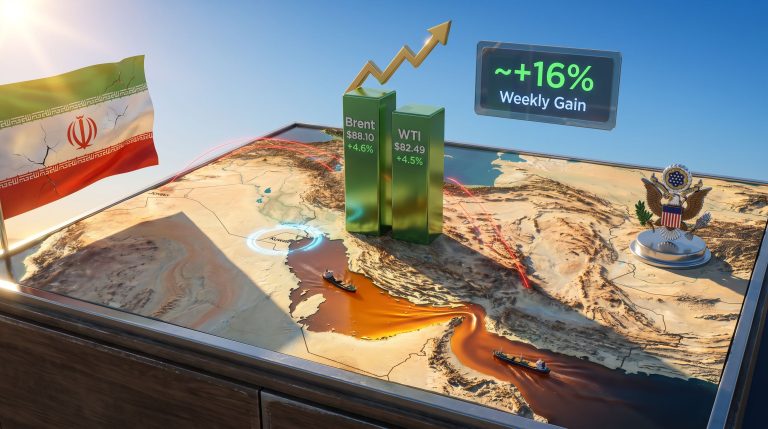
July 19, 2026
When a Waterway Becomes a Weapon: Understanding the Strategic Logic of the Strait of Hormuz
Throughout modern history, the control of narrow maritime passages has shaped the rise and fall of economic powers. The Suez Canal crisis of 1956, the Berlin blockade, the Malacca Strait piracy surge of the early 2000s — each demonstrated how geography can be weaponised with consequences that ripple far beyond the immediate theatre of conflict. What is unfolding today in the US and Iran Strait of Hormuz conflict represents something arguably more consequential than any of these precedents, because the waterway in question does not merely facilitate trade — it underpins the physical architecture of global energy supply.
When big ASX news breaks, our subscribers know first
The Geography of Vulnerability: Why No Other Route Comes Close
At its narrowest point, the Strait of Hormuz spans approximately 21 miles — a distance a commercial aircraft crosses in under two minutes. Yet this sliver of water connecting the Persian Gulf to the Gulf of Oman has historically carried roughly one-fifth of all crude oil and liquefied natural gas traded globally. No comparable alternative exists at equivalent scale.
Regional pipeline infrastructure offers partial relief but cannot substitute for Strait-scale volumes. The two most significant overland alternatives are:
- Saudi Arabia's Petroline (East-West Pipeline), which runs approximately 1,200 kilometres from Abqaiq to Yanbu on the Red Sea coast
- The Abu Dhabi Crude Oil Pipeline, which terminates at the Port of Fujairah on the Gulf of Oman, bypassing the Strait entirely
Both operate at or near maximum throughput capacity. Neither was engineered to absorb the full volume of displaced maritime trade. Meaningful pipeline expansion would require years of capital investment and permitting, not months — a structural reality that leaves energy markets with no short-term pressure valve.
The concept energy economists refer to as the chokepoint premium captures this vulnerability precisely. When a single geographic feature controls the movement of a resource this critical, whoever controls that feature acquires disproportionate leverage over every economy that depends on it. Furthermore, the disruption to global LNG supply chains compounds this pressure significantly for Asian import-dependent economies.
The Jurisdictional Fault Line Beneath the Military Conflict
What makes the US and Iran Strait of Hormuz conflict uniquely complex is that it is not reducible to a conventional military confrontation. Underneath the missile exchanges and naval blockades lies a foundational legal dispute that no weapons system can resolve.
The United States, along with the majority of the international community, maintains that the Strait constitutes an international waterway subject to transit passage rights under the United Nations Convention on the Law of the Sea (UNCLOS). Under this framework, all vessels retain the right of unimpeded passage through internationally recognised straits.
Iran's position is categorically different. Tehran asserts sovereign authority to regulate, tax, and restrict vessel movement through the corridor — a claim it has institutionalised through the creation of a new transit-permission agency. This agency functions as a bureaucratic mechanism to enforce what Iran frames as its jurisdictional rights over the waterway.
This conflict is not merely a military confrontation. It is a jurisdictional battle over who governs one of the most economically critical maritime corridors on Earth — and the resolution of that dispute will shape global energy security for decades.
The geopolitical landscape surrounding these competing legal claims has grown increasingly volatile, with third-party nations forced to choose between competing frameworks of international maritime law.
A Timeline of Escalation: From Operation Epic Fury to the July 2026 Strike Exchanges
Understanding how the current crisis reached this intensity requires tracing the causal chain from its origins.
Late February 2026: Coordinated US-Israel airstrikes designated Operation Epic Fury killed Iranian Supreme Leader Ayatollah Ali Khamenei. Iran responded immediately by declaring the Strait closed and initiating attacks on commercial shipping. The war had begun.
Mid-June 2026: A 60-day ceasefire was negotiated, temporarily reopening the waterway to limited commercial traffic. Critically, the truce lacked any third-party enforcement architecture — a structural weakness that would prove fatal to its survival.
July 8, 2026: The ceasefire collapsed following renewed exchanges between both parties. Iran formally re-announced the Strait's closure. The United States simultaneously revived its naval blockade of Iranian ports. Only one round of direct face-to-face diplomatic talks had occurred before the breakdown.
The pace of escalation since the ceasefire's collapse has been rapid and multi-directional.
| Date | Actor | Action | Target |
|---|---|---|---|
| July 18–19, 2026 | United States | Seventh consecutive night of airstrikes | Surveillance infrastructure, underground weapons storage, maritime capabilities, southern Iran |
| July 19, 2026 | Iran | Missile and drone strikes | Kuwait desalination plant, Kuwaiti oil facility, US regional bases |
| Ongoing | Iran | Drone attacks | Iraq (Irbil), Jordan, Bahrain, Saudi Arabia |
| Ongoing | United States | Naval blockade | Iranian port shipping lanes |
The Shipping Collapse: What the Numbers Reveal
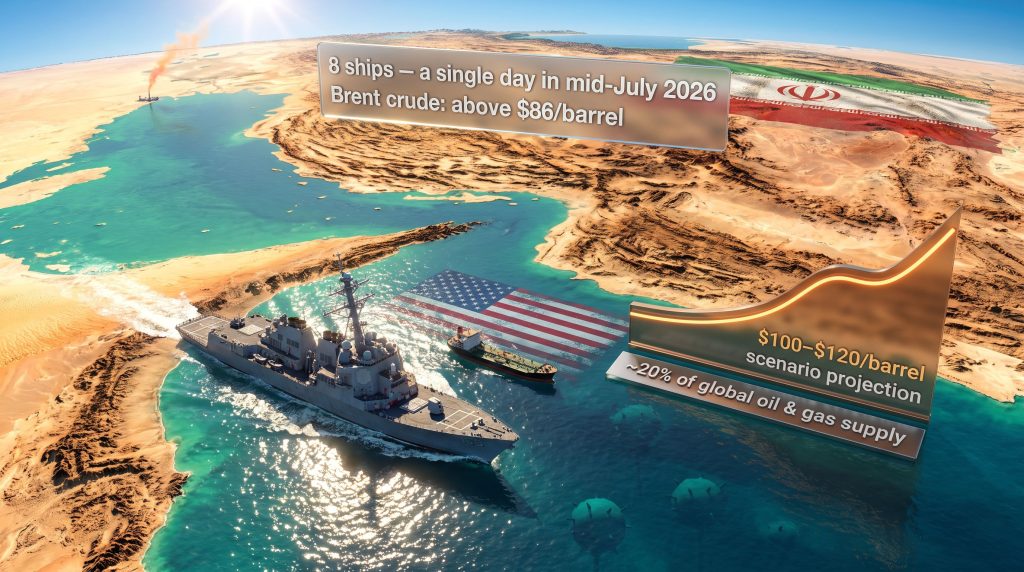
The operational reality of the blockade is starkly visible in vessel-tracking data. According to MarineTraffic.com, Strait crossings fell to a three-week low of just eight vessels on a single day in mid-July 2026 — a figure that stands in stark contrast to the hundreds of transits that previously occurred weekly during peacetime conditions.
Iran claims zero commercial transits have been recorded since May 4, 2026, though the United States disputes this characterisation, stating that escorted transits continue under naval protection. The truth likely lies somewhere between these competing claims, with the escorted-convoy model representing a fractional shadow of pre-war throughput.
The market has priced this disruption accordingly. Brent crude surpassed $86 per barrel in late July 2026, approaching a one-month high, driven by three compounding forces:
- Reduced Strait throughput cutting supply availability
- The US naval blockade eliminating Iranian crude export revenues
- Elevated geopolitical risk premiums embedded across energy derivatives markets
The resulting oil price shock has reverberated across global commodity markets, with energy-import-dependent economies in Asia — particularly Japan, South Korea, India, and China — facing acute exposure. These nations have historically sourced a disproportionate share of their crude requirements from Persian Gulf producers whose only viable export route ran through the Strait.
Kuwait: The Civilian Infrastructure Cost of the Conflict
Among the nations suffering collateral consequences of the US and Iran Strait of Hormuz conflict, Kuwait presents the most severe civilian vulnerability. On July 19, 2026, Iranian strikes hit both a water desalination plant and an oil facility within Kuwait. The desalination strike was the second such attack within 48 hours on a nation that depends on this technology for approximately 90% of its drinking water.
The strikes caused fires, forced multiple power generation units offline, and injured several workers. Kuwait briefly closed its airspace and Kuwait Airways rescheduled the majority of its international flights in response to ongoing missile threats.
The targeting of desalination infrastructure carries a strategic logic that extends beyond immediate military utility — it applies pressure on Gulf states hosting US military assets by demonstrating that Iranian strike capability reaches civilian life-support systems, not merely military installations.
The next major ASX story will hit our subscribers first
The Broader Regional Destabilisation
| Country | Reported Impact |
|---|---|
| Iraq | Air defence forces intercepted attack drones over Irbil |
| Jordan | State air defence systems downed Iranian missiles |
| Bahrain | Air raid sirens activated multiple times on July 19 |
| Saudi Arabia | Air sirens activated in morning hours of July 19 |
| Iran | At least 50 civilians killed, more than 500 wounded in US strikes over three weeks |
Since the war began in February 2026, 14 US service members have been killed and 427 wounded. Between July 14 and 19 alone, an additional 13 service members (10 Army soldiers and 3 Navy sailors) sustained injuries. The Islamic Revolutionary Guard Corps has intensified warnings directed at nations hosting US military forces, signalling a deliberate strategy of widening the conflict's geographic footprint.
These global trade tensions have consequently strained diplomatic relationships across the wider Middle East region, with neutral nations facing mounting pressure to declare alignments they would prefer to avoid.
Washington's Target Selection: Reading the Strategic Logic
US Central Command's stated strike priorities — surveillance networks, military logistics infrastructure, underground weapons storage, and maritime capabilities — follow a coherent strategic logic aimed at degrading Iran's capacity to sustain the Strait blockade. However, the targeting of civilian infrastructure in Hormozgan province introduces a secondary dimension.
Strikes on electricity generation, desalination facilities, road tunnels, and bridge networks in southern Iran serve a dual purpose. They degrade Iran's ability to resupply and reinforce its Strait-adjacent military assets, while simultaneously imposing economic and civilian costs designed to increase domestic pressure on the Iranian government.
Particularly significant is the targeting of transport links connecting Bandar Abbas — Iran's primary port, situated near the Strait's narrowest point — to Tehran and the country's interior. Severing this logistical corridor would degrade both military resupply chains and the commercial economic function of Iran's most strategically critical port. The Crisis Group's Strait of Hormuz flashpoint analysis highlights precisely this vulnerability as a long-standing concern in regional security planning.
The 20% Toll Proposal: Economic Coercion With Unintended Consequences
One of the more analytically complex elements of the current US approach is President Trump's proposed 20% toll on all cargo vessels transiting the Strait under US naval escort. Framed as a cost-recovery mechanism for American naval protection of international shipping lanes, the proposal carries significant geopolitical risk.
By imposing a transit fee on vessels using US-escorted passage, Washington risks mirroring Tehran's own toll demand — potentially legitimising Iran's sovereignty narrative in the eyes of neutral observers and non-aligned nations.
The Revolutionary Guards explicitly characterised the toll as a threat to global oil supply stability. From a strategic communication standpoint, the proposal blurs the legal distinction between the US position (freedom of navigation under UNCLOS) and Iran's position (sovereign regulatory authority) — a distinction that represents the core of Washington's legal justification for its presence in the waterway. The OPEC market influence dynamic adds a further layer of complexity, as member states face conflicting pressures between alliance obligations and economic self-interest.
Global Energy Market Scenarios: What a Prolonged Closure Could Mean
Independent energy economists caution that even a prompt resolution of hostilities would not immediately normalise supply chains. The depth of disruption already embedded in shipping schedules, storage positions, and contract pricing suggests a three-to-four-month recovery period would be required at minimum following any reopening.
The table below models potential market outcomes under a sustained 90-day closure scenario.
| Scenario Variable | Estimated Impact |
|---|---|
| Global oil price trajectory | Potential push toward $100–$120/barrel range |
| LNG spot market | Severe tightening, particularly for Asian buyers without long-term contract cover |
| Regional pipeline utilisation | Maximum capacity reached within weeks |
| Global GDP impact | Meaningful drag on import-dependent economies |
| Diplomatic pressure | Intensified multilateral pressure from G7, OPEC+, and Asian powers |
Disclaimer: The above scenario estimates represent analytical projections based on historical precedent and current market conditions. They are not investment advice and should not be treated as predictive certainties. Energy markets are subject to rapid change based on geopolitical developments.
The Path to De-escalation: Structural Barriers Remain Formidable
With only one round of direct face-to-face talks completed since February 2026, the diplomatic architecture for a durable settlement remains conspicuously thin. The June 2026 ceasefire's rapid collapse demonstrated that agreements lacking third-party monitoring and enforcement mechanisms cannot survive the pressures of an active conflict.
A durable resolution would require addressing several interconnected elements simultaneously:
- A legally binding navigation framework reconciling UNCLOS transit rights with Iran's sovereignty claims
- Dismantlement of Iran's transit-permission agency and cessation of Strait mining operations
- US withdrawal of the naval blockade on Iranian ports and suspension of the toll proposal
- A verified ceasefire with credible third-party enforcement — an architecture entirely absent from the collapsed June agreement
Iran's domestic political environment further complicates the path forward. Pro-Iranian protesters have maintained nightly demonstrations in Tehran for more than 100 consecutive days, generating internal pressure on any leadership that might be perceived as making concessions. On the US side, Trump faces competing pressures — domestic political fatigue with Middle East military engagement running against a stated reluctance to declare victory prematurely.
On July 17, 2026, Trump stated publicly that the war effort was progressing favourably and that results would be visible very shortly — a framing that suggested no imminent shift toward negotiated settlement. Pre-war nuclear talks between Washington and Tehran have been entirely suspended since hostilities began. Sky News reporting on the Iran war further underscores the scale of human cost accumulating on both sides as diplomatic channels remain closed.
Three Systemic Risks That Will Outlast This Conflict
Regardless of how the immediate military confrontation resolves, the US and Iran Strait of Hormuz conflict has exposed three structural vulnerabilities in the architecture of global energy security that will demand policy responses for years to come.
-
The legal legitimacy vacuum: No internationally accepted framework exists to adjudicate competing jurisdictional claims over critical maritime straits when a coastal nation rejects UNCLOS authority. The current conflict has exposed this gap with full force.
-
Infrastructure concentration risk: Decades of geopolitical stability obscured the systemic fragility of routing one-fifth of global energy trade through a single 21-mile corridor. Diversification of supply routes and storage infrastructure now represents a genuine strategic imperative for energy-importing nations.
-
Escalation without off-ramps: With diplomatic channels largely severed and both parties operating under domestic political pressures that reward confrontation over compromise, the conflict has entered a phase where military action has effectively replaced dialogue as the primary mechanism of strategic communication.
The resolution of the Strait of Hormuz crisis will not simply be a military outcome — it will define the legal, commercial, and geopolitical framework through which the world's most critical energy corridor operates for the next generation.
Want to Stay Ahead of the Commodity Market Shifts Driving the Next Major Mineral Discovery?
The escalating US–Iran Strait of Hormuz conflict is reshaping global energy markets and accelerating demand for alternative commodities — and Discovery Alert's proprietary Discovery IQ model ensures subscribers receive real-time alerts the moment significant ASX mineral discoveries are announced. Explore historic discoveries and their market returns, then begin your 14-day free trial to position yourself ahead of the broader market.