July 19, 2026
When Diplomacy Collapses: The Strategic Logic Behind Escalating U.S. Strikes on Iranian Forces After the Jordan Attack
Few geopolitical flashpoints carry the systemic risk profile of a direct military confrontation between the United States and Iran. Unlike the proxy conflicts that have defined much of the Middle East's modern security architecture, a bilateral exchange of lethal force between these two powers creates feedback loops that extend well beyond the battlefield, touching energy markets, regional alliances, nuclear non-proliferation frameworks, and the credibility of international diplomacy itself.
The events of mid-July 2026 represent exactly that kind of inflection. The U.S. strikes on Iranian forces after the Jordan attack have not simply intensified an existing conflict. They have fundamentally restructured the terms on which this war is being fought, and perhaps more critically, the terms on which it might eventually end.
When big ASX news breaks, our subscribers know first
From Proxy Engagements to Direct Attribution: Why the Jordan Attack Changed Everything
Since hostilities commenced on 28 February 2026, the conflict between U.S. and Iranian forces had largely operated through a familiar pattern: Iranian-affiliated militia networks in Iraq and Syria serving as pressure valves, absorbing U.S. counterstrikes while providing Tehran with deniability over direct engagement.
The 17 July strike on a U.S. military installation in Jordan shattered that dynamic. Two American service members were killed, one was reported missing, and four additional personnel sustained injuries. These casualties were not the result of proxy action. They were attributable directly to Iranian drone and missile forces, bringing the total number of confirmed U.S. service member deaths since the war's beginning to 16.
This distinction matters enormously from a strategic standpoint. Direct-attribution attacks carry a qualitatively different political weight compared to proxy-mediated violence:
- They remove the ambiguity that allows diplomatic channels to remain nominally open
- They generate overwhelming domestic pressure on any administration to respond with visible, demonstrable force
- They signal a deliberate Iranian decision to absorb the escalatory consequences of direct engagement
- They fundamentally compromise ceasefire frameworks that were premised on a degree of plausible deniability
The Iranian decision to launch direct strikes rather than routing the operation through affiliated militias has been interpreted through multiple analytical lenses. One reading suggests degraded proxy network capacity following sustained prior U.S. strikes forced a doctrinal shift. Another interpretation posits a calculated Iranian gamble to force diplomatic concessions through demonstrated resolve. Furthermore, a third possibility — less frequently discussed — is that the action served a domestic political purpose, signalling strength to hardline Iranian constituencies following Supreme Leader Ayatollah Mojtaba Khamenei's recent ascension.
The Eighth Night: Anatomy of the U.S. Military Response
U.S. Central Command confirmed the completion of an eighth consecutive night of strikes against Iranian military infrastructure, ordered by President Donald Trump with operations commencing Saturday at 6:00 p.m. ET. The dual stated objectives were to punish IRGC forces responsible for the Jordan attack and to degrade Iran's capacity to threaten commercial shipping through the Strait of Hormuz.
The target set reflects a coherent operational logic aimed at both punishment and attrition:
| Strike Target Category | Strategic Purpose |
|---|---|
| Coastal surveillance facilities | Degrade Iran's maritime domain awareness |
| Air defence infrastructure | Suppress anti-access and area denial capabilities |
| Maritime assets and capabilities | Protect commercial shipping corridors |
| Missile and drone storage sites | Reduce Iran's offensive strike inventory |
| IRGC forces in Jordan attack chain | Direct accountability and deterrence signalling |
The deliberate targeting of IRGC forces directly linked to the Jordan attack represents a notable shift in U.S. targeting philosophy. Earlier phases of the campaign had focused more broadly on degrading infrastructure. Naming and targeting the specific units responsible for American casualties introduces a personalised accountability dimension designed to deter future direct-attribution strikes by signalling that such actions will generate focused, personal consequences for the responsible commanders and forces.
Iran's state media alleged that U.S. strikes damaged civilian infrastructure, including bridges and a desalination facility. U.S. officials denied these characterisations. Such competing narratives are a consistent feature of modern information warfare in this conflict, where both sides have strong incentives to shape international perception of each military action.
The Islamabad MOU: How a Diplomatic Framework Collapsed in 48 Hours
The June 2026 Memorandum of Understanding signed in Islamabad had been constructed around two core objectives: reopening the Strait of Hormuz to commercial shipping and establishing a ceasefire mechanism to halt active hostilities. Critically, it was framed as an interim agreement, not a comprehensive resolution, which left significant structural vulnerabilities in its architecture.
The timeline of its unravelling following the Jordan attack illustrates how quickly negotiated frameworks can disintegrate under conditions of acute military escalation:
- Pre-July 17: Both parties nominally adhered to the MOU framework, with intermittent violations acknowledged by both sides
- July 17: Iranian drone and missile forces conduct a direct-attribution strike on U.S. personnel in Jordan, killing two service members
- July 18-19: The U.S. launches its eighth consecutive night of retaliatory strikes targeting IRGC assets across multiple categories
- Iranian diplomatic response: Deputy Foreign Minister Kazem Gharibabadi formally announces the suspension of Iran's commitments under the MOU, citing what he characterised as U.S. violations of the agreement's terms
- U.S. presidential response: When asked about Iran's withdrawal from the agreement, President Trump signalled complete indifference to its collapse
- Supreme Leader statement: Ayatollah Khamenei publicly declared Trump's signature on the memorandum to be without credibility and warned of consequences ahead for the United States
The public abandonment of a negotiated framework by both parties within a 48-hour window is a significant data point for conflict analysts. It suggests that neither side currently perceives a negotiated pause as domestically viable or strategically advantageous, a condition that historically precedes either decisive military resolution or protracted stalemate.
The collapse of the Islamabad MOU also removes the primary diplomatic circuit-breaker from the equation at precisely the moment when escalation risks are highest. With no active framework to provide face-saving off-ramps for either party, the conflict's near-term trajectory depends almost entirely on military calculations rather than diplomatic ones. The broader geopolitical risk landscape across the region has consequently deteriorated sharply.
Oil Markets Under Pressure: The Strait of Hormuz Premium
The Strait of Hormuz carries approximately 20% of global daily oil supply through a navigable channel that, at its narrowest point, measures roughly 21 miles wide. Its strategic significance as the world's most consequential energy chokepoint is difficult to overstate. Iran's IRGC has historically employed maritime interdiction as a coercive tool, and the current conflict has brought that capability into active use.
On Friday, 18 July, oil markets responded to the escalating confrontation with sharp single-session advances:
| Benchmark | Price (Friday Close) | Single-Day Move | Weekly Gain |
|---|---|---|---|
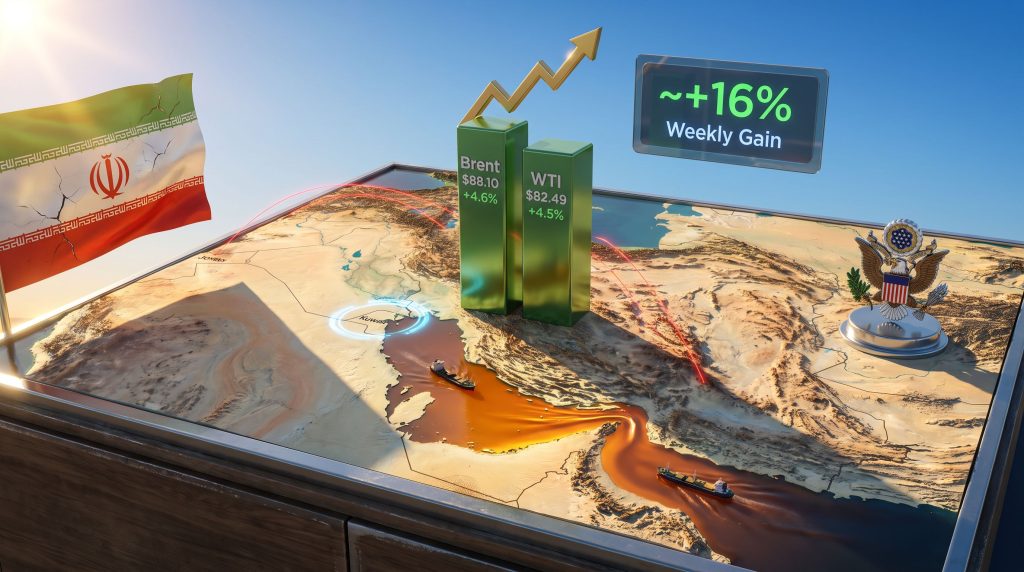
| Brent Crude (Sept. Delivery) | $88.10/barrel | +4.6% | ~16% |
| West Texas Intermediate (Aug. Delivery) | $82.49/barrel | +4.5% | ~16% |
Both benchmarks reached their highest levels since mid-June 2026. These crude oil price trends reflect a market pricing in sustained disruption risk. Brent was tracking toward a third consecutive weekly gain, while WTI was positioned for its second. The IRGC's reported blockage of four vessels attempting to transit the Strait of Hormuz under U.S. naval protection provided additional upward pressure on supply sentiment beyond the headline conflict dynamics.
What makes the current oil market environment particularly complex is the layering of risk factors. Energy traders are not simply pricing in disrupted shipments. They are attempting to model:
- The probability and duration of sustained Strait closure
- The likelihood of U.S. military success in degrading Iranian maritime interdiction capabilities
- The potential for conflict expansion to other Gulf states with major oil infrastructure
- The response capacity of strategic petroleum reserves if supply disruptions persist
The oil price shock risks associated with a prolonged Strait disruption are considerable, and scenario modelling suggests three plausible trajectories for energy markets:
Scenario A: Controlled Escalation with Partial Shipping Resumption
U.S. strikes sufficiently degrade Iranian maritime interdiction capacity, enabling partial commercial traffic resumption. Oil prices stabilise in the $80–$90 range with an elevated but declining risk premium.
Scenario B: Prolonged Stalemate and Sustained Strait Disruption
Neither side achieves decisive military advantage. The Strait remains functionally closed to commercial traffic for an extended period. Brent crude tests the $100 per barrel threshold, and global inflation pressures intensify as supply shortfalls interact with existing inventory constraints.
Scenario C: Rapid Diplomatic Re-engagement
Back-channel negotiations produce a revised ceasefire framework within weeks. Markets price out the geopolitical risk premium quickly, with oil prices retracing toward pre-conflict levels.
Disclaimer: These scenarios represent analytical frameworks for understanding possible market outcomes, not investment advice. Oil price forecasts are inherently speculative and subject to rapid revision as geopolitical conditions evolve.
Regional Spillover: Kuwait's Air Defence Activation and the GCC Dimension
One of the most strategically significant developments over the 18–19 July weekend received comparatively less analytical attention than the U.S.-Iran bilateral dynamics: Kuwait's military announced the activation of air defence systems in response to Iranian missile and drone attacks overnight.
This matters for several interconnected reasons:
- It confirms that the conflict's geographic perimeter is expanding beyond the primary bilateral confrontation
- It places Gulf Cooperation Council member states in an increasingly untenable position regarding their defensive postures
- It introduces new variables into energy market risk calculations, as Kuwait's oil infrastructure represents a significant component of regional supply capacity
- It potentially draws additional regional actors into a conflict that had been framed primarily as a U.S.-Iran confrontation
The GCC states occupy an inherently complex position in this conflict. Their security relationships with the United States are deep and institutionalised. Their economic relationships with Iran, and their geographic exposure to Iranian military reach, create powerful incentives toward caution and de-escalation. However, Kuwait's air defence activation suggests that caution is increasingly insufficient as a strategic posture.
The next major ASX story will hit our subscribers first
The Nuclear Dimension: The Highest-Stakes Variable
Cutting through all the tactical and operational complexity of the current conflict is a strategic question that defines its ultimate stakes: the Iranian nuclear programme.
President Trump reiterated the U.S. position that it will never permit Iran to acquire nuclear weapons capability. This stated red line creates a structural constraint on how far any de-escalation process can proceed without addressing the underlying nuclear question. The collapse of the Islamabad MOU removes the diplomatic architecture that had partially constrained Iranian nuclear-related activities during the ceasefire period.
The intersection of conventional military conflict, maritime economic warfare, and nuclear programme ambiguity creates a multi-dimensional risk environment that has few historical precedents in terms of its simultaneous complexity and consequence.
For conflict analysts and energy market participants alike, the nuclear dimension represents the tail risk scenario with the most profound long-term implications. Furthermore, every escalatory step that eliminates diplomatic frameworks brings the conventional conflict closer to the threshold where nuclear programme decisions become the primary variable driving strategic calculations on both sides. Consequently, the oil geopolitics analysis underpinning current market movements cannot be divorced from this nuclear backdrop.
Escalation Pathways: A Risk Matrix for the Coming Weeks
With the Islamabad MOU effectively defunct and military operations continuing on both sides, understanding the realistic escalation pathways becomes essential for anyone tracking this conflict's trajectory:
| Escalation Scenario | Key Trigger | Primary Risk |
|---|---|---|
| Expanded IRGC strikes on Gulf states | Continued U.S. degradation of Iranian military assets | GCC-wide security crisis |
| Iranian nuclear programme acceleration | Collapse of all diplomatic frameworks | Non-proliferation regime failure |
| Strait of Hormuz full closure | Sustained IRGC maritime interdiction | Global energy supply shock |
| U.S. strikes on civilian infrastructure | Additional U.S. service member casualties | International diplomatic isolation |
| Back-channel ceasefire revival | Mutual exhaustion and economic pressure | De-escalation with unresolved core tensions |
The current trajectory does not naturally resolve toward any of these outcomes with high probability in the near term. What it does suggest is that the conflict has entered a phase where the absence of active diplomacy, combined with ongoing military operations on both sides, creates conditions where escalatory incidents can occur with limited warning and unpredictable consequences.
Trump's previous threat to strike Iranian bridges and power plants if Iran refused to return to negotiations carries greater operational credibility now that the Jordan attack has already produced a significant U.S. military response. Whether that credibility functions as a deterrent or an accelerant to Iranian decision-making remains the central uncertainty shaping the conflict's next phase. In addition, gold safe-haven demand has surged as investors seek refuge from the widening risk environment.
Key Strategic Takeaways as of 19 July 2026
The convergence of military, diplomatic, and economic dynamics over the 17–19 July period has produced a strategic landscape with the following defining characteristics:
- The Jordan attack represents the most direct bilateral confrontation between U.S. and Iranian forces since hostilities began in February 2026
- The collapse of the Islamabad MOU eliminates the primary diplomatic mechanism available for managed de-escalation
- Oil markets have already embedded substantial geopolitical risk, with both major benchmarks posting approximately 16% weekly gains
- Kuwait's air defence activation signals meaningful geographic expansion of the conflict's active perimeter
- The intersection of conventional warfare, maritime interdiction, and nuclear programme ambiguity creates a risk environment with limited near-term resolution pathways
- Eight consecutive nights of U.S. strikes represent a sustained operational tempo that is progressively degrading Iranian military infrastructure while simultaneously hardening Iranian political resolve against negotiation
This article reflects publicly available information as of 19 July 2026. The geopolitical situation described is rapidly evolving. All forward-looking analysis, scenario modelling, and market projections contained herein are provided for informational purposes only and do not constitute financial or investment advice.
Want to Capitalise on the Market Volatility Driving Commodity Prices Right Now?
As geopolitical tensions reshape energy markets and send commodity prices surging, Discovery Alert's proprietary Discovery IQ model delivers real-time alerts on significant ASX mineral discoveries, instantly identifying actionable opportunities across gold, oil-linked equities, and beyond — explore how historic discoveries have generated substantial returns and begin your 14-day free trial at Discovery Alert to position yourself ahead of the market.