July 19, 2026
When the Weather Becomes the Supply Chain: Understanding Europe's Compounding Energy Crisis
Energy systems are engineered around statistical averages. Grid planners model demand curves based on decades of historical weather data, calibrating generation capacity to meet expected peaks during winter cold snaps and modest summer warmth. What those models did not adequately account for was the possibility that summer heat itself would become a structural threat, simultaneously driving electricity consumption to record levels while dismantling the generation capacity needed to serve it. That is precisely what is unfolding across Europe in the summer of 2026, and the Europe heatwave energy crisis is forcing a reckoning with assumptions that have underpinned energy security planning for generations.
When big ASX news breaks, our subscribers know first
A Grid Designed for a Different Climate
Europe's power infrastructure was conceived in an era when extreme summer heat was a statistical anomaly rather than a recurring operational baseline. The foundational engineering logic prioritised winter demand management, with generation capacity headroom built around cold-weather heating loads. Summer cooling was, until relatively recently, a marginal factor in most northern and central European countries where residential air conditioning penetration remained low.
That calculus has shifted dramatically. The Europe heatwave energy crisis of 2026 is not a single-point failure or an exogenous geopolitical shock of the kind that defined the 2022 energy crisis following Russia's invasion of Ukraine. Where 2022 was fundamentally a supply disruption, 2026 is a climate-system failure, one in which the same physical conditions that generate extreme electricity demand also degrade the capacity of the systems built to meet that demand.
This distinction is critical because conventional energy policy tools, such as diversifying gas import routes or building strategic reserves, offer limited protection against a threat that operates through the weather itself. Furthermore, European gas prices have already been under pressure from multiple directions, leaving fewer buffers available when climate shocks strike simultaneously.
The Four Simultaneous Failures Driving the Europe Heatwave Energy Crisis
Cooling Demand Reaching Grid-Breaking Levels
The demand side of this crisis is driven primarily by air conditioning load, a category of electricity consumption that behaves very differently from industrial demand. Industrial electricity use follows relatively predictable schedules and can, in many cases, be deferred or curtailed in response to price signals. Residential and commercial cooling load is far less flexible. When temperatures are extreme, the demand is non-negotiable for households, hospitals, data centres, and food storage facilities.
During peak heat periods across France, Germany, and Belgium in 2026, daily power demand increased by as much as 14% above typical seasonal levels, with evening peaks running up to 25% above off-season baselines in France, where urban heat retention keeps temperatures elevated well after sunset. The result is a demand profile that strains grid balancing mechanisms designed for entirely different seasonal conditions.
France's Nuclear Output Crisis: The Cooling Water Constraint
Perhaps the most structurally significant element of the Europe heatwave energy crisis is its impact on French nuclear generation, a fleet that normally supplies approximately 70% of France's electricity and positions the country as a net electricity exporter to its neighbours.
French nuclear reactors depend on river water, principally from the Loire, Rhône, and Rhine systems, to cool reactor cores and condense steam. EU environmental regulations impose strict limits on the temperature of water discharged back into river systems to protect aquatic ecosystems. When ambient river temperatures rise above defined thresholds during heatwaves, plants are legally required to reduce output or shut down entirely rather than discharge excessively warm water.
This regulatory constraint, designed to protect ecological integrity under normal climate conditions, becomes an acute energy security liability during precisely the periods when electricity demand is highest.
In the current crisis, French nuclear output was cut by 6.4 GW, representing approximately 14% of the country's total daily power demand. At the fleet level, up to 41 GW of French nuclear capacity has been affected during peak heat periods. Swiss reactors at the Beznau facility have experienced similar cooling constraints. Consequently, France has become a net electricity importer during the heatwave, a strategic reversal with significant pricing implications across neighbouring markets.
Wind Generation Collapse Under Heat Dome Conditions
High-pressure heat dome weather systems, the meteorological structures responsible for sustained extreme heat events, suppress wind speeds across large geographic areas. This is not a coincidence but a physical consequence of the same atmospheric dynamics that trap heat at the surface. For countries with high wind energy penetration, this creates a dangerous correlation: the weather events most likely to drive electricity demand to record levels are also the events most likely to collapse wind generation.
Great Britain, which has built substantial offshore and onshore wind capacity over the past decade, experienced a significant wind output collapse during the 2026 heatwave. Solar generation, while performing well during daylight hours, cannot compensate for the simultaneous loss of wind and constrained nuclear output, particularly during evening demand peaks when solar production falls to zero. In addition, renewable energy solutions that appeared robust under standard modelling assumptions have proven insufficient when multiple failure modes converge simultaneously.
Thermal Plant Failures: Heat Stress on Gas Infrastructure
Gas-fired power stations, nominally available as dispatchable backup generation, face their own heat-related constraints. Thermal plants lose efficiency as ambient temperatures rise because the thermodynamic cycle that converts heat into electricity becomes less effective in hotter conditions. Beyond efficiency losses, extreme heat can trigger operational constraints that force output reductions.
In Great Britain, five gas-fired power stations cut output due to ambient temperature constraints during the 2026 heatwave, removing approximately 25 GW from the national grid, enough electricity to serve roughly 2.5 million homes. This simultaneous failure of dispatchable backup capacity compounds the wind and cross-border generation shortfalls at precisely the moment the grid needs maximum flexibility. Moreover, LNG supply pressures have further limited the ability of gas-dependent backup systems to fill generation gaps quickly.
Wholesale Electricity Prices: A Market Under Extreme Stress
The combination of surging demand and collapsing generation capacity has driven wholesale electricity prices to levels not seen since the acute phase of the 2022 energy crisis.
| Country | Peak Price Recorded | Context |
|---|---|---|
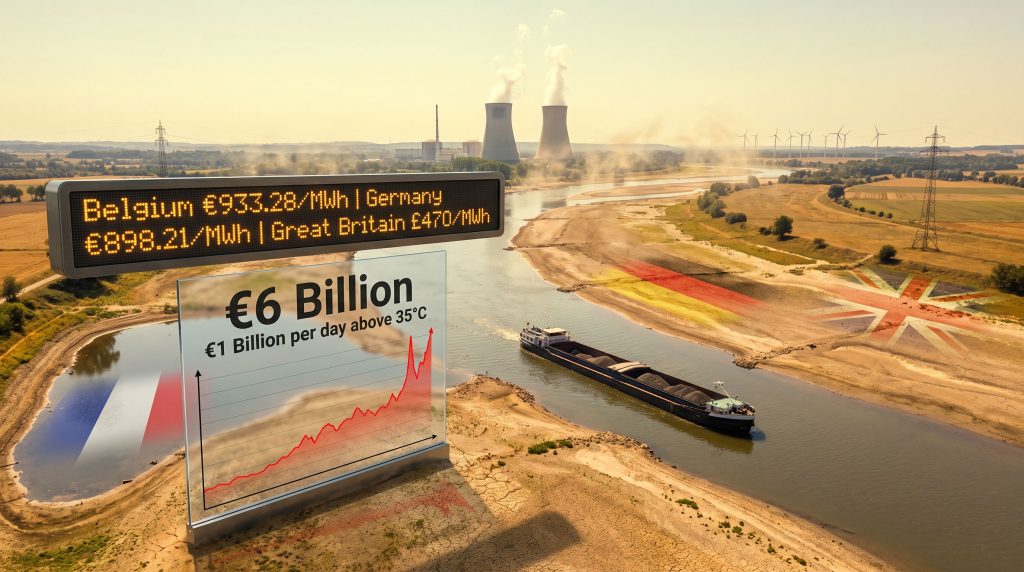
| Belgium | €933.28/MWh | Highest since 2022 energy crisis |
| Germany | €898.21/MWh | Highest since June 2024 |
| Great Britain | £470/MWh (emergency imports) | More than 6x typical import cost |
| France | Multi-year highs | Driven by import dependency reversal |
These prices do not remain isolated within national markets. Europe's interconnected electricity grid means that price spikes propagate rapidly across borders through transmission links. Emergency cross-border imports, while preventing widespread blackouts, carry extreme cost premiums that flow through to industrial and residential consumers.
Analysts tracking the intersection of the Hormuz supply disruption and the domestic heatwave crisis have warned that climate-driven supply shocks represent a renewed and potentially persistent source of inflationary pressure. Furthermore, crude oil price trends have compounded the difficulty for European economies already navigating elevated energy costs from multiple directions simultaneously.
The Rhine River: Europe's Hidden Energy Supply Chain Failure
While electricity market dynamics dominate headlines, one of the less visible but equally significant dimensions of the Europe heatwave energy crisis involves the Rhine River corridor, Europe's most critical inland freight artery.
The Rhine runs approximately 800 miles from its source in the Swiss Alps northwest through Germany, France, and the Netherlands before emptying into the North Sea near Rotterdam. It serves as the primary overland shipping route connecting the Amsterdam-Rotterdam-Antwerp (ARA) hub, one of the world's largest petroleum product trading centres, with the industrial heartland of Germany and central Europe.
The Kaub Chokepoint: A Single Gauge That Governs Continental Freight
A largely unknown but critical detail in understanding Rhine freight dynamics is the role of the Kaub gauge, located on the Middle Rhine between Koblenz and Mainz. This single measurement point sits at the shallowest section of the entire river corridor. Because all barge traffic between the ARA ports and inland industrial destinations must pass through this point, the water level at Kaub effectively determines the maximum freight capacity of the entire river system.
When water levels at Kaub fall, barges must reduce their cargo loads to avoid running aground. This reduces the effective freight capacity of every vessel transiting the corridor, increasing the number of trips required to move equivalent volumes and sharply raising shipping costs.
During the 2026 heatwave, Rhine water levels reached their lowest mid-July readings in decades, driving diesel freight costs from Rotterdam to southern Germany up by more than 50% within a single week. Coal and fuel delivery delays have compounded the energy supply constraints already created by the Hormuz crisis, creating a dual chokepoint situation for European energy logistics.
The Rhine has now experienced major low-water crises in 2018, 2022, and 2026, a pattern that challenges the assumption that these events are rare anomalies rather than increasingly structural features of European summers.
The 2018 precedent is instructive. The Kiel Institute for the World Economy estimated that low Rhine water levels in November 2018 contributed to a 1.5% decline in German industrial production and a 0.4% contraction in German GDP. The 2026 episode is occurring during the economically more sensitive summer production period and coincides with broader energy cost pressures that were absent in 2018.
Quantifying the Economic Damage: Germany's Heatwave Bill
The financial cost of the crisis is now measurable in concrete figures. Economic research firm Prognos, in analysis conducted for German business daily Handelsblatt, estimated that the end-of-June 2026 heatwave alone cost the German economy more than €6 billion (approximately $6.8 billion USD). Bloomberg's analysis of elevated European power prices suggests this pressure is unlikely to ease quickly as further heat events loom on the horizon.
The forward projections are even more confronting:
- Germany could face €1 billion ($1.14 billion) in economic losses for every day temperatures exceed 35°C (95°F)
- Scenarios involving three to four intense heatwaves per summer with sustained temperatures above this threshold could generate annual economic damage exceeding €20 billion ($23 billion)
- These figures do not include second-order effects from freight disruption, supply chain delays, or the inflationary transmission of elevated energy costs into consumer prices
The inflation transmission mechanism deserves particular attention. Energy price spikes during heatwave periods feed into producer input costs, transportation expenses, and ultimately consumer price indices. When this effect compounds with Hormuz-driven elevation in LNG and petroleum costs, the resulting inflationary pressure creates conditions that conventional monetary policy instruments are poorly equipped to address without damaging economic output.
The next major ASX story will hit our subscribers first
How 2026 Compares to Previous European Energy Shocks
| Crisis Event | Primary Trigger | Key Systems Affected | Estimated GDP Impact |
|---|---|---|---|
| 2018 Rhine Drought | Extreme summer heat | Inland freight, industrial supply | -0.4% German GDP |
| 2022 Post-Ukraine Energy Crisis | Geopolitical supply disruption | Gas supply, electricity pricing | Multi-country recession risk |
| 2026 Heatwave Crisis | Climate-driven multi-vector failure | Nuclear, wind, gas, freight, pricing | €6B+ German loss (to date) |
The 2026 crisis represents a qualitative escalation because it involves the simultaneous degradation of multiple generation types and energy supply routes under a single climate driver. In 2022, the problem was that natural gas was not arriving. In 2026, however, the problem is that the weather itself is dismantling generation capacity while preventing the delivery of backup fuel supplies. This is structurally harder to hedge.
Geographic Vulnerability: Where the Exposure Is Greatest
The crisis does not affect all European nations equally. Understanding the geographic distribution of vulnerability is essential for both policy planning and investment risk assessment:
- France: The highest nuclear dependency of any major economy makes France disproportionately exposed to cooling water constraints. Its transition from net exporter to net importer during heatwaves reverses a key stabilising mechanism for the broader European grid.
- Germany: Maximum Rhine freight dependency combined with the largest industrial base on the continent creates compounding exposure to both energy cost increases and supply chain disruption.
- Great Britain: High wind dependency, combined with thermal plant heat sensitivity and reliance on cross-channel import flows, leaves the UK particularly vulnerable to concurrent failures across multiple generation types.
Forward Scenarios: Where the Crisis Goes From Here
Scenario 1: Managed Containment
Emergency imports, demand-side management, and temperature normalisation bring the immediate crisis under control. Price spikes moderate within weeks. Inflationary pressure persists at manageable levels. No structural policy changes are implemented before the next summer season.
Scenario 2: Prolonged Escalation
Extended high temperatures sustain nuclear curtailments and Rhine navigation restrictions beyond the current period. Wholesale prices remain above €900/MWh across multiple markets for an extended period. Industrial curtailments in Germany and France generate measurable GDP contraction. Inflation re-accelerates, complicating European Central Bank policy decisions.
Scenario 3: Structural Transformation
The 2026 crisis catalyses accelerated investment in grid-scale battery storage, demand response infrastructure, and climate-resilient generation capacity. Regulatory frameworks governing nuclear cooling thresholds are reviewed to balance ecological protection with energy security during declared emergencies. Furthermore, green transition pressures are reshaping how policymakers approach long-term infrastructure investment in ways that this crisis is likely to accelerate considerably.
Frequently Asked Questions: Europe Heatwave Energy Crisis
Why does extreme heat reduce French nuclear output?
French reactors use river water for cooling. Regulations require facilities to reduce output when river temperatures exceed defined thresholds to prevent ecologically harmful warm-water discharge, creating a direct conflict between environmental protection and energy security during heatwaves.
How do low Rhine water levels affect energy supply?
The Rhine is the primary inland freight corridor for petroleum products, coal, and industrial goods across Germany and central Europe. Reduced water levels force barges to carry smaller loads, cutting throughput capacity, raising shipping costs, and delaying fuel and coal deliveries.
What has happened to electricity prices during the 2026 heatwave?
Belgium reached €933.28/MWh, Germany hit €898.21/MWh intraday, and Great Britain paid emergency import prices of £470/MWh, more than six times typical import costs.
How much has the heatwave cost Germany economically?
The end-of-June 2026 heatwave cost Germany an estimated €6 billion ($6.8 billion) according to Prognos analysis for Handelsblatt. Forward projections suggest annual damage could exceed €20 billion ($23 billion) as extreme heat events increase in frequency and intensity.
Does the Hormuz crisis make the heatwave impact worse?
Significantly so. The Strait of Hormuz disruption has already elevated European LNG and petroleum costs and tightened supply flexibility. The heatwave adds simultaneous demand pressure and domestic generation failure, leaving Europe with far less capacity to absorb either shock independently.
The Unavoidable Conclusion: Climate Risk Is Energy Security Risk
The events of summer 2026 have demonstrated something that energy policy frameworks have been slow to formally integrate: climate change is no longer a future risk to be modelled in long-term scenarios. It is a present operational reality that is actively failing infrastructure designed for a different climate.
The electrification paradox is particularly worth noting. As Europe accelerates its transition away from fossil fuels, the reliability of the electricity grid becomes more critical to economic function, not less. Every additional heat pump, electric vehicle, and industrial electrification project increases the systemic consequences of grid failure during extreme weather.
Storage capacity, grid hardening investment, and climate-adaptive generation architecture are not aspirational policy goals; they are the minimum necessary conditions for a functioning economy in a warming climate. What the Europe heatwave energy crisis has made undeniably clear is that the window for treating these as optional upgrades has already closed.
This article contains forward-looking statements, economic projections, and scenario analyses. All forecasts and estimates are inherently uncertain and should not be construed as financial or investment advice. Readers should conduct independent research before making any financial decisions.
Want to Stay Ahead of the Commodity Shifts Driving the Green Energy Transition?
Europe's compounding energy crisis is reshaping demand signals across critical minerals, battery storage materials, and energy infrastructure — and Discovery Alert's proprietary Discovery IQ model delivers real-time ASX mineral discovery alerts the moment significant announcements hit the market. Explore how historic mineral discoveries have generated substantial returns and begin your 14-day free trial today to position yourself ahead of the next major market opportunity.