
July 18, 2026
The Hidden Economics Behind China's Aluminum Import Collapse
Most commodity analysts focus on demand when explaining why a country's import volumes fall. Weaker factories, slowing construction, flagging consumer spending — these are the usual suspects. But the story unfolding in China's aluminum market through the first half of 2026 is fundamentally different. This is not a demand crisis. It is a price arithmetic story, and understanding the mechanics requires looking at how global metal markets price flows across borders rather than simply counting tonnes consumed.
When the mathematics of cross-border trade turn unfavourable, import volumes collapse with striking speed. That is precisely what happened as China aluminum imports fall on higher overseas prices, reshaping global trade flows in ways that extend well beyond one country's customs data.
When big ASX news breaks, our subscribers know first
The Price Arbitrage Mechanism That Controls Everything
How Import Economics Actually Work for Chinese Aluminum Traders
Professional aluminum traders in China do not make import decisions based on demand forecasts alone. Every cargo decision begins with an arbitrage calculation: the cost of sourcing metal overseas versus the price available domestically. This calculation incorporates the London Metal Exchange three-month benchmark price, regional physical delivery premiums, Chinese import duties and value-added tax, and freight and logistics costs from loading port to domestic warehouse.
When overseas metal, after all costs are accounted for, lands at a higher price than equivalent domestically produced aluminum, the import window is described as closed. No rational commercial importer will voluntarily absorb guaranteed losses on every tonne they bring in.
This arbitrage mechanism is frequently overlooked by generalist investors who assume China simply buys more metal when its economy grows and less when it slows. In reality, import volumes can swing dramatically even in periods of stable domestic demand, purely because international price levels have shifted the arithmetic.
| Arbitrage Condition | Implication for Chinese Importers | Expected Trade Response |
|---|---|---|
| Overseas price below domestic price | Importing is profitable | Import volumes rise |
| Overseas price roughly equal to domestic price | Marginal trade viability | Import volumes stabilise |
| Overseas price above domestic price | Importing generates losses | Import volumes contract sharply |
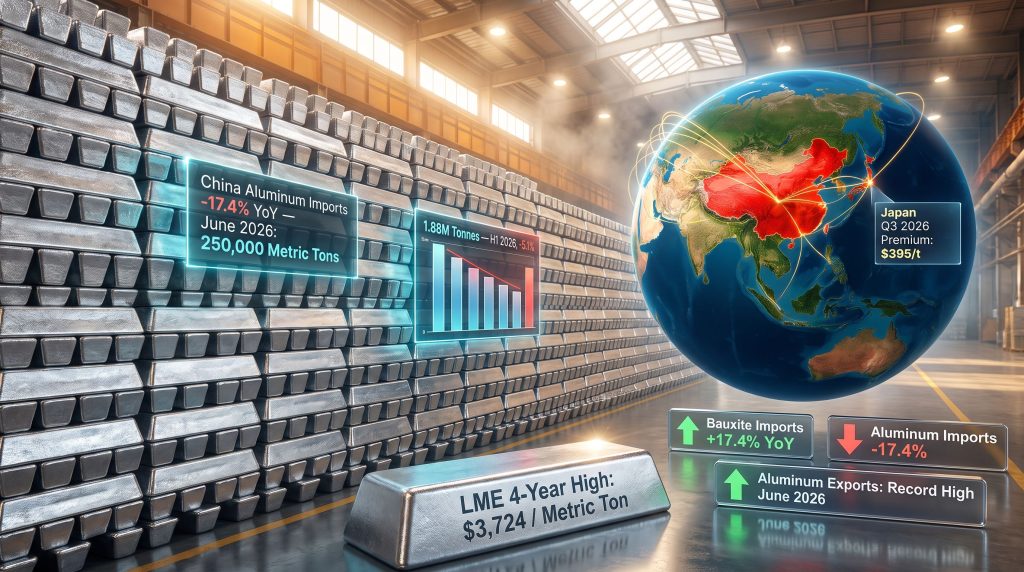
In April 2026, estimated import losses reached approximately 957 yuan per metric ton, effectively pricing out virtually all commercial import activity. By May 2026, the loss position had narrowed modestly but remained firmly negative. June 2026 data confirmed the sustained contraction, with volumes declining 17.4% year-on-year to 250,000 metric tons, according to China's General Administration of Customs.
What Drove International Aluminum Prices to Levels That Excluded China
The LME Surge and Its Middle East Origins
The London Metal Exchange three-month aluminum contract reached a four-year high of $3,724 per metric ton in early June 2026, driven by supply disruption concerns linked to the Middle East. Supply uncertainty affecting production or logistics from that region tightened the availability of internationally traded primary metal, creating upward price pressure across the entire LME curve.
It is worth noting that the LME price had retreated significantly by month's end, closing June down almost 16% from that early-month peak. This sharp reversal illustrates a critical feature of commodity markets: spot price spikes during periods of supply anxiety can close import arbitrage windows with brutal efficiency, even when the underlying supply disruption is relatively short-lived. The damage to import flows occurs in the weeks when prices are elevated, and recovery in volumes lags the price correction.
Physical Premiums: The Amplifier That Most Analysts Miss
Beyond the LME benchmark, a less-discussed but equally important cost component is the regional physical premium. Every buyer of physical aluminum pays a premium above the LME price that reflects local supply tightness, storage costs, and freight logistics specific to their delivery location. When these premiums rise simultaneously with the LME price, the total landed cost for any importer escalates at a compounding rate.
The physical premium is sometimes called the hidden price of aluminum because it does not appear on any exchange screen, yet it can add hundreds of dollars per tonne to real-world purchase costs for industrial buyers.
Japan's physical premium for Q3 2026 shipments settled at $395 per metric ton over the LME benchmark, representing a 13% increase from the already elevated Q2 2026 level of approximately $350 per tonne. This trajectory signals that buyers in Japan, Europe, and North America were actively competing for supply that had previously flowed toward China, driving regional premiums higher as each market sought to secure adequate metal.
Rusal's supply strategy during this period proved commercially rational, as the Russian aluminum producer redirected cargo shipments away from Chinese ports and toward Japanese and other Asian buyers willing to pay these elevated premiums. This redirection of supply further tightened availability in premium-paying markets and simultaneously reduced the volume of competitively priced metal available to Chinese importers.
Commodity Snapshot: Aluminum Within a Broader Metals Rally
The aluminum price story did not occur in isolation. Across the metals complex in mid-2026, significant price movements were underway.
| Commodity | Price Level | Recent Movement |
|---|---|---|
| Aluminum Futures | $3,314.25 per tonne | -1.21% |
| Copper | $5.6358 per lb | +2.72% |
| Gold Futures | $4,713.3 per troy oz | +3.84% |
| Silver Futures | $75.495 per troy oz | +7.47% |
| Palladium | $1,496.5 per troy oz | +5.39% |
The broader precious and industrial metals complex was experiencing significant volatility, reflecting macro uncertainty and supply-side disruptions across multiple commodities simultaneously.
China's Aluminum Import Data: A Structural Story Hidden in the Monthly Numbers
June 2026 Headline Figures in Context
The 17.4% year-on-year decline recorded in June 2026, bringing volumes to 250,000 metric tons, is striking on its own. However, the deeper signal lies in the cumulative data. China aluminum imports fall on higher overseas prices is not simply a June phenomenon; the full first half of 2026 totalled 1.88 million metric tons, down 5.1% compared to H1 2025. A single-month anomaly driven by a temporary price spike would not produce a six-month aggregate decline of this magnitude.
| Period | Import Volume | Year-on-Year Change |
|---|---|---|
| May 2026 | 208,200 tonnes | -6.72% |
| June 2026 | 250,000 tonnes | -17.4% |
| H1 2026 Total | 1,880,000 tonnes | -5.1% |
Net imports in May 2026 fell to approximately 186,000 tonnes, representing a decline of 2.49% year-on-year and a sharp 25.54% month-on-month contraction. While the June figure recovered sequentially from May's trough, the year-on-year comparison remained deeply negative, confirming that the trend is structural rather than seasonal.
What the Data Scope Actually Covers
Chinese customs data for aluminum imports encompasses three distinct product categories, and this breadth matters for interpretation:
- Primary unwrought aluminum ingots
- Unwrought alloyed aluminum in various grades
- Aluminum semi-fabricated products including billets, slabs, and wire rod
The inclusion of semi-fabricated products means the import figures capture not just raw metal demand but also demand for upstream processing capacity. A decline across all three categories simultaneously is a stronger signal than a fall in any single product type. Furthermore, these figures carry implications for aluminum and alumina markets globally, as reduced Chinese demand reshapes supply chains across multiple product tiers.
The Production Paradox: China Makes More While Importing Less
Domestic Output Expansion Accelerates the Import Decline
China produced 3.98 million metric tons of primary aluminum in June 2026, an increase of 4.7% year-on-year, according to the National Bureau of Statistics. This figure is not incidental to the import story; it is central to it. Expanding domestic output suppresses local prices relative to international benchmarks, widening the arbitrage gap and making imports even less viable.
The dynamic creates a self-reinforcing cycle that is worth tracing carefully:
- Chinese smelters increase output, adding supply to the domestic market
- Greater domestic availability exerts downward pressure on local aluminum prices
- Simultaneously, geopolitical events push LME and physical premiums higher internationally
- The gap between domestic and international pricing widens on both sides simultaneously
- Import arbitrage turns sharply negative, freezing commercial import activity
- Reduced import competition allows domestic prices to stabilise or soften further
- The now-cheaper Chinese metal becomes attractive to overseas buyers, triggering an export surge
This cascade explains why import and export trends moved in opposite directions simultaneously during mid-2026.
China's Export Surge: The Inverse of the Import Story
Record Export Volumes Confirm the Domestic Oversupply Dynamic
While China aluminum imports fall on higher overseas prices, the country's exports of unwrought aluminum and aluminum products climbed to a record high in June 2026. This simultaneous occurrence is not coincidental; it reflects the mirror image of the same price arithmetic.
When domestic Chinese prices sit below international benchmarks, Chinese producers gain a structural cost advantage in overseas markets. Smelters and trading houses redirect output toward export channels where margins are superior, particularly into markets like Japan, Southeast Asia, and Europe where physical premiums are elevated. Consequently, the impact of aluminum and steel tariffs in Western markets has further complicated these trade flow dynamics, prompting Chinese exporters to seek alternative destinations with greater price clarity.
| Trade Flow | June 2026 Direction | Primary Driver |
|---|---|---|
| Aluminum imports into China | Sharply lower (-17.4% YoY) | Unfavourable import arbitrage |
| Aluminum exports from China | Record high | Domestic oversupply; favourable export economics |
| Bauxite imports into China | Rising (+12.6% YoY) | Securing raw material for domestic smelting expansion |
This configuration, where China simultaneously reduces finished metal imports and increases finished metal exports, represents a qualitative shift in the country's role within global aluminum trade. Historically a major net importer of primary aluminum during periods of rapid industrialisation, China is increasingly behaving as a net exporter during this cycle.
The next major ASX story will hit our subscribers first
Bauxite Imports: The Signal That Reveals China's Long-Term Intent
Rising Ore Imports Contradict Any Demand Reduction Narrative
If China were genuinely reducing its aluminum activity due to weak domestic demand, bauxite imports would be falling alongside finished metal imports. The opposite is happening. China imported 20.32 million metric tons of bauxite in June 2026, a 12.6% increase year-on-year. For the full first half of 2026, bauxite imports reached 120.93 million metric tons, up 17.4% compared to H1 2025.
| Raw Material or Product | H1 2026 Volume | Year-on-Year Change |
|---|---|---|
| Bauxite imports | 120.93 million tonnes | +17.4% |
| Unwrought aluminum imports | 1.88 million tonnes | -5.1% |
This divergence is perhaps the single most important data point in understanding China's aluminum strategy. Rather than buying finished metal overseas, China is importing raw ore and converting it domestically through its own smelting infrastructure. This approach captures more of the value chain within Chinese borders, creates domestic employment and industrial capacity, and reduces long-term dependence on international metal markets.
The bauxite import trajectory is a forward-looking indicator. It tells us that Chinese smelting capacity expansion is ongoing, which means the structural forces suppressing finished aluminum imports will not reverse quickly even if international prices moderate.
The Alumina Processing Layer: An Often-Overlooked Step
Between bauxite ore and primary aluminum sits alumina, a refined intermediate product produced through the Bayer process. China's increasing bauxite imports feed not just aluminum smelters directly but also a rapidly expanding domestic alumina refining sector. This three-stage vertical integration from raw ore to finished metal positions China to be structurally less dependent on international primary metal trade over any multi-year horizon, regardless of short-term price fluctuations. In addition, China's metals demand outlook across steel and other materials suggests this domestic integration strategy extends well beyond aluminum alone.
Global Trade Flow Reconfigurations and What They Mean for Other Markets
Regional Winners and Losers as Supply Flows Redirect
The closure of China's import arbitrage window does not make internationally traded aluminum disappear. Supply that previously flowed to China is now being competed for more aggressively by other regional buyers, and this competition is reflected in rising physical premiums globally. According to recent market data on Chinese aluminium trade flows, the widening arbitrage gap has been a consistent feature throughout 2026.
- Japan: Secured Q3 2026 premiums at $395 per tonne over LME, up 13% from Q2 levels, reflecting genuine tightness as Rusal and other producers redirected cargoes toward premium-paying markets
- Europe and North America: Elevated physical premiums signal continued supply competition among buyers who must source internationally rather than from domestic producers
- Southeast Asia: Emerging as a significant destination for redirected cargo flows, benefiting from China's export surge while also competing for non-Chinese supply
The Full-Year 2026 Outlook: Why a Recovery in Chinese Imports Is Unlikely Near-Term
For China's import arbitrage window to reopen meaningfully, at least one of three conditions would need to materialise:
- A significant and sustained correction in LME aluminum prices from current levels
- A compression of physical premiums in Japan, Europe, and North America back toward historical norms
- A meaningful slowdown in China's domestic primary aluminum production growth
None of these conditions appears structurally likely in the near term. Middle Eastern supply uncertainty continues to underpin LME price floors. Physical premiums remain elevated as non-Chinese buyers compete for redirected supply. Furthermore, the top aluminium producers globally are adapting their distribution strategies in response to these shifts, which may entrench the current trade pattern for longer than markets currently anticipate.
Market forecasts as of mid-2026 indicate that China's net primary aluminum imports are expected to remain lower year-on-year for the full calendar year, representing a durable rather than transient shift in the country's trade position. Analysts tracking downward pressure on aluminum prices note that tariff-driven distortions are compounding these structural forces, creating a uniquely complex pricing environment heading into the second half of 2026.
Frequently Asked Questions
Why did China's aluminum imports fall so sharply in June 2026?
The decline of 17.4% year-on-year to 250,000 metric tons occurred because the LME aluminum price reached a four-year high of $3,724 per tonne in early June, simultaneously with elevated physical premiums in Japan and other markets. Together, these factors made imported metal significantly more expensive than domestically produced aluminum, shutting the import arbitrage window for Chinese traders.
What is the significance of the H1 2026 cumulative import figure?
The 5.1% year-on-year decline in first-half imports to 1.88 million tonnes is more meaningful than any single month's data because it eliminates the possibility of the June figure being a one-month anomaly. A sustained six-month contraction reflects structural pricing conditions rather than seasonal or temporary factors.
How does rising domestic production worsen the import arbitrage?
Increasing Chinese domestic output, which rose 4.7% year-on-year to 3.98 million tonnes in June 2026, adds supply to the local market and exerts downward pressure on domestic prices. As domestic prices fall relative to internationally elevated benchmarks, the cost gap between importing and buying locally widens, making imports progressively less viable.
Is rising bauxite import growth a concern for global aluminum supply?
Rising Chinese bauxite imports signal continued domestic smelting expansion, which over the medium term means China will require less finished aluminum from international markets. For producers and traders who relied on Chinese import demand as a pricing floor, this structural shift represents a meaningful headwind to global primary aluminum trade volumes.
Key Takeaways for Investors and Market Participants
- The China aluminum imports fall on higher overseas prices dynamic is a price arbitrage story, not a demand weakness story, and requires different analytical tools to interpret correctly
- The simultaneous record export surge confirms robust Chinese domestic production and a structural shift toward net exporter status during this price cycle
- Bauxite import growth of 17.4% in H1 2026 is the forward-looking indicator that matters most for assessing whether this import decline is temporary or durable
- Physical premiums in Japan at $395 per tonne for Q3 2026 reflect genuine supply competition in non-Chinese markets and are likely to remain elevated as long as Chinese import appetite stays suppressed
- Full-year 2026 is expected to record a net decline in Chinese primary aluminum imports, marking a potentially significant inflection point in the country's historical role as a global aluminum import anchor
This article contains forward-looking observations based on trade data and market pricing as of mid-2026. Commodity markets are subject to rapid change, and readers should conduct independent analysis before making any investment or trading decisions. Past trade flow trends do not guarantee future outcomes.
Want to Catch the Next Major Metals Discovery Before the Broader Market Does?
Discovery Alert's proprietary Discovery IQ model delivers real-time alerts on significant ASX mineral discoveries across aluminium, copper, gold, and beyond — instantly translating complex geological and market data into actionable investment insights for traders and long-term investors alike. Explore how historic discoveries have generated extraordinary returns on Discovery Alert's dedicated discoveries page, and begin your 14-day free trial today to position yourself ahead of the next major find.