July 18, 2026
The Strait of Hormuz in 2026: A Functional Blockade That No Ceasefire Can Instantly Fix
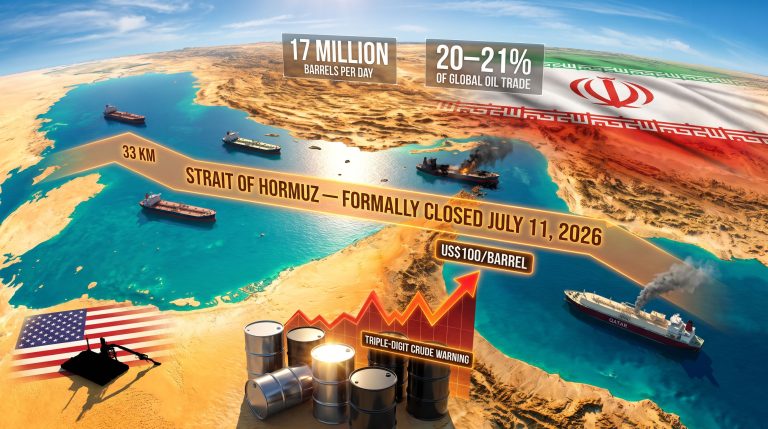
Few chokepoints in the global economy carry the weight of the Strait of Hormuz. Under normal conditions, roughly 20% of the world's oil supply threads through this narrow passage between Iran and Oman, making it the single most consequential maritime corridor on the planet. U.S. strikes against Iran and Strait of Hormuz shipping disruptions have consequently become the defining geopolitical crisis of mid-2026, with consequences rippling through energy markets, shipping networks, and the water supplies of entire nations.
When big ASX news breaks, our subscribers know first
Seven Nights of Strikes: What U.S. CENTCOM Has Actually Been Targeting
As of mid-July 2026, U.S. Central Command had completed seven consecutive nights of strikes against Iranian targets. Each operation has extended the geographic and operational scope of the campaign, moving beyond symbolic strikes to systematically targeting military logistics infrastructure, underground weapons storage facilities, and Iranian maritime capabilities.
The geographic footprint of the campaign is significant. Strikes have been confirmed or reported across multiple Iranian coastal and strategic locations, including Bushehr, Chah Bahar, Jask, Konarak, Abu Musa, and Bandar Abbas, covering much of Iran's Gulf and Gulf of Oman coastline. These are not random targets. They represent a deliberate effort to degrade the infrastructure Iran uses to threaten maritime traffic and project naval power into the strait.
CENTCOM has also formalised a naval blockade posture against Iranian ports, with the stated objective of protecting civilian mariners and ensuring commercial shipping can continue. In the first three days of renewed enforcement, U.S. forces redirected four commercial vessels, disabled one, and boarded another to verify compliance.
The Origin of the Conflict and the Collapse of the June Ceasefire
The current phase of hostilities traces back to February 28, when the initial U.S. and Israeli strikes against Iran set the conflict in motion. A subsequent memorandum, finalised in June, was intended to serve as a framework for reopening the Strait of Hormuz and winding down hostilities. According to reporting from Al Jazeera on the Strait of Hormuz developments since the June memorandum, that momentum collapsed when an attack on a Panama-flagged tanker named Kiku undermined the fragile ceasefire dynamic, and a UN-led evacuation plan contingent on a calmer maritime environment fell apart shortly thereafter.
The practical consequence of that failure is a conflict now operating without a functioning off-ramp, with both sides conducting military operations that make a physical restoration of the shipping corridor increasingly difficult, regardless of what any political document might say. The global trade disruption stemming from this impasse continues to deepen with each passing week.
The Mine Problem: Why the Strait Cannot Simply Be Switched Back On
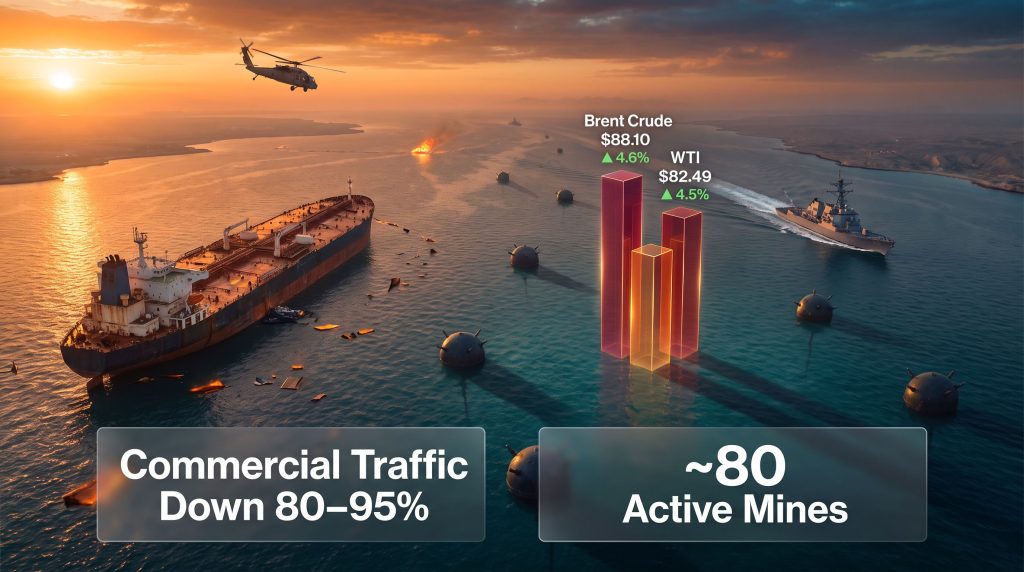
The most underappreciated dimension of the Hormuz crisis is not the diplomatic deadlock or even the oil price spike. It is the physical reality on the water. Approximately 80 active mines are currently blocking the central shipping lane of the strait. These mines do not disappear when politicians sign agreements.
Mine-clearance operations are among the most technically demanding, time-consuming, and inherently dangerous tasks in naval warfare. Each device must be identified, assessed, and neutralised individually. The process requires specialised vessels, trained ordnance disposal teams, and sustained operational windows free from active hostilities.
Historical precedent from previous Gulf conflict scenarios suggests that even under cooperative conditions, clearing a mining campaign of this scale could take months, not weeks. Furthermore, this creates a structural disconnect that markets and policymakers alike tend to underestimate. A ceasefire agreement, however comprehensive, does not restore the shipping lane.
Strait of Hormuz Disruption Snapshot: July 2026
| Disruption Factor | Current Status |
|---|---|
| Active mines in central corridor | ~80, requiring clearance before normal operations |
| Commercial traffic volume decline | Down 80-95% from pre-conflict baseline |
| Late-June daily vessel transits | ~25 vs. 30-50 previously |
| Vessels stranded inside the Gulf | 3,200+, with 150+ damaged or on fire |
| Vessels diverted around Africa (first 4 weeks) | 34,000+ rerouted |
| Global oil supply affected | ~20% of global supply, the largest fuel supply halt on record |
The Strait of Hormuz is not legally closed in the formal sense, but it is operationally paralysed. For the vast majority of commercial operators, the practical distinction between a formal closure and a corridor where war-risk premiums are prohibitive, mines are present, and naval interdiction is active is essentially meaningless.
Iran's Naval Counter-Operations
Iran has not been passive in the face of U.S. enforcement operations. The Islamic Revolutionary Guard Corps Navy conducted a coordinated missile and drone operation in the early hours of Saturday, July 19, halting and immobilising four vessels that were attempting to transit the strait under U.S. escort. Iran's state news agency IRNA reported the operation directly, framing it as a successful interdiction of vessels seeking U.S. military protection.
The strategic logic behind these operations is layered. At one level, they serve as deterrence signals, demonstrating that U.S. naval protection does not guarantee safe passage. At another level, they function as leverage in any eventual negotiation, maintaining Iran's ability to threaten the global energy supply as a bargaining chip.
Oil Markets Are Pricing a Structural Shock, Not a Volatility Spike
The energy market response to the sustained disruption has been decisive. As of mid-July 2026, Brent crude futures for September delivery were trading at $88.10 per barrel, up 4.6% on the day. WTI futures for August delivery settled at $82.49 per barrel, a gain of 4.5%. Both benchmarks recorded approximately 16% weekly gains, with Brent logging its third consecutive weekly advance and WTI its second.
A 16% weekly gain across both major benchmarks within a single conflict escalation cycle is not a transient volatility event. It reflects market participants repricing the probability of a sustained structural supply disruption, not a temporary dislocation.
Understanding oil price volatility trends in the context of Middle Eastern conflict is therefore essential for any investor or analyst tracking energy markets in this period. Both benchmarks reached their highest levels since mid-June 2026 as a result of the renewed escalation.
Shipping Industry Response: Rerouting, Premiums, and Crisis-Level Risk Indices
The commercial shipping industry's response to the crisis has been equally telling. Major carriers including MSC and Maersk have continued routing vessels around the Cape of Good Hope, adding substantial transit time and fuel costs to every voyage that would normally pass through the strait. Over 34,000 vessels were diverted from the Hormuz corridor in the first four weeks of the conflict.
Industry risk monitors have placed the crisis pressure index for the Hormuz corridor at 92 out of 100, a figure that effectively signals near-complete commercial avoidance of the route. War-risk insurance premiums have surged, adding further cost pressure to freight rates that are already elevated by the longer alternative routes.
This is not simply a Middle Eastern problem. Shipping cost inflation transmits directly into the prices of goods that move through global supply chains. The knock-on effects extend from Asian manufacturers dependent on Gulf energy to European importers relying on freight from the Indo-Pacific. Consequently, the commodity price impacts on mining and resource companies globally are becoming increasingly pronounced.
Regional Vulnerabilities: Kuwait, Bahrain, and the Human Cost of Escalation
The conflict has moved well beyond the maritime corridor itself. Kuwait has absorbed multiple Iranian attacks on its civilian infrastructure within a 48-hour window. An Iranian strike on a Kuwaiti water and power distillation station caused a fire, though no casualties were reported. This was the second such attack on Kuwaiti water facilities in two days.
The targeting of desalination infrastructure carries acute strategic implications. Kuwait is one of the most water-scarce nations on earth, with approximately 90% of its national water demand met through seawater desalination plants. Sustained attacks on this infrastructure could create a humanitarian crisis entirely independent of the energy and shipping disruptions already underway.
Kuwait Airways rescheduled the majority of its flight operations, citing ongoing missile and drone threats. Bahrain's air defence systems intercepted multiple Iranian projectiles overnight, with civilian sirens activated across the island nation. Iran separately claimed to have targeted U.S. military forces in Syria and Bahrain on July 17.
The targeting logic here appears deliberate: by striking civilian infrastructure across Gulf Cooperation Council states, Iran is demonstrating that the costs of the U.S. military campaign are not confined to Iranian territory. The broader geopolitical mining landscape across the region is being reshaped as GCC nations hosting U.S. forces reassess their strategic exposures.
The Strategic Gap: Military Dominance Without Political Resolution
Ian Lesser, Distinguished Fellow at the German Marshall Fund, has articulated what may be the most important strategic risk in the current conflict. His assessment centres on a pattern that has repeatedly characterised U.S. military engagements: the gap between overwhelming operational capability and the absence of a coherent strategy for political resolution.
Lesser's analysis, shared with CNBC, identifies the risk of the U.S. and Iran becoming entrenched in a prolonged conflict, noting that the two countries have existed in a state of cold, and occasionally hot, hostility for decades. His broader point is that superior military capability does not automatically translate into favourable political outcomes.
Strategic miscalculation at the outset of a military campaign can produce consequences that are difficult to reverse regardless of tactical success. This framing is particularly relevant to the Hormuz situation. The U.S. can strike Iranian targets indefinitely, enforce a naval blockade, and redirect or board commercial vessels. However, what it cannot do through military means alone is compel Iran to stand down its naval operations or re-enter a negotiating framework that both parties are willing to honour.
President Trump has publicly threatened to expand the target set to include Iranian bridges and power infrastructure if Iran refuses to return to negotiations, a move that would escalate civilian impact and potentially harden Iranian domestic sentiment against any diplomatic resolution.
According to UNCTAD analysis of Strait of Hormuz disruptions, the implications for global trade and development are severe, with the organisation warning of cascading effects across developing economies heavily reliant on affordable energy imports.
Scenario Modelling: Three Paths Forward for the Strait
| Scenario | Trigger Conditions | Oil Market Impact | Strait Timeline |
|---|---|---|---|
| Negotiated De-escalation | Iran returns to talks; U.S. pauses strikes | Brent retreats toward $70-75 range | 3-6 months for mine clearance and traffic normalisation |
| Sustained Attrition | Strikes continue with no ceasefire | Brent holds $85-95; supply shock deepens | 6-18 months of partial disruption |
| Full Escalation | Iran strikes U.S. installations; regional expansion | Brent spikes above $100+; demand destruction begins | Indefinite closure; alternative routes permanently repriced |
The sustained attrition scenario currently appears most probable given the trajectory of military operations on both sides. Neither party has signalled a genuine willingness to return to the framework established in the June memorandum, and the physical state of the shipping corridor makes any rapid normalisation unlikely even if political will were to emerge suddenly.
The next major ASX story will hit our subscribers first
What Genuine De-escalation Would Actually Require
It is worth being precise about what restoration of the Strait of Hormuz would actually demand in practice, because political commentary often glosses over the operational requirements. Any meaningful pathway to normalisation would need to include:
- A durable ceasefire framework that goes beyond the June memorandum and includes enforceable compliance mechanisms for both parties.
- A coordinated mine-clearance operation in the central shipping corridor, requiring specialised naval assets and a sustained period without active hostilities.
- An IRGC naval stand-down, including the cessation of vessel interdiction operations and the withdrawal of missile and drone threats against commercial shipping.
- A diplomatic re-engagement process involving credible third-party mediators capable of bridging the gap between U.S. and Iranian negotiating positions.
- A sustained period of reduced risk sufficient to bring war-risk insurance premiums back to levels where commercial operators are willing to transit the corridor without prohibitive cost penalties.
Each of these steps is a prerequisite for the next. A ceasefire alone accomplishes step one. It does nothing about steps two through five. Furthermore, markets and policymakers who assume that a political agreement translates quickly into restored commercial shipping flows are likely to be disappointed by the operational reality on the water. The oil price shock risks associated with a prolonged stalemate remain substantial and should not be underestimated.
Frequently Asked Questions: U.S. Strikes Against Iran and Strait of Hormuz Shipping Disruptions
Is the Strait of Hormuz currently open or closed?
The strait is neither formally closed under international maritime law nor freely operational in practice. With approximately 80 mines in the central corridor, active IRGC naval interdiction operations, and war-risk premiums at extreme levels, commercial traffic has declined by 80-95% from pre-conflict baselines. For most operators, this constitutes a functional closure regardless of what any government officially declares.
How many ships are currently stranded in the Persian Gulf?
Estimates place the number of stranded vessels at approximately 3,200, with more than 150 reported as damaged or on fire as of mid-July 2026.
Why can't shipping resume immediately after a ceasefire?
Even if a ceasefire were formalised tomorrow, the approximately 80 active mines blocking the central shipping lane would require a dedicated clearance operation before commercial vessels could safely transit. This process is technically complex, operationally dangerous, and historically takes months even under cooperative conditions.
What share of global oil supply normally passes through the strait?
Approximately 20% of global oil supply transits the Strait of Hormuz under normal conditions. The current disruption represents the largest fuel supply halt in recorded history by volume impact.
What are Brent and WTI trading at currently?
As of mid-July 2026, Brent crude was trading at approximately $88.10 per barrel and WTI at $82.49 per barrel, both up roughly 16% for the week and at their highest levels since mid-June.
How are major shipping companies responding?
Carriers including MSC and Maersk have rerouted their fleets around the Cape of Good Hope, adding significant transit time and operating costs. The industry crisis pressure index for the Hormuz corridor is reported at 92 out of 100, effectively signalling near-complete commercial avoidance of the route.
Disclaimer: This article contains forward-looking analysis, scenario modelling, and third-party assessments. Oil price projections and conflict scenario timelines are speculative in nature and subject to rapid change given the evolving geopolitical situation. This content is intended for informational purposes only and does not constitute financial or investment advice. Readers should consult qualified advisers before making decisions based on any information contained herein.
Want to Stay Ahead of the Commodity Disruptions Reshaping Global Markets?
While geopolitical shocks like the Strait of Hormuz crisis send oil and resource prices surging, Discovery Alert's proprietary Discovery IQ model delivers real-time alerts on significant ASX mineral discoveries — cutting through market noise to surface actionable opportunities before the broader market reacts. Start your 14-day free trial today and explore historic discovery returns that demonstrate just how transformative early positioning can be.