
August 5, 2026
The Chokepoint Crisis Rewriting Middle East Energy Architecture
Every major shift in global energy infrastructure begins not with a blueprint, but with a crisis. The world's oil supply chains have long been organised around assumptions of stable transit corridors, predictable geopolitics, and incremental change. When those assumptions collapse simultaneously, the result is not just a supply disruption but a fundamental reassessment of how energy moves across continents. That is precisely the moment the Middle East finds itself navigating in 2026, and the Iraqi-Syrian oil pipeline restoration is the most consequential response to emerge from that disruption.
Understanding why this particular pipeline matters requires stepping back from the immediate headlines and examining the structural fragility it is designed to address.
When big ASX news breaks, our subscribers know first
Iraq's Single-Route Vulnerability: The Problem That Preceded the Crisis
For decades, Iraq's crude export architecture has been built almost entirely around Persian Gulf shipping lanes. The vast majority of Iraqi oil reaches global markets via tankers departing from Basra and the Al-Faw terminal, navigating through the Strait of Hormuz before dispersing toward Asian, European, and global destinations. This concentration of export dependency on a single geographic chokepoint was always a latent risk, acknowledged in energy security literature but rarely treated as an urgent policy priority.
The strategic exposure became impossible to ignore once the June 2025 conflict between Israel and Iran introduced severe uncertainty around Hormuz transit. Approximately 20% of global oil trade passes through the strait daily, making it one of the most consequential maritime chokepoints on earth. When Iran subsequently locked down the strait following the resumption of U.S. military strikes, Iraq faced an acute and immediate export crisis with no ready alternative. These oil price movements had far-reaching consequences across global markets.
The response was improvised but revealing. Beginning in April 2026, Iraq began transporting crude oil overland through Syrian territory by truck, a logistically expensive and operationally constrained workaround that nevertheless demonstrated something critically important: the political will and physical feasibility of an overland route to the Mediterranean already existed. What was missing was the infrastructure to scale it.
That truck-based operation, costly and inefficient as it was, functioned as a real-world proof-of-concept for the pipeline corridor's strategic logic, validating the route before any formal engineering study had been commissioned.
What Is the Kirkuk–Baniyas Pipeline? A Technical and Historical Primer
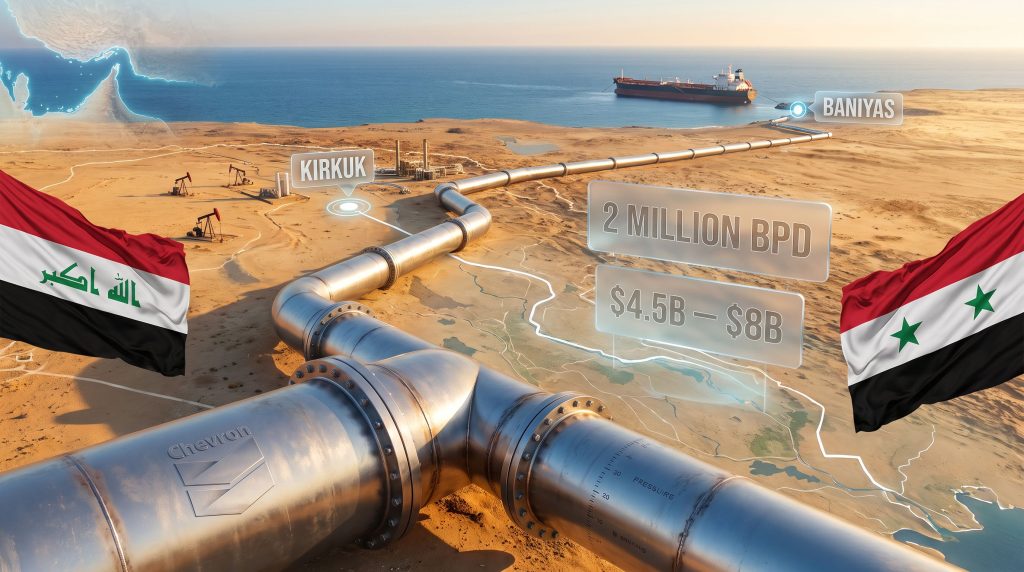
The Kirkuk–Baniyas pipeline is an approximately 800 to 850-kilometre crude oil conduit that once connected northern Iraq's prolific Kirkuk oil fields to the Syrian Mediterranean port of Baniyas. At its peak operational period, the pipeline represented one of the region's most strategically significant energy arteries, offering Iraq direct access to Mediterranean export markets without any reliance on Gulf shipping.
The infrastructure was rendered non-operational in 2003 following damage sustained during the U.S.-led invasion of Iraq. For more than two decades, rehabilitation was considered simultaneously unviable on economic, technical, and political grounds. The pipeline corridor crossed territory that would subsequently experience some of the most intense conflict of the twenty-first century, and the diplomatic relationship between Iraq and Syria was rarely stable enough to sustain a project of this magnitude.
That calculus has now shifted decisively. The key specifications of the proposed restoration are as follows:
| Specification | Detail |
|---|---|
| Origin Point | Kirkuk oil fields, northern Iraq |
| Terminus | Baniyas, Syria's Mediterranean coast |
| Approximate Length | 800 to 850 kilometres |
| Operational Status | Closed since 2003 |
| Planned Initial Capacity | 2 million barrels per day (bpd) |
| Estimated Rehabilitation Cost | USD $4.5 billion to $8 billion |
| Projected Construction Timeline | Approximately 36 months |
| Lead Executing Company | Chevron |
| Oversight Structure | U.S.-led international consortium |
The engineering complexity of restoration cannot be understated. Pumping stations along the corridor have experienced more than two decades of structural deterioration. Pipeline wall corrosion, compromised storage tank integrity, and degraded power supply infrastructure represent the three primary technical barriers to a rapid restart. Joint Iraqi-Syrian technical committees are currently evaluating two distinct engineering pathways:
-
Rehabilitation of the existing route through its established right-of-way, preserving sunk infrastructure where viable.
-
Construction of a new, shorter alignment rerouting south of Homs via Deir Ezzor, which could potentially reduce overall project costs and improve long-term operational efficiency.
A feasibility study has been commissioned with a Turkish engineering firm to assess both options before a final design decision is made.
U.S. Strategic Architecture: Why Washington Moved to Centre Stage
The involvement of the United States as the central diplomatic architect of this energy corridor distinguishes the Iraqi-Syrian oil pipeline restoration from a routine bilateral infrastructure agreement. On July 18, 2026, the U.S. State Department formally welcomed the restoration announcement, describing the project as being of bilateral and regional strategic significance and confirming that Washington is overseeing an international consortium tasked with managing both the technical and financial dimensions of the rehabilitation.
This framing is deliberate. By embedding American diplomatic endorsement and a U.S.-led consortium structure into the project's foundation, Washington is effectively repositioning Middle East energy infrastructure as an instrument of broader geopolitical strategy rather than a purely commercial transaction. Furthermore, these geopolitical trade tensions have accelerated the timeline for alternative energy corridor development across the region.
Chevron's designation as the lead executing company reflects a recognisable pattern in U.S. foreign policy: deploying major American energy companies as operational vehicles for achieving strategic objectives in post-conflict reconstruction zones. The model pairs government-level diplomatic legitimacy with private-sector technical capacity, creating a structure in which commercial and geopolitical incentives are mutually reinforcing.
The announcement coincided with Iraqi Prime Minister Ali al-Zaidi's visit to Washington, where U.S. President Donald Trump publicly praised his leadership, underscoring the high level of political capital that senior figures on both sides have invested in the initiative.
Timeline of Key Diplomatic Milestones
| Period | Development |
|---|---|
| Late 2025 | Preliminary bilateral agreements reached between Iraq and Syria |
| Early 2026 | Ministerial-level talks held in Damascus and Baghdad |
| April 2026 | Iraq begins trucking crude through Syria as a Hormuz alternative |
| Mid-2026 | Feasibility study commissioned with Turkish engineering firm |
| June 2026 | Iraqi PM al-Zaidi and U.S. Special Envoy Tom Barrack reaffirm commitment |
| July 18, 2026 | U.S. State Department formally welcomes pipeline restoration announcement |
TotalEnergies, Transit Economics, and Syria's New Role
One of the less-examined dimensions of this project is the economic transformation it could trigger for Syria. Transit fee revenue from 2 million barrels per day of Iraqi crude passing through Syrian territory would represent a substantial and recurring income stream for a country in active post-conflict reconstruction. For context, even at modest transit fee rates common in comparable pipeline arrangements, throughput at that scale generates annual revenues capable of meaningfully accelerating infrastructure rebuilding.
TotalEnergies CEO Patrick Pouyanne, speaking in Damascus during mid-2026, characterised Syria's potential role in terms that signal major international energy companies are beginning to incorporate a post-conflict Syrian economic recovery scenario into their forward planning assumptions. His framing of Syria as a potential significant transit corridor for Iraqi crude heading to Mediterranean markets was notable precisely because it came from a senior executive of one of the world's largest integrated energy companies rather than from a government official.
This matters for a less obvious reason. When energy majors begin publicly articulating strategic interest in a country's transit infrastructure, it typically precedes broader commercial engagement. Syria's emergence as a transit economy could therefore serve as a catalyst for additional investment across sectors well beyond energy, with knock-on implications for reconstruction financing from Gulf and Western partners alike.
Three Scenarios for the Pipeline's Strategic Outcome
The range of possible outcomes for the Iraqi-Syrian oil pipeline restoration spans from transformational to stalled, and the distinction between those scenarios depends on a relatively small number of critical variables.
Scenario 1: Full Rehabilitation at 2 Million bpd
At its planned initial capacity, the pipeline would represent one of the largest new crude export corridors activated in the Middle East in decades. Iraq would effectively possess a parallel export system capable of sustaining meaningful revenue flows independent of Persian Gulf access. European refiners, which have been actively seeking to diversify away from both Russian oil sanctions-affected supplies and Hormuz-exposed Gulf seaborne shipments since 2022, would gain access to a geographically proximate, politically aligned alternative supply source with direct Mediterranean delivery.
Scenario 2: Phased Restart at Reduced Capacity
Given the $4.5 billion to $8 billion cost range and the 36-month construction horizon, officials are reportedly considering a phased approach permitting a partial restart at lower throughput. This would generate early revenue to partially offset rehabilitation costs while full infrastructure upgrades proceed in parallel, reducing financial risk at the cost of extending the timeline to full strategic value.
Scenario 3: Project Stalls Due to Security or Financing Gaps
The most significant structural risk to the project is sustained political or security instability across a corridor that traverses more than 800 kilometres of historically contested territory. Financing gaps at the scale of $4.5 to $8 billion also represent a non-trivial execution risk, particularly if the international consortium fails to attract sufficient private capital.
Infrastructure projects of comparable scale in post-conflict environments carry completion rates well below those achieved in stable regions. Any investor or government assessing this project must weight security corridor guarantees as a foundational prerequisite, not a secondary consideration.
The next major ASX story will hit our subscribers first
Mediterranean Market Implications: What Changes at 2 Million bpd
The downstream effects of a fully operational Kirkuk–Baniyas pipeline would extend well beyond Iraq and Syria. At 2 million bpd, the corridor would add meaningful new supply capacity to Mediterranean crude markets, as confirmed by recent Reuters reporting on U.S. support for the initiative. If the pipeline reaches operational status while the Strait of Hormuz remains restricted, it could function as a critical price stabilisation mechanism, providing markets with a supply source that bypasses the Gulf chokepoint entirely.
Conversely, if Hormuz reopens concurrently with the pipeline reaching full capacity, the combined effect of restored Gulf flows and new Mediterranean supply could exert downward pressure on Brent crude benchmarks. The timing relationship between Hormuz's status and the pipeline's commissioning date will therefore be one of the most closely watched variables in global energy markets over the next three years.
For European refiners specifically, the Baniyas terminus positions Iraqi crude as a natural complement to existing North African and Eastern Mediterranean supply infrastructure, arriving via a route that carries no Russian geopolitical entanglement and no Gulf chokepoint exposure. A broader understanding of the crude oil market overview helps contextualise how transformative this new corridor could be for Mediterranean pricing dynamics.
Iraq's Fiscal Equation and the Export Route Sovereignty Argument
Iraq's national budget is structurally dependent on oil export revenues to a degree that makes route reliability not merely an energy security question but a fiscal stability issue. Sustained Hormuz disruptions have already demonstrated in real time the direct and material impact of single-route dependency on government revenue flows.
A functional Mediterranean alternative transforms Iraq's sovereign credit risk profile in a meaningful way, insulating government finances from Gulf geopolitical shocks. This factor is likely to feature in Iraq's sovereign credit assessments and international borrowing capacity evaluations going forward, adding a financial dimension to the project's strategic significance that extends beyond energy policy into macroeconomic positioning.
From a resource nationalism perspective, the pipeline also represents something Iraq has lacked since the early 2000s: genuine export route independence. The ability to move crude to market via two structurally distinct pathways is the foundation of energy sovereignty for a country whose fiscal architecture is built almost entirely on hydrocarbon revenues. Moreover, the trade war oil impact on global pricing has further reinforced why Iraq's pursuit of route diversification carries such urgency.
Frequently Asked Questions: Iraqi-Syrian Oil Pipeline Restoration
What is the Kirkuk–Baniyas pipeline and why was it shut down?
The Kirkuk–Baniyas pipeline is an approximately 800-kilometre crude oil corridor connecting Iraq's northern Kirkuk oil fields to Syria's Mediterranean port of Baniyas. It was rendered non-operational in 2003 following damage sustained during the U.S.-led invasion of Iraq and has remained dormant for over two decades due to infrastructure deterioration, political instability, and the absence of viable financing and diplomatic conditions.
How much will restoring the pipeline cost?
Rehabilitation cost estimates range from USD $4.5 billion to as high as $8 billion, depending on the engineering pathway selected. A feasibility study commissioned with a Turkish engineering firm is currently assessing whether rehabilitating the existing route or constructing a new alignment via Deir Ezzor represents the more cost-effective option.
Who is leading the pipeline's construction?
Chevron has been designated as the lead executing company. The project is overseen by a U.S.-led international consortium responsible for managing both the technical engineering and financial structuring aspects of the rehabilitation.
What is the pipeline's planned transport capacity?
The pipeline is designed to achieve an initial transport capacity of 2 million barrels per day upon full rehabilitation. Some planning frameworks reference a dual-line configuration capable of handling up to 1.5 million bpd per line.
How long will restoration take?
Current engineering projections indicate a completion window of approximately 36 months from the commencement of active construction, subject to security conditions across the corridor and financing availability.
Why is the Strait of Hormuz closure so significant to this project?
The Strait of Hormuz carries roughly 20% of global oil trade daily. Iran's blockade of the strait following resumed U.S. military strikes created an immediate and severe export bottleneck for Iraq, which relies almost entirely on Persian Gulf routes. The Kirkuk–Baniyas pipeline directly addresses that vulnerability by providing a Mediterranean-facing alternative that bypasses the Gulf entirely. The New Arab's coverage of Syria and Iraq's planning process offers additional regional context on this strategic rationale.
Key Takeaways
-
The Iraqi-Syrian oil pipeline restoration is a geopolitically engineered response to structural vulnerabilities in Middle East energy supply chains, not a routine infrastructure upgrade.
-
At 2 million bpd of planned capacity, the corridor would rank among the most consequential new crude routes activated globally in the past two decades.
-
U.S. involvement through diplomatic endorsement, consortium oversight, and Chevron's execution role embeds American commercial and strategic interests directly into the project's architecture.
-
Syria's emergence as a transit economy could accelerate broader reconstruction financing and elevate its strategic importance to Western and Gulf partners.
-
The pipeline's ultimate market impact will depend on three variables: construction timeline adherence, security corridor stability across 800-plus kilometres of historically contested territory, and the evolving status of the Strait of Hormuz.
-
European refiners stand to benefit from a new, geographically proximate crude source carrying neither Russian geopolitical exposure nor Gulf chokepoint risk.
This article contains forward-looking analysis and scenario projections based on publicly available information as of the date of publication. Readers should note that infrastructure projects of this scale in post-conflict environments carry significant execution risk. Nothing in this article constitutes investment advice. Outcomes described in scenario projections are illustrative and subject to material uncertainty.
Want to Stay Ahead of the Next Major Resource Discovery?
While geopolitical shifts reshape global energy infrastructure, significant mineral discoveries on the ASX are creating parallel opportunities for informed investors — and Discovery Alert's proprietary Discovery IQ model delivers real-time alerts the moment those discoveries are announced, turning complex data across 30-plus commodities into clear, actionable insights. Explore historic discovery returns on Discovery Alert's discoveries page and begin your 14-day free trial today to position yourself ahead of the broader market.