July 23, 2026
From Extraction to Ecological Renewal: The Policy Architecture Behind India's Mine Closure Revolution
Across the world's major coal-producing economies, the question of what happens after extraction has never been more consequential. As energy transitions accelerate and environmental scrutiny intensifies, the management of decommissioned mine sites has shifted from a regulatory afterthought to a strategic governance priority. For a country like India, where the coal sector underpins both energy security and rural employment across hundreds of operating and legacy sites, getting mine closure right is not simply an environmental concern. It is an economic, social, and reputational imperative.
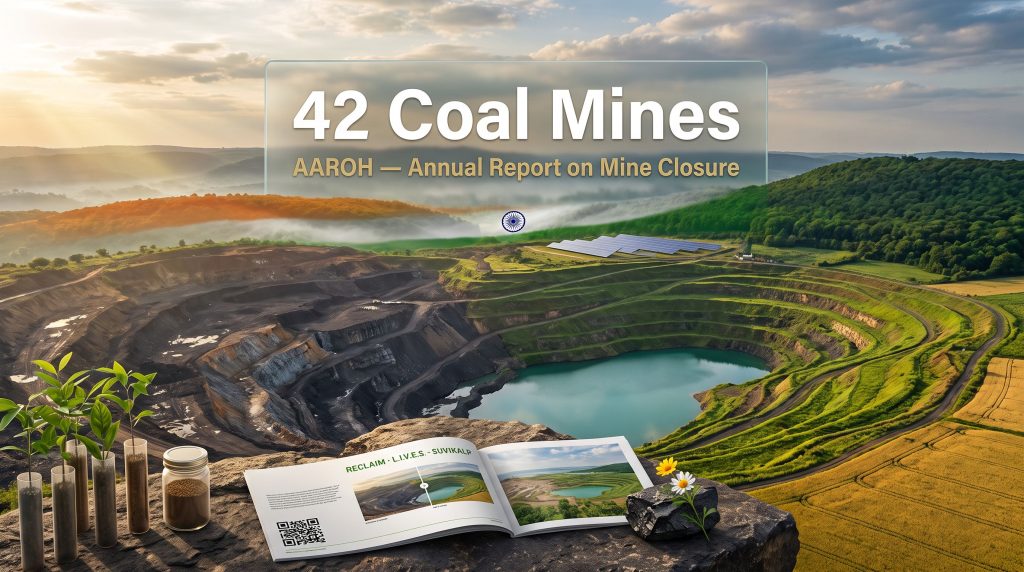
It is within this context that India's Ministry of Coal released the AAROH Annual Report on Mine Closure, a landmark publication documenting the scientific closure and ecological transformation of 42 coal mines across the country. Released in New Delhi, AAROH functions simultaneously as a knowledge repository, a policy transparency mechanism, and a blueprint for how formerly productive extraction sites can be reimagined as ecologically and socially regenerative landscapes.
When big ASX news breaks, our subscribers know first
Understanding AAROH: Scope, Structure, and Significance
The AAROH Annual Report on Mine Closure is not a routine compliance document. Its architecture reflects a deliberate institutional effort to capture, standardise, and communicate what responsible mine closure looks like at scale across a diverse national geography.
Each of the 42 mine profiles within the report follows a consistent documentation structure, covering:
- Structured reclamation methodologies applied at each site
- Post-mining land-use outcomes, including ecological and community outcomes
- Before-and-after visual documentation of site transformation
- QR code-linked documentary video footage providing site-specific evidence of progress
This QR code integration is a genuinely novel feature within the Indian regulatory context. By anchoring each mine profile to verifiable video records, the report reduces the risk of superficial or misleading closure claims, a problem that has historically undermined public trust in industrial self-reporting across multiple sectors globally.
The table below summarises the core structural features of the AAROH report:
| Feature | Detail |
|---|---|
| Mines Documented | 42 coal mines |
| Documentation Type | Profiles with closure initiatives, land-use outcomes, and visual records |
| Interactive Element | QR code-enabled video documentation per mine site |
| Primary Use Case | Knowledge repository for future closure and repurposing decisions |
| Release Authority | Ministry of Coal, Government of India |
| Release Location | New Delhi |
What Scientific Mine Closure Actually Involves
The phrase "scientific mine closure" is often used loosely, but it carries precise technical meaning in the context of modern mining governance. Unlike legacy abandonment, where exhausted sites were simply vacated, scientific closure follows a structured, multi-phase process designed to address both the physical hazards and ecological deficits created by decades of extraction activity. Furthermore, the importance of mine reclamation to long-term ecological recovery cannot be overstated.
The Core Technical Phases
- Geotechnical stabilisation — addressing subsidence risks, slope instability, and void management in both opencast and underground operations
- Hydrological management — controlling water ingress, managing pit lake formation, and preventing acid mine drainage from contaminating adjacent catchments
- Topsoil restoration — rebuilding soil horizons capable of supporting vegetation and agricultural productivity
- Biodiversity reintroduction — systematic replanting using native species suited to local ecological conditions, often supported by nursery programs operated by the mining entities themselves
- Long-term monitoring — ongoing environmental surveillance of reclaimed sites to verify the durability of restoration outcomes
One dimension of mine closure that receives insufficient public attention is the challenge of acid mine drainage (AMD), a phenomenon where exposed sulphide minerals in coal waste react with oxygen and water to generate sulphuric acid. AMD can persist for centuries in poorly managed sites, contaminating groundwater and surface water at considerable distances from the original mine. The inclusion of hydrological management as a core component of India's closure methodology signals an awareness of this long-tail environmental risk.
The Three-Framework Policy Architecture: RECLAIM, L.I.V.E.S., and SUVIKALP
What distinguishes India's approach from many peer economies is the deliberate integration of multiple policy frameworks operating in concert, each addressing a distinct dimension of the closure challenge. In addition, the broader context of mining sustainability transformation globally provides useful reference points for evaluating India's progress.
RECLAIM: The Scientific and Regulatory Scaffold
The RECLAIM Framework establishes standardised protocols for scientific assessment, stakeholder participation, knowledge exchange, and sustainable post-mining land use across decommissioned coal sites. By creating a replicable methodology applicable to diverse mine typologies, from shallow opencast operations to deep underground workings, RECLAIM reduces the discretion that has historically allowed closure quality to vary widely between operators.
L.I.V.E.S.: Integrating Social and Ecological Outcomes
The L.I.V.E.S. Framework extends the closure conversation beyond physical reclamation into the socioeconomic consequences of mine decommissioning. Mining communities face a distinctive form of economic vulnerability when operations cease. Skills developed over decades of underground or opencast work do not transfer easily to alternative employment, and the infrastructure built around active mines, from roads to healthcare facilities, often deteriorates without the operational revenue to sustain it.
Practical applications documented under this framework include:
- Vocational retraining programs for former mine workers
- Agricultural land restoration enabling displaced communities to resume food production
- Community infrastructure development repurposing former industrial land for schools, health centres, and recreational facilities
SUVIKALP: Decision Support for Repurposing Decommissioned Sites
The SUVIKALP Mine Repurposing Tool provides a structured analytical framework for evaluating alternative land-use options after closure. The variables assessed include land topography, proximity to urban centres, water availability, soil quality, and the specific needs of surrounding communities.
Critically, SUVIKALP Samvaad functions as its participatory consultation extension, bringing together local communities, technical experts, and government bodies to co-design post-mining futures. This co-design approach matters because repurposing decisions made without community input frequently encounter implementation resistance, regardless of their technical merit.
The integration of RECLAIM, L.I.V.E.S., and SUVIKALP into a unified governance architecture represents one of the most comprehensive mine closure policy ecosystems currently operating in any major coal-producing nation.
Post-Mining Land Use: What Happens to the Land?
The range of post-mining land uses documented across the 42 mine profiles reflects the diverse physical characteristics and community contexts of India's coal geography. There is no single template for what a closed mine becomes, and that flexibility is deliberate.
| Post-Mining Land Use Category | Description | Primary Beneficiaries |
|---|---|---|
| Agricultural Reclamation | Topsoil rebuilding for crop production | Local farming communities |
| Afforestation and Green Corridors | Native tree planting for biodiversity recovery | Regional ecosystems |
| Renewable Energy Infrastructure | Solar and wind installations on cleared land | Energy grid and local communities |
| Water Body Creation | Pit lakes and reservoirs for irrigation or recreation | Agricultural and urban users |
| Community Infrastructure | Schools, health centres, recreational spaces | Former mining workforce and families |
| Eco-Tourism Development | Nature reserves and heritage mining trails | Regional tourism economy |
One underappreciated opportunity within this landscape is the intersection of mine closure with carbon credit markets. Revegetated mine sites, particularly those supporting afforestation, can generate measurable increases in soil organic carbon and above-ground biomass, both of which are creditable under voluntary carbon market standards. As India's carbon market infrastructure matures, the integration of mine closure outcomes into carbon accounting frameworks could create a new revenue stream that partially offsets closure costs for operators.
How India Compares Internationally
Global Benchmarks
India's AAROH framework does not exist in isolation. Several international precedents offer both inspiration and cautionary lessons. According to CSIRO research, the complexity of mine closure demands genuinely integrated approaches that combine technical, social, and environmental dimensions simultaneously.
- Germany has undertaken one of the most ambitious mine closure programs in history in its Lausitz coal region, transforming former open-pit lignite mines into a network of lakes and tourism infrastructure, a project spanning decades and billions of euros in public and private investment.
- Australia mandates Mine Closure Plans (MCPs) as a condition of operating licences, backed by financial assurance bonds that operators must maintain to fund future closure liabilities. This financial assurance mechanism is widely regarded as a global best practice, ensuring that closure costs do not become public liabilities if companies exit the sector.
- South Africa presents a cautionary contrast, with thousands of abandoned mines carrying no formal closure plans and generating ongoing acid mine drainage, land subsidence, and community health impacts that are progressively more expensive to remediate as time passes.
India's Position on the Global Maturity Curve
India's strengths in this domain are real: the AAROH Annual Report on Mine Closure represents a significant institutional commitment to transparency and knowledge-sharing that most peer economies did not achieve within their first decade of formalised closure governance.
Areas where the framework can deepen include:
- Financial assurance mechanisms comparable to Australia's bonding requirements, ensuring closure funding is secured during the operational life of mines rather than retrospectively
- Third-party independent verification of closure outcomes, moving beyond self-reported data
- Long-term post-closure monitoring standards with defined timeframes and success criteria
While many major coal-producing nations have developed closure frameworks across multiple decades, India's consolidation of 42 mine profiles into a structured annual reporting cycle represents a meaningful institutional advance in transparency and accountability for an economy of its scale and coal dependency.
The next major ASX story will hit our subscribers first
Environmental Indicators: Measuring What Matters
The credibility of any mine closure reporting framework ultimately rests on the quality and rigour of its environmental measurement. The key indicators tracked across AAROH-documented sites include:
- Total land area reclaimed and revegetated, measured in hectares
- Species diversity recovery rates on restored land, tracking native versus invasive species ratios
- Water quality improvements in mine-adjacent catchments, particularly for pH and heavy metal concentrations
- Reduction in acid mine drainage and dust pollution following closure
- Soil organic carbon restoration as a proxy for long-term land productivity and ecological health
The before-and-after photographic documentation embedded in each mine profile serves a dual function: it provides verifiable evidence of physical transformation for regulatory and public purposes, and it creates a visual communication asset that makes the abstract outcomes of reclamation tangible to non-technical stakeholders. Considering natural capital in mining more broadly helps contextualise why these environmental indicators carry such strategic significance.
AAROH as an ESG and Investment Signal
For international institutional investors, the existence of a formalised annual mine closure reporting mechanism in India carries real significance. ESG evaluation frameworks increasingly penalise coal-heavy economies that lack credible transition and remediation pathways. The AAROH Annual Report on Mine Closure demonstrates that India's Ministry of Coal is treating closure not as an incidental regulatory burden but as a governance priority with dedicated institutional infrastructure.
This matters for India's potential access to green finance and just transition funding streams, where credible documentation of closure outcomes and environmental accountability is increasingly a prerequisite for engagement with multilateral development institutions.
Strategic Implications for Key Stakeholders
- Coal companies: AAROH creates a performance benchmark that establishes reputational incentives around closure quality, distinct from minimum regulatory compliance
- State governments: The knowledge repository provides replicable models for managing legacy mine sites within individual jurisdictions without starting from first principles
- Communities: Documented outcomes create accountability mechanisms and establish expectations for post-closure social investment commitments
- Policymakers: Annual reporting normalises mine closure as an ongoing governance function rather than a one-time administrative event tied to individual mine lifespans
Frequently Asked Questions About the AAROH Annual Report on Mine Closure
What does AAROH stand for?
AAROH stands for Annual Report on Mine Closure, published by India's Ministry of Coal to document progress in scientific mine closure, ecological restoration, and post-mining land transformation across the country's coal sector.
How many mines are covered in the AAROH report?
The inaugural AAROH report documents the closure and reclamation activities of 42 coal mines across India, with each receiving a dedicated profile covering closure initiatives, land-use outcomes, and visual transformation records.
What is the RECLAIM Framework?
The RECLAIM Framework is a Ministry of Coal policy tool that establishes structured protocols for scientific assessment, stakeholder participation, knowledge exchange, and sustainable post-mining land use across decommissioned coal mine sites.
What is the SUVIKALP Mine Repurposing Tool?
SUVIKALP is a decision-support system evaluating alternative land-use options for closed mine sites, incorporating variables such as land topography, community needs, water availability, and infrastructure proximity. SUVIKALP Samvaad is its participatory consultation extension enabling co-design of post-mining futures.
How does India's approach compare internationally?
India's AAROH framework is among the first formal annual mine closure reporting mechanisms across Asia's major coal-producing economies. However, whilst peers such as Australia and Germany have longer-established financial assurance and independent monitoring systems, India's multi-framework policy architecture represents a structurally sophisticated institutional approach.
What post-mining land uses are being pursued?
Documented outcomes span ecological restoration through afforestation, agricultural land reclamation, water body creation, renewable energy solutions deployed on former mine sites, community facility development, and eco-tourism development.
The Road Ahead: Scaling, Verifying, and Deepening the Framework
The AAROH Annual Report on Mine Closure is a beginning, not a finished product. Its long-term value will be determined by how the framework evolves across successive annual editions. Furthermore, green mine design principles will increasingly inform how future closure planning is integrated into site development from the outset. Several directions are particularly significant:
- Expanding coverage to a broader universe of mines, including non-coal mineral operations where legacy closure liabilities are accumulating
- Integrating independent third-party environmental auditing into future report editions to strengthen credibility with international audiences
- Developing real-time digital monitoring capability using satellite imagery and remote sensing data, which would allow closure progress to be tracked continuously rather than reported annually
The trajectory India is establishing with AAROH reflects a broader global recognition that mine closure is not a cost centre to be minimised but a governance challenge to be engineered with the same rigour applied to mine development. India's coal ministry has highlighted that AAROH marks a significant milestone in the country's journey towards responsible and sustainable mining practices. How that recognition translates into funded, verified, and community-endorsed outcomes over the next decade will determine whether the AAROH framework becomes a genuine model for coal-dependent economies navigating the energy transition.
Disclaimer: This article is intended for informational purposes only and does not constitute financial, investment, or legal advice. Readers should conduct independent research and consult qualified professionals before making any decisions based on the information presented here. Projections and forward-looking statements regarding policy development, environmental outcomes, or investment implications involve inherent uncertainty and should not be treated as guaranteed outcomes.
Want to Track the Next Major Mineral Discovery Before the Market Moves?
Discovery Alert's proprietary Discovery IQ model delivers real-time alerts on significant ASX mineral discoveries, transforming complex geological data into actionable investment insights for both short-term traders and long-term investors — explore historic discoveries and the returns they generated, then begin your 14-day free trial at Discovery Alert to position yourself ahead of the broader market.