June 27, 2026
When a Name Change Means More Than Marketing: Reading the Strategic Signals in Junior Mining Rebrands
Corporate rebranding in the mining sector rarely happens in isolation. When a company changes its name, it typically reflects a deeper shift already underway, one that has been building through acquisitions, operational milestones, and balance sheet transformation. The identity follows the strategy, not the other way around. Understanding this sequencing is critical for investors trying to decode what Minera Alamos rebrands as Mining Americas actually signals about where this company is headed.
The transition from a single-country junior explorer to a multi-asset North American gold producer is one of the most difficult evolutions in the resource sector. Most companies that attempt it either dilute shareholders into submission or stall at the development stage. The ones that succeed tend to share a common set of characteristics: operating cash flow, permitted projects ready to advance, and access to non-dilutive capital. Mining Americas, as the company is now formally known, has assembled all three.
When big ASX news breaks, our subscribers know first
The Anatomy of a Strategic Rebrand
Why Corporate Identity Lags Operational Reality
In junior mining, corporate names often become liabilities before they become assets. A name that anchors a company to a single geography can constrain its investor audience, complicate institutional mandates, and create perceptual friction when the underlying business has moved on.
The name Minera Alamos carried strong associations with Mexico, a market that has faced increasing regulatory uncertainty and investor wariness in recent years. While the company's Mexican assets remain part of the portfolio, the operational centre of gravity had already shifted north. Two transformational acquisitions, the Pan Operating Complex in White Pine County, Nevada, and the Copperstone gold project in La Paz County, Arizona, fundamentally repositioned the business before any name change was considered.
Formally approved at the Annual General and Special Meeting on June 25, 2026, the rebrand to Mining Americas Inc. is best understood as a lagging indicator of a strategic pivot that was already complete. The new corporate identity aligns the company's market presentation with its actual operational footprint. Importantly, trading tickers remain unchanged, with the company continuing to trade under MAI on the TSX Venture Exchange and MAIFF on the OTCQX market, preserving continuity for existing shareholders.
Decoding the Continental Messaging
The shift from a Spanish-language brand rooted in Mexican mining culture to the expansive "Americas" framing is deliberate and layered. It signals continental ambition rather than single-jurisdiction dependency. For institutional fund managers with geographic concentration limits, this distinction can meaningfully affect eligibility criteria.
For retail investors, it repositions the company within the context of the broader North American gold producer landscape, where valuation multiples have historically been more favourable than those applied to Latin American-focused peers. The name also removes a perceptual ceiling. Intermediate and senior gold producers operating across North America command different analyst attention, index consideration, and acquisition interest than country-specific junior explorers.
Furthermore, current record gold prices have intensified investor interest in producers with scalable North American portfolios, making the timing of this rebrand particularly advantageous. By aligning its identity with its aspirations, Mining Americas signals to the market that it intends to compete in a different weight class.
Board Reconstruction as a Confidence Signal
The Significance of Darren Pylot's Appointment
Shareholder approval of the name change was accompanied by a board restructuring that carries significant strategic weight. The confirmed directors — Bruce Durham, Darren Koningen, Ruben Padilla, Jason Kosec, and Darren Pylot — represent a blend of operational continuity and new leadership ambition. The appointment of Pylot as Chairman is the headline development.
Pylot's track record at Capstone Copper Corp. is directly relevant here. He founded the company, led it as President and CEO, and eventually transitioned to Executive Chair, overseeing its growth from a junior explorer into a multi-billion-dollar copper producer. This is not a passive board appointment. It is a deliberate signal that the company is entering a phase that requires company-building expertise at the governance level.
What makes this appointment particularly notable is the motivation behind it. Pylot's decision to take a large personal position in the company was driven by a specific combination of factors: active cash flow generation from existing operations, a portfolio of permitted development projects, and a balance sheet capable of funding advancement without returning to equity markets. This trifecta — operating production plus permitted pipeline plus non-dilutive capital access — is genuinely rare among companies at this stage of development.
Jason Kosec's transition from Chairman to Director reflects sensible governance continuity rather than displacement. His retained presence ensures institutional knowledge is preserved as the leadership structure evolves.
Performance Share Units and the TSX Graduation Pathway
The AGM also approved revisions to the company's Omnibus Incentive Plan, which now includes performance share units as a new award category. This is more than an administrative update. The introduction of performance-linked equity compensation, combined with provisions specifically designed to accommodate a main board Toronto Stock Exchange listing, indicates that governance architecture is being built ahead of schedule.
Conditional TSX approval has already been received. The governance amendments approved at the AGM represent the final structural alignment required to support that transition. In the context of broader mining industry consolidation, this governance upgrade also positions the company more favourably for potential partnership or acquisition interest.
Asset Portfolio: What Actually Backs the Ambition
Nevada: The Operational Foundation
The Pan Operating Complex in White Pine County, Nevada, is the engine that makes the rest of the strategy possible. Heap leach gold operations in Nevada benefit from well-understood geology, established regulatory frameworks, and relatively predictable operating cost structures. The method involves stacking crushed ore on lined pads and applying a dilute cyanide solution to extract gold, a capital-efficient approach that suits lower-grade disseminated deposits.
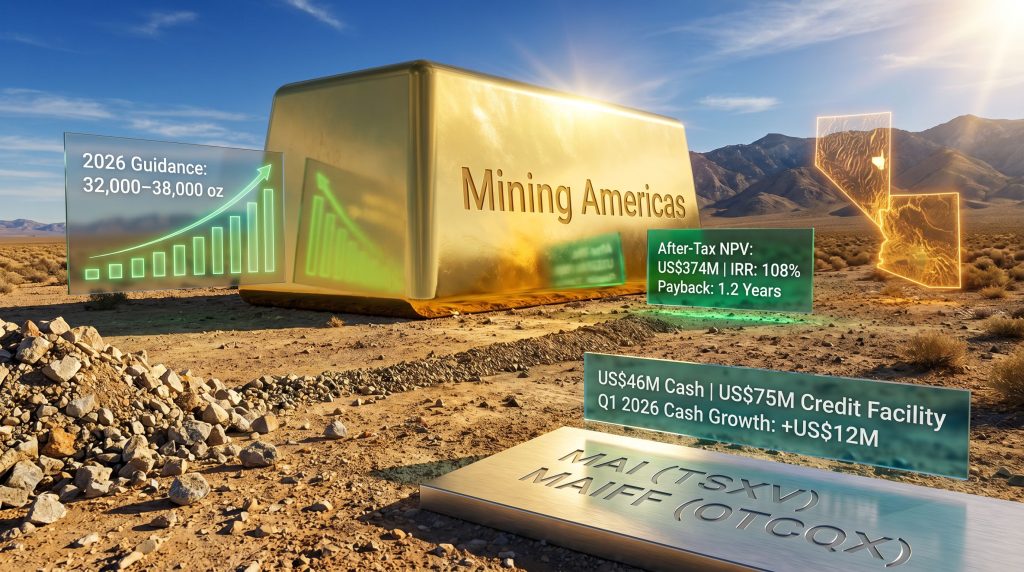
First quarter 2026 production came in at 8,734 oz, with full-year guidance set at 32,000 to 38,000 oz. This is not a spectacular output number by senior producer standards, but it serves a critical strategic function: it generates cash that funds development without shareholder dilution.
Adjacent to the operating mine, the Gold Rock project is already fully permitted and represents an organic mine life extension within an existing operational footprint. Advancing a permitted adjacent project carries substantially lower permitting risk and timeline uncertainty than greenfield development, making it a natural near-term catalyst that requires relatively modest incremental capital.
Arizona: The High-Return Development Catalyst
The Copperstone underground project in La Paz County, Arizona, is the portfolio's centrepiece development asset, and the pre-feasibility study results released on May 27, 2026, explain why Pylot described the company's project pipeline as a primary investment attraction.
| Metric | Value |
|---|---|
| Base Case Gold Price | US$3,500/oz |
| After-Tax NPV (5% Discount Rate) | US$374 million |
| Internal Rate of Return (IRR) | 108% |
| Payback Period | 1.2 years |
| Initial Production Target | Mid-2027 |
| Location | La Paz County, Arizona |
A 108% IRR places Copperstone among the most economically compelling near-term gold development projects currently advancing anywhere in the Americas. The 1.2-year payback period is particularly significant in the current environment, where capital discipline has become a primary screen for institutional resource investors. Projects with payback periods below two years at conservative gold prices attract a fundamentally different quality of investor interest than long-dated development plays.
Underground gold mining in Arizona also carries geological characteristics worth understanding. The Copperstone deposit is a structurally controlled, high-grade gold system, a style of mineralisation that typically supports stronger head grades than the disseminated heap leach material at Pan. Higher-grade underground operations generally produce more gold per tonne of ore processed, which supports better operating margins and faster capital recovery, both consistent with the PFS economics.
Initial production at Copperstone is targeted for mid-2027. If achieved on schedule, this would more than double the company's annual gold output, crossing a production threshold that is widely recognised within the sector as triggering expanded institutional eligibility, increased analyst coverage, and potential re-rating of the company's valuation multiple.
Mexico: Retained Optionality, Not Strategic Priority
The Cerro de Oro open-pit heap leach development project in northern Zacatecas remains within the portfolio and continues advancing through the Mexican permitting process. The project's positioning has shifted from strategic priority to secondary optionality, a distinction that matters for how capital is allocated and how the company's risk profile is presented to investors.
Mexico's mining sector has faced a more complex regulatory environment in recent years, with changes to environmental permitting requirements and broader policy uncertainty affecting project timelines across the industry. Retaining Cerro de Oro without committing primary capital to it represents a pragmatic approach: preserve the upside without exposing the company to the downside of regulatory delay in a jurisdiction where timelines have become less predictable.
It is worth noting that gold price sensitivity will play a role in how aggressively the Mexican portfolio is eventually advanced. At sustained prices above US$3,000 per ounce, heap leach projects with permissive economics become increasingly attractive even in higher-friction jurisdictions.
Financial Architecture: How the Capital Stack Enables Growth
Balance Sheet Strength as a Structural Differentiator
The financial position as of March 31, 2026 tells a compelling story about the company's capacity to fund its own development.
| Financial Metric | Value |
|---|---|
| Unrestricted Cash Balance (Q1 2026) | US$46 million |
| Cash Balance at Year-End 2025 | US$34 million |
| Quarter-on-Quarter Cash Growth | +US$12 million |
| Revolving Credit Facility | US$75 million |
| Credit Facility Arrangers | Scotiabank and National Bank |
The US$12 million cash increase in a single quarter is a direct function of operating cash generation at Pan. This is not balance sheet management; it is proof that the Nevada operation is genuinely cash-flow positive at current gold prices. The US$75 million revolving credit facility arranged through Scotiabank and National Bank adds non-dilutive development capital on top of organic cash generation.
Combined, these resources provide total liquidity headroom exceeding US$121 million, which is sufficient to advance Copperstone toward first production without requiring equity issuances that would dilute existing shareholders. In the junior mining sector, where the most common form of project financing is share issuance at a discount to market, the ability to self-fund through operations and credit represents a structurally superior position.
For investors evaluating junior-to-intermediate gold producer transitions, the single most important question is whether development capital can be sourced without shareholder dilution. Mining Americas' current capital structure provides a credible affirmative answer to that question.
The Non-Dilutive Advantage in Context
Junior mining investors have been conditioned by decades of equity dilution to expect that development always comes at a cost to per-share value. Companies that break this pattern by funding growth through operating cash flow and credit attract a premium from investors who have learned to price dilution risk into junior resource valuations.
The gold price impact on miners at this stage of development is particularly pronounced, as sustained high prices convert marginal projects into compelling cash generators. The combination of a producing asset generating incremental cash and a credit facility sized for meaningful development expenditure creates a financing model that more closely resembles an intermediate producer than a junior explorer.
Understanding the TSX Main Board Transition
Why the Exchange Graduation Matters Beyond Prestige
The conditional approval to graduate from the TSX Venture Exchange to the TSX main board is more consequential than it might appear on the surface. The TSXV serves primarily retail and early-stage institutional investors. The TSX main board opens the company to a substantially broader universe of fund mandates, many of which are explicitly prohibited from holding TSXV-listed securities by their investment policy statements.
| Factor | TSX Venture Exchange | TSX Main Board |
|---|---|---|
| Investor Base | Retail and early-stage institutional | Broader institutional and fund eligibility |
| Liquidity Profile | Lower average daily volume | Higher average daily volume |
| Index Inclusion | Limited | Eligible for S&P/TSX Composite |
| Regulatory Scrutiny | Standard junior requirements | Enhanced disclosure obligations |
| Peer Comparison | Junior and exploration stage | Intermediate and senior producers |
Index inclusion eligibility is particularly significant. Companies admitted to the S&P/TSX Composite Index attract passive fund flows from index-tracking vehicles, which can meaningfully improve liquidity and price discovery. The governance amendments approved at the June 2026 AGM, including the restructured Omnibus Incentive Plan and the introduction of performance share units, were specifically designed to satisfy TSX main board listing requirements.
The next major ASX story will hit our subscribers first
Scenario Analysis: Production Profile at Full Build-Out
What Mid-2027 Could Look Like
The following represents a scenario-based projection and is inherently speculative. It should not be construed as financial advice or a guarantee of future performance.
If Copperstone reaches initial production in mid-2027 as the pre-feasibility study projects, and Pan maintains output within its stated guidance range, Mining Americas could be producing in the vicinity of 70,000 to 80,000 oz of gold per annum on a combined basis. This production threshold is widely understood within the sector as a critical inflection point.
Mid-tier gold fund mandates typically require producers to demonstrate annualised output in excess of 50,000 to 75,000 oz before inclusion criteria are satisfied. Crossing 70,000 oz with a visible pathway to further growth positions a company materially differently in the eyes of portfolio managers running dedicated gold strategies. At sustained gold prices in the range of US$3,000 to US$3,500 per ounce, a production profile of this scale could support substantial free cash flow generation, accelerating debt repayment and potentially enabling a dividend policy that would further expand the investor universe.
Frequently Asked Questions: Mining Americas Inc.
What is the new name of Minera Alamos?
Minera Alamos rebrands as Mining Americas following shareholder approval at its Annual General and Special Meeting on June 25, 2026, with the company now formally operating as Mining Americas Inc.
Do the trading ticker symbols change with the rebrand?
No. The company continues to trade under MAI on the TSX Venture Exchange and MAIFF on the OTCQX market.
Where is the company's new corporate website?
The updated corporate identity is hosted at www.miningamericas.gold.
What is Mining Americas' primary producing asset?
The Pan Operating Complex in White Pine County, Nevada, with full-year 2026 gold production guidance of 32,000 to 38,000 oz.
What happened to the Mexican projects?
The Cerro de Oro heap leach development project in Zacatecas remains in the portfolio as secondary optionality while US assets take strategic priority.
Who is the new Chairman of Mining Americas?
Darren Pylot, formerly Founder, President, CEO, and Executive Chair of Capstone Copper Corp., was appointed Chairman following the June 2026 AGM.
What did the Copperstone pre-feasibility study find?
The May 2026 PFS returned an after-tax NPV of US$374 million at a 5% discount rate, an IRR of 108%, and a payback period of 1.2 years at a base case gold price of US$3,500/oz.
Key Takeaways for Investors Watching the Junior-to-Intermediate Transition
- The Minera Alamos rebrands as Mining Americas shift reflects a completed operational repositioning, not a forward aspiration. The US assets were acquired and advanced before the name changed.
- Darren Pylot's appointment as Chairman introduces a direct precedent for scaling a junior resource company to multi-billion-dollar status, with Capstone Copper as the reference case.
- The 108% IRR and 1.2-year payback at Copperstone represent economics that are genuinely exceptional by North American development project standards at any gold price environment.
- With US$46 million in unrestricted cash and a US$75 million revolving credit facility, the company enters its development phase with capital flexibility that removes dilution as the default financing mechanism.
- The TSX main board graduation pathway, already conditionally approved, carries structural implications for institutional eligibility, index inclusion, and liquidity that extend well beyond the symbolic value of a more prestigious listing venue.
- Furthermore, understanding the junior mining risks and rewards inherent to this transition stage remains essential for investors assessing position sizing and timeline expectations.
- Heightened gold M&A activity across North America adds an additional dimension of potential value realisation for well-positioned producers with permitted development pipelines.
- Mexico remains a portfolio option rather than a capital commitment, preserving gold price-sensitive upside without constraining US-focused development capital.
Disclaimer: This article contains forward-looking statements and scenario-based projections that involve material risks and uncertainties. Production guidance, project timelines, financial metrics, and valuation scenarios may not be achieved. Readers should conduct independent due diligence and consult a qualified financial adviser before making any investment decisions. Past performance of comparable companies, including those cited for reference, is not indicative of future results.
Want to Stay Ahead of the Next Major North American Gold Discovery?
Discovery Alert's proprietary Discovery IQ model scans ASX announcements in real time, instantly identifying significant mineral discoveries and turning complex data into actionable investment insights — explore historic discoveries and their returns to understand the scale of opportunity, then begin your 14-day free trial at Discovery Alert to position yourself ahead of the broader market.