June 5, 2026
Understanding Mineral Resources' Current Dividend Suspension Strategy
Mining companies navigate complex capital allocation decisions during commodity cycles, balancing immediate shareholder returns against long-term financial resilience. Mineral Resources dividends 2026 remain highly uncertain as the Australian resources sector has witnessed significant volatility in recent years, with iron ore trends and lithium markets experiencing dramatic price swings that have tested even established operators' financial frameworks.
The Financial Rationale Behind Zero Dividend Policy
Mineral Resources suspended dividend payments following its 1H FY24 distribution, implementing a comprehensive balance sheet strengthening initiative throughout FY25. The company reduced capital expenditure to what management described as "an absolute minimum" while maintaining operational capacity across its iron ore and lithium operations.
This strategic pivot reflects broader trends in the mining industry evolution, where mid-cap miners prioritise debt reduction and liquidity preservation during periods of commodity price uncertainty. The decision contrasts sharply with larger mining houses like BHP and Rio Tinto, which maintained modest dividend streams even during challenging market conditions, leveraging their diversified asset bases and stronger balance sheet positions.
The suspension addressed specific financial pressures that emerged during 2024, when debt servicing costs began impacting operational flexibility. Mining companies typically maintain higher leverage ratios than other sectors due to capital-intensive project development cycles, but Mineral Resources' position required immediate attention to maintain investment-grade financial metrics.
Historical Dividend Performance Context
Prior to the suspension, Mineral Resources maintained a discretionary dividend policy tied to underlying Net Profit After Tax (NPAT), with distributions typically ranging between 30-50% of earnings during profitable periods. The company's dividend track record from 2020-2024 demonstrated resilience during the initial stages of the lithium boom and iron ore price volatility.
The governance framework surrounding dividend decisions evolved significantly in 2024, following challenges that prompted enhanced oversight mechanisms. Independent Non-Executive Chair Malcolm Bundey emphasised during the November 2025 Annual General Meeting that prudent capital allocation required strengthening the balance sheet before resuming shareholder distributions.
When big ASX news breaks, our subscribers know first
What Are the Key Metrics Determining Dividend Resumption?
The board established quantitative thresholds for dividend eligibility, requiring achievement of specific net leverage and liquidity metrics before distributions can recommence. This framework represents a more conservative approach than the company's previous discretionary policy, incorporating forward-looking assessments spanning 12-18 months.
New Financial Thresholds and Governance Framework
| Metric | Requirement | Assessment Period |
|---|---|---|
| Net Leverage Ratio | Must be met OR clear line of sight | 12-18 months forward |
| Liquidity Metrics | Must be met OR clear line of sight | 12 months forward |
| Distribution Capacity | Up to 50% of underlying NPAT | Annual discretionary basis |
The "clear line of sight" provision provides operational flexibility, allowing dividend payments before technical metric achievement if the board determines targets will be met within specified timeframes. This approach balances prudent financial management with responsiveness to improving market conditions.
The 50% NPAT distribution ceiling remains unchanged from previous policies, but the additional leverage and liquidity prerequisites represent new constraints on capital allocation decisions. These thresholds align with industry best practices for mining companies operating in volatile commodity markets.
Balance Sheet Recovery Indicators to Monitor
Current debt-to-equity positioning requires improvement before dividend resumption becomes viable under the new framework. The company's focus on working capital optimisation and operational efficiency improvements during FY25 created foundation conditions for gradual balance sheet strengthening.
Furthermore, lithium industry innovations at the Wodgina lithium project's ramp-up progression and Pilbara iron ore production consistency remain critical variables in achieving target financial metrics within projected timeframes.
Capital expenditure optimisation continues through FY26, with management prioritising project completion over new development initiatives. This disciplined approach supports cash flow generation while maintaining long-term production capacity across core operations.
Analyst Forecasts and Market Expectations for 2026 Dividends
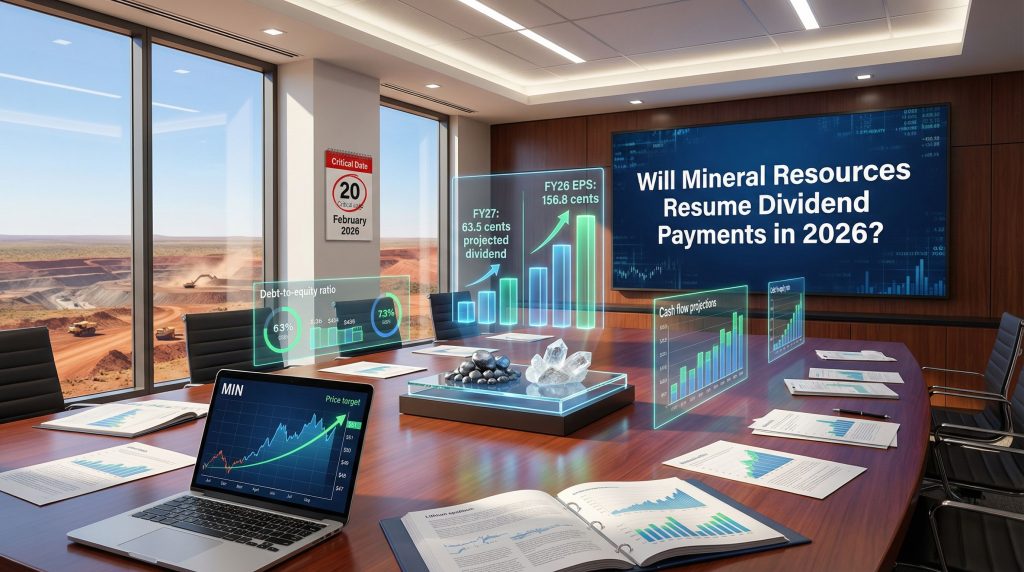
Professional investment research demonstrates high consensus that Mineral Resources dividends 2026 will not materialise, with analysts projecting dividend resumption in FY27. CommSec analyst consensus suggests a 63.5 cents per share payment for FY27, representing approximately 40% of projected earnings under current commodity price assumptions.
Professional Investment Research Consensus
| Forecast Period | Expected Dividend Per Share | Analyst Confidence Level |
|---|---|---|
| FY26 | No dividend expected | High consensus |
| FY27 | 63.5 cents projected | Moderate confidence |
| FY28+ | Growth trajectory anticipated | Variable estimates |
The consensus reflects analyst assessment that balance sheet recovery will require the full FY26 period, with sufficient improvement achieved by mid-FY27 to support dividend resumption. This timeline aligns with management's forward-looking guidance about meeting leverage and liquidity thresholds.
Macquarie's Updated Earnings Projections
Macquarie upgraded Mineral Resources from "underperform" to "neutral" in December 2025, significantly revising earnings forecasts upward. The broker increased FY26 earnings per share projections by 58% to 156.8 cents, while raising FY27 estimates by 15% to 158.6 cents per share.
These substantial upward revisions reflect improved assumptions about iron ore and lithium pricing, with the broker noting that commodity price movements represent the most material risk to earnings forecasts. The upgraded price target increased from $47 to $51, representing a 9% improvement in valuation expectations.
Macquarie's analysis highlighted operational risks associated with the Wodgina lithium project and Onslow iron ore operations, both undergoing ramp-up phases that could impact earnings stability. Capital and operating cost variances at these facilities could materially affect earnings forecasts and dividend resumption timing.
Critical Calendar Dates and Reporting Milestones for 2026
Mineral Resources dividends 2026 prospects will be determined through key reporting events throughout the financial year, with the February half-year results representing the primary decision point for any interim dividend consideration.
Key Financial Disclosure Schedule
| Date | Event | Materiality for Dividend Decision |
|---|---|---|
| 20 February 2026 | 1H FY26 Results Announcement | PRIMARY DECISION POINT |
| 27 August 2026 | Full-Year FY26 Results | FINAL FY26 DIVIDEND DECISION |
| 18 November 2026 | Annual General Meeting | Strategic outlook and governance |
The February 2026 announcement will provide the first comprehensive assessment of whether leverage and liquidity metrics show sufficient improvement to warrant dividend consideration. Market expectations suggest this timeline remains too early for dividend resumption, but stronger-than-expected operational performance could alter board decision-making.
Quarterly Production Reporting Timeline
Mineral Resources provides quarterly production updates that offer insights into operational performance supporting financial recovery:
• Q1 FY26: 29 January 2026
• Q2 FY26: 30 April 2026
• Q3 FY26: 29 July 2026
• Q4 FY26: 23 October 2026
These production reports focus on iron ore volumes, lithium spodumene output from Wodgina, and mining services revenue generation. Consistent operational performance across these metrics supports cash flow stability required for balance sheet improvement.
Commodity Price Dependencies and Operational Risk Factors
Mining companies remain highly exposed to commodity price volatility, with Mineral Resources dividends 2026 prospects directly influenced by iron ore and lithium market dynamics. Current pricing assumptions embedded in analyst forecasts require sustained support from global demand patterns.
Iron Ore Market Dynamics Impact
Iron ore represents the primary revenue driver for Mineral Resources, with spot price movements significantly affecting cash generation capacity. Chinese steel production and infrastructure spending patterns continue influencing global iron ore demand, while supply chain disruptions from Australian operations can impact pricing dynamics.
Currency exchange rates add another layer of complexity, with AUD/USD fluctuations affecting revenue conversion for commodity sales typically denominated in US dollars. A stronger Australian dollar reduces AUD-equivalent revenues, while currency weakness provides natural hedging benefits for export-focused operations.
Pilbara region operations face logistical challenges during cyclone seasons, potentially disrupting production schedules and affecting quarterly cash flow patterns. These operational risks require careful management to maintain consistent earnings generation supporting dividend resumption objectives.
Lithium Market Recovery Prospects
Lithium markets experienced significant volatility through 2024-2025, with spodumene pricing declining from peak levels before showing signs of stabilisation. Electric vehicle demand growth provides long-term fundamental support, but near-term pricing remains sensitive to global supply-demand balance shifts.
The Wodgina project's ramp-up progress directly impacts Mineral Resources' exposure to lithium price recovery. Successful operational scaling at this facility could provide material earnings upside if lithium markets strengthen ahead of analyst expectations.
Global lithium supply additions from various producers may pressure pricing in the short term, while growing battery manufacturing capacity supports medium-term demand growth. This dynamic creates uncertainty around the timing and sustainability of lithium price recovery.
Investment Strategy Implications and Risk Assessment
Income-focused investors face strategic decisions about maintaining positions during dividend suspension periods versus reallocating capital to consistent dividend-paying alternatives. The 49% share price appreciation during 2025 demonstrates that total return opportunities can compensate for absent dividend income.
Dividend Investor Considerations
Portfolio allocation strategies require assessment of whether potential capital appreciation justifies foregoing immediate income generation. However, incorporating capital raising strategies and understanding investment strategy components becomes crucial when evaluating alternative ASX 200 mining dividend opportunities from established producers with more stable dividend policies, though these typically offer lower growth potential.
Tax implications favour capital gains treatment over dividend income for many investors, particularly those in higher marginal tax brackets. The franking credit system provides benefits for dividend income, but capital gains tax concessions may prove more advantageous depending on individual circumstances.
Risk tolerance becomes crucial when evaluating suspended dividend stocks, as commodity price volatility can impact both share prices and dividend resumption timing. Diversified portfolio construction should consider concentration limits for suspended dividend positions.
Broker Rating Analysis and Valuation Metrics
Current analyst sentiment shows mixed opinions across 15 covering analysts, with narrow majority support for accumulating positions. CommSec platform data reveals:
• Strong buy ratings: 5 analysts
• Moderate buy ratings: 2 analysts
• Hold ratings: 4 analysts
• Moderate sell ratings: 1 analyst
• Strong sell ratings: 3 analysts
This distribution indicates moderate optimism about long-term prospects, while acknowledging near-term dividend uncertainty. The 47% buy/strong buy recommendation rate suggests professional investors view current valuations as attractive despite dividend suspension.
Valuation multiples comparison with BHP, Rio Tinto, and Fortescue Metals Group shows Mineral Resources trading at enterprise value to EBITDA ratios reflecting both operational scale differences and financial leverage considerations. Price-to-book value metrics account for asset-heavy mining operations requiring substantial capital investment.
The next major ASX story will hit our subscribers first
Strategic Scenarios for Dividend Resumption Timeline
Multiple pathways exist for dividend resumption, with timing dependent on commodity price performance, operational execution, and balance sheet recovery pace. Scenario analysis helps investors understand potential outcomes and associated probabilities.
Optimistic Recovery Scenario (Early 2026)
Rapid commodity price recovery enabling accelerated debt reduction could prompt earlier dividend consideration than current consensus expectations. Iron ore prices sustaining above $120 per tonne combined with lithium price stabilisation above $1,000 per tonne would materially improve cash generation.
Operational efficiency gains from cost optimisation programs implemented during FY25 could amplify earnings improvement, potentially enabling special dividend consideration if cash generation exceeds targets. Market sentiment improvement driving share price appreciation would provide additional flexibility for capital allocation decisions.
This scenario would require achievement of leverage and liquidity thresholds ahead of schedule, with the board demonstrating confidence in sustained improvement. Probability remains low given current analyst consensus and management's conservative guidance approach.
Conservative Base Case (FY27 Resumption)
Gradual balance sheet improvement through FY26 represents the most likely scenario, with steady commodity price environment supporting consistent cash flow generation. This timeline aligns with analyst consensus expectations for 63.5 cents per share payment in FY27.
Measured capital allocation approach balancing growth investment with shareholder returns would characterise this scenario. Management would demonstrate disciplined financial management while rebuilding market confidence in dividend sustainability.
The FY27 resumption timeline provides sufficient recovery period for achieving target leverage ratios while maintaining operational investment levels. This conservative approach reduces risk of future dividend suspensions during commodity price downturns.
Delayed Recovery Scenario (Post-FY27)
Extended commodity price weakness could necessitate additional balance sheet focus beyond current projections. Iron ore prices below $100 per tonne combined with continued lithium market softness would pressure cash generation capacity.
Unforeseen operational challenges at key facilities or additional capital expenditure requirements could delay balance sheet recovery. Environmental compliance costs or regulatory changes might impact cash flow availability for dividend payments.
Market volatility requiring conservative financial management approach would extend dividend suspension periods. This scenario emphasises the importance of maintaining financial flexibility during uncertain market conditions.
Frequently Asked Questions About MIN Dividend Prospects
Understanding Mineral Resources dividends 2026 requires analysis of multiple variables affecting timing and magnitude of potential payments. Investor questions typically focus on resumption timing, accelerating factors, and comparative policy approaches.
When Will Mineral Resources Pay Its Next Dividend?
Current analyst consensus suggests no dividend payment in FY26, with potential resumption in FY27 at approximately 63.5 cents per share. This timeline depends on meeting new financial thresholds established by the board during 2025.
The February 2026 half-year results announcement will provide the first comprehensive assessment of progress toward dividend resumption criteria. However, high analyst confidence in no FY26 payment indicates market belief that balance sheet recovery requires additional time.
Dividend resumption will be subject to achieving net leverage and liquidity metrics, or demonstrating clear line of sight to meeting these requirements within 12 months. The discretionary policy framework allows up to 50% of underlying NPAT distribution once eligibility criteria are satisfied.
What Factors Could Accelerate Dividend Resumption?
Stronger-than-expected iron ore and lithium prices represent the most significant variables that could accelerate dividend timing. Sustained iron ore pricing above $120 per tonne combined with lithium price recovery would materially improve cash generation capacity.
Rapid debt reduction through operational cash flow generation or asset divestment could enable earlier achievement of leverage ratio targets. Operational efficiency improvements at key facilities might amplify earnings improvement beyond current projections.
Achievement of target leverage ratios ahead of schedule would provide board flexibility to consider interim dividend payments. Market conditions supporting sustained commodity price improvement would increase confidence in dividend sustainability.
How Does MIN's Dividend Policy Compare to Other ASX Miners?
Mineral Resources' discretionary approach contrasts with more predictable policies from BHP and Rio Tinto, reflecting the company's smaller scale and higher operational leverage to commodity cycles. Moreover, detailed dividend analysis shows that larger miners maintain dividend payments during downturns using stronger balance sheet positions and diversified operations.
The new leverage and liquidity threshold requirements represent more conservative capital allocation than many peer companies, emphasising balance sheet strength over consistent distributions. This approach reduces dividend cut risk during future commodity price weakness.
Mid-cap miners typically adopt more volatile dividend policies aligned with earnings cycles, while major miners prioritise dividend stability through commodity price fluctuations. Mineral Resources' framework attempts to balance these approaches through forward-looking threshold assessments.
Looking to Capitalise on Major ASX Mineral Discoveries?
Discovery Alert's proprietary Discovery IQ model delivers instant notifications on significant ASX mineral discoveries, providing subscribers with real-time insights into actionable trading and investment opportunities before the broader market reacts. Visit Discovery Alert's dedicated discoveries page to understand how historic mineral discoveries have generated substantial market returns, then begin your 30-day free trial to position yourself ahead of the next major breakthrough.