May 19, 2026
The Silent Revolution Underneath the Ore: How Mining Is Being Rebuilt From the Data Layer Up
The history of mining is fundamentally a history of extraction becoming progressively harder. Every generation of operators has confronted the same underlying reality: the easiest deposits get worked first, leaving successively more complex, deeper, and lower-grade ore bodies for those who follow. What distinguishes the current era from previous cycles is not the problem itself, but the sophistication of the tools now available to solve it. Mining automation and digitalisation trends are converging to address this structural challenge at a scale and speed the industry has never previously attempted.
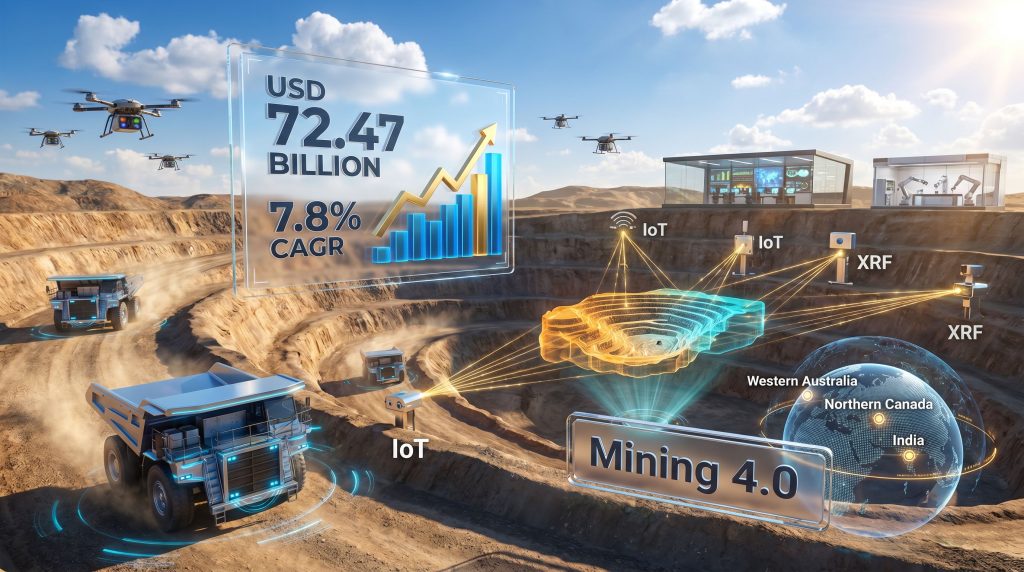
The numbers behind this shift are substantial. The digital mining market is projected to reach USD 72.47 billion in 2026, rising to USD 105.60 billion by 2031 at a 7.8% compound annual growth rate, according to analysis from MarketsandMarkets. A separate estimate from Grand View Research places the market at USD 18.11 billion by 2030, growing at 9.8% annually from 2024. Both point to the same conclusion: digital mining is one of the fastest-growing investment categories within a global mining sector forecast to reach approximately USD 3.35 trillion in 2026.
Understanding why this transformation is accelerating now requires looking at the structural pressures converging on mining operations simultaneously, and why digital infrastructure has become the primary mechanism for responding to all of them at once.
When big ASX news breaks, our subscribers know first
Why the Economics of Mining Are Forcing a Digital Reckoning
Five distinct pressures are pushing mining operators toward comprehensive digitalisation, and critically, they are all intensifying at the same time.
- Declining ore grades are making per-tonne processing economics progressively more challenging, requiring tighter quality control and more precise extraction to maintain margin.
- Labour scarcity in remote and hazardous environments is constraining operational capacity in ways that cannot be solved through traditional workforce expansion.
- ESG compliance obligations now require verifiable, real-time environmental data for regulatory reporting, investor disclosure, and maintaining access to institutional capital.
- Commodity price volatility demands faster operational decision-making, compressing the time between data collection and actionable response.
- Critical mineral demand for copper, cobalt, nickel, and rare earth elements is intensifying pressure to extract more value from complex, lower-grade, and secondary material streams.
No single technology addresses all five pressures in isolation. The strategic insight driving the current wave of investment is that an integrated digital infrastructure — spanning field analysis, laboratory characterisation, online process monitoring, and connected fleet management — can address all of them simultaneously. Furthermore, as articulated by Dr. Uwe König, Global Mining Segment Manager at Malvern Panalytical, end-to-end materials insight is no longer a technological aspiration but the operational foundation for confident, rapid decision-making in an environment where ore grades are declining, ESG expectations are rising, and the margin for error is narrowing.
Mining 4.0: The Distinction Between Digitising and Transforming
A critical conceptual distinction is often blurred in industry discussions about mining automation and digitalisation trends. Digitisation refers to converting analogue processes into digital formats — adding sensors, deploying software, and recording data electronically. Digital transformation refers to something fundamentally different: redesigning entire operational workflows around data, automation, and connected systems.
The mining industry has spent the past decade largely in the first phase. The current shift is into the second. According to PwC survey data, 49% of global mining and metals executives now include automation and digitisation objectives within their long-term corporate strategy, reflecting the extent to which digital capabilities have moved from peripheral enhancement to core strategic priority. Mining automation trends are, consequently, reshaping how operators approach every layer of their business.
The technologies being deployed span a wide maturity spectrum:
| Technology | Primary Application | Maturity Level |
|---|---|---|
| IoT / Sensors | Real-time process monitoring | Mainstream |
| AI / Machine Learning | Predictive maintenance, optimisation | Rapidly scaling |
| Autonomous haulage | Fleet management, remote operations | Established in major regions |
| Digital twins | Simulation and scenario modelling | Emerging mainstream |
| Drones / 3D mapping | Site surveying, volumetric analysis | Widely deployed |
| AR / VR | Operator training, remote maintenance | Growing adoption |
| Blockchain | Supply chain traceability | Early-stage |
| Cloud platforms | Integrated data management | Accelerating |
What Infosys describes as Mining 4.0 encompasses this full spectrum: site surveying drones, autonomous trucks, augmented and virtual reality training platforms, and AI-driven analytics operating in concert rather than in isolation. The value is not in any individual technology but in the connective architecture that allows data to flow between them.
Real-Time Analysis: From Competitive Advantage to Operational Baseline
The Technologies Enabling Continuous Measurement
One of the most consequential shifts in current mining automation and digitalisation trends is the transition of real-time analytical monitoring from premium capability to standard operational expectation. Advances in sensor technology, automation, and data integration have made continuous measurement significantly more reliable and cost-effective, accelerating adoption across the processing value chain. Data-driven mining operations are, in addition, setting a new benchmark for what operators consider baseline performance.
The primary technologies enabling this shift include:
- Prompt-gamma neutron activation analysis (PGTNA): Enables bulk elemental analysis of moving ore streams without contact, providing continuous compositional data in near-real-time.
- Online XRF (X-ray fluorescence): Delivers continuous monitoring of elemental composition at process control points, enabling dynamic adjustment of processing parameters.
- Laser diffraction: Provides continuous particle size measurement critical for controlling grinding circuits and optimising reagent dosing in flotation operations.
Deployment of these technologies now spans ore sorting and blending, beneficiation control, hydrometallurgical processing, and tailings monitoring. In India, real-time analysis has become a regulatory requirement for certain mining operations, establishing a precedent that observers expect other jurisdictions to follow as governments seek greater operational transparency and environmental accountability.
Portable Instrumentation: Closing the Gap Between Observation and Action
The value of real-time analytical capability extends beyond fixed process points to the field itself. Rapid feed composition changes, particularly common in mixed or recycled material streams, require on-the-spot analytical capability to inform processing strategy adjustments before material enters the circuit.
Portable instruments gaining traction include:
- Handheld XRF: Widely deployed for rapid elemental identification across a broad range of mining applications.
- LIBS (Laser-Induced Breakdown Spectroscopy): Extends elemental detection range beyond the capability of XRF, particularly useful for light elements.
- Infrared spectroscopy: Enables mineral identification in remote or highly variable environments, complementing elemental analysis with mineralogical characterisation.
The strategic value of portable instrumentation lies in compressing the feedback loop between field observation and operational response — a factor that is becoming directly tied to profitability as processing margins tighten.
Geometallurgy: The Discipline Redefining What Ore Grade Actually Means
Beyond Chemistry: Why Mineralogy Now Drives Processing Strategy
Traditional ore analysis has focused primarily on elemental composition expressed as a percentage grade. Geometallurgy challenges this framework by establishing that how minerals behave through the processing circuit is as strategically important as what elements they contain.
Two ore samples with identical copper grades can respond entirely differently to crushing, flotation, or leaching depending on the mineralogical structure of the host material. If the copper occurs as chalcopyrite versus chalcocite, if gangue minerals are reactive or inert, if particle liberation requires different grind sizes, the processing outcomes diverge significantly despite identical assay results. Geometallurgy integrates this mineralogical complexity into processing strategy from the earliest stages of mine planning.
Treating mineralogy as equally critical to chemistry in process strategy is not simply a technical refinement. It represents a fundamental reconceptualisation of how ore value is assessed and extracted.
Tailings Reprocessing: The Secondary Resource Opportunity
Rising commodity prices have transformed the economics of tailings deposits, making previously uneconomic material viable as processing feed. This shift is particularly relevant for critical minerals where demand growth is outpacing primary supply development.
Tailings present unique analytical and processing challenges that make geometallurgical approaches especially valuable:
- High heterogeneity in particle size and mineral distribution, reflecting the mixed source material and variable processing history of accumulated waste streams.
- Complex and variable mineralogy, often including partially liberated particles and secondary mineral phases formed through long-term weathering and oxidation.
- Unpredictable processing behaviour that cannot be reliably inferred from periodic batch testing alone.
| Dimension | Conventional Approach | Geometallurgical Approach |
|---|---|---|
| Primary analysis focus | Elemental grade (%) | Mineralogy + elemental grade |
| Processing prediction | Grade-based estimation | Behaviour-based modelling |
| Sampling frequency | Periodic batch testing | Continuous / high-frequency |
| Tailings strategy | Waste disposal | Potential secondary feed |
| Decision speed | Shift or daily reporting | Real-time or near-real-time |
Frequent, representative measurement is now considered essential to understanding tailings feed quality and predicting recovery rates, driving adoption of continuous analytical systems specifically configured for the heterogeneous characteristics of reprocessed material streams.
Workforce Transformation: Automation Redistributes Skills, It Does Not Simply Eliminate Them
The New Competency Architecture
A persistent misconception about mining automation frames it primarily as a job elimination force. The operational reality is more nuanced. Automation is redistributing skill requirements across the operational hierarchy, creating growing demand for new competencies while reducing the need for others.
Skills in growing demand across automated mining operations include:
- Digital workflow management across multi-system environments.
- Remote systems operation and real-time monitoring from centralised control centres.
- Data interpretation and analytical literacy capable of translating sensor output into operational decisions.
- Flexible deployment across multi-site operations from single locations.
Automation is already well established across remote operations in Western Australia and Northern Canada and is expanding into newer frontiers including Arctic environments. The on-site expertise model is giving way to remote support structures, fundamentally altering the human geography of mining operations. For instance, advances in AI in drilling and blasting are among the clearest examples of how digital tools are reshaping traditionally manual roles.
Sample Preparation: The Underappreciated Entry Point
Automated sample preparation is frequently overlooked in discussions of mining automation despite representing one of the highest-return entry points available to operators. Even the most sophisticated analytical systems produce results only as reliable as the samples they process.
Many operations are prioritising automation at this stage precisely because it delivers measurable improvements in analytical data quality and laboratory throughput without requiring full-scale operational redesign. This sequencing approach allows mining companies to build confidence in automated systems and demonstrate internal ROI before committing to broader transformation initiatives.
Automated sample preparation is frequently the highest-ROI entry point for mining automation, delivering immediate improvements in data quality and laboratory throughput without requiring full-scale operational redesign.
The next major ASX story will hit our subscribers first
ESG as an Operational Architecture: Beyond Reporting Into Mine Design
The relationship between ESG and mining operations has undergone a fundamental structural shift. What began as a reporting and investor relations obligation has become embedded in how mines are designed, managed, and optimised from inception.
Key operational ESG priorities as of 2026 include:
- Water management in arid and water-stressed mining regions, where tightening availability and regulatory oversight are making water efficiency a core engineering constraint.
- Decarbonisation through emissions reduction programmes and energy efficiency improvements across extraction and processing.
- Renewable and on-site energy integration to reduce diesel dependency in remote operations. Renewable energy in mining is, furthermore, increasingly embedded in project design from the earliest development stages.
- Community and indigenous engagement embedded into project planning from the earliest development stages.
MarketsandMarkets identifies strict ESG regulations as one of the primary demand drivers for digital mining technology adoption. Operators that cannot produce verifiable, real-time environmental performance data face growing difficulty accessing institutional capital, satisfying regulatory requirements, and securing offtake agreements with downstream partners who carry their own ESG commitments.
Deep-Sea Mining: Where Digital Infrastructure Is Not Optional From Day One
The Frontier With No Analogue Precedent
Deep-sea mining operations targeting manganese, nickel, cobalt, and rare earth elements represent a domain where the conventional mining development model simply does not apply. Early-stage activity is advancing across Southeast Asia and Latin America, however the operational conditions of extreme remoteness, crushing depths, and complete absence of surface infrastructure create a context where automation and digital connectivity are not enhancements to traditional methods but the only viable operational framework. The deep-sea mining controversy surrounding these projects further intensifies scrutiny on data quality and transparency.
From initial development, deep-sea operations must rely on:
- Full automation of extraction and sampling systems with no meaningful capacity for manual intervention.
- Remote real-time data transmission capable of supporting decision-making from facilities thousands of kilometres from the extraction point.
- High-quality, defensible analytical datasets that satisfy environmental regulators scrutinising projects with exceptional intensity given the fragility and scientific significance of deep-sea ecosystems.
The Regulatory Data Imperative
The intensity of environmental scrutiny surrounding deep-sea mining means that analytical data quality is not merely operationally useful; it is the primary determinant of whether projects receive approval to proceed. This makes deep-sea mining perhaps the clearest current example of where digital infrastructure functions as a project viability prerequisite rather than a performance optimisation tool.
Cybersecurity and Implementation Barriers: The Other Side of the Digital Equation
An Expanding Attack Surface
The connectivity that makes digital mining valuable simultaneously creates new categories of operational risk. As mines integrate more systems, migrate data to cloud platforms, and expand remote operations, the cybersecurity exposure increases substantially. According to industry analysis on digital mining trends, this expanding attack surface is among the most pressing concerns facing operators in 2025 and beyond.
PwC explicitly identifies building digital trust as a core challenge, noting that digitisation creates complex cybersecurity vulnerabilities across connected mine infrastructure. Key risk areas include:
- Convergence of operational technology (OT) and information technology (IT) networks, which were historically air-gapped for security.
- Remote access points for autonomous equipment, which present exploitation opportunities if not properly secured.
- Cloud data integrity and access controls governing increasingly centralised operational data.
Barriers Slowing Comprehensive Adoption
Beyond cybersecurity, several structural barriers continue to constrain the pace of digital transformation across the broader mining sector:
- Capital intensity of full-scale transformation, particularly for mid-tier and junior operators without the balance sheet flexibility of major producers.
- Skills gaps in data science, automation engineering, and digital systems management that cannot be resolved quickly through conventional workforce development pipelines.
- Legacy infrastructure incompatibility with modern integrated platforms, requiring costly middleware solutions and extended transition periods.
- Data governance challenges across multi-jurisdiction and multi-asset operations where data ownership, format standardisation, and access rights remain unresolved.
- Organisational culture resistance within established operational environments where data-driven decision-making represents a significant departure from embedded practices.
Regional Adoption Patterns: Where Mining Digitalisation Is Moving Fastest
| Region | Key Digitalisation Activity |
|---|---|
| Australia | Autonomous haulage, lithium and critical mineral digitalisation, remote operations centres |
| India | Regulatory mandate for real-time analysis; predictive maintenance and drone-based monitoring |
| Indonesia | Digital ore control systems, fleet analytics platforms |
| China | Large-scale process automation across major mineral districts |
| Mongolia | Remote monitoring in coal operations |
| Canada (Arctic) | Autonomous operations expansion into extreme-environment mining |
| Southeast Asia / Latin America | Early-stage deep-sea mining with automation dependency from inception |
The geographic distribution of adoption reveals a clear pattern: regions combining large-scale operations, strong capital availability, and either regulatory pressure or labour scarcity tend to lead adoption. The emergence of regulatory mandates in India and growing Arctic expansion in Canada signal that adoption is broadening beyond the early-mover jurisdictions into a wider global transformation. For additional perspective on how this is unfolding operationally, automation and digitalisation insights from sector specialists provide a useful lens on regional implementation challenges.
The Competitive Divide Is Already Opening
The mining operations that will define the industry through 2027 and beyond share a common characteristic: they are not treating digital transformation as a future aspiration but as a current operational imperative. End-to-end data infrastructure — spanning portable field analysis through rapid laboratory characterisation, online process monitoring, and cloud-connected fleet management — is becoming the foundational architecture separating competitive operations from those facing structural disadvantage.
The divergence between digitally mature operators and those still working within siloed, manual workflows is accelerating. For companies navigating this transition, the strategic question is no longer whether to invest in mining automation and digitalisation trends but at what pace, in what sequence, and with what governance frameworks to ensure the investment delivers durable operational value rather than isolated technological novelty.
Disclaimer: Market size projections and growth forecasts referenced in this article are sourced from third-party research organisations. These figures represent analytical estimates subject to revision and should not be interpreted as financial advice or investment guidance. Readers should conduct independent research before making any investment decisions.
For further industry analysis and ongoing coverage of automation, regulation, and sustainability trends shaping mining operations through 2027, visit globalminingreview.com.
Want to Know Which ASX Mining Companies Are Leading the Digital Revolution?
Discovery Alert's proprietary Discovery IQ model scans ASX announcements in real time, instantly identifying significant mineral discoveries and transforming complex data into actionable investment insights — precisely the kind of edge that matters as the gap between digitally advanced operators and the rest continues to widen. Explore Discovery Alert's discoveries page to see how historic finds have generated substantial returns, and begin a 14-day free trial to position yourself ahead of the market.