June 20, 2026
The Systemic Crisis Hiding in Plain Sight Across Mining's Capital Projects
Across extractive industries, a pattern has quietly solidified into one of the most expensive recurring failures in global infrastructure investment. It is not geological bad luck, geopolitical disruption, or commodity price collapse that most reliably destroys value in mining capital programs. It is something far more preventable: the consistent inability of the industry to deliver what it promises, when it promises it, and at the cost it commits to. This failure is not a series of isolated incidents. It is a structural condition, embedded in how projects are conceived, defined, governed, and executed across the sector.
Understanding why mining capital delivery and predictability have deteriorated so significantly, and what it would take to rebuild both, requires looking beyond individual project post-mortems and examining the systemic forces that convert sound investment cases into budget overruns, schedule compressions, and eroded stakeholder confidence.
When big ASX news breaks, our subscribers know first
The Numbers That Define a Sector-Wide Problem
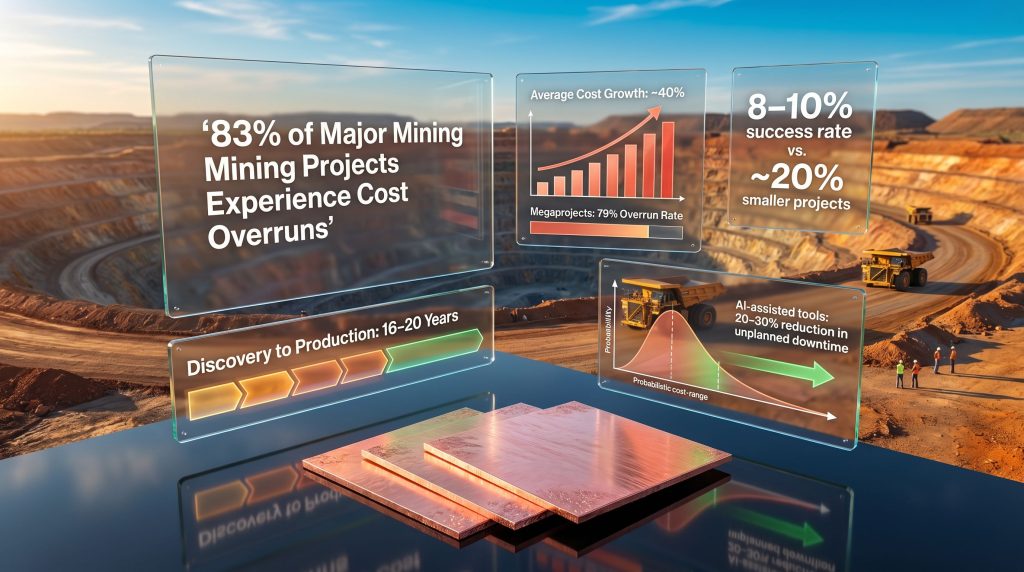
The statistical reality of mining's capital delivery performance is stark. According to McKinsey analysis of global mining and metals projects, more than 80% of major mining projects experience material cost or schedule overruns, with average cost growth sitting at approximately 40%. These are not outlier results from unusually complex or poorly managed ventures. They represent the central tendency of an industry executing capital work.
The data becomes more concentrated as project scale increases:
| Project Category | Budget Overrun Rate | Avg. Cost Growth | Schedule Delay Rate |
|---|---|---|---|
| All major mining projects | ~83% | ~40% | 20–30% |
| Megaprojects (>$1B capex) | ~79% | ~39% | ~52% |
| Sub-$1B projects avoiding overruns | ~20% success rate | — | — |
| Megaprojects avoiding overruns | 8–10% success rate | — | — |
The implications of that final row deserve particular attention. For the largest, most consequential, and most strategically critical projects the sector undertakes, only 8 to 10 in every 100 are completed without significant cost or schedule variance. That is not a risk profile that attracts patient, long-term capital.
EY's 2025 Top 10 Risks and Opportunities report for mining and metals companies ranked capital deployment as the number one risk confronting the sector, reflecting a marked shift in how institutional investors are scrutinising the industry's ability to convert committed capital into productive assets. Annual capex inflation running at 10 to 15% per year compounds this exposure, adding an estimated $10 to $15 billion in incremental costs across the sector annually.
Commodity and Scale Divergence
Not all commodities experience the same degree of delivery failure. Copper projects are disproportionately affected, with approximately 33% facing delays exceeding 30%, compared to just 13% for iron ore projects. This divergence likely reflects differences in processing complexity, ore body variability, and the geographic concentration of large copper development in jurisdictions with longer permitting timelines.
Critically, analysis shows that open-pit versus underground project type has minimal statistical bearing on overrun probability. This finding directly challenges the instinct to attribute delivery failure to geological or technical difficulty. If underground projects and open-pit projects fail at similar rates, the root cause is organisational and process-driven, not buried in the rock.
Why Front-End Definition Is Where Projects Are Won or Lost
The most widely overlooked driver of downstream execution failure is not what happens during construction. It is what does not happen during studies. Projects routinely reach Final Investment Decision carrying unresolved gaps in:
- Ore body characterisation and geological confidence thresholds
- Processing and infrastructure scope maturity
- Operating model selection and technology integration assumptions
- ESG, community engagement, and permitting pathway mapping
- Execution strategy and contracting model commitment
When risks are acknowledged in a study report but not actively priced, mitigated, or used to reshape project scope before capital is committed, they do not disappear. They migrate into execution, where resolving them costs orders of magnitude more than addressing them in the study phase.
Industry conversations consistently highlight under-resourced concept stages, inadequate early geological understanding, poor integration across technical, ESG, and community inputs, and a lack of clarity around what constitutes sufficient information to make and hold decisions through to completion. These gaps at the front end flow directly into rework, cost volatility, and schedule compression during execution. Conducting thorough drilling programs at the earliest possible stage is one of the most effective ways to reduce this uncertainty before it becomes embedded in project scope.
"The front-end loading (FEL) phase is where the majority of project value is either created or destroyed. Underinvestment in early-stage studies is the single largest driver of downstream execution volatility."
Effective front-end definition works differently. It brings geology, mine planning, processing, materials handling, infrastructure, ESG, and execution considerations into a unified, simultaneous analytical process. The objective is to surface uncertainties, test assumptions, and distinguish between risks that are acceptable, risks that can be mitigated, and risks that should fundamentally reshape project scope. The study phases are where optionality belongs. Once Final Investment Decision is reached, the plan should be ready for execution, with focus shifting entirely to delivering the plan rather than continuing to refine it.
The Organisational Siloes Creating Handoff Failures
Mining organisations still largely operate through sequential rather than integrated workflows. Geology completes its work before mine planning begins. Mine planning passes scope to processing engineers. Processing hands off to infrastructure. Environmental and community functions are engaged after technical scope is largely fixed. Each transition creates handoff risk, information loss, and assumption gaps.
This sequential model is compounded by how organisations manage lessons from prior projects. Experience from past successes and failures is rarely institutionalised in ways that prevent the same risk exposures from recurring in successive projects. The consequence is a sector that relearns expensive lessons repeatedly rather than building compounding institutional knowledge.
Permitting Treated as an Afterthought
Regulatory approval pathways compound timeline risk when treated as a late-stage project activity. Furthermore, considerations around grade and permitting must be mapped as critical path workstreams from concept stage, rather than being sequenced after technical scope is defined. The current industry norm of 16 to 20 years from discovery to first production partly reflects this misalignment. Greenfield projects now require an estimated 30 to 50% more capital than historical benchmarks, reflecting the combined effect of deeper ore bodies, tighter environmental standards, and more extensive community engagement requirements.
How Supply Chain Fragility Amplifies Execution Risk
The COVID-19 period delivered a concrete demonstration of a risk that had been building for years. Lean, just-in-time supply chain models applied to capital-intensive mining projects proved severely fragile when global logistics networks were disrupted. Vendor concentration in critical long-lead equipment categories, including processing plant components, electrical systems, and haulage fleets, creates single-point-of-failure exposure that project risk registers frequently underweight.
Supply chain disruption has transitioned from an episodic to a persistent risk factor. Projects that do not secure contractual lead time commitments from equipment suppliers at FID, maintain dual-sourcing strategies for critical components, or deploy digital supply chain visibility tools are systematically exposed to delays that emerge well after the construction critical path is established.
The Energy Transition Raises the Stakes on Every Overrun
The consequences of poor mining capital delivery have historically been contained within project economics and investor returns. The acceleration of global critical minerals demand changes that calculus fundamentally. Lithium, copper, cobalt, nickel, and rare earth elements underpin:
- Electric vehicle manufacturing at scale
- Grid-scale battery storage deployment
- Digital infrastructure expansion
- Advanced manufacturing and defence applications
The projects most critical to supplying these materials are, by definition, the largest and most complex. They are also, statistically, the projects most likely to overrun. A sector with an 8 to 10% success rate in delivering megaprojects without material variance is poorly positioned to supply the pace and scale of mineral production the energy transition requires.
Repeated overruns erode institutional investor confidence, increase required risk premiums, and delay project sanctioning. These downstream consequences of poor delivery track records create a compounding effect: reduced capital access makes adequate front-end investment harder to justify, which reduces delivery quality, which further erodes confidence. Breaking this cycle requires demonstrating consistent, disciplined capital execution.
Technology's Underutilised Potential in Capital Efficiency
Advanced technologies are widely available across the mining project lifecycle. Autonomous trucks in mining, digital twin platforms, remote operations centres, and AI-assisted scheduling tools have all demonstrated performance advantages in operational settings. Yet, however, they are systematically underutilised in capital project design.
The structural reason is consistent: early-stage studies default to conservative, human-operated baseline assumptions. Automation and remote operations are treated as optional enhancements to be layered onto a traditionally designed project, rather than foundational design parameters that reshape what the project requires to be built.
The autonomous haulage example illustrates this precisely:
| Design Parameter | Human-Operated Standard | Autonomous Potential | Typical Project Approach |
|---|---|---|---|
| Haul road width | Wide (human error tolerance) | Narrower, consistent | Designed to human standard |
| Traffic management | Complex intersection rules | Simplified routing | Legacy rules retained |
| Earthworks scope | High volume | Materially reduced | Full scope maintained |
| Infrastructure cost | Baseline | Potentially 10–20% lower | Savings not captured |
Autonomous haulage systems can operate with far tighter and more consistent tolerances than human-operated fleets. In theory, this enables narrower haul roads, simplified intersections, and materially reduced earthworks and infrastructure scope. In practice, many projects continue designing to human driving tolerances as a contingency. The result is that projects carry both the legacy and future operating cases in parallel, with the conservative case anchoring design decisions and preventing minimum viable project pathways from being defined and committed to.
"Warning: Projects that default to traditional design assumptions while planning to incorporate automation post-commissioning systematically fail to capture the capital efficiency gains that autonomous operations make possible. Technology only delivers its efficiency potential when treated as a baseline design assumption from the earliest study phases."
Digital twin technology and simulation-driven design tools address a different dimension of the problem. They enable rigorous scenario testing of layout configurations, logistics assumptions, and infrastructure trade-offs before physical commitments are made. AI-assisted tools in operational contexts have demonstrated potential for:
- 20 to 30% reduction in unplanned equipment downtime
- 15 to 25% improvement in fleet utilisation efficiency
- 30 to 40% reduction in exploration risk through predictive geological modelling
These performance improvements translate into capital efficiency gains only when the underlying operating model is defined early enough to shape infrastructure and layout design.
The next major ASX story will hit our subscribers first
Contracting Models That Create Predictability Rather Than Conflict
Traditional transactional contracting structures create incentive misalignment that is structurally incompatible with predictable capital delivery. When contractors bear concentrated risk on fixed-price terms without sufficient project definition to quantify that risk accurately, contingency inflation, adversarial claims, and scope disputes become the dominant contracting dynamic.
Shared-risk contracting structures change this dynamic by aligning all participants around common delivery outcomes:
- Pain/gain share mechanisms tied to measurable project performance metrics
- Early contractor involvement (ECI) in front-end study phases, before scope is fixed
- Integrated project delivery (IPD) frameworks that eliminate handoff failures between owner, engineer, and contractor teams
- EPC partnering models with performance-linked milestone incentives and upfront collaboration commitments
Minimum Viable Project frameworks complement these contracting structures by phasing capital deployment to follow revenue generation where possible, designing infrastructure for expandability rather than full-scale from day one, and staging capital commitments to reduce exposure to early-phase uncertainty. The combination of collaborative contracting and phased capital deployment can materially reduce the risk exposure carried through FID.
A Practical Framework for Rebuilding Capital Predictability
The tools required to restore mining capital delivery and predictability already exist. What the industry requires is the discipline to apply them consistently, and the organisational trust to commit to decisions once made. The following step-by-step framework reflects the integrated approach that consistently distinguishes high-performing capital programs:
- Invest in geological confidence before advancing studies – Define minimum ore body knowledge thresholds required at each study stage and enforce them as gatekeeping criteria
- Integrate all disciplines at concept stage – Bring geology, processing, infrastructure, ESG, and execution planning into a single front-end team from project inception
- Select and commit to the operating model before FID – Treat automation and technology as baseline design assumptions, not optional additions to be confirmed later
- Define stage-gate information requirements in advance – Establish what sufficient information means at each decision point before the gate process begins, and hold decisions once made
- Implement risk-based estimating – Replace deterministic point-estimate budgets with probabilistic cost ranges that accurately reflect project uncertainty
- Activate the project ecosystem during study phases – Engage contractors, OEM suppliers, logistics providers, and community stakeholders before FID, not after
- Deploy leading indicator dashboards – Monitor contingency drawdown rates, procurement lead time status, productivity benchmarks, and stakeholder milestone metrics rather than relying solely on cost and schedule variance reporting
- Institutionalise lessons learned systematically – Create formal mechanisms to capture, store, and apply experience from prior projects across successive programs within the organisation
In addition, definitive feasibility studies play a critical role at step four, providing the rigorous analytical foundation that separates disciplined decision-making from premature capital commitment.
Frequently Asked Questions: Mining Capital Delivery and Predictability
What percentage of mining projects experience cost overruns?
McKinsey analysis of global mining and metals projects indicates that more than 80% of major mining projects experience material cost or schedule overruns, with average cost growth of approximately 40%. For megaprojects exceeding $1 billion in capital expenditure, the overrun rate is approximately 79%, with schedule delays affecting more than half of all projects in this category.
Why do large mining projects overrun more frequently than smaller ones?
Projects exceeding $1 billion in capital expenditure have only an 8 to 10% success rate in avoiding overruns, compared to approximately 20% for smaller projects. Scale amplifies pre-existing weaknesses in front-end definition, supply chain management, and organisational integration across longer project timelines, compounding risk exposure at every stage.
What is front-end loading and why does it matter?
Front-end loading refers to the investment of time, analytical rigour, and cross-disciplinary resources in pre-FID study phases. High-quality front-end loading resolves geological, technical, environmental, and commercial questions before capital is committed, reducing execution uncertainty. Projects with strong front-end loading consistently demonstrate lower cost growth and schedule variance than those that proceed to FID with unresolved scope gaps.
How does autonomous technology improve mining capital efficiency?
Autonomous systems, particularly haulage fleets, operate with tighter, more consistent tolerances than human-operated equipment. This theoretically enables narrower road designs, simplified traffic management, and reduced earthworks scope. However, capital efficiency gains are only captured when autonomous operations are treated as a baseline design assumption from the earliest study phases, rather than incorporated as a late-stage enhancement after infrastructure is already designed to human-operated standards.
What contracting model best supports capital delivery predictability?
Shared-risk contracting structures, including pain/gain mechanisms, early contractor involvement, and integrated project delivery frameworks, consistently outperform traditional transactional models by aligning incentives across all project participants. EPC partnering with upfront collaboration and performance-linked milestones provides an additional layer of delivery predictability when combined with well-defined project scope at FID.
How long does it take to develop a new mine from discovery to production?
Current industry benchmarks indicate that new mine development typically requires 16 to 20 years from initial discovery to first production. Sequential rather than integrated decision-making, under-resourced front-end studies, and permitting and regulatory requirements treated as late-stage activities are primary contributors to this extended development cycle. Consequently, interpreting drill results accurately from the outset is one practical step towards compressing that timeline by enabling better-informed decisions at every subsequent stage.
What the Industry Must Do Differently
- More than 80% of major projects overrun – this is a systemic failure requiring systemic solutions, not project-by-project corrections
- The front-end phase is where capital predictability is established or forfeited – underinvestment here is the sector's most consistently expensive recurring mistake
- Technology delivers its full efficiency potential only when embedded as a foundational design assumption, not retrofitted as an operational enhancement
- Collaborative contracting, integrated delivery models, and early ecosystem engagement are proven mechanisms for reducing execution volatility
- The energy transition creates genuine urgency – the sector's ability to attract capital at scale and pace depends on demonstrating consistent, disciplined delivery
- Outcomes ultimately depend on all stakeholders – owners, engineers, contractors, operators, technology providers, and capital providers – committing to the right delivery model and trusting the plan through execution
Furthermore, EY's insights on capital productivity offer a complementary perspective on how better project management practices can directly strengthen the sector's long-term investment case. Readers seeking additional perspectives on mining project delivery performance and capital efficiency frameworks may find value in exploring related industry analysis published by Global Mining Review. Visit globalminingreview.com for further reading on this topic.
Want to Capitalise on the Next Major Mineral Discovery Before the Market Catches On?
While mining capital projects continue to struggle with delivery and predictability, the real opportunity often lies at the very beginning — the moment a significant discovery is announced. Discovery Alert's proprietary Discovery IQ model instantly scans ASX announcements across more than 30 commodities, delivering real-time alerts that turn complex mineral data into actionable insights for both short-term traders and long-term investors — explore historic discovery returns on the Discovery Alert discoveries page and begin your 14-day free trial to position yourself ahead of the market.