
June 20, 2026
When the Ground Shifts: Understanding Capital Escalation in Greenfield Potash Mining
Across the global mining industry, there is a well-documented but underappreciated phenomenon: the gap between a project's pre-feasibility cost estimate and its final development price tag. In commodity sectors defined by deep underground infrastructure, complex processing requirements, and decade-long build timelines, that gap is rarely small. Potash mining — with its unique shaft-sinking engineering demands, evaporite geology, and brine management systems — sits at the extreme end of capital unpredictability. Understanding this structural reality is the essential starting point for interpreting the BHP Jansen potash project write-down that sent shockwaves through equity markets in June 2026.
When big ASX news breaks, our subscribers know first
The Anatomy of a US$2.3 Billion Impairment
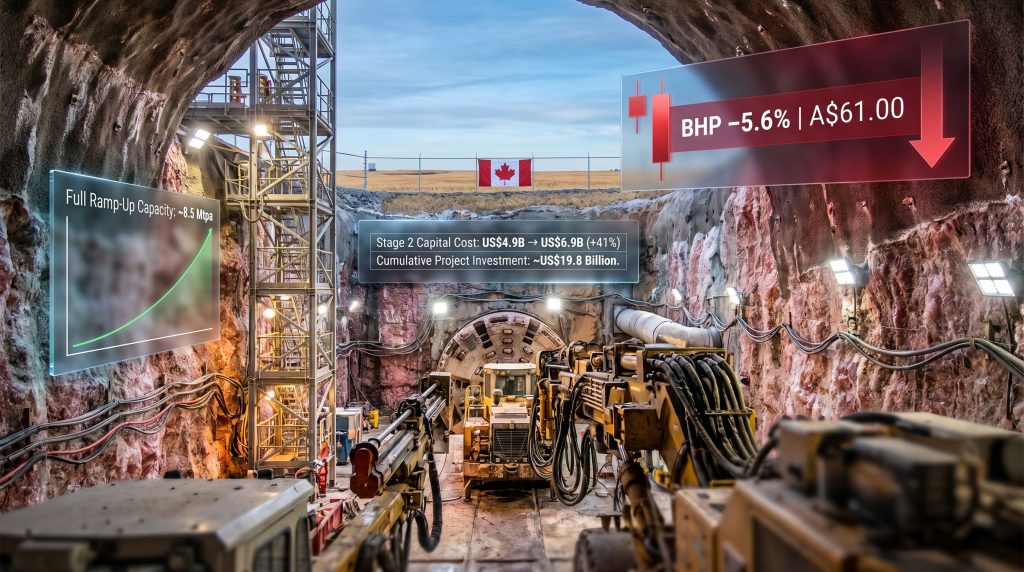
The accounting recognition of a US$2.3 billion impairment is rarely just an accounting event. At its core, it signals that the economic value of a project, as projected under current market conditions and revised cost assumptions, has fallen below the carrying value previously recorded on the balance sheet. For the BHP Jansen potash project write-down, this gap emerged from a material upward revision to Stage 2 capital expenditure, which moved from an earlier estimate of US$4.9 billion to a revised figure of US$6.9 billion — an increase of US$2 billion, or approximately 41%.
What makes this revision particularly significant is its context. This was not an isolated estimate blowout attributable to a single unforeseen event. According to Jefferies analysts, the revision represents the third upward cost adjustment to Jansen's development budget in less than twelve months, a pattern that points toward systemic challenges in project estimation rather than discrete construction surprises.
The cumulative committed investment across both stages of the Jansen project now stands at approximately US$19.8 billion, making it one of the largest single-project capital commitments in BHP's corporate history. Furthermore, a definitive feasibility study conducted early in a project's life often struggles to anticipate the full spectrum of cost pressures that emerge during construction at this scale.
Cost Drivers: What Is Pushing Jansen's Price Higher?
Several structural forces are combining to inflate Jansen's capital profile:
- Construction inflation — the post-pandemic surge in materials and equipment costs has not fully reversed across major mining jurisdictions, with Saskatchewan's remote infrastructure environment amplifying procurement challenges
- Labour market tightness — skilled underground mining workers, shaft sinkers, and specialist construction crews remain in short supply across North America, driving wage escalation and subcontractor cost increases
- Logistical complexity — transporting heavy mining equipment and construction materials to interior Saskatchewan adds both cost and timeline risk that pre-feasibility models frequently underestimate
- Deep shaft engineering demands — the Jansen orebody sits at depths exceeding 1,000 metres, requiring precision shaft-sinking techniques that are among the most technically demanding and cost-variable processes in the mining industry
With approximately 84% of Stage 2 construction work still outstanding at the time of the revision, the financial exposure ahead remains substantially front-loaded. Even modest additional overruns on remaining work — say, a further 10 to 15 percent on the residual construction program — could push total Stage 2 costs toward or beyond US$7.5 billion, a scenario that would intensify pressure on project-level internal rate of return calculations.
| Metric | Previous Estimate | Revised Estimate | Change |
|---|---|---|---|
| Stage 2 Capital Cost | US$4.9 billion | US$6.9 billion | +US$2 billion (+41%) |
| Stage 2 First Production | Earlier target | Late 2031 | Delayed |
| Cumulative Project Investment | ~US$17.8 billion | ~US$19.8 billion | +US$2 billion |
| Stage 1 First Production Target | On track | Mid-2027 | Unchanged |
| Full Ramp-Up Capacity | ~8.5 Mtpa | ~8.5 Mtpa | Unchanged |
The Geology Behind the Capital Intensity: Why Jansen Is Structurally Expensive
To understand why the BHP Jansen potash project write-down has unfolded the way it has, it helps to appreciate what makes Saskatchewan potash mining fundamentally different from other large-scale mineral developments.
The Jansen deposit sits within the Williston Basin, one of the world's premier potash-bearing geological formations. The mineralisation consists primarily of sylvinite — a mixture of sylvite (potassium chloride) and halite (sodium chloride) — hosted within Devonian-age evaporite sequences. While the ore grade and lateral continuity of Saskatchewan potash deposits are genuinely world-class, the depth at which the mineralisation occurs creates engineering complexity that surface or shallow-pit mining operations simply do not face.
Potash mines in Saskatchewan typically operate at depths between 900 and 1,100 metres, requiring concrete-lined circular shafts sunk through water-bearing formations before reaching the ore horizon. The shaft-sinking process alone can take several years and represents one of the most capital-intensive and schedule-sensitive phases of the entire development program. Any ground condition surprises, water inflow events, or equipment delays during shaft construction have an outsized impact on total project costs.
Beyond sinking, potash processing requires dedicated mill infrastructure to crush and separate the sylvite from the host rock matrix through a combination of flotation and crystallisation circuits — a further capital-intensive layer that distinguishes potash from simpler bulk commodity extraction. In addition, the cut-off grade economics of deep evaporite deposits demand robust ore sorting and processing efficiency to remain viable at prevailing market prices.
This geological and engineering complexity is not unique to Jansen. It is a sector-wide characteristic that has historically caused pre-feasibility cost estimates for greenfield potash mines to understate final development costs by meaningful margins. Investors evaluating any new potash development should treat early-stage capital estimates with significant scepticism.
Stage 1 vs. Stage 2: Two Very Different Risk Profiles
One of the more nuanced dimensions of the current situation is that not all of Jansen is under pressure simultaneously. Stage 1 construction remains on schedule, with first production targeted for mid-2027, providing BHP with a near-term operational anchor for its potash investment thesis. According to BHP's Jansen project page, the mine is designed to become one of the world's largest potash operations upon full completion.
However, Stage 1's progress does not automatically de-risk Stage 2. The two phases have distinct cost bases, construction timelines, and forward economic assumptions. The incremental return on capital for Stage 2 must be evaluated independently — and at a revised cost base of US$6.9 billion, with potash market conditions currently subdued, that calculation becomes considerably more challenging.
The critical distinction here is between sunk cost logic and forward-looking capital allocation discipline. The approximately US$19.8 billion committed to date is irreversible. What remains fully within BHP's control is whether the incremental capital required to complete Stage 2 generates returns that exceed the company's hurdle rate. That is the question investors and analysts are now pressing.
Scenario Analysis: Three Futures for Jansen Stage 2
Given the uncertainty surrounding both project costs and potash market conditions, it is instructive to model three plausible forward scenarios:
Scenario A — Bull Case: Potash Price Recovery
- Potash prices recover toward US$400 to US$450 per tonne by 2030, driven by constrained Eurasian supply and accelerating agricultural demand from emerging markets
- Jansen's full combined capacity of approximately 8.5 million tonnes per annum positions BHP among the top five global potash producers
- At elevated price levels, returns on the revised Stage 2 cost base become defensible across a 20 to 30 year operational mine life
- This scenario assumes no further material cost escalation on the remaining 84% of Stage 2 construction
Scenario B — Base Case: Prolonged Price Softness
- Potash prices remain range-bound through the late 2020s, consistent with the current outlook described by Jefferies as weak for the foreseeable future
- Jansen's economics remain marginal at the revised cost base, with project IRR under sustained pressure
- BHP maintains the project but faces ongoing investor scrutiny around capital allocation priorities, particularly given competing copper growth opportunities
Scenario C — Bear Case: Further Cost Escalation
- Additional construction overruns push Stage 2 costs beyond US$7.5 billion
- BHP reaches a formal strategic decision point on whether to continue, restructure, or partially divest Stage 2 interests
- Historical precedent from large-scale greenfield deferrals across the mining sector — including examples in iron ore, copper, and nickel — confirms this pathway is not without precedent. Indeed, mining asset sales and joint ventures have historically served as a viable mechanism for managing capital exposure on projects of this scale
Market Reaction and What the 5.6% Fall Actually Tells Us
BHP shares declined approximately 5.6% in a single Sydney trading session to around A$61.00, marking the company's largest single-day fall in 14 months. For a company of BHP's scale, a move of that magnitude represents substantial market capitalisation destruction in absolute dollar terms.
The scale of the reaction is analytically informative. If institutional investors had fully priced in the magnitude of the revision, the share price response would likely have been more muted. The severity of the decline suggests the market was caught off-guard not by the fact of a cost revision — BHP had previously flagged that estimates were under review — but by the size of the adjustment and its implications for project governance credibility.
When a company signals that cost estimates are under review, sophisticated investors typically build a range of possible outcomes into their models. A revision landing at the upper end of plausible scenarios, as appears to have occurred here, produces a correction that reflects both the financial impact and a reassessment of management's forecasting reliability.
Jefferies estimated that the revised spending guidance reduces BHP's net asset value by approximately 1.1%. While that percentage appears modest, applied to BHP's market capitalisation it translates into a material figure. Furthermore, the compounding effect of three consecutive cost revisions at a single project introduces a credibility discount that extends beyond the immediate NAV calculation. The bank maintained its Hold rating on BHP shares, noting that superior value opportunities exist elsewhere across the mining sector.
The next major ASX story will hit our subscribers first
Global Potash Market Dynamics: The Demand Case Under Scrutiny
Potash is one of three primary macronutrients essential for plant growth — alongside nitrogen and phosphate — and has no functional substitute in agricultural production. Demand is structurally underpinned by global food requirements, growing middle-class dietary shifts toward protein-intensive food in developing economies, and the accelerating soil depletion associated with intensive farming practices across Asia, South America, and Africa.
The global potash supply chain has historically been concentrated in a small number of jurisdictions:
- Canada (Saskatchewan) — historically the world's largest potash reserve base, dominated by established producers operating conventional room-and-pillar underground mines
- Russia and Belarus — collectively accounting for a significant share of global export capacity prior to geopolitical disruptions from 2022 onward
- Germany — a smaller but established producing jurisdiction with different ore body characteristics
The displacement of significant Eastern European export volumes following geopolitical disruptions in 2022 initially supported the investment case for new North American potash capacity. However, the subsequent gradual market rebalancing, combined with demand softness from key importing nations, has compressed potash prices meaningfully from their peak levels.
Current potash prices remain well below the elevated levels that made projects like Jansen appear highly attractive during the 2021 to 2022 price spike. Analysts tracking commodity prices and mining performance note that a sustained recovery above US$350 per tonne on a standard granular potash benchmark would materially improve Jansen's economics at the revised cost base — but such a recovery is not confidently built into near-term market consensus forecasts.
Capital Allocation and the Broader BHP Portfolio Question
The BHP Jansen potash project write-down cannot be evaluated in isolation from the broader portfolio context. BHP is simultaneously pursuing significant copper growth investments — a commodity with arguably stronger near-term demand visibility from the energy transition — alongside ongoing capital returns to shareholders.
The strategic tension is real. Every incremental dollar committed to completing Stage 2 of Jansen at a revised cost base represents a dollar not deployed into copper assets, buybacks, or other value-accretive opportunities. For institutional shareholders focused on capital allocation discipline, three consecutive cost revisions at a single asset naturally prompt questions about whether the marginal investment case for Stage 2 still meets BHP's internal return thresholds.
This does not mean Jansen is strategically wrong. A generational agricultural input asset, producing at scale from one of the world's highest-quality potash ore bodies, with a mine life potentially spanning multiple decades, represents genuine long-term optionality. The question is the price being paid for that optionality — and whether the revised cost base still delivers acceptable returns under realistic price assumptions.
Lessons for Mining Investors: Building Contingency Into Project Economics
The Jansen experience carries transferable lessons for investors evaluating any large-scale greenfield mining development:
- Pre-feasibility estimates are structurally optimistic — across the mining industry, studies consistently show that early-stage capital estimates understate final project costs, often by 20 to 50 percent for complex underground developments
- Depth and remoteness multiply cost risk — projects requiring deep shaft access or operating in remote logistics environments carry higher execution uncertainty than comparable surface or shallow operations
- Sequential cost revisions signal systemic issues — a single revision can reflect genuine unforeseen events; multiple sequential revisions within a short period typically indicate inadequate contingency buffers in the original estimate or unresolved structural cost drivers
- Market price assumptions embedded in feasibility studies age quickly — commodity price cycles can move dramatically between when a project is sanctioned and when it reaches production, making sensitivity analysis across a wide price range essential
- Sunk cost fallacy is a real institutional risk — the psychological and political difficulty of deferring or restructuring a project after committing tens of billions of dollars can lead to continued capital allocation that forward-looking return analysis would not support. Moreover, permitting risk in mining adds a further layer of irreversibility that reinforces this tendency
- Hatch's engineering work on Stage 1 — as documented by the project's engineering team, the technical complexity of Jansen's shaft and infrastructure design underscores why contingency margins must be embedded from the outset
Frequently Asked Questions: BHP Jansen Potash Write-Down
What is the BHP Jansen potash project?
Jansen is a large-scale underground potash mine under development in Saskatchewan, Canada, targeting potash production for use in agricultural fertilisers. The project is structured in two stages, with Stage 1 targeting first production in mid-2027 and Stage 2 now expected to deliver first output toward the end of 2031.
Why did BHP take a US$2.3 billion write-down on Jansen?
The impairment reflects a material upward revision to Stage 2 capital costs, moving from approximately US$4.9 billion to US$6.9 billion, driven by higher construction costs, labour pressures, and schedule delays. The write-down represents the accounting recognition of the difference between the project's revised economic value and its previous carrying value on BHP's balance sheet.
How much has BHP invested in Jansen in total?
Cumulative committed investment across the Jansen project now stands at approximately US$19.8 billion, representing one of the largest single-project capital commitments in BHP's history.
What is Jansen's planned production capacity?
Once fully developed and ramped across both stages, Jansen is expected to produce approximately 8.5 million tonnes of potash per year, which would position BHP as a significant global potash supplier.
How did the market respond to the write-down announcement?
BHP shares declined approximately 5.6% in a single Sydney trading session — the company's largest one-day fall in 14 months — reflecting investor concern about the scale of the cost revision and its implications for project-level returns in a challenging pricing environment.
Is Stage 1 of Jansen still on track?
Yes. Stage 1 construction remains on schedule, with first production targeted for mid-2027, providing near-term operational validation for the broader project.
Key Indicators for Investors to Monitor
For those tracking BHP and the broader potash sector, the following variables will shape how the Jansen story develops:
- Stage 1 production milestones through to mid-2027 as the most immediate test of BHP's execution capability at Jansen
- Potash benchmark pricing over the 2026 to 2030 window, particularly whether a recovery above US$350 to US$400 per tonne materialises to support Stage 2 economics
- Further capital estimate revisions for Stage 2, given that approximately 84% of construction work remains ahead and the pattern of sequential upgrades continues
- BHP's capital allocation decisions at upcoming strategic reviews, including whether Stage 2 proceeds unmodified, is restructured, or becomes subject to further scope adjustments
- Broader mining sector read-across, particularly how other companies with large greenfield developments are managing construction cost inflation and whether Jansen's experience is representative of a wider industry challenge
This article is intended for informational purposes only and does not constitute financial advice. Past project economics and market price trajectories are not reliable indicators of future outcomes. Investors should conduct their own independent research and consult a qualified financial adviser before making any investment decisions. All financial figures referenced are sourced from company disclosures and analyst commentary as reported at the time of publication.
Want to Spot the Next Major ASX Mineral Discovery Before the Market Does?
Discovery Alert's proprietary Discovery IQ model delivers real-time alerts on significant ASX mineral discoveries, cutting through complex geological and financial data to surface actionable investment opportunities the moment they are announced — explore the historic returns major discoveries have generated and begin your 14-day free trial today to position yourself ahead of the broader market.