June 20, 2026
The Multilateral Architecture Reshaping Latin America's Critical Minerals Landscape
The global energy transition has done something quietly extraordinary to the world's development finance institutions. Organisations historically focused on poverty alleviation through infrastructure lending are now repositioning themselves around a new operational imperative: securing the mineral supply chains that make decarbonisation physically possible. This shift is not cosmetic. It reflects a fundamental recognition that critical minerals and energy transition planning, copper wiring, lithium chemistry, and the governance frameworks surrounding their extraction are as central to the net-zero agenda as solar panels or wind turbines.
Latin America sits at the epicentre of this repositioning. The region holds an estimated 40% or more of the world's identified lithium reserves and contains approximately 22% of global copper reserves, the majority concentrated in Chile's northern Atacama region. For multilateral development banks, this concentration creates both an opportunity and a governance obligation. How these mineral endowments are extracted, financed, and managed will materially determine whether the energy transition is clean, equitable, and economically sustainable for host communities. Understanding why the World Bank backs regional mining agenda and commits to Chile requires examining not a single transaction, but an evolving institutional architecture.
When big ASX news breaks, our subscribers know first
Three Financial Instruments, One Institutional Mission
The World Bank Group is not a single entity in the way that its brand recognition might suggest. It operates as a coordinated family of institutions, each targeting a distinct segment of the development finance ecosystem. Understanding how these arms interact is essential to understanding the depth of the institution's commitment to Latin American mining.
The three primary instruments are:
-
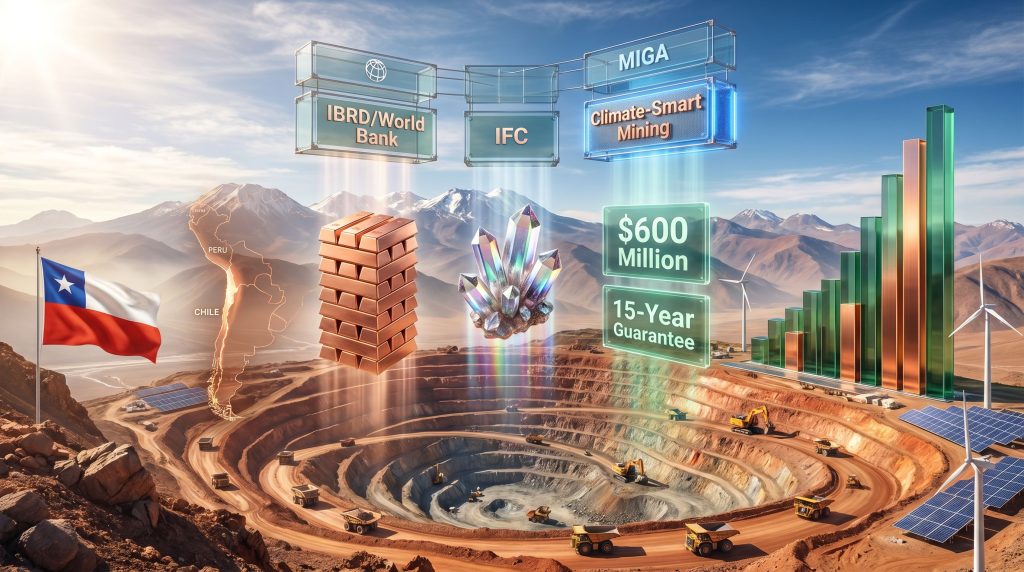
The World Bank (IBRD/IDA): Provides sovereign lending and policy advisory services to national governments. In mining contexts, this translates into regulatory reform support, green hydrogen safety framework development, water management programs, and social protection infrastructure.
-
The International Finance Corporation (IFC): Focuses exclusively on private sector investment and advisory services. The IFC can take direct equity stakes, provide long-tenor loans to private companies, and facilitate public-private partnership (PPP) structures in mining-adjacent industries.
-
The Multilateral Investment Guarantee Agency (MIGA): Offers political risk insurance and credit enhancement guarantees. For mining finance, MIGA is arguably the most operationally significant instrument because it can de-risk long-duration financing structures in jurisdictions where sovereign or regulatory uncertainty would otherwise inflate the cost of private capital to prohibitive levels.
| World Bank Group Arm | Primary Function | Role in Mining and Transition Finance |
|---|---|---|
| World Bank (IBRD/IDA) | Sovereign lending and policy advisory | Governance reform, green hydrogen regulation, water and social infrastructure |
| IFC | Private sector investment and advisory | Direct investment, PPP facilitation, mining-adjacent industry development |
| MIGA | Political risk guarantees | Credit enhancement for renewable energy PPAs at state-owned mining enterprises |
When all three arms operate together under a single consolidated country office structure, it signals something more significant than routine engagement. It represents an elevated institutional commitment that functions as a visible de-risking signal to private capital markets. The message to commercial lenders and institutional investors is direct: the World Bank Group has assessed this jurisdiction and deployed its full toolkit here.
Chile's Unique Position in the Global Copper and Lithium Hierarchy
Chile is not merely a large mining country. It occupies a structurally irreplaceable position in the global supply chains that underpin the energy transition. According to the United States Geological Survey, Chile holds the largest copper reserves of any nation on Earth, accounting for roughly 22% of the global total. Copper demand is projected to increase substantially through 2035 and beyond, driven by EV manufacturing, grid expansion, and renewable energy hardware installation, all of which are copper-intensive at a scale that existing production cannot easily satisfy.
Alongside copper, Chile's lithium strategy positions the country as the world's largest lithium reserve holder and second-largest producer globally after Australia. Lithium carbonate and lithium hydroxide, the refined products derived from Chilean brine extraction in the Atacama Salt Flat, are critical inputs for cathode manufacturing in lithium-ion battery production. These two minerals together make Chile arguably the most strategically positioned mining jurisdiction on the planet for the energy transition.
Yet this endowment creates a paradox. Chile's mining sector is simultaneously:
-
A decarbonisation enabler, supplying the transition metals on which clean energy technologies depend
-
A decarbonisation challenge, because copper and lithium extraction are energy-intensive industrial processes that currently rely heavily on fossil fuel inputs, particularly in remote high-altitude environments
Resolving this paradox is where the World Bank Group's engagement becomes most consequential.
The CODELCO Equation: Decarbonising the World's Largest Copper Producer
No analysis of the World Bank's commitment to Chile can avoid CODELCO. Codelco's copper strategy is central to understanding Chile's mining landscape, as the state-owned enterprise is not only Chile's dominant copper producer but is frequently described as the world's largest copper-producing company by output volume. It is also, critically, Chile's single largest electricity consumer, a distinction that concentrates the country's energy transition risk into one institutional balance sheet.
CODELCO's challenge is straightforward to describe but complex to finance. Transitioning its energy mix from fossil fuels to renewables requires long-duration power purchase agreements with renewable energy developers. These contracts are commercially bankable, but lenders require risk mitigation instruments when the offtake counterparty is a state-owned enterprise in an emerging market, regardless of how creditworthy that enterprise may appear.
This is precisely where MIGA has intervened. The transaction timeline illustrates a deliberate, sequenced approach:
-
July 2024: MIGA executed its first guarantee transaction supporting CODELCO's renewable energy transition. The structure was classified as fully climate-aligned under international climate finance frameworks, establishing a precedent for how state-owned mining enterprise decarbonisation can be financed using multilateral guarantee instruments.
-
January 2026: MIGA executed a second, expanded guarantee covering a 15-year tenor loan of $600 million, structured around CODELCO's broadened renewable power purchase agreement portfolio. The extended tenor is significant: 15-year renewable energy contracts are far more valuable for developers than shorter agreements because they underpin long-term project finance structures, but they also carry more political and regulatory risk over their duration. MIGA's guarantee effectively absorbs that risk, allowing commercial lenders to price the transaction closer to investment-grade standards.
The MIGA guarantee model for state-owned mining enterprise decarbonisation has potential replication value across Latin America and beyond. It solves a structural financing gap that exists wherever sovereign balance sheet exposure limits and commercial risk appetite diverge.
What the Lobito Corridor Reveals About the World Bank's Regional Ambitions
To understand where World Bank Group strategy in Latin America may be heading, it is instructive to examine what the institution has already built in Africa. The Lobito Corridor, a major infrastructure initiative spanning Angola, the Democratic Republic of Congo, and Zambia, represents the World Bank's most advanced experiment in minerals-anchored regional development. The corridor integrates railway rehabilitation, energy access, governance reform, and trade facilitation around the copper and cobalt supply chains of Central Africa.
The relevance to Latin America is not incidental. The Andean mineral belt, stretching through Chile, Peru, and Argentina, contains concentrations of copper, lithium, and silver that collectively represent one of the most valuable resource corridors on Earth. A hypothetical multilateral infrastructure initiative connecting Chilean copper processing zones with Peruvian mining districts and Argentine lithium production regions would require:
-
Cross-border regulatory harmonisation among three distinct legal and environmental frameworks
-
Coordinated transport and logistics infrastructure investment
-
Multilateral political risk coverage for cross-border assets
-
Shared governance standards for community consultation and environmental permitting
These are precisely the capabilities the World Bank Group is assembling through its expanded regional engagement. Whether a formal Andean minerals corridor framework eventually emerges remains speculative, but the institutional building blocks are being positioned. Analysts tracking multilateral development finance trends have noted the structural parallels between the Lobito model and the World Bank's growing Andean portfolio, though no formal corridor framework has been announced as of mid-2026.
Governance Quality as the Determining Variable
One of the less-discussed dimensions of the World Bank's engagement model is the degree to which governance quality, rather than resource endowment, determines the institution's actual financing decisions. The geopolitics of mining are equally significant here, as Latin America's mining jurisdictions are not uniformly investable from a multilateral perspective, despite their extraordinary mineral wealth. Social conflict, permitting delays, inadequate water management frameworks, and weak local content regulations have stalled or cancelled major projects across the region.
The World Bank's Chile program addresses this directly through several parallel workstreams:
-
Regulatory advisory on green hydrogen: Chile is pursuing hydrogen derived from renewable electricity as a potential fuel source for its mining fleet, which would represent one of the most significant decarbonisation pathways available to the sector. World Bank advisory work on safety standards and regulatory frameworks for hydrogen applications in mining environments is foundational to enabling this transition.
-
Water management programs: Water scarcity in Chile's Atacama region is among the most acute environmental constraints on mining expansion. World Bank lending programs that address water governance directly reduce the risk of community opposition and regulatory intervention that would otherwise threaten project timelines.
-
Social protection infrastructure: The intersections between mining communities, environmental stress, and social equity are well-documented in Latin American resource literature. World Bank social protection lending in mining regions addresses the underlying conditions that generate opposition to resource development, reducing tail risk for the sector as a whole.
Benchmarking World Bank Engagement Against Competing Multilateral Frameworks
The World Bank Group is not alone in targeting Latin American mining, but its institutional architecture provides capabilities that competing multilateral bodies currently cannot replicate in combination. Furthermore, renewable energy in mining is increasingly central to how these multilateral institutions differentiate their engagement strategies across the region.
| Institution | Regional Focus | Primary Instrument | Mining-Specific Initiative |
|---|---|---|---|
| World Bank Group | Global, with Latin America focus | Sovereign lending, IFC equity, MIGA guarantees | Climate-Smart Mining Initiative |
| Inter-American Development Bank | Latin America and Caribbean | Concessional lending | Infrastructure and governance programs |
| Asian Development Bank | Asia-Pacific | Project finance | Energy transition financing |
| African Development Bank | Africa | Sovereign and private lending | Lobito Corridor co-financing |
The World Bank Group's key competitive advantage is its ability to deploy lending, equity advisory, and political risk guarantee capacity simultaneously and in a coordinated manner within a single country framework. No other multilateral institution currently combines these three instruments with equivalent scale or geographic breadth. This integration is what gives the joint country office model its signal value to private markets.
The next major ASX story will hit our subscribers first
Investment Implications and the Catalytic Capital Model
For institutional investors and mining companies evaluating exposure to Latin American assets, the World Bank Group's deepening regional commitment has concrete implications that extend beyond development finance theory. The presence of MIGA guarantees in a jurisdiction demonstrably reduces the political risk premium that commercial lenders apply to project financing. This compression in risk pricing translates directly into lower debt servicing costs, improved project economics, and expanded bankability for assets that might otherwise struggle to attract long-tenor commercial financing.
The catalytic multiplier effect that multilateral development banks target suggests that each dollar of guarantee capacity or concessional lending is designed to mobilise three to five dollars of private capital in well-structured transactions, though actual leverage ratios vary significantly by jurisdiction and transaction structure. This is not guaranteed, and investors should note that multilateral engagement does not eliminate sovereign, operational, or commodity price risk. It reduces specific categories of political and regulatory risk, which is meaningful but not comprehensive.
According to the World Bank's Climate-Smart Mining Initiative, the programme serves as the institution's primary operational vehicle for lower-footprint extraction support. Mining companies operating within its framework gain access to technical advisory services, governance benchmarking, and a credentialing signal that is increasingly relevant to institutional investors applying environmental, social, and governance screens to their portfolios.
Disclaimer: The investment implications discussed in this article represent analytical observations based on publicly available information about multilateral development finance mechanisms. They do not constitute financial advice. Investors should conduct independent due diligence before making any investment decisions related to Latin American mining assets.
Frequently Asked Questions: World Bank, Mining, and Latin America
What does it mean when the World Bank backs a regional mining agenda?
It signals a coordinated institutional commitment to improving governance, financing conditions, and environmental standards across multiple mining jurisdictions simultaneously, using the full range of World Bank Group financial instruments rather than isolated project-level transactions.
Why is the MIGA guarantee structure significant for mining finance?
MIGA guarantees reduce the political and regulatory risk premium that commercial lenders apply to long-duration financing in emerging markets. For state-owned mining enterprises like CODELCO, this makes 15-year renewable energy financing commercially viable without requiring full sovereign balance sheet exposure, creating a replicable model for industrial decarbonisation finance.
What is green hydrogen's relevance to mining decarbonisation?
Green hydrogen, produced through electrolysis powered by renewable electricity, is being investigated as a zero-emission fuel for heavy mining equipment and processing operations. Chile's combination of abundant solar and wind resources with a large mining sector makes it one of the world's most promising environments for this application, though commercial-scale deployment remains at an early stage.
How does the Lobito Corridor model relate to Latin America?
The Lobito Corridor demonstrates that the World Bank Group can structure minerals-anchored regional infrastructure initiatives that integrate transport, energy, governance, and trade facilitation investment. The Andean mineral belt presents a comparable geographic and resource logic, though no formal equivalent initiative has been announced for Latin America as of mid-2026.
What are the main risks that multilateral engagement does not eliminate?
Commodity price volatility, operational execution risk, water and energy input constraints, community opposition, and changes in national government policy are all material risks that persist regardless of multilateral involvement. MIGA and World Bank instruments address specific categories of political and regulatory risk, not the full spectrum of investment risk in mining assets.
The Structural Convergence Driving a Decade of Engagement
The World Bank backs regional mining agenda and commits to Chile not because of any single transaction, but because three structural forces have converged simultaneously: accelerating global demand for transition metals, a growing recognition that governance gaps in resource-rich economies represent systemic risks to supply chain reliability, and an institutional mandate evolution that has repositioned multilateral development banks as active participants in the energy transition rather than passive infrastructure lenders.
Chile's 75-plus year institutional relationship with the World Bank Group provides the trust infrastructure on which this accelerating engagement phase is built. The CODELCO guarantee transactions, the green hydrogen regulatory advisory work, the water management lending, and the social protection programs are not isolated initiatives. They form a coherent, multi-layered commitment to ensuring that Chile's extraordinary mineral endowment is developed in a manner that is financially sustainable, environmentally defensible, and socially viable.
MIGA's support for Chile's renewable energy drive further illustrates the depth of multilateral commitment, as the agency's guarantee structures have enabled long-tenor private financing at scale across Chile's mining and energy sectors. Whether the full ambition of a multilateral minerals strategy for the Andean region is realised over the coming decade will depend on factors that no institution fully controls: political continuity in host countries, commodity price cycles, community acceptance of large-scale resource development, and the pace at which renewable energy technologies become cost-competitive in remote mining environments. What is clear is that the institutional architecture being assembled is more sophisticated, better capitalised, and more strategically coherent than anything the region has seen before.
Want to Track the Next Major Mineral Discovery Before the Market Does?
Discovery Alert's proprietary Discovery IQ model delivers real-time alerts on significant ASX mineral discoveries — including copper and lithium plays driving the global energy transition — ensuring subscribers can identify actionable opportunities the moment they are announced. Explore historic examples of extraordinary mineral discovery returns and begin your 14-day free trial today to position yourself ahead of the market.