June 21, 2026
Why Physical Gatherings Remain the Backbone of Global Mining Strategy
The most valuable intelligence in the mining industry has never lived in a database. It circulates through hallway conversations, emerges from unscripted exchanges between executives and investors, and crystallises during the kind of candid roundtable discussion that no press release will ever capture. In a sector defined by geological uncertainty, geopolitical complexity, and capital cycles that can turn within a quarter, the ability to read a room, assess a management team directly, and triangulate market sentiment in real time remains irreplaceable.
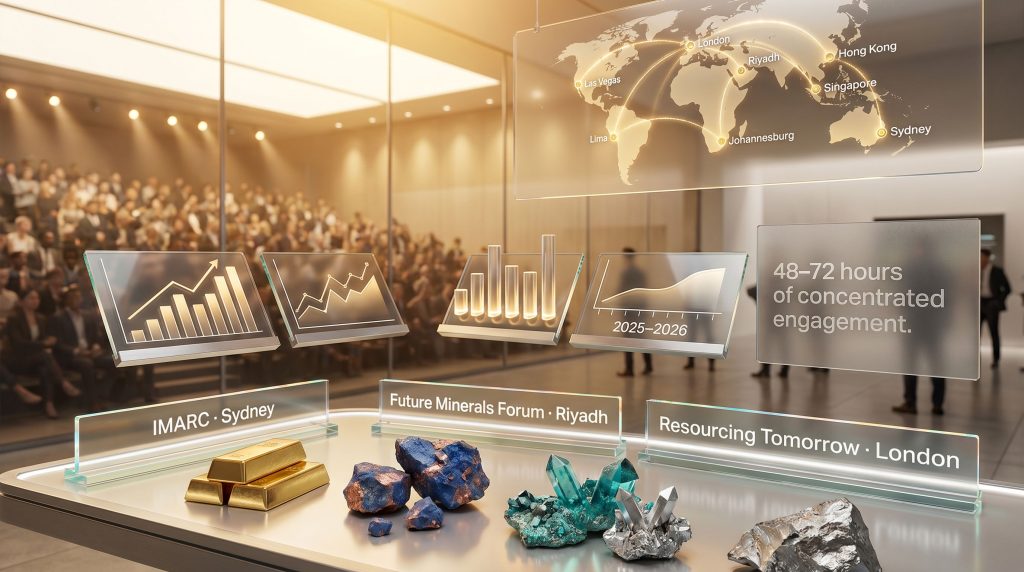
Mining conferences and industry events have evolved well beyond their origins as trade showcases. Today, they function as compressed intelligence ecosystems, where months of relationship development are distilled into 48 to 72 hours of structured interaction. Understanding how to navigate this ecosystem, and why it matters more now than at almost any previous point in the commodity cycle, is essential for investors, operators, and policymakers alike.
When big ASX news breaks, our subscribers know first
The Multi-Stakeholder Architecture Underneath Every Major Mining Event
Four Groups, One Venue, Divergent Objectives
The surface-level description of a mining conference, speakers presenting to an audience, understates the operational complexity underneath. In practice, these events function as simultaneous marketplaces serving at least four distinct participant groups, each pursuing fundamentally different outcomes within the same physical space.
| Participant Type | Primary Objective | Key Success Metric |
|---|---|---|
| Institutional Investor | Pipeline discovery, management assessment | Qualified 1:1 meetings completed |
| Mining CEO / Executive | Capital access, strategic partnerships | Investor introductions, media visibility |
| Government Delegate | Policy signalling, FDI attraction | Bilateral engagements, MOU signings |
| Service Provider / Supplier | Lead generation, brand positioning | Qualified leads, contract conversations |
| Technical Professional | Knowledge transfer, peer benchmarking | Sessions attended, certifications earned |
The conference format creates structured conditions for cross-group interaction that no digital platform has reliably replicated. A mining CEO pitching institutional capital, a government delegate signalling permitting reform, and a service provider identifying procurement opportunities may occupy adjacent seats at the same session, with shared context enabling conversations that would otherwise require months of cold outreach to initiate.
Key Insight: The most sophisticated conference participants treat attendance as a structured intelligence-gathering exercise. Pre-scheduled meetings, targeted session selection, and disciplined post-event follow-through collectively determine whether attendance generates measurable returns or simply fills a travel budget.
The ROI Case: Attending, Exhibiting, or Speaking
For junior mining companies seeking capital, junior mining conferences represent one of the highest-ROI business development activities available, provided the company enters with a prepared investor presentation, pre-scheduled meetings via the event's matchmaking application, and clear messaging around both its asset quality and management credentials. A well-executed two-to-three day conference should generate between 50 and 100 new qualified business connections. If this threshold is not being approached, either the event's delegate quality or its matchmaking infrastructure warrants reassessment.
The Global Mining Conference Landscape in 2025 and 2026
Four Distinct Event Categories
A common source of misaligned expectations among first-time attendees is the failure to distinguish between event types. The four primary categories serve meaningfully different purposes.
1. Global Trade Exhibitions
- Focus: Equipment demonstrations, technology showcases, supplier procurement
- Scale: Tens of thousands of attendees, large exhibition floors
- Examples: MINExpo INTERNATIONAL (Las Vegas, next edition September 2028), Electra Mining Africa (Johannesburg)
2. Technical and Scientific Conferences
- Focus: Engineering research, operational safety, geoscience, innovation
- Audience: Mining engineers, geologists, environmental scientists, academics
- Examples: World Mining Congress 2026 (Lima Convention Center, Peru), SME MINEXCHANGE (Denver 2027, Phoenix 2028)
3. Investment and Capital Markets Forums
- Focus: Capital raising, investor-company introductions, deal origination
- Audience: Fund managers, institutional investors, junior and mid-tier mining companies
- Examples: Mines and Money series, IMARC (Sydney, October), Resourcing Tomorrow (London, December)
4. Regional Industry and Policy Forums
- Focus: Jurisdiction-specific policy, local supply chain development, community engagement
- Examples: Discoveries 2026 Mining Conference (Mexico), Elko Mining Expo (Nevada), Future Minerals Forum (Riyadh)
2025 to 2026 Global Events Calendar
| Event | Location | Timing | Primary Focus |
|---|---|---|---|
| IMARC | Sydney, Australia | Late October | Investment, operations, policy |
| Resourcing Tomorrow | London, UK | Early December | Capital markets, supply chain |
| Future Minerals Forum | Riyadh, Saudi Arabia | Early year | Critical minerals, government policy |
| World Mining Congress | Lima, Peru | 2026 | Technical, sustainability |
| Electra Mining Africa | Johannesburg | Biennial | Equipment, technology |
| SME MINEXCHANGE | Denver, USA | 2027 | Technical, engineering |
| MINExpo INTERNATIONAL | Las Vegas, USA | September 2028 | Equipment, technology, safety |
Furthermore, the WA Mining Conference remains a cornerstone of the regional calendar, drawing significant participation from both operators and investors with exposure to Western Australian assets.
Asian Financial Centres and the Reshaping of Mining Capital Markets
The Numbers That Western Markets Tend to Underestimate
A structural reality that frequently escapes Western-centric industry narratives: six of the world's top ten global financial centres are located in Asia. The current ranking places New York first, London second, Hong Kong third, and Singapore fourth. Also represented in the top ten are Shanghai, Shenzhen, Seoul, and Tokyo. This geographic concentration of financial infrastructure has direct implications for where mining capital is sourced, and where the most relevant mining conferences and industry events need to establish presence.
Hong Kong's Specific Role in Mining Finance
Hong Kong's position as a mining finance hub is frequently underestimated by Western industry participants, many of whom have not visited since the pandemic period and have formed perceptions based on secondhand accounts. The reality on the ground is considerably more active. The Hong Kong Stock Exchange has experienced one of its most vibrant periods for mining-related listings, with major names including Zijin Mining and CATL having listed there in recent years.
The exchange has also actively approached mining companies in jurisdictions such as Australia, encouraging them to consider dual or primary listings. The Hong Kong mining summit has consequently grown in strategic significance as a venue for these conversations to take shape.
Beyond exchange activity, Hong Kong functions as the primary gateway for Chinese institutional and ultra-high-net-worth capital flows into the global mining sector. It ranks as the world's second largest centre for ultra-high-net-worth individuals, meaning significant private wealth is continuously seeking deployment into asset classes including resource equities.
Crucially, the investor culture in Hong Kong demonstrates a materially higher risk tolerance for resource sector exposure, including junior exploration companies, compared to most other Asian financial centres. This mirrors the investor psychology found in Vancouver and Perth, where proximity to mining culture generates genuine appetite for early-stage resource risk.
Singapore's Distinct Profile
Singapore's role is structurally different. As a commodities trading hub rather than a mining equity finance centre, it has built particular depth in iron ore futures trading over the past decade, driven by sustained investment in exchange infrastructure by the Singapore Exchange. The cultural investment profile of Singaporean investors tends toward real estate and ETF structures rather than direct resource equity exposure, making it less fertile ground for junior mining capital raising despite its overall financial centre ranking.
Structural Observation: Hong Kong and Singapore are not interchangeable in the context of mining investment. The distinction between equity risk appetite and commodities trading infrastructure creates meaningfully different engagement environments for mining companies seeking capital versus those managing commodity price exposure.
The Middle East as an Emerging Conference and Capital Hub
Saudi Arabia's Future Minerals Forum has established itself rapidly as the leading mining event for the Middle East and Africa region. In addition, the expansion of Saudi exploration licences is drawing increased attention from international operators seeking entry into the kingdom's developing resources sector. The scale of Gulf sovereign capital being directed toward the mining sector represents a qualitatively different level of commitment compared to earlier Western-led supply chain initiatives.
Macro Trends Reshaping Mining Conference Agendas
Trend 1: Governments Have Become the Most Sought-After Conference Voices
Five years ago, institutional investor and mining executive presentations dominated conference agendas. Today, government participation has become a primary content driver. Investors and operating companies now actively seek direct policy perspectives at conferences, particularly regarding US government critical minerals initiatives such as Project Vault, and the broader question of what policy continuity will look like across future administration changes.
The frequency and substantiveness of government participation at major mining conferences has become a de facto proxy indicator for the seriousness of national critical minerals strategies.
Trend 2: Supply Chain Resilience Has Moved from Theme to Structural Priority
Disruptions across the Strait of Hormuz, combined with the sustained geopolitical pressures that have accumulated since the Covid period and the Russian invasion of Ukraine, have made supply chain security a perennial headline issue at every major mining conference. The conversation has matured considerably, moving beyond upstream production security to encompass the midstream processing gap and downstream manufacturing integration.
Critical Gap: The mining industry has historically organised itself, and its conferences, around upstream extraction. The growing recognition that midstream processing represents the most strategically vulnerable point in Western critical mineral supply chains is now forcing a structural reorientation of conference programming and policy discussion.
China's dominance of midstream processing capacity across rare earths, lithium, cobalt, graphite, and other critical materials is a recurring reference point. What distinguishes China's position is not simply its current processing share but its demonstrated capacity to execute long-horizon industrial planning across decades rather than election cycles. Western policy documents have proliferated; actual execution of processing infrastructure has lagged significantly.
Trend 3: Defence Applications Are Creating a New Conference Demand Category
Critical minerals used in defence applications, including rare earths for permanent magnets, titanium for aerospace structures, and tungsten for munitions, are generating a distinct category of conference interest. Defence prime contractors and procurement agencies are beginning to participate in mining conference programming, often within confidential discussion formats.
This has driven the adoption of Chatham House Rule sessions as a structural innovation in conference design. These 90-minute small-group roundtables, operating under strict non-attribution rules, allow defence-sector participants to engage with mining topics as individual experts rather than institutional representatives, removing the public attribution risk that suppresses candid discussion in open plenary formats.
Trend 4: Downstream Integration Is Pulling Conference Content Beyond the Mine Gate
Battery manufacturing, EV supply chains, and renewable energy infrastructure are expanding mining conference content into refining, processing, and materials specification. Conferences that previously focused exclusively on extraction are now programming sessions that engage with the entire value chain. This reflects the broader industry recognition that value capture in the critical minerals cycle increasingly occurs downstream of the mine gate.
Commodities Attracting the Most Attention in 2025 and 2026
Four commodity categories are generating disproportionate conference discussion and investor inquiry at present.
Gold continues to attract sustained institutional interest anchored in macro uncertainty, currency debasement concerns, and geopolitical risk premiums. Many institutional investors are constructive on continued price appreciation through the current cycle, with various market commentators projecting price levels in the range of $5,000 to $5,500 per ounce by year end, though such forecasts carry inherent uncertainty and should not be treated as financial advice.
Copper has arguably generated more concentrated conference discussion in 2025 than any other single commodity, with notable activity captured in PDAC 2025 insights. The demand thesis is anchored in electrification infrastructure requirements across grid expansion, EV charging networks, and renewable energy installations, while the supply case is amplified by declining ore grades and extended permitting timelines at major projects.
High-grade iron ore represents a less-discussed but emerging theme in conference programming. Arguments for its reclassification as a strategic or critical material in specific contexts are gaining some traction, though the commodity has historically been siloed within steel industry events rather than critical minerals forums.
Defence-linked critical minerals as a basket category, encompassing rare earths, tungsten, titanium, and antimony, are attracting growing interest driven by the intersection of national security procurement and resource investment. This category represents a structural convergence of two previously separate conference communities.
The next major ASX story will hit our subscribers first
Investment Discipline and the Management Quality Question
Position Sizing: A Framework That Scales With Research Capacity
A principle associated with experienced mining investor Rick Rule offers a useful discipline for managing mining equity portfolios: the number of positions held should roughly correspond to the number of hours per month an investor is genuinely prepared to dedicate to active research and monitoring. Holding fifteen mining stocks implies fifteen hours of monthly research to maintain informed conviction on each position.
This framework argues against broad diversification without corresponding research capacity, and it helps explain why many retail investors in junior mining underperform their initial entry instincts through exit indiscipline rather than poor stock selection. The psychological pattern is consistent: strong entry discipline, weak exit discipline.
Management Quality as the Primary Investment Variable
The ongoing debate between asset quality, jurisdiction quality, and management quality as the primary investment determinant is a recurring discussion at mining conferences and industry events. A practical heuristic drawn from operational experience across the conference industry itself suggests that execution quality determines outcomes more consistently than asset quality in isolation.
Strong management teams frequently extract value from average assets through superior capital allocation, stakeholder management, and strategic timing. Poor management teams reliably underperform strong assets.
Investment Framework: When evaluating junior mining companies, experienced investors tend to prioritise three variables in approximate order: (1) management track record and capital discipline, (2) asset quality and resource scale, (3) jurisdiction risk and permitting environment. Rarely do all three align. The trade-off analysis between these variables is where investment skill is demonstrated, and the conference environment provides one of the few opportunities to assess management quality through unscripted interaction.
How to Maximise Value From Mining Conference Attendance
Before the Event
- Review the full speaker program at least two weeks in advance and identify 8 to 12 priority sessions aligned with your investment thesis or business development objectives
- Use the conference meeting planner application early; the most sought-after meeting slots fill quickly
- Research the backgrounds of speakers whose sessions you plan to attend; informed questions generate more valuable responses and more memorable interactions
- Define measurable attendance objectives in advance: number of investor meetings, specific companies to assess, policy questions to investigate
- Explore upcoming industry events across professional bodies to ensure your calendar captures the most relevant gatherings for your sector focus
During the Event
- Attend at least one Chatham House Rule roundtable if available; these sessions consistently generate the most candid and commercially useful insights available anywhere in the conference program
- Prioritise informal exchanges during networking breaks over passive session attendance where trade-offs are necessary
- Record context notes on new contacts immediately; conference fatigue degrades recall rapidly across multi-day events
After the Event
- Follow up within 48 hours while context remains fresh for both parties
- Categorise new contacts by relationship type and required next action
- Review session notes against your pre-event investment thesis to identify where assumptions were confirmed, challenged, or usefully complicated
The Compounding Value of Consistent Participation
Single-event attendance generates introductions. Consistent multi-year participation builds the reputational capital and relationship depth that drives material business outcomes. The mining industry's culture of openness and information sharing, which stands in notable contrast to many other sectors where CEO access is heavily managed, makes conference participation particularly productive for those who engage authentically over time.
For a comprehensive view of scheduled gatherings across jurisdictions, the Global Mining Review events calendar offers a useful starting point for planning multi-year conference strategies. The structural forces currently elevating the strategic importance of mining, critical minerals competition between major economies, supply chain resilience imperatives, defence procurement shifts, and the evolution of Asian financial centres, are simultaneously increasing the premium on accurate, unfiltered, relationship-sourced intelligence.
In that context, well-executed mining conferences and industry events are not diminishing in relevance relative to digital information channels. They are, however, becoming more indispensable than ever.
This article contains forward-looking statements and commodity price references that reflect market commentary and should not be construed as financial advice. All investment decisions should be made in consultation with a qualified financial adviser. Past performance is not indicative of future results.
Want to Identify the Next Major ASX Mineral Discovery Before the Broader Market?
Discovery Alert's proprietary Discovery IQ model delivers real-time alerts on significant ASX mineral discoveries, transforming complex geological and market data into actionable investment insights for both short-term traders and long-term investors — begin your 14-day free trial today and explore historic discoveries that have generated substantial returns to understand why being first to act on a major find can be genuinely transformative.