May 19, 2026
What Are Mining Environmental Management Services and Why Do They Matter?
The extraction industry faces unprecedented pressure to balance resource demand with ecological stewardship. Modern mining operations require sophisticated environmental frameworks that extend far beyond basic regulatory compliance. This operational necessity has given rise to specialized mining environmental management services, representing a fundamental shift from reactive damage control to proactive ecosystem protection. These services encompass comprehensive solutions spanning waste management, water conservation, air quality control, land rehabilitation, and energy optimization.
Furthermore, understanding mining permitting basics becomes essential for navigating the complex regulatory landscape that drives demand for these specialised services.
When big ASX news breaks, our subscribers know first
Defining the Scope of Environmental Stewardship in Resource Extraction
Mining environmental management services operate across three critical domains that determine long-term project viability. Operational environmental control involves real-time monitoring of air and water quality parameters, noise regulation compliance, and ground stability assessment systems. Resource optimization focuses on minimizing freshwater consumption through advanced filtration, desalination, and recycling technologies while implementing dust suppression techniques and cleaner energy adoption. Ecosystem restoration encompasses biodiversity protection protocols and comprehensive land rehabilitation programs designed to restore disturbed landscapes to stable, productive states.
These service categories address specific environmental interaction points requiring specialized expertise. IoT-enabled sensors provide continuous monitoring capabilities, while ground stability assessment systems prevent catastrophic failures. The integration of biomining technologies offers environmentally responsible alternatives to conventional chemical extraction methods by utilizing microorganisms to extract metals, thereby reducing reliance on hazardous substances and minimizing waste generation.
The Business Case for Proactive Environmental Management
Environmental management services typically deliver measurable performance improvements across multiple operational metrics. Companies implementing comprehensive mining environmental management services achieve:
• 30-50% reduction in water consumption through advanced recycling and conservation systems
• 25-40% decrease in air emissions via battery-electric fleet integration and renewable energy adoption
• 60-80% improvement in land rehabilitation success rates when implemented comprehensively
The Asia-Pacific region currently holds the largest market share in mining waste management, reflecting strong growth projections driven by industrial expansion and urbanization pressures. This regional dominance demonstrates how environmental responsibility directly correlates with operational viability and social acceptance in resource-rich territories.
In addition, implementing effective mining waste solutions has become crucial for achieving these performance improvements while maintaining regulatory compliance.
Regulatory Drivers Reshaping Industry Standards
Environmental impact assessments (EIAs) now serve as foundational requirements before project commencement, with detailed environmental management plans (EMPs) becoming standard regulatory mandates. The global regulatory landscape enforces strict compliance limits on air emissions, water discharges, and waste disposal through regular monitoring, reporting, and auditing protocols.
International agreements and voluntary standards promote transparency, accountability, and environmental, social, and governance (ESG) principle integration throughout mining operations. Adherence to these frameworks has become essential for maintaining social license to operate and attracting institutional investment capital.
How Do Environmental Management Services Transform Mining Operations?
Environmental transformation occurs through systematic integration across three operational lifecycle phases, each requiring distinct technological approaches and performance measurements. Pre-development assessment establishes baseline environmental conditions and predicts potential impacts through comprehensive evaluation frameworks. Operational monitoring implements continuous tracking systems for air quality, water parameters, waste streams, and emissions performance. Post-closure stewardship ensures long-term ecosystem stability through rehabilitation programs and environmental legacy management.
Pre-Development Environmental Assessment Frameworks
Comprehensive baseline establishment requires 12-24 months for thorough environmental characterization, utilizing satellite imagery and airborne geophysical surveys to map existing conditions. Geographic Information Systems (GIS) platforms support spatial data analysis for risk assessment and mitigation planning, while hyperspectral imaging with artificial intelligence processes hundreds of narrow spectral bands to identify environmental sensitivity zones.
Environmental impact prediction models utilize machine learning classifiers to assign probabilities of ecosystem disruption to specific operational scenarios. These predictive frameworks enable mining companies to design mitigation strategies before ground disturbance begins, significantly reducing environmental legacy costs and regulatory compliance risks.
Moreover, CSIRO's environmental management research provides valuable insights into developing robust assessment methodologies for Australian mining operations.
Operational Phase Environmental Monitoring Systems
Real-time environmental monitoring networks deploy Internet of Things (IoT) sensors throughout operational areas to track air and water quality parameters, noise levels, and ground stability indicators. These systems generate continuous data streams that feed into artificial intelligence and machine learning platforms for predictive analytics, resource allocation optimization, and environmental risk identification.
Autonomous vehicles and remote-controlled machinery enhance operational efficiency while reducing emissions and improving safety in hazardous conditions. Implementation timelines for operational environmental management systems typically range from 6-18 months, with costs representing 3-8% of total project capital expenditure depending on project complexity and regulatory requirements.
Post-Closure Rehabilitation and Long-Term Stewardship
Land rehabilitation services focus on restoring disturbed landscapes to stable, productive states through scientifically-driven ecosystem reconstruction. These programs incorporate native species reintroduction, soil chemistry restoration, and hydrological system rehabilitation to ensure long-term environmental sustainability beyond operational closure.
Post-closure monitoring systems utilise remote sensing technologies and automated data collection networks to track rehabilitation success over decades. This long-term stewardship approach protects mining companies from future environmental liabilities while demonstrating commitment to ecosystem restoration.
Consequently, mine reclamation innovation plays a crucial role in ensuring successful land rehabilitation outcomes that meet modern environmental standards.
What Technologies Are Revolutionising Environmental Compliance in Mining?
Digital transformation has fundamentally altered environmental management capabilities, enabling predictive analytics, automated response systems, and integrated operational optimisation. These technological advances deliver quantifiable efficiency improvements and cost reductions across multiple operational domains.
IoT-Enabled Real-Time Environmental Monitoring Networks
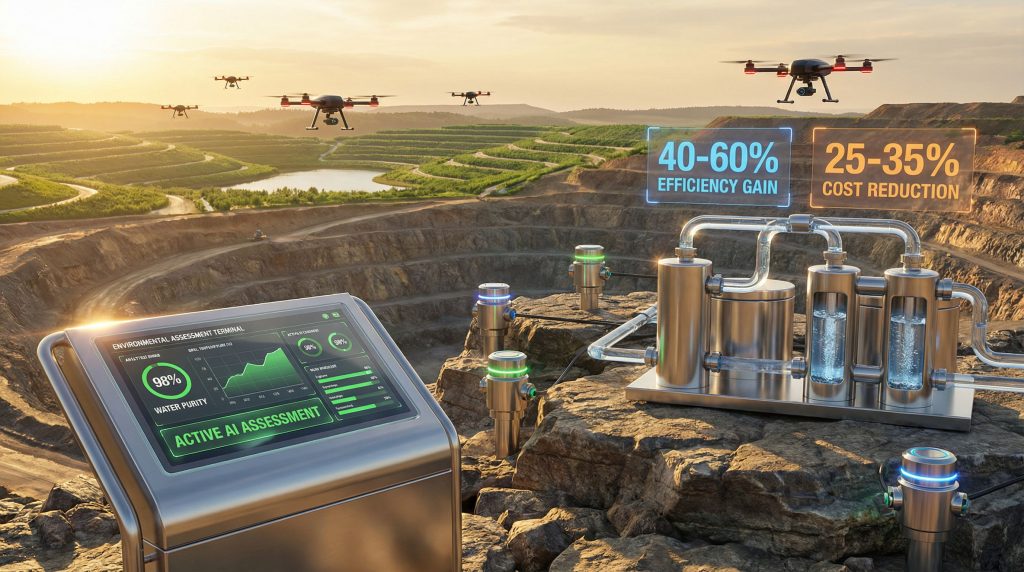
Internet of Things sensor networks provide continuous environmental parameter monitoring with unprecedented accuracy and coverage. These systems track air and water quality, noise levels, ground stability, and emissions performance through distributed sensor arrays connected via high-bandwidth private LTE and 5G networks at remote mine sites.
Key Environmental Monitoring Technologies and Applications
| Technology | Primary Application | Efficiency Gain | Cost Reduction |
|---|---|---|---|
| IoT Sensors | Air/Water Quality Monitoring | 40-60% | 25-35% |
| AI Analytics | Predictive Risk Assessment | 50-70% | 30-45% |
| Automated Systems | Waste Processing | 35-55% | 20-40% |
Real-time data transmission capabilities enable immediate response to environmental deviations, preventing minor issues from escalating into regulatory violations or ecosystem damage. Sensor-based ore sorting systems utilise high-speed cameras and X-ray Fluorescence (XRF) sensors to analyse raw ore on conveyor belts, enabling separation within milliseconds and reducing water consumption by up to 30 percent through pre-concentration processes.
AI-Powered Predictive Environmental Risk Assessment
Machine learning algorithms analyse historical environmental data, weather patterns, operational variables, and geological conditions to predict potential environmental risks before they manifest. These systems utilise Bayesian Belief Networks and Ensemble Learning methods to assign probabilities of environmental incidents to specific operational scenarios.
Advanced geospatial data fusion platforms combine hyperspectral satellite sensors, airborne magnetic surveys, and ground-level geochemical assays to generate three-dimensional environmental risk models. Convolutional Neural Networks (CNNs) and Recurrent Neural Networks (RNNs) excel at recognising spatial patterns in environmental data, enabling prediction of contamination pathways and ecosystem impact zones.
Predictive algorithms adjust pH levels, temperature, and reagent flow rates in real time to maximise environmental performance while maintaining operational efficiency. These machine learning models employ reinforcement learning to continuously identify optimal operational parameters from live sensor data, resulting in environmental performance that consistently surpasses manual benchmarks.
Automated Water Treatment and Waste Management Systems
Automated water treatment systems integrate advanced filtration, desalination, and recycling technologies to minimise freshwater consumption while ensuring discharge water meets environmental standards. These systems utilise artificial intelligence to optimise treatment processes based on water chemistry, flow rates, and regulatory requirements.
Waste processing automation employs sensor-based material classification and automated sorting systems to maximise resource recovery from mining waste. Smart waste management protocols identify recyclable materials, hazardous substances, and disposal-ready waste streams through computer vision and chemical analysis technologies.
Remote Operations Centers (ROCs) enable centralised control of multiple environmental management systems from urban hubs, allowing operators to manage complex equipment fleets and treatment facilities from hundreds of kilometres away. This centralisation improves response times, reduces operational costs, and ensures consistent environmental performance across multiple operational sites.
Which Service Categories Drive the Highest Environmental Impact Reduction?
Specialised service categories target specific environmental challenges through systematic approaches that deliver measurable impact reduction across water resources, air quality, and biodiversity protection domains. These services integrate technological solutions with ecological expertise to address the most significant environmental risks in mining operations.
Water Resource Management and Conservation Solutions
Water management represents the most critical environmental challenge for mining operations, requiring sophisticated conservation strategies and treatment technologies. Advanced filtration systems, desalination technologies, and recycling protocols minimise freshwater consumption while maintaining operational requirements.
Critical Success Metrics: Environmental management services typically achieve 30-50% reduction in water consumption, 25-40% decrease in air emissions, and 60-80% improvement in land rehabilitation success rates when implemented comprehensively.
Measurement While Drilling (MWD) technology enables real-time monitoring of water pressure, temperature, and chemical composition during operational activities. This technology records torque, penetration rate, rotation speed, and water pressure parameters, allowing engineers to infer hydrological conditions and prevent groundwater contamination.
Digital twin simulations of hydrological systems enable engineers to simulate various water management scenarios, evaluate environmental outcomes, and optimise water usage without disrupting operational activities. These interactive systems advance alongside physical operations, incorporating real-time data from IoT sensors and current performance measurements.
Air Quality Control and Emissions Reduction Programs
Air quality management programs integrate dust suppression techniques, cleaner energy adoption, and battery-electric fleet deployment to minimise atmospheric emissions. Autonomous haulage systems deliver greater precision and consistency than manual operation, improving fuel efficiency and reducing particulate emissions from heavy equipment operations.
Renewable energy mining integration through solar, wind, and battery storage systems reduces operational carbon footprints while providing energy cost stability. Smart energy consumption systems utilise predictive maintenance and efficiency optimisation to minimise overall energy requirements without compromising operational performance.
Consequently, renewable energy mining solutions have become essential for achieving meaningful emissions reduction targets while maintaining operational competitiveness.
Predictive analytics support ore-grade control by enabling equipment to distinguish between high-value ore and waste accurately, reducing unnecessary processing and associated emissions. Machine learning models analyse sensor data to adjust processing parameters in real time, maximising mineral recovery while minimising energy consumption.
Biodiversity Protection and Ecosystem Restoration Services
Biodiversity protection programs utilise satellite imagery and airborne geophysical surveys to map environmental changes and habitat distribution patterns. Geographic Information Systems platforms support spatial analysis for ecosystem risk assessment and restoration planning across operational areas.
Ecosystem restoration services employ native species reintroduction, soil chemistry optimisation, and hydrological system reconstruction to restore disturbed landscapes to stable, productive states. These programs incorporate circular economy principles where waste materials are repurposed as resources for ecosystem reconstruction projects.
Biomining technologies offer environmentally responsible alternatives to conventional extraction methods by utilising microorganisms to extract metals, reducing reliance on hazardous chemical processes that threaten local ecosystems. These biological approaches minimise waste generation while protecting sensitive environmental areas.
How Do Regional Markets Shape Environmental Management Demand?
Geographic variations in environmental regulations, geological conditions, and economic development patterns create distinct regional markets for mining environmental management services. These regional differences influence service demand, technology adoption rates, and regulatory compliance requirements across global mining operations.
Asia-Pacific Leading Global Market Growth Patterns
The Asia-Pacific region holds the largest market share in mining waste management, driven by rapid industrial expansion, urbanisation pressures, and increasing environmental awareness. Regional environmental standards continue evolving toward stricter compliance requirements, creating demand for advanced environmental management technologies.
Regional Market Analysis – Environmental Management Services
| Region | Market Share | Growth Rate | Key Drivers |
|---|---|---|---|
| Asia-Pacific | 45% | 8.5% annually | Industrial expansion, urbanisation |
| North America | 28% | 6.2% annually | Regulatory compliance, ESG focus |
| Europe | 18% | 7.1% annually | Sustainability mandates, green transition |
Lithium Triangle countries including Argentina, Chile, and Bolivia demonstrate specialised demand for brine-processing equipment and chemical extraction technologies. Unlike traditional hard-rock mining, lithium extraction from salars requires high-precision pumps, filtration systems, and evaporation pond management services, creating significant opportunities for technical service providers specialising in fluid dynamics and chemical processing.
North American Regulatory Complexity and Service Innovation
North American markets emphasise regulatory compliance and environmental, social, and governance (ESG) focus, driving demand for comprehensive environmental management solutions. Provincial codes and WorkSafe regulations require rigorous, engineer-certified stability assessments for both pit walls and underground operations, creating strong demand for data-driven environmental services.
Permafrost regions require specialised sonic drilling technologies that generate minimal heat to preserve thermal integrity of frozen core samples, providing accurate ground ice distribution analysis essential for preventing thaw-induced instability. These specialised requirements create niche markets for environmental service providers with Arctic expertise.
European Sustainability Standards Driving Premium Services
European markets prioritise sustainability mandates and green transition initiatives, creating demand for premium environmental management services that exceed basic regulatory compliance. Circular economy principles drive demand for waste-to-resource conversion technologies and comprehensive lifecycle environmental management.
Carbon footprint reduction programs incorporate renewable energy integration, energy efficiency optimisation, and emissions monitoring systems that align with European Union climate targets. These requirements create opportunities for environmental service providers specialising in carbon management and climate adaptation strategies.
The next major ASX story will hit our subscribers first
What Specialised Services Address Critical Mining Environmental Challenges?
Mining operations face specific environmental challenges that require targeted technical solutions and specialised expertise. These challenges demand integrated approaches combining technological innovation, ecological understanding, and operational optimisation to deliver effective environmental protection.
Tailings Management and Mine Waste Optimisation
Tailings management represents one of the most critical environmental risks in mining operations, requiring sophisticated containment, treatment, and monitoring systems. Advanced tailings management services integrate structural engineering, geochemistry, and long-term stability assessment to prevent catastrophic failures and environmental contamination.
Resource recovery from mining waste utilises sensor-based sorting technologies and chemical processing innovations to extract valuable materials from tailings streams. These circular economy approaches transform waste streams into revenue sources while reducing environmental footprint and long-term liability exposure.
Digital twin technology enables simulation of tailings dam behaviour under various environmental conditions, allowing engineers to evaluate structural integrity, predict potential failures, and optimise maintenance schedules without compromising operational safety.
Groundwater Protection and Contamination Prevention
Groundwater protection requires comprehensive hydrological assessment, monitoring well networks, and contamination prevention systems throughout operational lifecycles. Advanced filtration and treatment technologies ensure that operational activities do not compromise local water resources or create long-term contamination legacies.
Sonic drilling technology preserves subsurface conditions during monitoring well installation, providing accurate baseline data for groundwater quality assessment and contamination detection systems. This technology generates less heat than conventional drilling methods, preventing thermal alteration of sensitive groundwater systems.
Predictive contamination modelling utilises artificial intelligence and machine learning to identify potential groundwater contamination pathways before they develop, enabling proactive intervention and prevention strategies.
Carbon Footprint Reduction and Energy Efficiency Programs
Carbon management programs integrate renewable energy systems, energy efficiency optimisation, and emissions monitoring technologies to minimise operational carbon footprints. Battery-electric vehicle fleets replace diesel-powered equipment in underground applications, requiring specialised charging infrastructure and battery management systems.
Energy optimisation through smart systems, efficient equipment, and predictive maintenance enhances overall environmental performance while reducing operational costs. Autonomous systems and remote-controlled machinery improve energy efficiency while reducing direct emissions from operational activities.
Climate resilience planning incorporates adaptation strategies for changing environmental conditions, extreme weather events, and long-term climate impacts on operational sustainability.
How Do Companies Select and Implement Environmental Management Partners?
Strategic partner selection requires comprehensive evaluation frameworks that assess technical capabilities, regulatory compliance expertise, and long-term service delivery capacity. Successful implementation demands systematic integration approaches that minimise operational disruption while maximising environmental performance improvements.
Due Diligence Frameworks for Service Provider Evaluation
Environmental management partner selection requires evaluation across multiple technical and operational dimensions to ensure long-term project success. Companies must assess provider capabilities against specific geological conditions, regulatory environments, and operational requirements.
Service Provider Selection Criteria:
- Technical expertise in specific geological conditions including hard rock, soft rock, permafrost, and complex mineralisation environments
- Regulatory compliance track record and certifications demonstrating successful navigation of environmental regulations across multiple jurisdictions
- Technology platform capabilities and integration options enabling seamless data sharing and operational coordination
- Local knowledge and stakeholder relationship management ensuring effective community engagement and social licence maintenance
- Cost-effectiveness and scalable service delivery models providing flexible solutions that adapt to changing operational requirements
Provider evaluation should include assessment of technology integration capabilities, particularly compatibility with existing IoT sensors, artificial intelligence platforms, and autonomous systems already deployed at operational sites.
Furthermore, companies can benefit from exploring WSP's mine environmental services to understand industry-leading approaches to environmental management integration.
Integration Strategies for Seamless Operational Implementation
Successful environmental management system integration requires phased implementation approaches that minimise operational disruption while establishing robust environmental monitoring and control capabilities. Integration timelines typically range from 6-18 months for existing operational sites, with comprehensive baseline establishment requiring 12-24 months for new developments.
Technology integration strategies must address high-bandwidth private LTE and 5G network requirements for real-time data transmission, particularly at remote mine sites where traditional communication infrastructure may be limited. Remote Operations Centers enable centralised environmental management across multiple operational locations.
Staff training programs ensure operational personnel can effectively utilise new environmental management technologies and respond appropriately to system alerts and recommendations. These programs must address both technical operation and emergency response protocols.
Performance Measurement and Continuous Improvement Protocols
Environmental performance measurement requires establishment of baseline metrics, key performance indicators, and continuous improvement frameworks that demonstrate measurable environmental impact reduction over time.
Performance Measurement Framework:
• Water consumption reduction targets with monthly measurement and reporting
• Air quality compliance monitoring with real-time alert systems
• Land rehabilitation success metrics with quarterly assessment protocols
• Energy efficiency improvements with automated tracking and optimisation
• Waste reduction and resource recovery quantification with daily measurement
Continuous improvement protocols incorporate machine learning algorithms that analyse environmental performance data to identify optimisation opportunities and predict potential compliance risks before they manifest.
What Emerging Trends Will Shape the Future of Mining Environmental Services?
Environmental management services continue evolving toward more integrated, predictive, and autonomous systems that anticipate environmental challenges before they develop. These emerging trends reflect technological advancement, regulatory evolution, and changing stakeholder expectations for environmental performance.
However, understanding industry innovation trends provides crucial context for evaluating which environmental management approaches will deliver long-term competitive advantages.
Circular Economy Principles in Resource Recovery
Circular economy approaches transform traditional waste streams into valuable resource inputs, fundamentally altering environmental impact profiles while creating additional revenue opportunities. Advanced sensor-based ore sorting enables recovery of previously discarded materials, while biomining technologies extract metals from low-grade waste using biological processes.
Resource recovery from tailings and waste rock utilises artificial intelligence and machine learning to identify valuable materials that conventional processing methods overlooked. These recovery processes reduce environmental liability while extending operational life and improving project economics.
Waste-to-resource conversion technologies incorporate chemical processing innovations, materials science advances, and automated separation systems to maximise value recovery from all operational waste streams.
Digital Twin Technology for Environmental Simulation
Digital twin environmental simulation enables mining companies to model complex environmental interactions and predict ecosystem responses to various operational scenarios. These interactive systems integrate real-time data from IoT sensors, historical environmental records, and current performance measurements to create dynamic environmental models.
Environmental digital twins support design optimisation to enhance efficiency, reduce waste, minimise costs, and limit environmental effects throughout operational lifecycles. Engineers can simulate environmental impacts under various conditions, evaluate different mitigation scenarios, and enhance environmental performance without interrupting operational activities.
Predictive environmental management utilises digital twin simulations to identify potential environmental risks, optimise resource allocation, and support data-driven environmental decision-making with unprecedented accuracy and foresight.
Climate Resilience and Adaptation Planning Services
Climate adaptation planning incorporates long-term climate projections, extreme weather preparedness, and operational resilience strategies to ensure environmental management systems remain effective under changing environmental conditions.
Resilience planning addresses infrastructure vulnerability to climate impacts, water resource availability changes, and extreme weather frequency increases that could compromise environmental management system effectiveness over operational lifecycles.
Adaptive management strategies enable environmental systems to evolve and adjust based on changing conditions, technological advances, and regulatory requirements throughout multi-decade operational periods.
How Can Mining Companies Maximise ROI from Environmental Management Investments?
Environmental management investments deliver returns through risk mitigation, operational efficiency improvements, regulatory compliance assurance, and long-term asset value protection. Quantifying these returns requires comprehensive cost-benefit analysis frameworks that capture both direct financial benefits and indirect value creation.
Cost-Benefit Analysis Frameworks for Environmental Programs
Environmental management investment analysis must incorporate multiple value creation mechanisms beyond direct operational cost savings. These frameworks assess risk mitigation value, regulatory compliance cost avoidance, operational efficiency gains, and long-term asset value protection.
Investment Analysis Components:
• Direct cost savings from resource efficiency improvements and waste reduction
• Risk mitigation value from environmental liability prevention
• Regulatory compliance cost avoidance through proactive environmental management
• Operational efficiency gains from automated environmental monitoring and control
• Long-term asset value protection through ecosystem restoration and stakeholder relationship maintenance
Return on investment calculations should incorporate technology efficiency gains, including 40-60% improvements in monitoring accuracy, 35-55% automation efficiency gains, and 25-35% cost reductions from integrated environmental management systems.
Risk Mitigation Value Quantification Methods
Environmental risk mitigation value quantification requires assessment of potential liability exposure, regulatory violation costs, operational disruption impacts, and reputational damage consequences. Water contamination, air quality violations, and inadequate waste management typically represent the highest financial and reputational risks for mining operations.
Predictive risk assessment utilising artificial intelligence and machine learning enables quantification of environmental risk probabilities and potential financial impacts across different operational scenarios. These assessments support insurance cost reduction, financing cost optimisation, and investment risk profile improvement.
Risk-adjusted return calculations demonstrate how environmental management investments reduce overall project risk profiles while improving long-term financial performance and stakeholder confidence.
Long-Term Asset Value Protection Strategies
Environmental management investments protect long-term asset value through ecosystem restoration, stakeholder relationship maintenance, and operational sustainability assurance. These investments ensure mining assets retain value throughout operational lifecycles and beyond closure.
Social licence to operate maintenance through effective environmental management enables sustained operational permissions, community support, and regulatory cooperation essential for long-term project success. Environmental performance directly correlates with stakeholder acceptance and institutional investment attractiveness.
Legacy asset value protection through comprehensive environmental management ensures operational sites retain productive capacity after mining activities conclude, providing long-term value creation opportunities through alternative land uses and ecosystem services.
Frequently Asked Questions
What is the typical cost range for comprehensive environmental management services?
Comprehensive mining environmental management services typically cost 3-8% of total project capital expenditure, with variations based on project complexity, regulatory requirements, and geographic location. These costs encompass technology deployment, monitoring systems, regulatory compliance, and long-term stewardship programs.
How long does it take to implement a complete environmental management system?
Implementation timelines range from 6-18 months for existing operational sites, while pre-development environmental assessments require 12-24 months for comprehensive baseline establishment. Complex projects in sensitive environments or challenging geological conditions may require extended implementation periods.
Which environmental risks pose the greatest financial exposure for mining operations?
Water contamination, air quality violations, and inadequate waste management represent the highest financial and reputational risks for mining operations. These risks can result in regulatory penalties, operational shutdowns, long-term liability exposure, and significant reputational damage affecting stakeholder relationships.
Strategic Environmental Management as Competitive Advantage
Environmental management excellence has evolved from regulatory compliance requirement to strategic competitive advantage, enabling mining companies to access capital markets, maintain operational permissions, and build long-term stakeholder relationships essential for sustained success.
Building Sustainable Operations for Long-Term Success
Sustainable mining operations integrate environmental stewardship throughout operational lifecycles, from initial exploration through post-closure stewardship. These integrated approaches ensure operational activities enhance rather than degrade local ecosystems while maintaining economic viability and community support.
Mining environmental management services enable companies to demonstrate measurable environmental performance improvements, regulatory compliance excellence, and commitment to ecosystem restoration. These capabilities support operational permission maintenance, financing access, and institutional investment attraction.
Stakeholder Confidence and Social Licence Maintenance
Environmental performance directly influences stakeholder confidence, community acceptance, and regulatory cooperation essential for operational sustainability. Transparent environmental management, measurable impact reduction, and ecosystem restoration demonstrate commitment to responsible resource extraction.
Effective environmental management services build trust with local communities, regulatory agencies, and institutional investors through consistent performance delivery and transparent reporting. This trust foundation enables sustained operational permissions and community support throughout project lifecycles.
Preparing for Next-Generation Environmental Standards
Emerging environmental regulations, evolving stakeholder expectations, and advancing technological capabilities require proactive environmental management approaches that exceed current compliance requirements. Companies implementing advanced environmental management systems position themselves advantageously for future regulatory changes and market demands.
Next-generation environmental standards will likely emphasise circular economy principles, carbon neutrality requirements, and comprehensive ecosystem restoration obligations. Mining environmental management services that incorporate these principles today provide competitive advantages and reduced compliance costs as standards evolve.
The mining industry's environmental transformation reflects fundamental shifts toward technological integration, ecosystem stewardship, and stakeholder engagement that define successful resource extraction in the modern economy. Companies investing in comprehensive environmental management services today build foundations for sustained operational success and long-term value creation.
Want to Capitalise on ASX Mining Discoveries Before Environmental Management Transforms the Industry?
Discovery Alert's proprietary Discovery IQ model delivers instant notifications on significant ASX mineral discoveries, helping subscribers identify companies with robust environmental management frameworks ahead of major announcements. Explore how historic mining discoveries have generated substantial returns by visiting Discovery Alert's discoveries page, then begin your 14-day free trial to position yourself at the forefront of responsible mining investment opportunities.