
May 15, 2026
The Hidden Architecture of Mining Value: Why Risk Management Now Comes First
The history of commodity cycles is littered with companies that had exceptional ore grades, well-capitalised balance sheets, and technically competent management teams, yet still destroyed shareholder value in ways that no geological model could have predicted. The common thread running through many of those collapses is not resource quality or capital structure. It is preparedness, specifically the failure to build and maintain a layered, proactive approach to mining geopolitical risk management before conditions deteriorated.
In the current environment, that failure is becoming increasingly costly. Geopolitical instability, regulatory overreach, community conflict, and supply chain fragility are no longer risks that cluster neatly in frontier or developing-world jurisdictions. They are now operating conditions across global mining markets, including those that institutional investors have historically treated as safe.
Understanding how companies navigate this reality is no longer a secondary consideration for sophisticated investors. It is, furthermore, becoming a primary one.
When big ASX news breaks, our subscribers know first
How the Definition of Geopolitical Risk Has Fundamentally Shifted
For decades, the mental model for geopolitical risk in mining was relatively straightforward: developed economies were stable, developing economies were risky, and the industry structured its expectations accordingly. That framework has, however, broken down.
What practitioners operating at the frontlines of mining risk are now observing is a convergence, where jurisdictions historically considered safe are beginning to exhibit the same patterns of regulatory interference, policy instability, and political pressure that were once confined to higher-risk regions. North America, parts of Western Europe, and established mining economies in the Asia-Pacific are all experiencing rising levels of permitting uncertainty, policy reversals, and community-driven legal exposure that were not part of the traditional risk calculus for those regions.
This shift has significant implications for how investors should read risk disclosures, management commentary, and project valuations. The broader geopolitical mining landscape is reshaping assumptions that once underpinned even the most conservative investment theses.
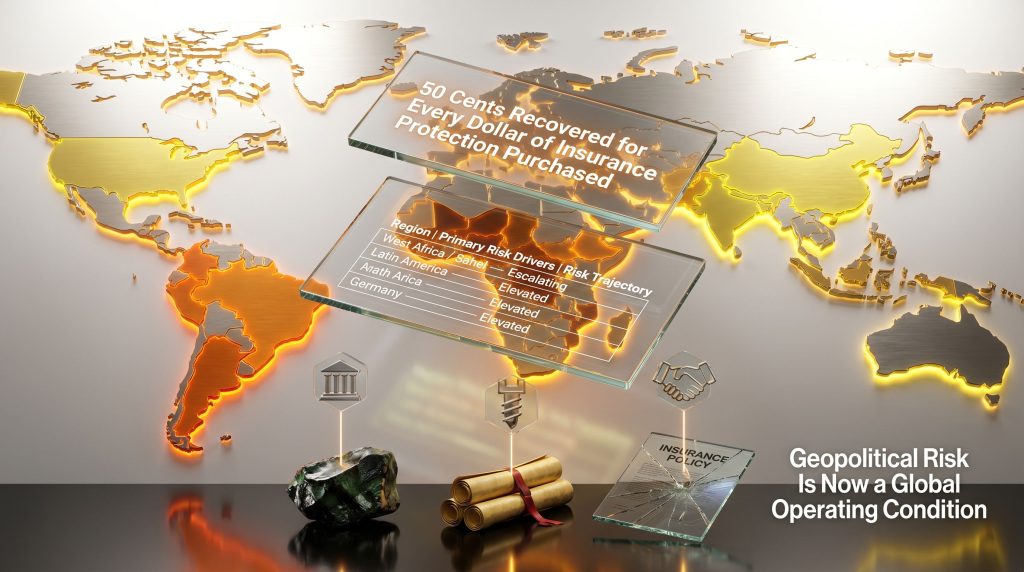
"The assumption that OECD membership or historical stability provides automatic protection from political interference is increasingly obsolete. Geopolitical risk is now a global operating condition, not a developing-world phenomenon."
Regional Risk Snapshot: Where Pressure Is Building in 2025–2026
| Region | Primary Risk Drivers | Risk Trajectory |
|---|---|---|
| West Africa / Sahel | Military governance, permitting instability, coup risk | Escalating |
| Latin America | Resource nationalism, royalty increases, community conflict | Elevated |
| North America | Regulatory uncertainty, permitting delays, policy swings | Rising |
| Asia-Pacific | Export controls, trade fragmentation, critical mineral competition | Elevated |
| Europe | Supply chain regulation, ESG compliance pressure | Moderate-Rising |
The Commodity Price Paradox: Why Rising Valuations Amplify Risk Exposure
One of the most counterintuitive dynamics in mining risk is the relationship between commodity prices and operational vulnerability. The instinct is to assume that higher commodity prices create a buffer, that elevated revenues absorb disruption costs and reduce the financial consequence of operational setbacks. The reality is, however, the opposite.
When commodity prices spike to multi-year or unprecedented highs, the financial consequence of any production disruption expands proportionally. A six-hour production stoppage at elevated gold or copper prices destroys far more value than the same event at lower price levels. Supply chain vulnerabilities that were tolerable during lower price environments become critical failure points when commodity values are elevated, because procurement competition intensifies and component lead times lengthen precisely when operational continuity matters most.
Capital project development carries the same dynamic. Engineering advancement and capital adequacy are necessary conditions for successful project delivery, but they are not sufficient. The tariff-driven supply chain risks that can derail project timelines become more consequential, not less, when project valuations are high.
This is what Raul Munoz, North American industry leader for mining and natural resources at Marsh, identifies as one of the most systematically underestimated risk dimensions in the current cycle. The excitement generated by elevated commodity valuations can obscure the fact that risk exposure is expanding in parallel, not contracting.
The 50-Cent Recovery Problem: What Insurance Data Actually Reveals
The mining industry's relationship with insurance is one of the most structurally misunderstood elements of risk management across the sector. The dominant assumption is that having coverage is equivalent to being protected. The data suggests otherwise.
Analysis of approximately $15 billion in mining loss data spanning 20 years reveals that for every dollar of insurance protection purchased, companies recover approximately 50 cents on average once the combined effect of deductibles, retention thresholds, sublimits, and policy exceptions is applied. For a deeper understanding of how geopolitical risk affects mining operations, this structural gap becomes even more significant.
"This structural recovery gap is not an anomaly specific to mining. It reflects the standard architecture of how insurance companies transfer risk across industries. What makes it particularly significant in mining is the scale of individual loss events and the degree to which management teams conflate coverage with actual financial protection."
Several mechanisms contribute to this gap:
- Retention levels and deductibles: Companies absorb a defined portion of every loss before policy coverage activates, and those retention thresholds are often set at levels that are significant relative to the actual loss
- Sublimits: Many policies contain category-specific caps that limit recovery for particular types of losses, underground mining losses being a clear and well-documented example, regardless of the overall policy limit
- Policy exceptions and exclusions: Insurance contracts are legal documents with extensive exception clauses. The specific conditions of a loss event may interact with those exceptions in ways that reduce recovery substantially
- Aggregation effects: When multiple smaller losses occur within a single policy period, the combined effect of retentions and sublimits can erode aggregate recovery far below the face value of coverage purchased
The practical implication is that insurance should be understood as one component of a broader risk transfer architecture, not as a complete solution. The shift from thinking about insurance to thinking about risk transfer as a broader discipline is a meaningful reframing that distinguishes sophisticated operators from those still treating risk management as a procurement function.
Comparing Protection Layers: Understanding the Full Risk Transfer Architecture
| Protection Layer | Mechanism | Scope | Key Limitation |
|---|---|---|---|
| Standard property/casualty insurance | Contractual indemnity | Physical asset loss | Sublimits, exceptions, retention gaps |
| Political risk insurance | Expropriation, currency, contract frustration | Political interference | Premium cost, coverage architecture |
| Investment treaty protection | State-to-state treaty claims | Unlawful government interference | Requires structural setup before a dispute |
| Business continuity planning | Operational resilience | Production disruption | Non-financial, requires proactive investment |
Investment Treaty Protection: A Different Layer of Geopolitical Defence
While political risk insurance operates as a contractual indemnity product, investment treaty protection functions through an entirely different legal mechanism. Bilateral investment treaties (BITs) are agreements signed between two states that, among other provisions, give investors the right to bring claims directly against a host state when government action unlawfully interferes with their investment.
The practical scope of this protection is broad. Treaty protections can be triggered by:
- Arbitrary or discriminatory regulatory changes that specifically target an investment
- Direct expropriation or measures that are economically equivalent to expropriation
- Denial of justice through domestic legal proceedings
- Breach of legitimate expectations that were established at the time an investment was made
Dr. Robert Kovac of Withers, an internationally recognised disputes lawyer specialising in investment protection and geopolitical disputes, notes that a critical aspect of treaty protection is the timing of structural setup. Treaty protections must be built into the investment architecture before a dispute emerges. A company that has not structured its investment to access treaty-level protections at entry cannot easily retrofit that protection once a government measure has already been taken.
This is a dimension of mining geopolitical risk management that separates highly sophisticated operators from the broader industry. Most companies think about legal structuring in the context of corporate governance and regulatory compliance. Fewer think about it as a pre-investment risk architecture decision that determines whether international law protections will be available if political conditions deteriorate.
"Political risk insurance and investment treaty protection are not competing instruments. They operate at different layers of the risk architecture. One provides contractual indemnity through a private market product. The other provides direct recourse against state action under international treaty standards. Companies that treat these as alternatives rather than complements leave meaningful protection gaps."
Human Rights and Community Risk: From Reputational Concern to Legal Liability
The evolution of human rights risk in mining over the past fifteen years represents one of the most significant structural shifts in the legal and operational landscape of the industry. What began as a reputational concern has consequently become a material legal liability with direct valuation consequences.
The Regulatory Timeline That Changed Everything
| Year | Regulatory Milestone | Impact on Mining Operations |
|---|---|---|
| 2011 | UN Guiding Principles on Business and Human Rights published | Established the baseline corporate responsibility framework for the industry |
| 2017–2020 | Modern slavery legislation enacted (UK, Australia) | Created mandatory supply chain disclosure obligations |
| 2021–2024 | EU Supply Chain Due Diligence Directive | Introduced binding human rights and environmental due diligence requirements |
| 2025–2026 | Expanding transnational tort litigation | Community claims now being pursued in home-country courts |
The most operationally significant development in recent years is the growth of transnational tort litigation, where affected communities bring claims in the home-country courts of mining companies. This removes the traditional assumption that legal exposure from community impacts is confined to the jurisdictions where mines operate. UK courts have already seen such cases proceed, and similar litigation frameworks are developing across multiple jurisdictions.
In addition, evolving Indigenous claims framework developments are reshaping how operators must engage with communities well before project development begins. The destruction of indigenous cultural heritage sites by a major mining company several years ago, which ultimately resulted in executive-level resignations, illustrates the severity of consequences that community and heritage impacts can generate.
On the positive side, mining companies operating in Africa and elsewhere have demonstrated that proactive community engagement, structured through formal grievance mechanisms and local partnership frameworks, can preserve operational continuity and protect asset value in situations that would otherwise have resulted in significant value destruction.
The next major ASX story will hit our subscribers first
Death by a Thousand Cuts: The Operational Risk Investors Are Underpricing
When investors and analysts assess operational risk in mining, the mental model tends to default to catastrophic events: tailings dam failures, major geological collapses, large-scale equipment losses. These events are real, but they represent the tail of the operational risk distribution. The more structurally damaging category of operational risk is far less dramatic and far more common.
Production losses of six or twelve hours, driven by inadequate maintenance culture, weak human process discipline, or absent business continuity protocols, accumulate into material valuation impacts over time. At elevated commodity prices, the financial consequence of this incremental attrition expands substantially.
What differentiates strong operators from vulnerable ones is not primarily their ability to respond to catastrophic events. It is the quality of their pre-loss preparation across routine operational dimensions. The strongest signals of operational resilience include:
- Boots-on-ground site assessment: Physical evaluation of operational culture, human processes, and community dynamics that cannot be captured through remote financial analysis
- Business continuity architecture: Pre-designed recovery protocols that have been stress-tested before losses occur, not improvised after them
- Supply chain visibility beyond Tier-1: Identification of concentration risks and fragility points across the full supply chain, not just primary contractors
- Structured community engagement: Local partnership frameworks that convert social licence risk into operational alignment
- Pre-established crisis management protocols: Coordinated legal, communications, and operational response frameworks that are ready before they are needed
- M&A resilience due diligence: Acquiring companies increasingly evaluating operational resilience as a core component of deal valuation, not just resource and financial metrics
What Sophisticated Investors Should Be Asking Right Now
The most revealing questions in mining investment due diligence are not about how a company would respond to a loss event. They are about what pre-existing structural conditions make a loss more or less likely in the first place.
Red Flags That Signal Structural Gaps in Risk Management
Recognising management red flags early can be the difference between preserving capital and experiencing material loss. The following indicators warrant particular scrutiny:
Red Flag 1: The conversation about risk immediately defaults to insurance coverage. Insurance should be the last component discussed in a mature risk management framework, not the first.
Red Flag 2: Risk management is framed as a compliance or procurement function rather than a strategic discipline integrated into operational and investment decision-making.
Red Flag 3: No differentiation between jurisdictional risk profiles. Treating Panama, the Ivory Coast, and Nevada as equivalent operating environments signals that jurisdiction-specific risk assessment is not being conducted.
Red Flag 4: Absence of sanctions compliance, AML controls, and supply chain audit trails. These are not optional elements of risk architecture for companies operating across multiple international jurisdictions.
Red Flag 5: No visible community engagement strategy or formal grievance mechanism. The absence of these structures is itself a risk indicator, not merely a reputational gap.
The Investor Due Diligence Framework: Questions That Actually Reveal Management Quality
- How is the investment structured to access treaty-level protections if government interference occurs?
- What jurisdiction-specific risk assessments have been conducted, and how recently were they updated?
- What supply chain visibility exists beyond primary contractors, and how is Tier-2 and Tier-3 exposure monitored?
- How are human rights obligations integrated into operational-level decision-making, not just sustainability reporting?
- What does the business continuity plan cover, and when was it last stress-tested against realistic scenarios?
- How does the company communicate community engagement outcomes to investors and other stakeholders?
Furthermore, the recent US mining permit changes underscore why regulatory monitoring must form part of ongoing due diligence, not merely initial project assessment.
Reactive vs. Resilient: The Management Quality Comparison
| Management Quality Indicator | Reactive Operator | Resilient Operator |
|---|---|---|
| Risk management framing | Insurance-first | Layered risk transfer architecture |
| Jurisdictional assessment | Assumed safe | Continuously monitored |
| Community engagement | Reactive to conflict | Embedded in operations |
| Crisis management | Ad hoc response | Pre-designed protocols |
| Human rights compliance | Minimum reporting obligations | Operational integration |
| Treaty structuring | Post-dispute consideration | Pre-investment structuring |
The Storytelling Gap: Why Good Operators Are Being Undervalued
One of the more counterintuitive findings from frontline risk practitioners is that many of the mining industry's strongest operators are being systematically undervalued, not because their risk management is weak, but because they fail to communicate it effectively.
Operators in jurisdictions like Peru have developed community partnership models in which indigenous-led enterprises take on operational roles including logistics and transport, creating genuine economic alignment between the mine and surrounding communities. These structures reduce social licence risk in measurable ways. Yet these stories rarely reach investors in a form that affects risk assessments or valuation models.
The proliferation of sustainability reporting over the past five to six years has been a positive development for the sector. However, the depth and specificity of community engagement outcomes that actually matter to risk-adjusted valuation are still not being communicated with the clarity and consistency they warrant. Research published via ScienceDirect on geopolitical risk and energy transition minerals further highlights how inadequate disclosure compounds investor uncertainty across the sector.
Proactive risk communication is consequently a competitive advantage, not just a governance obligation. Companies that build the narrative capacity to translate operational resilience into investor-legible signals will attract higher-quality capital and trade at premiums relative to operationally equivalent peers who remain silent on these dimensions.
FAQ: Mining Geopolitical Risk Management
What is geopolitical risk in mining?
Geopolitical risk in mining refers to the potential for political, regulatory, or social instability in operating jurisdictions to disrupt production, reduce asset values, or expose companies to legal liability. It encompasses resource nationalism, expropriation, arbitrary regulatory changes, community conflict, and supply chain disruption driven by political factors.
Which regions carry the highest geopolitical risk for mining in 2025–2026?
The West African Sahel carries acute instability risk driven by military governance and permitting uncertainty. Latin America presents elevated resource nationalism and community conflict exposure. North America is experiencing rising regulatory uncertainty. Critically, historically stable jurisdictions in developed economies are no longer considered automatically safe operating environments.
How does political risk insurance differ from investment treaty protection?
Political risk insurance is a contractual product providing indemnity against specific losses caused by political interference. Investment treaty protection is a structural legal mechanism giving investors the right to bring claims directly against a state for unlawful interference under international treaty standards. The two instruments are complementary and operate at different layers of the risk architecture.
Why do mining companies only recover approximately 50% of insured losses?
Analysis of approximately $15 billion in historical mining loss data indicates that the combined effect of deductibles, retention thresholds, sublimits, and policy exceptions means companies recover roughly 50 cents for every dollar of insurance protection purchased. This structural gap underscores the importance of treating insurance as one component of a broader risk management framework.
What questions should investors ask mining companies about geopolitical risk?
Investors should focus on pre-loss conditions rather than post-loss response plans. Key questions include how investments are structured to access treaty protections, what jurisdiction-specific risk assessments have been conducted, how supply chain visibility is maintained beyond Tier-1 suppliers, and how human rights obligations are integrated at the operational level.
How has human rights regulation changed the risk landscape for mining?
Since the UN Guiding Principles on Business and Human Rights were published in 2011, human rights risk has evolved from a reputational concern to a legal liability. Transnational tort litigation allows affected communities to bring claims in the home-country courts of mining companies. EU supply chain due diligence directives and modern slavery legislation in multiple jurisdictions now impose binding compliance obligations on mining operators.
Preparedness as the New Competitive Advantage in Mining
The future winners in mining will not be defined solely by resource grade, capital efficiency, or jurisdiction. They will be defined by the quality of their risk architecture, specifically their capacity to build layered, proactive systems that convert geopolitical, legal, and operational risk into manageable variables rather than unexpected value destroyers.
The convergence of supply chain fragmentation, resource nationalism, transnational legal liability, and rising stakeholder expectations means that mining geopolitical risk management is no longer a supporting function. It is the discipline that determines whether a project retains its value through conditions that will destroy less prepared operators.
Companies that understand this, that structure their investments to access treaty protections before disputes emerge, that build business continuity protocols before losses occur, that engage communities before conflicts develop, and that communicate their risk architecture to investors with clarity and consistency, will attract better capital, trade at higher multiples, and sustain operational continuity through the cycles that expose everyone else.
"In a global environment defined by uncertainty, preparedness is not a cost centre. It is a valuation driver. The question for every mining investor is not whether the companies they hold understand this principle. It is whether they can demonstrate it."
This article is intended for informational purposes only and does not constitute financial advice or a recommendation to invest in any security or asset class. Forward-looking statements and projections involve inherent uncertainty. Readers should conduct their own due diligence and consult qualified professional advisers before making investment decisions.
Want to Know Which ASX Mining Companies Are Making Significant Discoveries Right Now?
Discovery Alert's proprietary Discovery IQ model delivers real-time alerts the moment significant ASX mineral discoveries are announced, giving investors an immediate edge in identifying companies with strong operational fundamentals before the broader market reacts — explore Discovery Alert's discoveries page to see the historic returns major mineral discoveries have generated, and begin a 14-day free trial to position yourself ahead of the next major find.