May 15, 2026
The Architecture of Cross-Border Capital: Why Mining Companies Are Rethinking Where They List
For most of the past three decades, the global mining capital stack followed a predictable geography. Toronto handled the juniors, London absorbed the majors, and Sydney catered to the resource-heavy Australian market. New York was largely viewed as a destination reserved for the largest, most liquid producers. That structural assumption is now being tested, and a US listing for mining companies has moved from a peripheral consideration to a genuine strategic priority.
The forces reshaping this dynamic are not temporary. A convergence of commodity price strength, geopolitical supply chain pressure, and a renewed institutional appetite for real assets has repositioned mining from a niche commodity play into a sector with direct relevance to national defence, energy transition infrastructure, and monetary policy hedging. The question is no longer whether US markets are relevant to mining. The question is whether a specific company is ready to meet what those markets demand.
When big ASX news breaks, our subscribers know first
Why the US Capital Market Conversation Is No Longer Optional
Gold, Geopolitics, and the Deregulation Tailwind
Three distinct forces have aligned to make the US listing conversation more compelling than at any previous point in modern mining history.
The first is commodity pricing. Record gold prices have reached record nominal levels, driven by a combination of persistent inflation, central bank buying, and investor demand for hard asset exposure. Silver has followed a similar trajectory. These price movements have elevated the financial profile of mining companies across the capitalisation spectrum, making them more attractive to institutional allocators who had previously deprioritised the sector.
The second force is geopolitical in nature. The restructuring of global supply chains, particularly the strategic effort to reduce dependence on Chinese processing and production across critical mineral categories, has elevated the policy relevance of domestic and allied-nation mining. Critical minerals and energy security have moved from a commodity story into a national security conversation, one being held at the highest levels of government and defence policy.
The third force is regulatory. The Trump critical minerals order has issued a series of executive directives aimed at promoting domestic resource development and streamlining the regulatory environment for mining. While this does not represent project-specific support for individual companies, the broader deregulatory posture has contributed to a more favourable sentiment environment among US investors toward the resource sector.
These three forces have not created the US capital market opportunity for mining. That opportunity existed before. What they have done is activate latent institutional interest that had previously not been systematically targeted by the mining sector.
The Institutional Depth Argument
One of the most consistently underappreciated structural advantages of a US listing is the sheer scale of the institutional investor base. A significant proportion of institutional capital that already holds Canadian mining equities is US-domiciled. Many of these funds face internal mandate restrictions that limit or complicate their ability to hold securities not listed on recognised US exchanges.
A US listing does not create new investment theses. It removes the structural friction that prevents existing investment theses from being executed at full scale. Settlement infrastructure, custody arrangements, regulatory familiarity, and index eligibility all function more efficiently for securities listed on NASDAQ or the NYSE than for foreign-listed equivalents held through cross-border custody arrangements.
The practical consequence is that a US listing can accelerate the natural progression from retail-dominated to institutionally weighted ownership — a transition that most growth-stage mining companies pursue but often struggle to achieve on Canadian or Australian exchanges alone.
What a US Listing Actually Delivers and What It Demands
The Exchange Landscape: Matching Venue to Company Profile
Not all US exchange listings are structurally equivalent. The three primary venues available to mining companies carry distinct reputational profiles, investor base characteristics, and listing requirements.
| Exchange | Typical Company Profile | Key Advantage | Notable Mining Listings |
|---|---|---|---|
| NYSE | Large-cap, established producers | Maximum institutional credibility | Newmont (NEM), Freeport-McMoRan (FCX), Southern Copper (SCCO) |
| NASDAQ | Mid-cap, growth-oriented | Technology-adjacent institutional base | U.S. Gold Corp (USAU), various cross-listers |
| OTC Markets | Early-stage, smaller float | Lower barrier to entry | Smaller explorers and developers |
For most growth-stage and mid-cap mining companies pursuing a cross-listing, NASDAQ represents the most practical primary target. Its listing standards are achievable for companies of meaningful but not massive scale, and its institutional investor base spans a wide range of sector orientations. Furthermore, the junior mining investment landscape has evolved considerably, with smaller producers now increasingly viable candidates for US exchange consideration.
Minimum NASDAQ Listing Requirements for Mining Companies (2025)
To qualify for a NASDAQ listing, mining companies generally need to satisfy the following baseline thresholds:
- Minimum public float: $15 million (non-affiliated shareholders)
- Minimum shareholders' equity: $5 million
- Market capitalisation: Typically $75 million or above for streamlined cross-listing pathways
- Financial statements: Must comply with US GAAP or reconciled IFRS standards
- Technical reporting: SK-1300 technical report summaries required for all material properties (non-MJDS filers)
"The bar to list in the United States is not as prohibitively high as many mining executives assume. A $15 million non-affiliated public float and $5 million in shareholders' equity are the two most critical thresholds. Companies that meet those two requirements can technically qualify. The more significant challenge is ensuring enough post-listing capital to sustain the ongoing compliance infrastructure."
The MJDS System: The Most Underutilised Pathway in Mining Capital Markets
How the Multi-Jurisdictional Disclosure System Works
For eligible Canadian issuers, the Multi-Jurisdictional Disclosure System (MJDS) represents one of the most strategically underutilised tools available in cross-border capital markets. It is a bilateral regulatory framework between the United States and Canada that permits qualifying Canadian companies to access US markets using substantially the same disclosure documents already filed with Canadian regulators.
The core logic of MJDS is regulatory equivalence. Canada and the United States have agreed that certain Canadian disclosure standards are sufficiently comparable to their US equivalents that duplication serves no material investor protection purpose. As a result, MJDS-eligible companies can list in the US without rebuilding their entire disclosure infrastructure from scratch.
Key eligibility criteria for MJDS:
- Minimum market capitalisation of approximately $75 million USD (non-affiliated public float)
- Must be a reporting issuer in good standing under Canadian securities law
- Must have filed continuous disclosure documents with Canadian regulators for a minimum of 12 months
What the MJDS pathway simplifies:
- Canadian NI 43-101 technical reports are accepted in lieu of US SK-1300 reports
- Canadian GAAP or IFRS financial statements are accepted without full US GAAP reconciliation
- The primary US filing is a wrapper document (Form F-10 or Form 40-F) around existing Canadian disclosure materials
- Post-listing capital raises can be executed through an F-10 registration statement process that essentially mirrors the Canadian filing structure
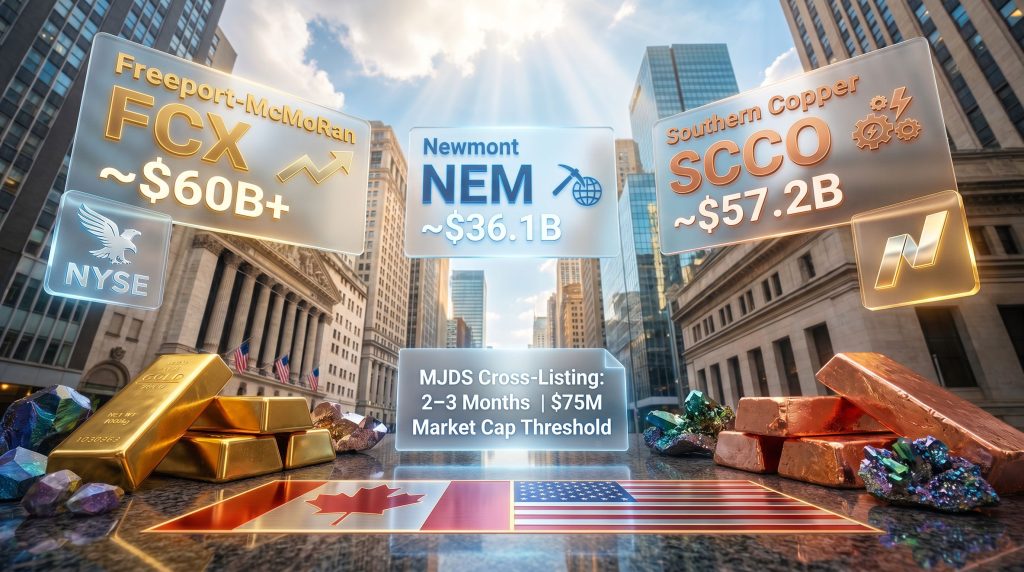
The timeline for an MJDS cross-listing, assuming the company is already in regulatory good standing in Canada, is typically two to three months from initiation to completed US listing. That is a materially compressed timeline compared to any alternative pathway.
Pathway Comparison: MJDS vs. Traditional IPO vs. Reverse Merger
| Pathway | Best Suited For | Complexity | Timeline | Key Regulatory Hurdle |
|---|---|---|---|---|
| MJDS Cross-Listing | Canadian issuers with $75M+ market cap | Low | 2 to 3 months | Existing Canadian compliance in good standing |
| Traditional US IPO | Non-Canadian issuers, growth-stage companies | High | 9 to 18 months | SEC review, SK-1300 reports, US GAAP compliance |
| Reverse Merger / RTO | Smaller companies seeking faster market access | Medium to High | 3 to 6 months | Due diligence complexity, shell company risks |
| Form 20-F Direct Listing | Non-MJDS foreign private issuers | Medium | 6 to 12 months | Full SEC disclosure compliance |
It is worth noting that some Canadian companies have bypassed the MJDS pathway entirely and pursued a straight IPO directly on a US exchange. While this is a more resource-intensive process, it can be appropriate for companies seeking to establish their primary trading market in the United States from day one rather than maintaining parallel listings.
Compliance Pitfalls: Where Mining Companies Most Often Fail
The SK-1300 Technical Report Problem
For mining companies pursuing a traditional US IPO or Form 20-F registration, the SEC's SK-1300 standard introduces a technical reporting obligation that is frequently underestimated in terms of time and resource requirements.
SK-1300 requires technical report summaries for every property considered material to the company's business. Each report must be prepared by a qualified person, must comply with SEC-specific disclosure language around reserves and resource classifications, and must be accompanied by the written consent of every author named in the report.
"Mining companies with multiple material properties should begin the SK-1300 technical reporting process significantly in advance of initiating their IPO timeline. Delays in obtaining completed reports and securing author consents are among the most common causes of extended SEC review periods for mining issuers. This is one area where companies regularly underestimate the lead time required."
MJDS filers are exempt from this requirement, which is one of the primary structural advantages of the Canadian cross-listing pathway. Companies pursuing non-MJDS routes should, however, treat technical report preparation as a parallel workstream to legal and financial preparation, not a sequential one.
Financial Statement Readiness and Audit Standards
A second compliance failure point involves financial statement preparedness. Companies pursuing US listings through non-MJDS pathways must ensure their financial statements comply with US GAAP or provide a full reconciliation. Audit quality, audit firm recognition, and the ability to produce clean financial statements on an accelerated timeline all matter significantly in how the SEC evaluates a registration.
The importance of the Chief Financial Officer in this context cannot be overstated. Experienced legal practitioners in the cross-listing space consistently identify CFO capability as a more critical near-term factor than CEO profile when evaluating a company's listing readiness. The CFO is the functional owner of ongoing disclosure obligations, and an underqualified finance function creates material compliance risk at precisely the moment when investor scrutiny is highest.
SEC Review Risk and the Investor Relations Gap
Companies that do not qualify for MJDS and pursue either a reverse takeover structure or a direct Form 20-F registration are exposed to the full SEC review process. This can extend timelines significantly when documentation is incomplete, technical reports are not in order, or financial statements require material reworking.
Separately, and often overlooked by mining executives focused on regulatory compliance, is the investor relations gap. A US listing for mining companies places the business in a market with thousands of listed securities competing simultaneously for institutional attention. Without a structured pre-listing and post-listing investor relations programme — including conference participation, roadshow infrastructure, and proactive media engagement — it is genuinely possible for a newly listed mining company to generate almost no incremental trading activity.
Assessing Readiness: The Three Pillars Framework
Financial Infrastructure
- A CFO with experience managing public company disclosure obligations in a continuous reporting environment
- Audit-ready financial statements prepared to the applicable standard (US GAAP, reconciled IFRS, or Canadian GAAP for MJDS filers)
- A minimum of 12 to 24 months of post-listing operating capital secured before proceeding, covering legal fees, audit costs, investor relations expenditure, and exchange compliance obligations
Governance and Board Composition
- Independent directors with relevant sector expertise across mining, finance, and capital markets
- Board-level understanding of continuous disclosure obligations under US securities law
- Risk management frameworks aligned with SEC expectations for public company governance
Capital Markets Strategy
- A pre-listing investor relations strategy with defined institutional targets and conference presence
- A coherent equity story capable of competing within a crowded US market where commodity, technology, and growth equities all compete for the same institutional capital
- Clear production milestones, resource expansion catalysts, or strategic asset characteristics that differentiate the company within its commodity category
The next major ASX story will hit our subscribers first
Which Commodities Are Commanding US Investor Attention
Gold and Silver: The Inflation Hedging Mandate
Gold and silver remain the most actively cross-listed commodity categories in the current cycle. Sustained institutional interest in precious metals producers and developers has reached levels not seen in previous cycles, driven by monetary policy uncertainty and safe-haven demand. Silver has followed gold's trajectory with increasing momentum.
Uranium: Quiet but Significant Cross-Listing Activity
The uranium market dynamics of recent years have made it one of the more active cross-listing categories, driven by the intersection of energy security policy, nuclear power's role in decarbonisation, and constrained global supply. Legal practitioners working extensively in the cross-border mining space have noted uranium as a disproportionately active category relative to its broader market visibility.
Critical Minerals and the Energy Transition
Copper, rare earth elements, and lithium occupy a distinct narrative space in the US investor conversation. These commodities are positioned at the intersection of electric vehicle infrastructure, grid storage buildout, and defence manufacturing supply chains. The policy relevance of these materials has created a category of investor interest that goes well beyond traditional commodity cycle analysis.
Aluminium, by contrast, has seen markedly less cross-listing activity. Despite its industrial significance, aluminium is not currently classified as a critical mineral under most US policy frameworks, and the presence of substantial recycled supply in the market reduces the supply constraint narrative that drives enthusiasm for other materials.
Top US-Listed Mining Companies by Approximate Market Capitalisation (2025)
| Company | Ticker | Market Cap (Approx.) | Primary Commodity |
|---|---|---|---|
| Freeport-McMoRan | FCX | ~$60B+ | Copper, Molybdenum |
| Southern Copper | SCCO | ~$57.2B | Copper, Zinc, Silver |
| Newmont Corporation | NEM | ~$36.1B | Gold, Copper, Silver |
| MP Materials | MP | ~$5.8B | Rare Earth Minerals |
| Hecla Mining | HL | ~$3.1B | Silver |
For a broader view of US-based mining companies and their market positioning, publicly available industry resources provide useful context for benchmarking listing ambitions against established peers.
A Three-Step Decision Framework Before Pursuing a US Listing
Step 1: Determine Your Qualifying Pathway
Before engaging external advisers or committing internal resources, every mining company should first establish with clarity which listing pathway it actually qualifies for. The MJDS route, available to Canadian issuers meeting the $75 million market cap threshold, is the lowest-friction option by a significant margin. Companies below that threshold, or incorporated outside Canada, must evaluate the traditional IPO, reverse merger, or Form 20-F pathways, each carrying distinct cost profiles, timelines, and regulatory exposure.
Step 2: Audit Internal Financial and Governance Infrastructure
A US listing for mining companies is a sustained compliance commitment, not a discrete transaction. Before initiating any public filing process, companies should conduct a rigorous internal assessment of their financial reporting capability, board composition, and audit readiness. Non-MJDS filers should also conduct a full inventory of material properties to assess the scope of technical reporting work required under SK-1300.
Step 3: Build a Pre-Listing Investor Relations Strategy
Entering the US market without a structured investor engagement programme is one of the most commonly underestimated risks in the cross-listing process. Conference attendance, roadshow preparation, targeted institutional outreach, and consistent media presence are not optional add-ons to a US listing strategy. They are prerequisites for converting the listing into genuine liquidity and investor diversification.
Frequently Asked Questions: US Listings for Mining Companies
Can a small exploration-stage mining company list directly on NASDAQ?
Yes, provided it meets the minimum public float threshold of $15 million and holds at least $5 million in shareholders' equity. However, smaller companies must carefully evaluate whether their post-listing capital position can sustain ongoing compliance costs before proceeding.
How long does it take for a Canadian mining company to cross-list in the US using MJDS?
Typically two to three months from initiation, assuming the company is already in good regulatory standing in Canada and meets the MJDS eligibility criteria including the $75 million non-affiliated public float requirement.
What is the practical difference between SK-1300 and NI 43-101 technical reports?
Both serve as technical reporting standards for mineral properties, but SK-1300 is the SEC's US-specific standard while NI 43-101 is the Canadian equivalent. MJDS filers can rely on their existing NI 43-101 reports. Non-MJDS filers must prepare SK-1300-compliant summaries for all material properties, a process that is significantly more time-intensive when a company holds multiple assets.
What commodity sectors are currently seeing the most US cross-listing activity?
Gold, silver, and uranium have seen the most active cross-listing interest in the current period. Critical minerals broadly — including copper, rare earths, and lithium — are attracting increasing institutional attention due to their strategic policy relevance. Aluminium has seen comparatively limited activity.
Is a reverse merger a viable alternative to a traditional IPO for accessing US markets?
It can be, particularly for companies seeking faster market access without meeting MJDS eligibility criteria. However, reverse mergers carry their own due diligence complexities, reputational considerations, and regulatory scrutiny that companies should evaluate carefully before committing to that structure.
Do US institutional investors already hold positions in Canadian-listed mining companies?
Yes. A substantial portion of institutional capital already holding Canadian mining equities is US-based. A US listing removes the structural barriers — including settlement, custody, and regulatory familiarity — that can limit the depth and scale of that participation.
The Maturity Test: What the US Market Demands That Others Do Not
Credibility as a Structural Requirement
The US capital market does not simply reward listing. It rewards preparation, governance, and the ability to sustain the ongoing obligations of public company life in a high-scrutiny environment. Mining companies that arrive without adequate financial infrastructure, a compelling equity story, and a functioning investor relations programme will find that the liquidity and institutional access they anticipated remains theoretical.
The companies that have successfully leveraged US cross-listings to fundamentally expand their investor base share a common characteristic: they treated the listing as the beginning of a sustained capital markets programme rather than a destination in itself. The listing creates the access. Sustained engagement creates the value.
"A US listing for mining companies is not simply a market access exercise. For those with the right assets, governance standards, and capital markets strategy, it functions as an institutional credibility signal that positions the business within a global conversation about critical minerals, resource security, and long-term commodity fundamentals. The companies that succeed are those that arrive prepared for what comes after the listing, not just the listing itself."
Critical minerals are no longer a peripheral conversation in the global economy. They are embedded in energy policy, defence procurement, technology manufacturing, and monetary frameworks simultaneously. For mining companies with genuine asset quality and the organisational maturity to meet US market standards, the cross-listing opportunity is real, substantial, and increasingly urgent to evaluate.
This article is intended for informational purposes only and does not constitute financial advice or a recommendation to invest in any security. Readers should conduct their own due diligence and consult qualified professional advisers before making any investment decisions. Market capitalisation figures are approximate and subject to change.
Want To Be Among The First To Know When The Next Major ASX Mineral Discovery Hits The Market?
Discovery Alert's proprietary Discovery IQ model delivers real-time alerts the moment significant mineral discoveries are announced on the ASX, cutting through complex data to surface actionable opportunities across more than 30 commodities — from gold and copper to critical minerals driving the energy transition. Explore historic discovery returns on Discovery Alert's dedicated discoveries page and begin your 14-day free trial at discoveryalert.com.au to position yourself ahead of the broader market.