May 13, 2026
Understanding the Mining Investment Revolution
Modern mining companies face unprecedented capital allocation pressures as traditional resource extraction models confront evolving market dynamics. The intersection of regulatory complexity, operational cost escalation, and commodity price volatility has fundamentally altered investment decision frameworks across the sector. This transformation extends beyond cyclical downturns to represent structural shifts in how mining operations compete for scarce capital resources, reflecting broader mining industry evolution patterns.
The Australian mining landscape exemplifies these challenges, where established operations that historically generated reliable cash flows now struggle to justify continued investment. BHP coal mines investment challenges reflect broader industry patterns where traditional fossil fuel assets compete unsuccessfully against future-facing commodities for limited capital allocation.
When big ASX news breaks, our subscribers know first
The Capital Allocation Crisis in Modern Mining
Investment returns in coal operations have deteriorated to unprecedented levels, with some major Queensland operations generating zero returns despite substantial revenue streams. BHP's Queensland coal portfolio, operated through a 50-50 joint venture with Mitsubishi Development Pty Ltd., generated $1.67 billion in revenue during the six months through December 2025, yet delivered no profitability during this period.
This represents a fundamental breakdown in traditional mining economics where large-scale production volumes typically ensure baseline profit margins. The situation extends beyond normal commodity cycle volatility to encompass structural factors that undermine the basic investment thesis for coal operations.
Key Performance Deterioration Indicators:
• Revenue generation failing to translate into operational returns
• Capital investments producing zero cash return on deployment
• Operating cash flows insufficient to cover maintenance expenditures
• Total capital requirements exceeding production-related cash generation
• Competitive positioning deteriorating versus alternative investment opportunities
Economic Forces Reshaping Mining Profitability
Cost Inflation Convergence
Multiple cost inflation vectors have converged to create operational margin compression across Queensland coal operations. Unlike cyclical downturns where typically one or two factors drive profitability deterioration, current conditions present simultaneous escalation across all major expense categories.
Labor Market Pressures:
Queensland mining operations face intense competition for skilled workers across multiple resource sectors. Iron ore, lithium exploration, and critical minerals development offer comparable or superior wages, creating persistent upward pressure on labor costs. This dynamic reflects broader Australian employment conditions combined with sector-specific talent scarcity.
Equipment and Infrastructure Costs:
Mining equipment procurement continues experiencing elevated inflation despite post-pandemic supply chain normalisation. Furthermore, semiconductor shortages and manufacturing capacity constraints in specialised mining equipment sectors maintain cost escalation rates of 15-20% annually. These increases directly impact haul truck fleets, processing machinery, and maintenance operations.
Energy Input Escalation
Operational energy costs encompassing diesel for haul truck fleets, electricity for processing operations, and natural gas for thermal processing have created significant margin compression. Queensland coal operations face particular vulnerability to energy price volatility given their dependence on fuel-intensive extraction and transport operations. Moreover, companies are exploring various capital raising methods to fund operational improvements.
Infrastructure Bottleneck Analysis
Queensland coal operations depend critically on third-party infrastructure including the Central Queensland Coal Network and port facilities at Gladstone. Unlike operational costs that companies can address through efficiency initiatives, infrastructure constraints require government investment or negotiation with competing mining users.
Congestion and maintenance backlogs translate directly to operational delays and cost escalation. During periods of elevated coal demand, capacity constraints paradoxically drive logistics costs upward precisely when commodity prices support higher margins, creating a systematic reduction in returns during optimal price environments.
Commodity Price Volatility Impact Framework
Metallurgical Coal Price Dynamics
Metallurgical coal pricing reflects global supply-demand balances with limited geographical substitution options. Unlike standardised global markets for oil or natural gas, coal pricing remains segmented by trade routes and logistics costs, creating regional price disparities that cannot be arbitraged efficiently.
Queensland coal competes primarily in Asian markets where Chinese steel production sets marginal pricing. When Chinese steelmakers reduce blast furnace utilisation rates, metallurgical coal prices experience rapid deterioration regardless of Queensland-specific supply-demand fundamentals. These challenges align with broader energy transition insights affecting commodity markets.
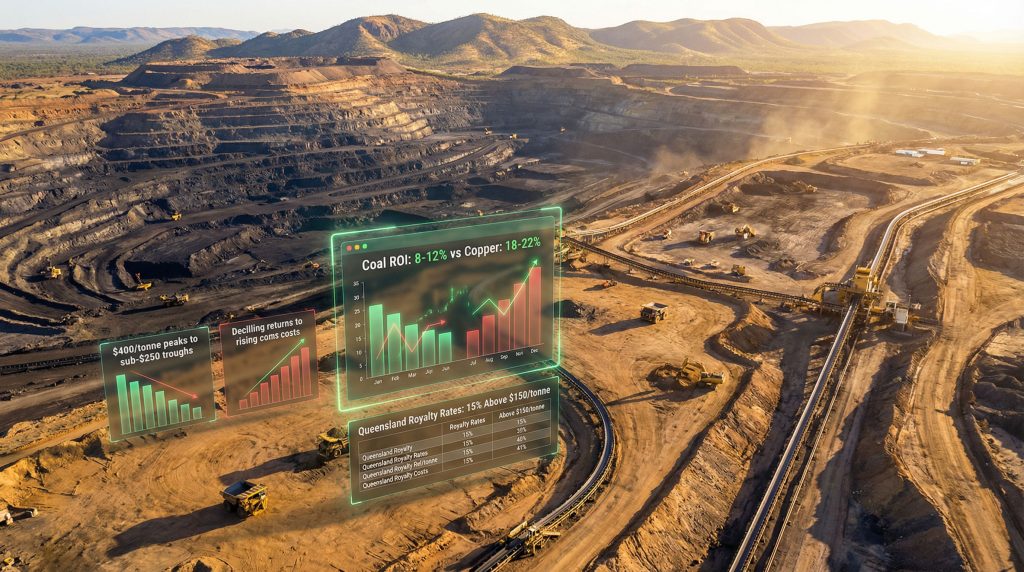
Recent price volatility has ranged from peaks exceeding $400 per tonne to troughs below $250 per tonne, representing approximately 37.5% downside movement from peak levels. This volatility creates severe earnings unpredictability for operations designed with higher price assumptions embedded in capital budgeting frameworks.
Asian Steel Production Impact:
| Region | Steel Production Trend | Coal Demand Impact |
|---|---|---|
| China | Plateauing after decades of growth | Primary demand driver declining |
| India | Moderate growth continuing | Partial offset to Chinese decline |
| Southeast Asia | Infrastructure-driven expansion | Supporting metallurgical coal demand |
| Europe | Industrial contraction | Reducing export opportunities |
Thermal Coal Secular Decline
Global thermal coal consumption for electricity generation has entered structural decline as renewable energy capacity expands across developed markets. European thermal coal demand has contracted sharply, whilst North American consumption follows similar trajectories. Emerging market coal demand growth, primarily in India, provides only partial offset against developed market contraction.
This secular demand destruction creates permanent headwinds for thermal coal operations, distinguishing current conditions from cyclical price downturns where demand recovery could reasonably be anticipated within normal commodity cycle timeframes. In addition, developments in battery recycling breakthrough technologies further emphasise the transition away from fossil fuels.
Queensland's Progressive Royalty Structure Analysis
Royalty Rate Mechanics
Queensland's coal royalty regime employs a progressive rate structure that concentrates state revenue extraction during periods when operations should be most cash-generative. This approach contrasts with flat-rate royalty systems that provide operational predictability across commodity cycles.
Current Queensland Coal Royalty Structure:
| Coal Price Range (AUD/tonne) | Royalty Rate | Combined Tax Burden |
|---|---|---|
| Below $100 | 7% | 37% |
| $100-$150 | 12.5% | 45% |
| Above $150 | 15% | 52% |
The combined tax burden figures incorporate both coal royalties plus corporate income tax on remaining profits. At maximum rates, Queensland state and federal governments collectively extract 52% of gross coal revenues, leaving operating companies with 48% for operational expenses, capital investment, and shareholder returns.
According to a recent analysis, BHP has explicitly stated that its coal mines cannot compete for capital allocation under current conditions. This statement underscores the severity of the BHP coal mines investment challenges facing the sector.
Comparative Jurisdictional Assessment
Western Australia Iron Ore: Maintains a flat 7.5% royalty rate, enabling capital planning with consistent after-royalty cash generation assumptions across commodity cycles.
New South Wales Coal: Employs more flexible royalty structures that provide operators with greater predictability in capital budgeting frameworks.
International Operations: Demonstrate 25-35% lower total tax burdens compared to Queensland coal operations, creating material competitive disadvantages for Australian-based extraction.
The progressive structure theoretically protects government revenue during price downturns whilst capturing increased revenue during upswings. However, practical implementation creates a systematic penalty on operational success, reducing cyclical volatility buffering that fixed-rate royalties provide.
Strategic Portfolio Optimisation Scenarios
Selective Divestment Strategy
Target Assets for Divestment:
• Daunia mine operations
• Caval Ridge extension projects
• Other lowest-margin thermal coal operations
Retention Strategy:
• Goonyella Riverside (high-grade metallurgical coal)
• Peak Downs (premium product characteristics)
• Core metallurgical coal assets with sustainable competitive advantages
Financial Impact Projections:
• Expected capital release: $3-5 billion over three-year period
• Risk mitigation through reduced volatile thermal coal exposure
• Portfolio concentration on highest-margin operations
This approach enables capital redeployment toward higher-return opportunities whilst maintaining exposure to premium metallurgical coal markets that demonstrate greater pricing stability and demand resilience.
Joint Venture Restructuring Options
Renegotiating the existing 50-50 partnership with Mitsubishi Development requires mutual agreement on strategic direction, presenting execution risks if partners maintain divergent asset valuations. Historical precedent suggests such joint venture restructuring negotiations extend 12-18 months for complex mining joint ventures.
Infrastructure Sharing Initiatives:
• Port facility capacity optimisation
• Rail network utilisation coordination
• Shared maintenance and logistics operations
• Potential cost savings of 12-18% through operational synergies
Infrastructure sharing with competitors represents unconventional approaches for traditionally competitive mining operations. Regulatory approval processes and practical implementation barriers limit the applicability of such arrangements across the Queensland coal sector.
Technology-Driven Efficiency Implementation
Autonomous Haulage Systems:
• Labor cost reduction potential: 20-30%
• Implementation timeline: 18-36 months for phased deployment
• Operational precedent: Rio Tinto Pilbara iron ore operations
Predictive Maintenance Technology:
• Equipment downtime reduction through sensor-based monitoring
• Maintenance cost optimisation via predictive analytics
• Integration with existing operational management systems
Digital Twin Mine Planning:
• Optimised extraction sequencing
• Real-time operational adjustment capabilities
• Enhanced resource recovery through modelling precision
Autonomous haul truck technology demonstrates operational viability across multiple mining sites globally, though implementation requires substantial capital investment and workforce transition management.
The next major ASX story will hit our subscribers first
Global Steel Industry Transformation Impact
Steelmaking Technology Evolution
Electric Arc Furnace Adoption:
• Reducing metallurgical coal demand by 2-3% annually
• Increasing steel recycling utilisation rates
• Particularly prevalent in developed market steel production
Hydrogen-Based Steel Production:
• Pilot projects demonstrating technical feasibility
• Long-term threat to traditional blast furnace metallurgical coal demand
• Implementation timeline: 2030-2040 for commercial scale deployment
Steel Recycling Rate Increases:
• Developed markets achieving 80%+ recycling rates
• Reducing primary steel production requirements
• Diminishing overall metallurgical coal consumption per unit of steel output
These technological shifts represent structural demand headwinds that extend beyond cyclical steel production variations to threaten fundamental metallurgical coal consumption patterns.
Capital Allocation Framework Evolution
Investment Hurdle Rate Adjustments
Modern mining capital allocation frameworks incorporate multiple risk premium adjustments that significantly elevate required returns for coal projects relative to historical standards.
Adjusted Return Requirements:
| Risk Factor | Premium Addition | Rationale |
|---|---|---|
| Base case requirements | 15% IRR | Standard mining project threshold |
| Regulatory uncertainty | +3-5% | Queensland royalty volatility |
| Climate transition risk | +2-3% | Stranded asset provisions |
| Commodity price volatility | +2-4% | Historical price standard deviation |
Stranded Asset Provisions:
Coal projects now require 10-15% discounts for climate transition risks, reflecting potential asset value impairment as global energy systems transition toward renewable alternatives.
Alternative Investment Comparison Matrix
Expected Investment Returns by Asset Class:
| Asset Class | Expected IRR | Risk Profile | Capital Requirements | Strategic Priority |
|---|---|---|---|---|
| Copper expansion | 18-22% | Medium | $2-4B per project | High |
| Iron ore optimisation | 16-20% | Low-Medium | $1-3B per project | Medium-High |
| Nickel development | 20-25% | High | $3-6B per project | High |
| Coal maintenance | 8-12% | High | $500M-1B annually | Low |
This comparative framework demonstrates how BHP coal mines investment challenges stem from fundamental competitive disadvantage in capital allocation decisions rather than temporary operational difficulties.
Future-Facing Commodity Transition Strategy
Capital Reallocation Priorities
Copper Project Acceleration:
• Chilean and Peruvian expansion opportunities
• Energy transition demand growth supporting long-term pricing
• Infrastructure and operational expertise transferability from existing operations
Battery Metals Development:
• Nickel operations supporting electric vehicle battery demand
• Lithium exploration and development opportunities
• Strategic positioning for energy storage market growth
Potash Development:
• Saskatchewan fertiliser demand supporting global food security requirements
• Population growth driving agricultural productivity enhancement needs
• Limited geographical concentration creating supply security premium
Strategic Transition Timeline Framework
2026-2027 Period:
• Optimisation of existing coal operations through efficiency initiatives
• Selective divestment of marginal coal assets
• Capital preservation pending market condition stabilisation
2028-2030 Period:
• Major capital deployment shift toward copper and critical minerals
• Accelerated development of battery metals projects
• Reduced coal operation maintenance capital to minimum viable levels
2030+ Outlook:
• Coal operations maintained exclusively if generating superior returns
• Portfolio concentration on energy transition supporting commodities
• Complete strategic realignment toward future-facing commodity exposure
Investment Risk Assessment Framework
Regulatory Risk Quantification
Queensland coal operations face regulatory risk weighting of 25-30% in total project risk assessments, significantly higher than comparable mining operations in other jurisdictions. This elevated risk premium reflects:
• Progressive royalty rate unpredictability
• Environmental compliance cost escalation
• Potential for additional regulatory restrictions
• Infrastructure access dependency on government policy
Furthermore, an industry report describes BHP's coal operations as transitioning from "cash cow to capital trap," highlighting the deteriorating investment proposition.
Operational Risk Factor Analysis
Labour Availability Constraints:
• Skills shortage driving wage inflation beyond productivity gains
• Competition from alternative mining sectors for qualified workers
• Remote location operational challenges increasing recruitment costs
Equipment Reliability Dependencies:
• Specialised coal mining equipment replacement costs escalating
• Limited supplier alternatives creating procurement vulnerabilities
• Maintenance cost inflation exceeding general industrial equipment trends
Environmental Compliance Trajectory:
• Compliance costs trending upward 8-12% annually
• Regulatory complexity increasing operational management burden
• Environmental impact assessment requirements extending project timelines
Market Psychology and Investor Sentiment
Capital Market Perception Shifts
Institutional investors increasingly apply environmental, social, and governance (ESG) screening criteria that explicitly exclude or limit coal asset exposure. This systematic capital constraint creates permanent valuation discounts for coal operations regardless of operational performance metrics.
Financing Availability Constraints:
• Traditional mining project financing increasingly unavailable for coal developments
• Insurance costs escalating due to climate-related risk assessments
• Debt financing terms incorporating climate transition risk premiums
Competitive Capital Allocation Pressures
Mining companies face internal competition between coal operations and future-facing commodity projects for scarce capital resources. Management teams must justify coal investments against copper, nickel, and lithium opportunities that offer superior risk-adjusted returns with positive long-term demand trajectories.
This internal capital competition has fundamentally altered investment decision frameworks where coal projects require exceptional returns to justify capital deployment relative to alternative opportunities within the same corporate portfolio.
Conclusion: Navigating Industrial Transformation
BHP coal mines investment challenges exemplify broader mining industry transformation where traditional fossil fuel extraction competes unsuccessfully against future-facing commodities for scarce capital resources. The convergence of regulatory complexity, operational cost escalation, and commodity demand uncertainty has created structural headwinds that extend beyond normal cyclical downturns.
Successful navigation requires disciplined capital allocation frameworks that prioritise investments generating superior risk-adjusted returns whilst maintaining operational flexibility to adapt to rapidly evolving market conditions. However, the industry's strategic pivot toward energy transition supporting commodities reflects fundamental shifts in global demand patterns rather than temporary market dislocations.
Consequently, mining companies that recognise these structural changes and adapt their portfolio strategies accordingly position themselves advantageously for long-term value creation. In contrast, those maintaining traditional coal exposure face persistent capital allocation challenges and competitive disadvantages in institutional capital markets.
Disclaimer: This analysis contains forward-looking statements and speculative assessments regarding commodity markets, mining operations, and investment returns. Actual results may differ materially from projections presented. Readers should conduct independent research and consult financial advisors before making investment decisions.
Looking for the Next Major Mining Discovery?
Discovery Alert's proprietary Discovery IQ model delivers real-time alerts on significant ASX mineral discoveries, instantly empowering subscribers to identify actionable opportunities ahead of the broader market. Understand why historic discoveries can generate substantial returns by exploring Discovery Alert's dedicated discoveries page, then begin your 14-day free trial today to position yourself ahead of the market.