June 27, 2026
The Three-Cycle Convergence Reshaping Global Capital Flows
Rarely in modern investment history has a single geographic region found itself at the intersection of three simultaneously accelerating capital cycles. Across Latin America, hydrocarbon development, critical mineral extraction, and renewable energy buildout are not competing for dominance — they are running in parallel, feeding one another through supply chains, corporate off-take agreements, and shared infrastructure corridors. For investors tracking big bets in mining oil and renewables in Latin America, understanding how these three cycles interact is more valuable than analysing any one of them in isolation.
The structural logic is compelling. No other region on Earth combines world-scale deposits of the minerals essential to clean energy manufacturing, an electricity grid already dominated by renewable sources, and significant remaining hydrocarbon production capacity — all within a single contiguous geography. This trifecta is drawing capital from sovereign wealth funds, Chinese state enterprises, North American pension funds, and private equity houses simultaneously, each pursuing different risk profiles within the same regional corridor.
When big ASX news breaks, our subscribers know first
Latin America's Renewable Electricity Baseline: A Global Outlier
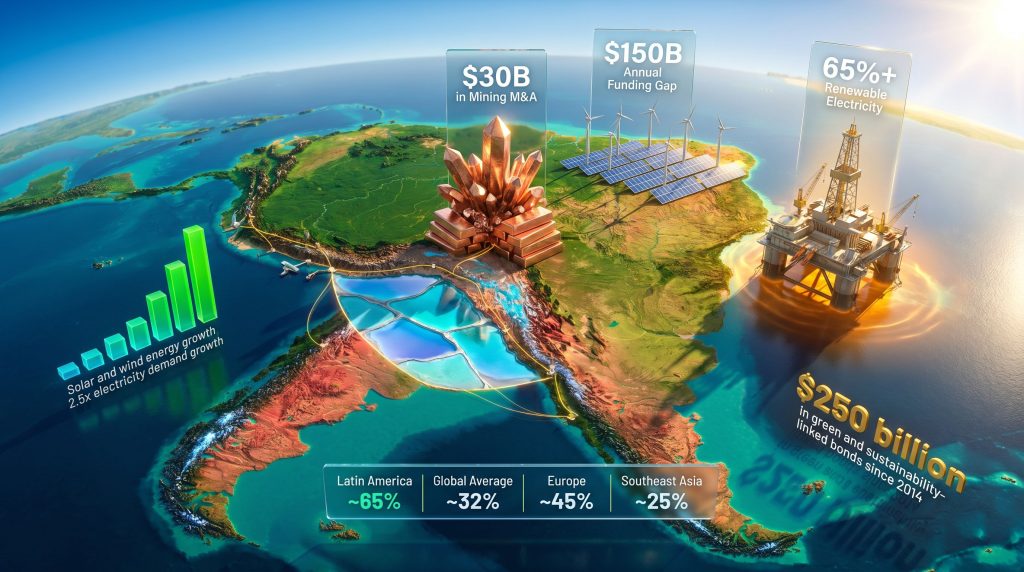
The starting point for any serious analysis of Latin American energy investment is an appreciation of how dramatically different the region's electricity mix already is compared to the rest of the world. Latin America generates more than 65% of its electricity from renewable sources, roughly double the global average of approximately 32%. This is not a projection — it is an established operational reality built over decades, anchored by large-scale hydropower infrastructure across Brazil, Colombia, and the Andes.
What is newer, and more significant for capital allocators, is the pace at which solar and wind are now expanding on top of that hydro foundation. In 2025, solar and wind capacity additions across the region were growing at 2.5 times the pace of electricity demand growth, a ratio that signals oversupply risk in the near term but also structural cost compression that makes Latin American clean energy economics among the most attractive globally. Furthermore, renewables for mining operations are increasingly integrated into project finance structures across multiple jurisdictions.
| Region | Renewable Electricity Share (2025 est.) | Primary Source |
|---|---|---|
| Latin America | ~65%+ | Hydro, Solar, Wind |
| Global Average | ~32% | Mixed |
| Europe | ~45% | Wind, Solar, Hydro |
| Southeast Asia | ~25% | Hydro, Geothermal |
Despite this renewable dominance, the region faces a structural funding shortfall of approximately $150 billion per year through 2030 to sustain the full scope of its energy sector ambitions. Of that total, an estimated $30 billion annually is required for transmission and distribution grid upgrades alone. Grid constraints are increasingly the binding bottleneck, particularly in remote mining corridors where new solar and wind projects lack the transmission infrastructure to deliver power to buyers or to national grids. Public-private partnerships are emerging as the primary mechanism for bridging this deficit, though deal pipelines remain insufficient relative to the scale of need.
Mining Investment and the Critical Mineral Supercycle
The numbers defining Latin America's positioning in global mining investment are striking. In the first three quarters of 2025, 74% of all global mining merger and acquisition activity — representing roughly $30 billion in deal value — was directed into Latin American assets. This concentration reflects a structural realignment of global supply chains rather than opportunistic deal-making. The region hosts disproportionate concentrations of copper, lithium, and gold: the three minerals most central to electric vehicle manufacturing, grid-scale battery storage, and renewable energy infrastructure.
Chile and Peru collectively account for approximately 40% of global copper production, while the so-called Lithium Triangle formed by Chile, Argentina, and Bolivia contains the largest known lithium brine reserves on Earth. Argentina lithium brines, in particular, are attracting significant international capital given their scale and favourable extraction economics. Brine-hosted lithium deposits, unlike the hard-rock spodumene deposits more common in Australia, are extracted through solar evaporation processes that require significantly less energy per tonne of lithium carbonate equivalent produced — a cost structure advantage that becomes increasingly valuable as battery manufacturers tighten supply chain economics.
The EV Supply Chain as a Demand Anchor
Corporate off-take agreements between Latin American miners and Asian battery manufacturers are now being structured with tenors of 10 to 15 years, embedding the region's geology directly into global EV supply chain architecture. The role of critical minerals in energy transition planning is consequently elevating Latin America's strategic importance to an unprecedented degree. What makes this dynamic particularly powerful is that the same mining operations creating this mineral supply are simultaneously becoming the region's largest corporate buyers of clean energy through Power Purchase Agreements.
Mining companies in Brazil and Chile have emerged as leading corporate purchasers of clean energy through PPAs, with a record 2 GW of clean energy contracted by mining operators in the most recent reporting period. This is not incidental — energy costs represent 20% to 30% of total cash operating costs at most copper and lithium operations, making long-term PPA contracts with solar and wind generators economically rational rather than simply ESG-motivated.
"The mining sector is not merely a beneficiary of Latin America's energy transition. It is functioning as one of its primary financing engines, locking in long-term clean energy demand that underwrites the project finance economics of new solar and wind developments across the region."
Why Oil and Gas Investment in Latin America Has Not Peaked
A persistent misconception among investors anchored to the net-zero narrative is that oil and gas investment in Latin America is in structural decline. The production data tells a different story. Brazil's crude oil output has expanded 13 times over since 1980, establishing the country as the dominant hydrocarbon producer in the region and one of the most significant new-supply contributors globally. According to BNamericas analysis of Latin American energy, regional production volumes across the medium-term planning horizon are forecast to remain stable, with new exploration blocks continuing to be tendered across offshore basins and Amazonian frontier zones.
The pre-salt deepwater basins off Brazil's southeast coast represent the centrepiece of this hydrocarbon story. These ultra-deepwater reservoirs, located beneath thick layers of salt at water depths exceeding 2,000 metres, contain light crude oil with relatively low sulphur content — characteristics that command premium pricing in refinery markets. The capital expenditure profiles for pre-salt platform development are substantial, but the production economics at scale are among the most competitive of any deepwater basin globally.
Argentina's Vaca Muerta formation adds a different dimension to the regional hydrocarbon picture. As one of the largest shale formations outside North America by estimated recoverable resource, Vaca Muerta is positioning Argentina as a meaningful natural gas and tight oil producer. However, the country's persistent macroeconomic volatility creates a wide risk-adjusted return range that separates opportunistic investors from those with genuinely long-horizon conviction.
Brazil's Dual-Track Energy Model
Brazil has developed what is arguably the most sophisticated parallel-track energy investment model of any major emerging economy. The country is simultaneously maximising hydrocarbon revenue through continued offshore expansion while accelerating renewable capacity deployment and exploring offshore wind at scale.
The financial architecture supporting this dual-track approach includes $88 billion in public investment committed across energy and infrastructure sectors, with the national development bank BNDES — managing approximately $132 billion in assets — functioning as the primary project finance vehicle for both clean energy and hydrocarbon developments. This institutional capacity is a significant differentiator: most resource-rich developing economies lack a domestic financing institution of BNDES's scale and sophistication, forcing heavier reliance on international capital markets with all the currency and refinancing risk that entails.
| Investment Category | Estimated Allocation | Primary Instrument |
|---|---|---|
| Renewables (Solar, Wind, Hydro) | Significant share of $88B public envelope | BNDES project finance |
| Oil & Gas Exploration | Ongoing via state enterprise | Petrobras capex budget |
| Grid & Transmission | ~$30B annual regional need | PPP and public investment |
| Critical Minerals | Part of $30B M&A surge | Private and sovereign capital |
Since 2014, Latin America has issued more than $250 billion in green and sustainability-linked bonds, a figure that signals durable institutional investor confidence in the region's clean energy credentials rather than a cyclical financing trend.
Country-Level Investment Intensity: Where Capital Is Concentrating
Understanding which national markets are absorbing the largest capital commitments requires a country-by-country lens, because the risk-return profiles are genuinely distinct:
-
Brazil attracts the largest share of regional energy investment across all three sectors simultaneously, supported by deep domestic capital markets, a large internal demand base, and BNDES financing capacity. Offshore wind licensing is emerging as the next major capital deployment frontier.
-
Chile holds global leadership in both copper production and lithium extraction, combined with one of the most competitive solar auction price environments worldwide. The mining-to-clean-energy PPA market here is the most mature in the region and serves as a template for other jurisdictions.
-
Argentina offers high-conviction investors risk-adjusted opportunity in Vaca Muerta hydrocarbons and Lithium Triangle participation. In addition, lithium brine extraction across the Puna region is attracting increased corporate interest, though political and macroeconomic volatility acts as a natural filter that elevates return requirements and reduces competition from more risk-averse capital pools.
-
Colombia is transitioning actively from coal and oil dependence, with Caribbean offshore exploration blocks drawing international operator interest and the Guajira Peninsula accelerating as an onshore wind resource.
-
Peru hosts world-class copper and gold operations but faces infrastructure connectivity constraints — particularly road and transmission access to high-altitude mining corridors — that continue to limit investment velocity.
The Geopolitical Contest: Chinese Infrastructure Control
One dimension of Latin America's energy investment landscape that receives insufficient attention in mainstream financial analysis is the extent to which Chinese state-owned enterprises have established controlling positions in power grid infrastructure. Across Peru, Chile, and parts of Brazil, Chinese entities hold significant ownership stakes in electricity transmission and distribution networks — a strategic footprint that translates infrastructure ownership into long-term commercial positioning and geopolitical leverage over energy delivery.
This infrastructure penetration is increasingly shaping how Western capital — particularly from the United States, Canada, and Europe — approaches the region. The competitive dynamic is no longer simply about project-level economics. It extends to port capacity, transmission line routing, and the terms on which critical mineral output can be exported. Furthermore, the emergence of large Argentina copper systems is adding another layer of strategic complexity to the region's geopolitical resource map.
"Tracking Latin American energy investment requires monitoring not only individual project economics but also the broader strategic contest between state-directed capital from multiple geopolitical actors across grid, port, and extraction infrastructure simultaneously."
The next major ASX story will hit our subscribers first
Risk Dimensions That Sophisticated Investors Must Price
The concentration of capital into Latin American energy assets brings a corresponding concentration of risk that is frequently underweighted by investors focused on resource endowment narratives:
-
Regulatory and fiscal risk is material across multiple jurisdictions, with mining royalty frameworks, hydrocarbon fiscal terms, and renewable energy auction rules subject to revision following electoral cycles. Resource nationalism tendencies in Bolivia and Mexico, and periodic policy reversals in Argentina, illustrate the breadth of this exposure.
-
Environmental and social risk is growing in significance. Indigenous land rights disputes represent an expanding constraint on mining and hydropower project timelines, particularly in Peru and Chile. Water availability in lithium brine extraction operations across the Atacama and Puna regions is attracting increasing regulatory scrutiny, as brine extraction intersects with Andean freshwater systems in ways that are scientifically complex and politically sensitive.
-
Hydrological variability creates production risk for the region's hydropower baseload, which underpins grid stability across multiple countries. Prolonged drought events — increasingly associated with El Niño cycles and longer-term climate shifts — have caused generation shortfalls in Brazil and Colombia that have required emergency thermal generation to compensate.
-
Currency and financing risk is particularly acute in Argentina, where USD-denominated project debt set against local-currency revenue streams creates structural mismatch. Development finance institutions including the IFC, IDB, and CAF are actively structuring risk mitigation facilities to partially offset this exposure for qualifying projects.
Frontier Technologies and the Next Investment Layer
Beyond the established solar, wind, and hydropower sectors, several frontier technologies are beginning to attract serious capital in the region. The IEA's analysis of Latin America's critical mineral opportunity highlights how frontier investment is closely linked to broader clean energy supply chain development across the region:
-
Battery Energy Storage Systems (BESS) are being deployed to manage intermittency in solar and wind-heavy grids, with mining operations increasingly serving as anchor customers for behind-the-meter storage solutions that smooth energy costs and reduce diesel dependence.
-
Green hydrogen is attracting significant strategic attention, particularly in Chile, where the combination of world-class solar irradiance in the Atacama and strong coastal wind resources creates the lowest-cost green hydrogen production economics in the Southern Hemisphere. Brazil is exploring green hydrogen production anchored to its expanding offshore wind capacity.
-
Geothermal energy along the Andean volcanic corridor represents a largely underdeveloped resource with baseload generation characteristics that would complement intermittent solar and wind capacity. Development has been slow due to high upfront drilling costs and geological uncertainty, but interest is increasing as grid balancing challenges intensify.
-
Data centres in Brazil and Chile are emerging as significant clean energy demand anchors, adding a technology infrastructure dimension to the region's clean energy investment case that extends well beyond the traditional mining and industrial buyer base.
The Strategic Outlook: Three Scenarios for Latin America's Energy Investment Decade
The trajectory of big bets in mining oil and renewables in Latin America across the next decade will likely resolve into one of three broad scenarios:
-
Accelerated transition scenario: Renewable investment dominates capital allocation, critical mineral demand surges with EV adoption globally, and hydrocarbon investment gradually tapers as alternative revenues prove sufficient. Chile and Brazil emerge as the primary beneficiaries, with lithium, copper, solar, wind, and green hydrogen as the leading sectors.
-
Dual-track continuation (base case): Oil and gas investment remains stable through the medium term while renewables expand in parallel, and critical minerals attract record capital as supply chain realignment continues. Brazil, Argentina, and Peru benefit most, with offshore oil, copper, lithium, and onshore wind as the dominant sectors.
-
Resource nationalism escalation: Policy shifts in key jurisdictions restrict foreign capital access, state enterprises expand market share at the expense of international operators, and risk premiums rise across the region. Bolivia, Mexico, and potentially Argentina represent the highest-risk nodes in this scenario, with bilateral investment treaties and political risk insurance becoming essential tools for capital preservation.
The logistics infrastructure underpinning whichever scenario materialises — ports, high-voltage transmission lines, freight rail, and road connectivity to remote resource corridors — will ultimately determine which projects move from development pipeline to production reality. Investors treating infrastructure access as an afterthought to resource quality are likely to find that the bottleneck they underweighted becomes the most expensive line item in their final project economics. Consequently, understanding the full capital stack of big bets in mining oil and renewables in Latin America — from subsurface geology through to port export capacity — is the discipline that will separate the region's most successful investors from those who arrived with conviction but insufficient operational intelligence.
Disclaimer: This article contains forward-looking statements, scenario projections, and financial estimates drawn from publicly available data sources. These should not be construed as investment advice. Investors should conduct independent due diligence and consult qualified financial advisors before making capital allocation decisions in any of the sectors or geographies discussed.
Want to Stay Ahead of the Next Major Mineral Discovery in the Americas?
Discovery Alert's proprietary Discovery IQ model delivers real-time alerts on significant ASX mineral discoveries — instantly translating complex geological data into actionable investment opportunities for both short-term traders and long-horizon investors. Explore how historic discoveries have generated substantial returns on Discovery Alert's dedicated discoveries page, and begin your 14-day free trial today to ensure you never miss the next major find.