May 16, 2026
Understanding Mining Operations Through Technical Performance Metrics
The global mining industry operates on razor-thin margins where operational efficiency determines profitability across commodity cycles. Modern mining companies leverage sophisticated production monitoring systems to track performance indicators that directly correlate with share price movements and investor sentiment. Understanding these technical frameworks provides crucial insights for investment timing decisions around quarterly production updates, particularly when considering whether to buy BHP shares ahead of production update.
Large-scale mining operations employ comprehensive operational excellence frameworks that measure everything from ore grade consistency to equipment utilization rates. These systems generate real-time data that institutional investors use to evaluate management effectiveness and forward guidance accuracy. When production targets are consistently met or exceeded, it demonstrates operational discipline that often translates to premium valuations during volatile commodity markets.
Why Copper Operations Drive Modern Mining Valuations
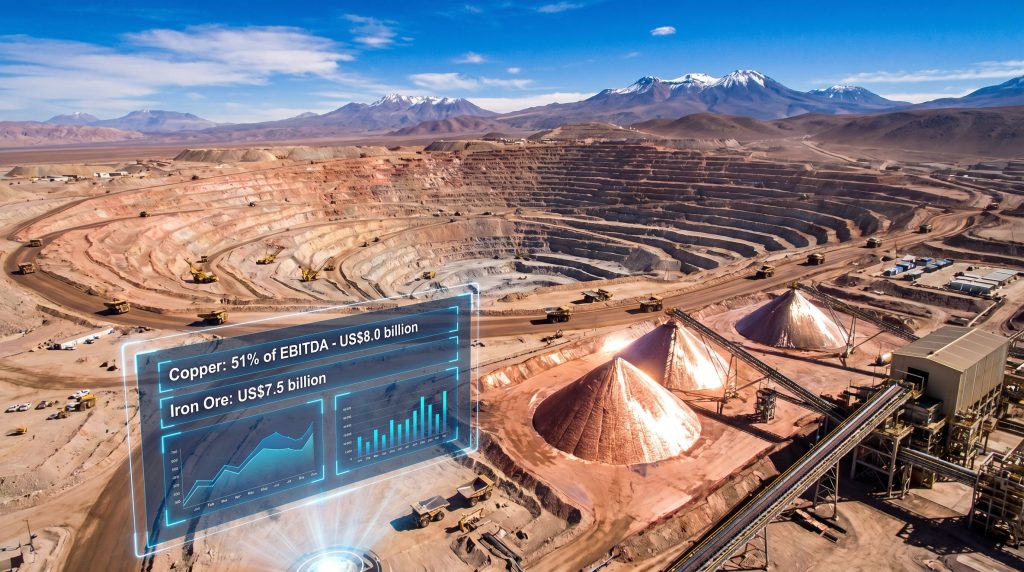
The structural transformation occurring within diversified mining companies reflects broader electrification trends reshaping global commodity demand patterns. Copper production now generates over 51% of underlying EBITDA at major mining operations, representing a fundamental shift from traditional iron ore dominance in earnings composition. This transition reflects copper's critical role in renewable energy infrastructure, electric vehicle manufacturing, and grid modernisation projects worldwide.
Production efficiency metrics for copper operations include:
• Mine life extension projects: Strategic capital deployment extending operational timelines beyond 2030
• Joint venture partnerships: International collaborations targeting production scaling through the 2030s
• Guidance achievement rates: Current trajectory analysis suggesting upper production range performance
• Cost per tonne optimisation: Continuous improvement programs reducing cash costs per unit produced
Advanced copper mining operations utilise automated extraction systems and real-time ore grade monitoring to maximise recovery rates whilst minimising processing costs. Furthermore, the technical complexity of modern copper extraction requires significant capital investment in specialised equipment and skilled technical personnel, creating barriers to entry that support sustainable competitive advantages for established operators.
The emergence of a major copper system in Argentina demonstrates the global scope of copper development opportunities. However, established operators benefit from sophisticated copper pricing insights that inform strategic production decisions.
Current copper market dynamics show:
| Metric | Current Status | Annual Change |
|---|---|---|
| Copper prices | US$13,275 per tonne | +42% year-over-year |
| Production guidance | 1.9-2.0 million tonnes | Upper range achievement |
| EBITDA contribution | US$8.0 billion H1 FY2026 | +59% year-over-year |
Iron Ore: The Foundation of Mining Cash Generation
Despite copper's rising prominence, iron ore operations continue serving as the primary cash generation mechanism for diversified mining companies. Iron ore production guidance maintained at approximately 292 million tonnes demonstrates operational stability that underpins dividend sustainability and provides financial flexibility during commodity price volatility periods.
Iron ore processing involves complex beneficiation techniques that separate valuable iron content from waste rock through magnetic separation, flotation, and pelletising processes. For instance, modern iron ore operations achieve recovery rates exceeding 70% through advanced crushing and screening technologies, with automated quality control systems ensuring consistent product specifications for steel industry customers.
Understanding iron ore price trends remains crucial for evaluating long-term mining investment prospects. These trends directly influence cash flow generation capabilities across the sector.
Iron ore operational metrics include:
• Production volume consistency: Maintaining annual guidance levels around 292 million tonnes
• Quality specifications: Iron content percentages meeting metallurgical requirements
• Shipping logistics: Port infrastructure capacity and vessel scheduling optimisation
• Cost structure management: Maintaining competitive cash costs per tonne despite inflationary pressures
Geographic demand shifts significantly impact iron ore pricing dynamics. While Chinese steel demand has moderated from peak levels, Indian infrastructure development increasingly provides structural demand growth. Any recovery signals from Chinese manufacturing sectors materially affect full-year earnings projections for major iron ore producers.
Iron ore price environment shows:
Current iron ore trading levels around US$85 per tonne reflect balanced supply-demand fundamentals, with pricing supported by infrastructure investment programmes across developing economies. Consequently, this pricing environment provides stable cash flow generation capabilities while copper operations drive earnings growth acceleration.
Production Timing Strategy and Market Psychology
Investment timing around quarterly production updates requires understanding historical volatility patterns and market reaction mechanisms. BHP shares demonstrate 52.2% gains over 12 months compared to the ASX 200's 14.3% advance, indicating significant outperformance that may reflect operational excellence or forward-looking commodity price expectations.
Pre-announcement positioning carries execution risk but offers potential upside capture opportunities when production results exceed market expectations. Conversely, post-announcement entry allows for volatility-adjusted pricing but may miss immediate positive reactions to strong operational performance.
Technical momentum indicators include:
• Relative strength metrics: Outperformance versus benchmark indices over multiple timeframes
• Volume analysis: Trading activity patterns around production announcement dates
• Dividend yield considerations: 3.5% fully franked yield providing income buffer during volatility
• Institutional positioning: Fund manager allocation changes based on operational guidance
Market psychology around production updates focuses heavily on guidance achievement rates and forward-looking commentary from management teams. Historical analysis suggests heightened volatility around announcement dates, with direction dependent on actual versus expected performance metrics and qualitative outlook statements.
Commodity Price Sensitivity and Revenue Optimisation
Current commodity pricing environments significantly amplify the importance of production efficiency and volume achievement. With copper trading at elevated levels and iron ore maintaining stable pricing, production volumes translate directly to enhanced revenue per unit, making operational execution increasingly critical for financial performance.
Revenue optimisation strategies include:
• Product mix management: Balancing high-grade versus bulk production based on market pricing
• Inventory timing: Strategic stockpiling during favourable pricing environments
• Contract negotiations: Long-term supply agreements providing price stability
• Currency hedging: Managing foreign exchange exposure on international commodity sales
The mathematical relationship between commodity prices and operational leverage means small production variances create magnified earnings impacts. A 5% production increase during favourable pricing periods can generate disproportionately higher cash flow increases, while production shortfalls during peak pricing create significant opportunity costs.
Risk Assessment Framework for Mining Investments
Operational risks affecting mining investment performance include:
• Commodity cycle exposure: Inherent volatility in resource pricing affecting earnings predictability
• Geopolitical factors: International trade relationships influencing demand patterns
• Weather and infrastructure: Natural disasters and equipment failures impacting production schedules
• Regulatory compliance: Environmental and safety requirements affecting operational costs
Technical risk management involves diversification across multiple commodities, geographic regions, and production timelines. Companies with balanced exposure to both growth commodities like copper and stable cash generators like iron ore typically demonstrate lower volatility while maintaining upside participation in favourable market cycles.
Furthermore, the implementation of data-driven operations helps mitigate operational risks through improved predictive maintenance and real-time monitoring systems.
Risk mitigation strategies include:
| Risk Category | Mitigation Approach | Implementation Timeline |
|---|---|---|
| Price volatility | Diversified commodity exposure | Ongoing portfolio management |
| Operational disruption | Redundant production capacity | Multi-year infrastructure investment |
| Regulatory changes | Proactive compliance programmes | Continuous monitoring systems |
Investment Integration and Portfolio Considerations
Mining companies with strong operational frameworks provide portfolio exposure to global economic growth whilst maintaining dividend income characteristics. The combination of technical efficiency improvements and strategic asset development supports long-term value creation beyond short-term production cycles.
Portfolio integration considerations include:
• Correlation analysis: Mining stocks typically correlate with broader economic cycles
• Currency exposure: International operations provide natural hedging against domestic currency weakness
• Inflation protection: Hard asset ownership historically provides inflation protection
• Dividend sustainability: Cash flow generation supporting consistent income payments
Strategic asset development programmes, including mine life extensions and joint venture partnerships, demonstrate management's commitment to long-term value creation rather than short-term earnings maximisation. These initiatives typically require multi-year investment periods but provide sustainable competitive advantages through the commodity cycle.
Forward-Looking Production Catalysts
Operational developments driving future performance potential include:
• Automation integration: Technology improvements reducing labour costs and improving safety
• Sustainability initiatives: ESG-focused improvements supporting premium valuations
• Exploration programmes: Resource base expansion providing long-term growth options
• Processing efficiency: Technical improvements increasing recovery rates and reducing waste
Advanced mining technologies enable real-time optimisation of extraction processes, predictive maintenance scheduling, and automated quality control systems. However, companies investing in these technological capabilities typically achieve superior operational performance and cost structure advantages that persist through multiple commodity cycles.
The integration of AI in mining operations represents a significant technological leap forward, enabling unprecedented levels of operational efficiency and safety improvements.
Technology implementation areas include:
The integration of autonomous equipment and artificial intelligence systems allows mining operations to optimise production schedules based on real-time ore grade data and equipment performance metrics.
Environmental and social governance considerations increasingly influence investment decisions, with companies demonstrating strong sustainability practices often receiving premium valuations from institutional investors focused on long-term value creation.
Investment Timing Analysis and Execution Strategy
The decision to buy BHP shares ahead of production update requires careful evaluation of current operational momentum against existing valuation levels. Strong production guidance achievement, particularly in copper operations, combined with stable iron ore performance, suggests fundamental support for current market pricing.
However, significant recent share price appreciation may indicate that much positive operational news is already reflected in current valuations. The 52.2% annual gain suggests substantial market expectations for continued operational excellence and favourable commodity pricing environments.
Tactical considerations include:
• Dollar-cost averaging: Gradual position building to manage timing risk
• Volatility management: Using options strategies to participate in upside whilst limiting downside exposure
• Sector allocation: Balanced exposure to multiple mining companies rather than concentrated positions
• Time horizon matching: Aligning investment timeline with commodity cycle expectations
Professional investors often employ systematic approaches that balance operational momentum indicators with valuation metrics and technical positioning. This methodology allows participation in mining sector opportunities whilst managing the inherent volatility associated with commodity-dependent businesses.
Moreover, recent analysis of BHP's performance highlights the company's successful copper strategy that has driven substantial share price gains. Additionally, investors may want to consider the latest BHP investment analysis when making their investment decisions.
Key factors to consider when timing BHP share purchases include:
The timing decision to buy BHP shares ahead of production update ultimately depends on individual risk tolerance, investment timeline, and portfolio objectives. In addition, the strong operational momentum and favourable commodity pricing environment provide fundamental support for current valuations.
This analysis is for educational purposes and does not constitute personalised investment advice. Readers should conduct independent research and consider their individual financial circumstances before making investment decisions. Mining investments carry significant risks including commodity price volatility, operational disruptions, and regulatory changes that can materially impact returns.
Looking to Capitalise on Australia's Next Major Mineral Discovery?
Discovery Alert's proprietary Discovery IQ model instantly identifies significant ASX mineral discoveries, empowering subscribers to position themselves ahead of the market when breakthrough announcements occur. Start your 14-day free trial today and explore historic discovery returns to understand how major mineral finds can transform investment portfolios.