June 9, 2026
Understanding Mining Sector Cash Flow Optimization Through Operational Excellence
Mining companies face constant pressure to optimise cash flow generation while navigating volatile commodity cycles. The ability to enhance shareholder returns through operational efficiency, rather than relying solely on favourable pricing conditions, distinguishes sophisticated mining operators from purely cyclical players. This operational leverage creates sustainable value creation frameworks that can deliver consistent returns across different market environments.
Modern mining enterprises employ sophisticated capital allocation strategies that balance growth investment, operational excellence, and shareholder returns. When executed effectively, these frameworks enable companies to increase dividend payments while maintaining investment capacity for future growth projects. The key lies in developing operational capabilities that can generate superior cash flows independent of short-term commodity price fluctuations.
When big ASX news breaks, our subscribers know first
How Operational Efficiency Drives Enhanced Shareholder Returns
The mining sector has experienced significant mining evolution trends over the past decade. Companies now focus intensively on cost structure optimisation, production efficiency enhancement, and portfolio rationalisation strategies. This shift enables sustained cash flow generation even during periods of commodity price volatility.
Key Performance Indicators for Mining Operations:
| Operational Metric | Performance Impact | Strategic Significance |
|---|---|---|
| EBITDA Margin Expansion | Direct cash flow enhancement | Demonstrates cost discipline |
| Production Guidance Stability | Predictable revenue streams | Enables confident capital allocation |
| Unit Cost Reduction | Improved profit margins | Competitive positioning advantage |
| Portfolio Optimisation | Resource concentration | Higher-return asset focus |
The ability to achieve earnings growth while maintaining stable production guidance indicates sophisticated operational management. This performance demonstrates management confidence in mining recovery rates, ore grade consistency, and operational reliability across multiple commodity segments.
Cost structure improvements often result from systematic operational enhancements including:
- Process optimisation initiatives that improve recovery rates and reduce waste
- Equipment efficiency programmes that minimise maintenance downtime
- Energy management strategies that reduce power consumption costs
- Labour productivity improvements through training and technology adoption
Strategic Asset Portfolio Management for Sustainable Returns
Modern mining companies increasingly focus on portfolio curation rather than diversification for its own sake. This approach involves divesting non-core operations while concentrating resources on assets with superior return profiles and longer operational lives. Furthermore, this strategy reduces operational complexity and enables more effective capital allocation decisions.
Portfolio Optimisation Framework:
- Asset Quality Assessment: Evaluating each operation's return on invested capital, mine life expectations, and cash cost positioning relative to industry benchmarks
- Geographic Risk Analysis: Balancing exposure across stable mining jurisdictions while minimising sovereign risk concentration
- Commodity Mix Evaluation: Aligning asset portfolio with long-term demand trends, particularly energy transition requirements
- Operational Synergy Identification: Leveraging shared infrastructure and expertise across retained operations
The transition of certain operations to care and maintenance status rather than complete divestiture provides valuable optionality. This approach preserves the ability to restart production if commodity fundamentals improve sufficiently while minimising ongoing cash requirements during unfavourable market conditions.
In addition, the industry consolidation insights reveal how asset rationalisation decisions require careful evaluation of:
- Sunk cost considerations versus future investment requirements
- Market timing factors for optimal divestiture valuations
- Operational integration impacts on remaining asset performance
- Capital redeployment opportunities within the retained portfolio
Production Stability and Operational Predictability
Maintaining unchanged production and cost guidance across reporting periods demonstrates operational excellence and management confidence. In an industry characterised by production volatility from geological challenges, weather disruptions, and equipment failures, guidance stability provides significant signalling value to investors.
Factors Supporting Operational Predictability:
- Geological understanding: Comprehensive ore body knowledge enables accurate production forecasting
- Equipment reliability programmes: Preventive maintenance strategies minimise unplanned downtime
- Supply chain management: Secured reagent and spare parts inventory reduces operational disruptions
- Workforce stability: Experienced labour force reduces productivity variability
The ability to maintain guidance while achieving earnings growth suggests that commodity price improvements provided operational leverage benefits. This dynamic indicates that production volumes remained stable while pricing realisation improved, demonstrating the company's market positioning effectiveness.
However, growth project development alongside operational stability requires sophisticated capital allocation balancing. Management must simultaneously:
- Invest in life extension projects to maintain long-term production capacity
- Develop new mining opportunities to replace depleting reserves
- Maintain operational excellence at existing facilities
- Preserve shareholder return capacity through disciplined payout policies
Advanced Capital Allocation and Return Frameworks
Sophisticated mining companies employ structured capital management programmes that provide explicit frameworks for shareholder returns while maintaining investment flexibility. These programmes typically involve predetermined payout ratios combined with supplementary return mechanisms during favourable market conditions.
Capital Allocation Hierarchy in Practice:
- Operational Excellence Investment: Safety systems, environmental compliance, and production efficiency enhancement
- Growth Capital Deployment: Mine life extensions, new project development, and capacity expansion
- Base Shareholder Returns: Sustainable dividend payments aligned with earnings generation
- Opportunistic Returns: Additional buybacks or special dividends during strong cash flow periods
The expansion of capital return programmes signals management confidence in sustainable cash generation capability. Rather than reducing shareholder returns during uncertain commodity environments, programme expansion indicates belief in operational improvement sustainability and future cash flow generation.
Risk Management Considerations:
- Commodity price volatility exposure requiring conservative baseline assumptions
- Capital intensity requirements for maintaining competitive operations
- Regulatory compliance costs including environmental and safety obligations
- Market cycle timing affecting optimal capital deployment decisions
Consequently, payout ratio discipline ensures that shareholder returns remain sustainable across commodity cycles. Conservative ratios preserve investment capacity for growth projects while providing predictable income streams for investors seeking mining sector exposure.
What Drives Commodity Market Positioning and Financial Leverage?
The ability to achieve earnings growth despite revenue decline demonstrates operational leverage to commodity price movements. This performance indicates that cost structure improvements and production mix optimisation can offset volume or pricing challenges in specific commodity segments.
Operational Leverage Mechanisms:
- Fixed cost absorption: Higher production volumes spread fixed costs across larger output
- Commodity mix benefits: Strong performance in higher-margin products offset weakness elsewhere
- Cost reduction achievement: Systematic efficiency improvements reduced unit production costs
- Pricing realisation optimisation: Improved sales timing and contract management
Mining companies with diversified commodity exposure benefit from natural hedging effects where strength in certain metals offsets weakness in others. This diversification reduces earnings volatility compared to single-commodity producers while providing exposure to multiple demand drivers.
For instance, the mathematical relationship between revenue decline and EBITDA growth suggests either:
- Significant cost reduction achievements across operations
- Favourable commodity mix shifts toward higher-margin products
- Volume increases in higher-value commodity segments
- Improved pricing realisation through contract optimisation
The next major ASX story will hit our subscribers first
Investment Analysis and Sector Positioning
Mining companies that demonstrate operational excellence through efficiency improvements rather than purely commodity price gains offer more sustainable investment propositions. These operators can generate superior returns across different market environments while providing more predictable dividend growth trajectories.
Investment Evaluation Criteria:
- Operational leverage demonstration: Ability to grow earnings independent of commodity price improvements
- Portfolio quality assessment: Asset base composition and competitive positioning analysis
- Management execution capability: Track record of operational improvement delivery
- Capital allocation discipline: Balance between growth investment and shareholder returns
Important Investment Disclaimer: Mining sector investments involve significant risks including commodity price volatility, operational disruptions, regulatory changes, and geological uncertainties. Past dividend payments do not guarantee future dividend sustainability or growth. Investors should conduct thorough due diligence and consider their risk tolerance before investing in mining securities.
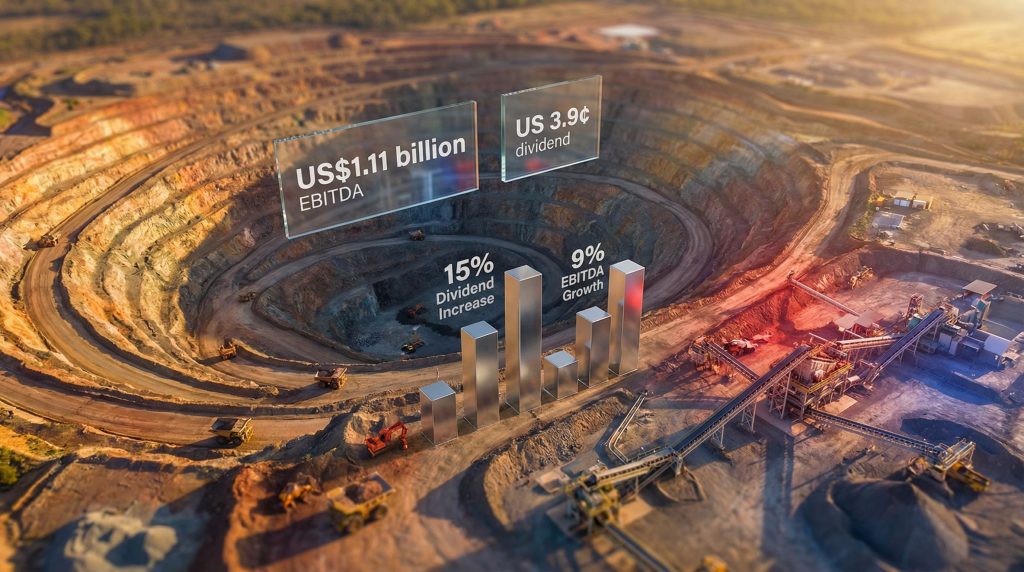
The South32 dividend increase of 15% to 3.9 US cents per share reflects underlying operational improvements rather than purely cyclical factors. The company's underlying EBITDA growth of 9% to US$1.11 billion, combined with 16% earnings expansion to US$435 million, demonstrates systematic cost management and efficiency enhancement across multiple commodity operations. According to South32's latest financial results, this performance showcases the company's commitment to operational excellence.
Sector Comparative Analysis:
Mid-tier diversified miners like South32 occupy a unique market position between large-scale integrated producers and single-commodity specialists. This positioning provides:
- Operational flexibility to optimise production across different commodity segments
- Geographic diversification reducing single-jurisdiction regulatory risk exposure
- Scale advantages in procurement and shared infrastructure utilisation
- Capital allocation optionality across multiple growth project opportunities
How Technology Enhances Mining Operations
Furthermore, data-driven operations have become increasingly important in modern mining. Advanced analytics and automation technologies enable companies to optimise recovery rates, predict equipment failures, and enhance safety protocols across operations.
Environmental and Social Considerations
The mining sector's sustainability transformation represents a critical factor in long-term value creation. Companies implementing comprehensive ESG frameworks often achieve better operational performance and stakeholder acceptance, supporting sustainable dividend growth trajectories.
Risk Assessment and Dividend Sustainability Framework
Mining dividend sustainability requires careful evaluation of operational, financial, and market risk factors. The 40% payout ratio maintained by South32 provides a conservative framework that preserves investment capacity while delivering meaningful shareholder returns.
Primary Risk Categories:
- Operational Risks: Equipment failures, geological surprises, labour disruptions, and regulatory compliance challenges
- Market Risks: Commodity price volatility, demand fluctuations, and currency exchange rate movements
- Financial Risks: Debt service obligations, capital expenditure requirements, and working capital needs
- Strategic Risks: Asset portfolio optimisation decisions, growth project execution, and competitive positioning
Mitigation Strategies:
- Diversified commodity exposure reduces single-product dependency
- Geographic spread across stable mining jurisdictions minimises political risk
- Strong balance sheet management provides financial flexibility during downturns
- Active portfolio management enables resource reallocation to highest-return opportunities
However, the South32 dividend increase occurs within a context of unchanged production guidance, suggesting management confidence in operational capability and cash flow generation sustainability. This stability provides a foundation for dividend growth that extends beyond short-term commodity cycle benefits. Market analysts, as highlighted in The Motley Fool's analysis, view this dividend enhancement as reflecting the company's robust operational performance.
Long-term Sustainability Outlook
Long-term dividend sustainability depends on the company's ability to maintain competitive cost structures, replace depleting reserves through exploration or acquisition, and adapt operations to evolving environmental and social requirements. The combination of operational excellence and disciplined capital allocation provides the framework for sustained shareholder value creation across commodity market cycles.
In addition, the South32 dividend increase demonstrates how well-managed mining companies can deliver consistent shareholder value through disciplined operational improvement rather than relying purely on favourable commodity cycles. This approach builds investor confidence and supports premium valuations within the mining sector.
Ready to Capitalise on Australia's Next Major Mining Discovery?
Discovery Alert's proprietary Discovery IQ model delivers instant notifications on significant ASX mineral discoveries, empowering subscribers to identify actionable trading opportunities before broader market awareness develops. Explore how historic mining discoveries have generated substantial returns and begin your 14-day free trial today to position yourself ahead of the market.