June 5, 2026
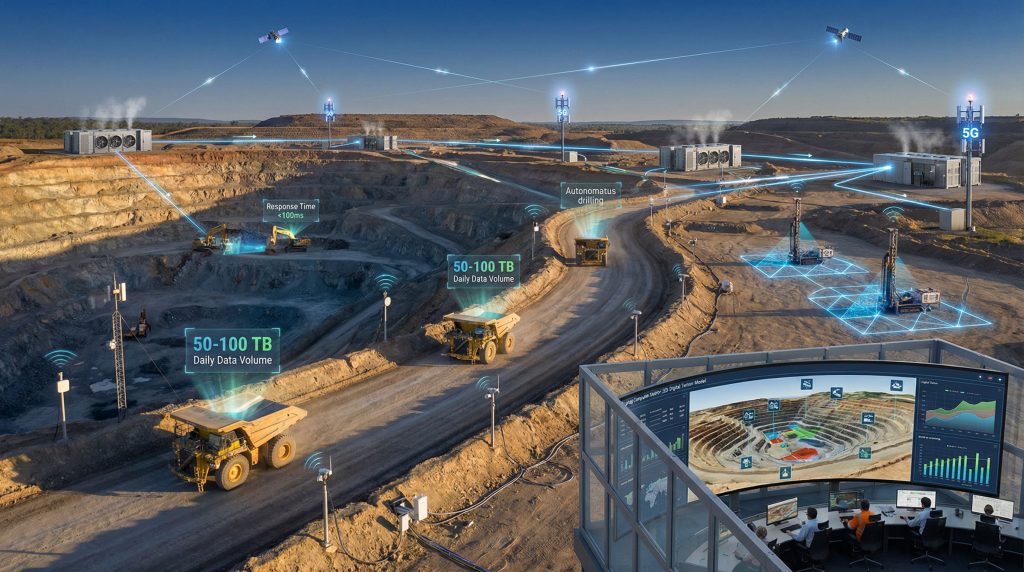
The evolution of processing architecture represents a fundamental shift in how mining operations manage and leverage data for operational excellence. Traditional approaches relied heavily on centralized cloud processing, creating latency bottlenecks that undermined real-time decision-making capabilities. Modern mining smarter with AI and data demands instant response times measured in milliseconds rather than seconds, particularly when autonomous systems and safety-critical applications are involved.
This transformation centres on bringing computational power directly to extraction sites through edge computing infrastructure, private network deployments, and hybrid connectivity solutions. The integration of operational technology with information technology has eliminated the traditional air gap that once separated industrial control systems from network connectivity, creating new opportunities for intelligent operations while introducing cybersecurity considerations.
Defining Intelligence-Driven Mining Operations
Real-time decision-making capabilities now replace reactive management approaches through sophisticated sensor networks and machine learning algorithms. Underground operations in Western Australia demonstrate how private LTE networks enable continuous vehicle and personnel tracking, eliminating communication blackspots that previously created operational blind spots throughout kilometres of subterranean tunnels.
The shift from historical reporting to predictive operational control represents a fundamental change in mining methodology. Rather than analysing production data after shifts conclude, modern systems provide instantaneous feedback loops that enable immediate operational adjustments based on changing conditions.
When big ASX news breaks, our subscribers know first
The Four Pillars of Smart Mining Infrastructure
Edge computing architecture delivers millisecond response times by processing data at the point of generation rather than transmitting information to distant cloud servers. NEXTDC has constructed new edge data centres in Port Hedland and Newman, interconnected through Vocus' 2000-kilometre Horizon fibre network to support local artificial intelligence processing for mine operations.
Private network connectivity through LTE and emerging 5G technologies ensures reliable data transmission across mine sites. These dedicated networks provide predictable performance characteristics essential for safety-critical autonomous systems and real-time monitoring applications.
Digital twin integration creates virtual operational modelling capabilities that enable production optimisation testing without disrupting actual operations. These software-based replicas of physical mining assets require continuous high-quality data streams to maintain accuracy and effectiveness.
Why Traditional Mining Data Management Has Hit a Wall
The connectivity crisis in remote mining operations stems from fundamental limitations in legacy communication infrastructure. Underground mining environments present unique challenges where traditional two-way radio systems experience coverage failures, creating operational inefficiencies and safety concerns.
The Connectivity Crisis in Remote Operations
Underground communication blackspots limit real-time monitoring capabilities in subterranean tunnel systems. A Tier 1 underground gold mine in Western Australia experienced this challenge firsthand, where traditional radio technology struggled to maintain reliable coverage throughout extensive tunnel networks.
Satellite dependency traditionally created latency issues for autonomous systems, particularly when operations required split-second response times. Processing data over 1000 kilometres away in Perth or other distant locations introduced unacceptable delays for safety-critical vehicle control systems.
Data silos in legacy systems prevented integrated operational visibility, forcing mining operations to rely on disconnected information streams that hindered comprehensive decision-making processes.
Processing Power Requirements for Modern Mining
Volume of sensor data generated across mine sites has increased exponentially with the deployment of Internet of Things devices, autonomous vehicles, and environmental monitoring systems. This data generation requires substantial bandwidth and processing capabilities to extract actionable insights in real-time.
Bandwidth limitations force critical decisions between local versus cloud processing architectures. The 330-tonne autonomous haul trucks operating on a 150-kilometre private haul road in the Pilbara region demonstrate this challenge, where constant low-latency data paths are essential for safe high-speed operations.
Network reliability demands for safety-critical applications cannot accommodate the intermittent connectivity characteristics of traditional satellite links or unreliable terrestrial networks.
| Operation Type | Response Time Requirements | Primary Challenge | Solution Architecture |
|---|---|---|---|
| Underground Gold Mining | Sub-100 milliseconds | Communication blackspots | Private LTE networks |
| Autonomous Haul Trucks | Sub-50 milliseconds | Processing latency | Edge computing + fibre |
| Remote Exploration | Sub-1000 milliseconds | Bandwidth limitations | LEO satellite integration |
How Edge Computing Is Transforming Mine Site Operations
Bringing processing power directly to extraction sites represents a paradigm shift from traditional centralised cloud architectures. Local data centres reduce response times from seconds to milliseconds, enabling artificial intelligence analysis to influence operational decisions instantaneously rather than after significant delays.
Bringing Processing Power to the Pit
Local data centres eliminate dependency on external connectivity for critical operational decisions. This infrastructure transformation places computational resources within immediate proximity of data generation points, ensuring that autonomous systems and safety applications can function reliably regardless of external network conditions.
Real-time AI analysis enables immediate operational adjustments based on changing site conditions. Machine learning algorithms can process sensor data, environmental conditions, and equipment performance metrics to recommend or automatically implement operational modifications without human intervention.
Integration with existing SCADA and control systems ensures compatibility with established mining infrastructure while enhancing capabilities through intelligent automation and predictive analytics.
Infrastructure Requirements for Edge Implementation
Power and cooling considerations in harsh mining environments require specialised engineering solutions to maintain optimal performance of computing equipment in extreme temperatures, dust-laden atmospheres, and remote locations with limited utility infrastructure.
Redundancy systems prevent single points of failure through distributed architecture designs that maintain operational continuity even when individual components experience malfunctions or require maintenance.
Case Study Analysis: Underground vs. Surface Edge Deployment
Underground Gold Mine Implementation: The Western Australian operation deployed a private LTE network engineered specifically for underground conditions, enabling real-time vehicle and personnel tracking while eliminating hours of lost productivity associated with equipment location at shift changes. The system also enables granular ventilation control, allowing operators to reduce energy consumption by powering down ventilation in unused tunnel areas without compromising safety protocols.
Pilbara Iron Ore Operations: The 330-tonne autonomous road trains utilise constant low-latency data connections via private fibre networks linked to 4G mobile infrastructure. This architecture ensures ultra-fast network response times essential for safe high-speed autonomous operations across 150 kilometres of private haul roads.
Remote Exploration Networks: Portable edge computing solutions integrate with Low Earth Orbit satellite terminals to provide processing capabilities in locations far beyond traditional power grid reach, enabling real-time geological analysis and collaborative decision-making.
What Role Do Private Networks Play in Mining Intelligence?
Private network infrastructure provides the foundation for reliable, low-latency connectivity essential for modern mining operations. These dedicated communication systems ensure predictable performance characteristics that commercial networks cannot guarantee, particularly in remote locations with challenging environmental conditions.
LTE/5G Network Architecture for Mining Applications
Coverage requirements for underground tunnel systems demand specialised antenna placement and signal propagation engineering to eliminate communication dead zones. Private LTE networks engineered for mining environments provide consistent connectivity throughout complex subterranean infrastructure.
Network performance optimisation for different operational priorities enables quality of service configurations that prioritise safety-critical communications over administrative data transfers. This approach ensures that autonomous vehicle control signals and emergency communications receive guaranteed bandwidth allocation.
Fibre Infrastructure Development
Regional connectivity projects link remote mining hubs through high-capacity fibre networks. The Vocus Horizon cable represents a 2000-kilometre infrastructure investment connecting major Western Australian mining centres with reliable, high-bandwidth connectivity.
Redundant path design ensures operational continuity through multiple routing options that maintain connectivity even when primary pathways experience disruptions due to equipment failures or environmental factors.
Integration with satellite systems creates comprehensive coverage architectures that combine terrestrial fibre with space-based connectivity to reach the most remote operational areas.
Low Earth Orbit (LEO) Satellite Integration
Bandwidth capabilities of LEO satellite constellations provide metro-like performance to remote exploration sites that historically relied on expensive, slow geostationary satellite connections. These next-generation satellite systems deliver significantly improved latency characteristics compared to traditional satellite technologies.
Portable terminal deployment enables backpack-transportable connectivity solutions that exploration teams can deploy rapidly in previously inaccessible locations. These terminals connect directly into Australian fibre backbones through new landing stations, providing more stable performance than standalone satellite services.
Network Integration Strategy
The mining industry is adopting hybrid architectures that combine edge computing for immediate decision-making, private LTE networks for reliable site-wide coverage, high-capacity fibre for regional data transport, and LEO satellites for remote accessibility. This integrated approach creates digital backbones that enable artificial intelligence processing at operational speeds.
How AI Enables Real-Time Operational Decision Making
Artificial intelligence applications in mining require instantaneous data processing capabilities to influence operational decisions before conditions change. The integration of machine learning algorithms with real-time sensor networks creates predictive capabilities that anticipate equipment failures, optimise energy consumption, and enhance safety protocols. Furthermore, these AI mill optimization systems demonstrate significant improvements in processing efficiency.
Predictive Maintenance Systems Architecture
Sensor integration across mining equipment fleets provides continuous monitoring of mechanical performance, wear patterns, and operational efficiency metrics. These systems generate massive data streams that machine learning algorithms analyse to identify patterns indicating potential failures before they occur.
Machine learning model deployment for failure prediction requires edge computing infrastructure to process sensor data locally and provide immediate alerts to maintenance teams. This approach enables proactive maintenance scheduling that prevents unplanned downtime and reduces operational costs through mining smarter with AI and data methodologies.
Integration with maintenance scheduling and parts inventory systems creates automated workflows that optimise resource allocation and minimise equipment unavailability through predictive maintenance protocols.
Autonomous Vehicle Control Systems
Network requirements for 330-tonne autonomous haul truck operations demand ultra-low latency connectivity that enables split-second decision-making for vehicle safety systems. These massive vehicles operate at high speeds across challenging terrain, requiring constant communication with control centres to maintain safe operations.
Safety protocols for vehicle-to-infrastructure communication ensure that autonomous systems receive priority network access and redundant communication pathways to prevent single points of failure that could compromise operational safety. Moreover, these systems contribute to boosting mining safety across the industry.
Environmental Monitoring and Control
Real-time air quality and safety system integration enables immediate responses to changing environmental conditions in underground mining operations. Advanced sensor networks monitor atmospheric conditions, personnel locations, and environmental hazards to trigger automated safety responses.
Automated ventilation control based on personnel location data optimises energy consumption while maintaining safety standards. The Western Australian gold mine implementation demonstrates how real-time personnel tracking enables granular ventilation management that reduces energy consumption and emissions without compromising worker safety.
Energy optimisation through predictive occupancy modelling anticipates personnel movement patterns and adjusts environmental control systems accordingly, delivering significant energy savings while maintaining optimal working conditions.
Wearable Technology Integration: EEG-based fatigue monitoring systems predict microsleeps and alert supervisors before safety risks escalate. These real-time physiological monitoring systems represent advanced applications of artificial intelligence in mining safety protocols.
The next major ASX story will hit our subscribers first
What Are the Cybersecurity Implications of Connected Mining?
The convergence of information technology with operational technology has eliminated traditional air gaps that once protected industrial control systems from external threats. Modern mining operations integrate everything from conveyor belt controllers to dewatering pumps into networked environments, creating new vulnerability surfaces that require comprehensive cybersecurity strategies.
IT/OT Convergence Security Challenges
Elimination of air-gap protection in industrial control systems exposes previously isolated mining equipment to potential cyber attacks. Where network breaches in corporate office environments once represented administrative inconveniences, similar incidents affecting production control systems can halt operations immediately and cost millions in lost revenue.
Attack surface expansion from office networks to production systems requires security architectures that protect operational technology while maintaining the connectivity necessary for intelligent mining applications.
Critical infrastructure protection requirements demand specialised cybersecurity approaches that understand the unique operational characteristics and safety requirements of mining equipment and processes.
Network Security Architecture Design
Zero-trust network implementation for mining operations treats every network connection as potentially compromised, requiring continuous authentication and authorisation for all system interactions regardless of network location or user credentials.
Segmentation strategies for different operational zones create isolated network environments that prevent lateral movement of potential threats between administrative systems and production control infrastructure.
Incident response procedures for production-critical systems require specialised protocols that balance cybersecurity response with operational continuity requirements, ensuring that security measures do not inadvertently disrupt safe mining operations.
Cybersecurity Risk Assessment
Mining operations face unique challenges where cyber attacks affecting conveyor belt controllers or dewatering pump systems can immediately halt production, potentially costing millions per hour in lost revenue. Digital safety protocols have become integral components of physical safety management systems.
How Digital Twins Are Changing Mine Planning and Operations
Virtual replica architecture creates comprehensive digital representations of physical mining assets, enabling operators to test production optimisations and simulate equipment failures without disrupting actual operations. These digital twins require continuous high-quality data synchronisation to maintain accuracy and effectiveness.
Virtual Replica Architecture Requirements
Real-time data synchronisation from physical to digital systems ensures that virtual models accurately reflect current operational conditions. This synchronisation requires robust network infrastructure and edge computing capabilities to process massive data streams without introducing latency that could compromise model accuracy.
Processing power requirements for complex geological modelling demand significant computational resources to simulate ore body characteristics, equipment interactions, and environmental factors that influence mining operations.
Integration with existing mine planning software systems enables seamless workflows that incorporate digital twin insights into established operational planning processes without disrupting existing methodologies.
Simulation Capabilities and Applications
Production optimisation testing enables mining operators to evaluate potential process improvements through virtual testing before implementing changes in actual operations. This approach reduces risks associated with operational modifications while identifying opportunities for efficiency improvements through data-driven operations.
Equipment failure scenario modelling allows maintenance teams to understand the operational impacts of various failure modes and develop response strategies that minimise downtime and safety risks.
Environmental impact assessment through virtual testing enables mining companies to evaluate the consequences of operational changes on environmental compliance and sustainability metrics before implementation.
Data Quality Requirements for Effective Digital Twins
Sensor accuracy and calibration maintenance procedures ensure that data feeding digital twin models meets quality standards necessary for reliable simulation results. Poor quality input data can compromise model accuracy and lead to incorrect operational decisions.
Data validation and cleansing processes identify and correct sensor errors, communication failures, and other data quality issues that could affect digital twin performance and reliability.
Historical data integration enables digital twin systems to learn from past operational patterns and equipment performance, improving predictive capabilities and simulation accuracy over time.
What Economic Factors Drive Smart Mining Adoption?
Economic pressures across the mining industry create compelling justifications for investing in intelligent mining infrastructure. Resource export earnings are experiencing volatility as coal and gas prices adjust from recent highs, while critical minerals present growth opportunities that require enhanced operational efficiency to capture maximum value. Additionally, electrification & decarbonisation initiatives drive further investment in smart mining technologies.
Cost-Benefit Analysis Framework
Infrastructure investment requirements for smart mining implementations typically range from millions to tens of millions of dollars, depending on the scope and complexity of technological deployments. These investments must demonstrate clear returns through operational savings, productivity improvements, and risk reduction.
Productivity improvements through reduced equipment downtime represent significant value propositions for mining operations. The elimination of hours spent locating equipment at shift changes, demonstrated in the Western Australian gold mine case, translates directly to increased productive time and operational efficiency.
Energy efficiency gains from optimised operations provide both cost savings and environmental compliance benefits. Granular ventilation control based on personnel location data reduces energy consumption while maintaining safety standards, delivering measurable returns on technology investments.
Market Pressure and Competitive Advantages
Commodity price volatility creates pressure to improve profit margins through higher productivity per tonne, making digital efficiency an operational necessity rather than an optional enhancement. Mining companies that cannot demonstrate competitive operational efficiency risk losing market share to more technologically advanced competitors.
Critical mineral supply chain visibility requirements from global markets demand real-time reporting capabilities that traditional mining operations cannot provide. Smart mining infrastructure enables the unbroken digital chain of custody from extraction to export that modern supply chain transparency requirements demand.
Carbon intensity reporting and ESG compliance needs require precise monitoring and measurement capabilities that intelligent mining systems provide. Real-time environmental monitoring enables immediate operational adjustments to maintain compliance with increasingly stringent environmental regulations, particularly through smarter mining with AI approaches.
| Technology Category | Typical Investment Range | Primary ROI Driver | Payback Timeline |
|---|---|---|---|
| Private Network Infrastructure | $5-15 million | Operational visibility and safety | 24-36 months |
| Edge Computing Systems | $2-5 million | Reduced processing latency | 18-24 months |
| AI/ML Applications | $1-3 million | Predictive maintenance and optimisation | 12-18 months |
| Digital Twin Platforms | $3-8 million | Production optimisation testing | 24-30 months |
How to Implement Smart Mining Infrastructure Successfully
Successful implementation of intelligent mining systems requires phased deployment strategies that demonstrate value incrementally while building organisational capabilities and technical infrastructure. Mining companies must balance operational continuity requirements with technological transformation objectives throughout implementation processes.
Phased Deployment Strategy
Pilot project selection focuses on high-impact, low-risk applications that can demonstrate clear value propositions without disrupting critical operations. Underground communication improvements and predictive maintenance applications often provide ideal starting points for smart mining initiatives.
Scalability planning for enterprise-wide implementation ensures that pilot projects contribute to broader technological transformation rather than creating isolated technology islands that cannot integrate with larger systems.
Change management for operational staff adaptation addresses the human factors associated with technological transformation, providing training and support systems that enable workforce adaptation to intelligent mining technologies.
Technology Integration Considerations
Legacy system compatibility and migration planning ensure that new intelligent mining systems can integrate with existing operational infrastructure without requiring complete replacement of established mining equipment and control systems.
Vendor selection criteria for long-term partnerships prioritise companies with proven experience in mining applications, robust support capabilities, and technology roadmaps aligned with mining industry requirements.
Training and skill development requirements address the need for technical expertise in artificial intelligence, network administration, and cybersecurity within mining operations teams.
Performance Monitoring and Optimisation
Key performance indicators for smart mining initiatives must balance operational efficiency metrics with safety performance and environmental compliance measures to ensure that technological improvements support all organisational objectives.
Continuous improvement processes for AI model refinement enable mining operations to enhance system performance over time through machine learning algorithm optimisation and expanded data collection capabilities.
Network performance monitoring and optimisation procedures ensure that communication infrastructure maintains the reliability and performance characteristics necessary for safety-critical mining applications.
What Does the Future Hold for AI-Driven Mining?
The trajectory of artificial intelligence development in mining operations points toward increasingly sophisticated autonomous systems, enhanced environmental monitoring capabilities, and integration with emerging technologies that will further transform extraction and processing operations. Consequently, mining smarter with AI and data will become the industry standard rather than an innovative advantage.
Emerging Technology Trends
Space-based AI processing represents an emerging frontier where artificial intelligence algorithms operate directly within Low Earth Orbit satellites to provide environmental monitoring analysis and alerting capabilities in near real-time. This approach reduces latency for remote mining operations while expanding monitoring capabilities.
Advanced materials enabling more robust edge computing solutions will allow deployment of sophisticated processing systems in increasingly harsh mining environments, extending intelligent mining capabilities to previously inaccessible operational areas.
Quantum computing applications for complex optimisation problems may eventually address challenges in ore body modelling, logistics optimisation, and resource allocation that current computing architectures cannot solve efficiently.
Industry Transformation Timeline
Short-term adoption patterns through 2027 will likely focus on expanding private network infrastructure, enhancing predictive maintenance capabilities, and integrating autonomous vehicle systems across surface mining operations.
Medium-term infrastructure evolution between 2027 and 2030 may see widespread deployment of digital twin systems, comprehensive environmental monitoring networks, and advanced artificial intelligence applications that optimise entire mining value chains.
Long-term autonomous mining scenarios beyond 2030 could feature fully automated extraction operations with minimal human intervention, integrated with intelligent supply chain systems that optimise production based on real-time market demand.
Regulatory and Standards Development
Safety certification requirements for autonomous systems will likely evolve to address the unique challenges of artificial intelligence decision-making in safety-critical mining applications, potentially requiring new testing and validation methodologies.
Data governance frameworks for mining operations must balance operational efficiency requirements with privacy protection, environmental monitoring obligations, and national security considerations related to critical mineral extraction.
Environmental monitoring and reporting standards will probably incorporate real-time measurement requirements that leverage intelligent mining infrastructure to provide continuous compliance verification rather than periodic reporting.
Investment Strategy Consideration: Mining companies that establish intelligent infrastructure foundations now position themselves to capitalise on future technological developments while competitors struggle to catch up with fundamental connectivity and processing requirements.
Frequently Asked Questions About Smart Mining Implementation
What are the minimum network requirements for AI-enabled mining?
Minimum network requirements vary significantly based on application types and operational environments. Underground operations typically require private LTE networks with coverage engineered for tunnel conditions, while surface operations may utilise hybrid fibre and wireless architectures. Critical autonomous systems demand sub-50 millisecond response times with redundant connectivity pathways.
How do mining companies protect against cyber attacks on operational systems?
Cybersecurity protection requires zero-trust network architectures that segment operational technology from administrative systems while maintaining necessary connectivity. Mining companies implement continuous monitoring systems, specialised incident response procedures, and security protocols designed specifically for industrial control system protection rather than traditional office IT security approaches.
What skills do mining professionals need for smart mining operations?
Mining professionals require expanded technical competencies including network administration, artificial intelligence system management, and cybersecurity awareness. However, implementation strategies typically emphasise enhancing existing mining expertise rather than replacing experienced operators with technology specialists.
How long does it typically take to see ROI from smart mining investments?
Return on investment timelines range from 12 to 36 months depending on technology categories and implementation scope. Artificial intelligence applications focused on predictive maintenance often deliver fastest returns, while comprehensive infrastructure investments like private networks and edge computing systems require longer payback periods but provide foundations for multiple future applications.
Disclaimer: This analysis is based on publicly available information and industry reports as of February 2026. Technology capabilities, implementation costs, and performance characteristics may vary significantly based on specific operational requirements and site conditions. Mining companies should conduct detailed technical and financial assessments before making infrastructure investment decisions.
Further Information: Organisations interested in exploring connectivity solutions for mining operations can access educational resources from infrastructure specialists and technology providers who offer insights into network architecture and implementation strategies for remote industrial environments.
Ready to Capitalise on the Next Major Mining Discovery?
Discovery Alert instantly notifies subscribers about significant ASX mineral discoveries using its proprietary Discovery IQ model, transforming complex exploration data into actionable investment opportunities for both short-term traders and long-term investors. Begin your 14-day free trial today and position yourself ahead of the market with real-time alerts on the mining sector's most promising discovery announcements.