May 13, 2026
Understanding the Strategic Context Behind Mining's Biggest Deal
Global commodity markets find themselves at a critical juncture where traditional mining strategies no longer suffice for navigating complex regulatory environments, evolving demand patterns, and intensifying competition for strategic resources. The confirmation of preliminary discussions between two mining giants represents a fundamental shift in how resource companies position themselves for the next decade of industrial transformation.
Mining consolidation has accelerated dramatically as companies seek scale advantages essential for competing in increasingly sophisticated global markets. The formal acknowledgment of engagement between these industry leaders demonstrates investor recognition that traditional operational models require strategic evolution. Market reactions following confirmation of talks revealed the materiality of this development, with London-traded shares jumping more than 8% for one entity while Australian-listed shares for the other declined approximately 6% on valuation concerns.
Furthermore, the Rio Tinto and Glencore merger talks have captured global attention. The scope of operations under discussion spans more than 35 countries with approximately 60,000 employees for one company, while the other maintains activities across more than 30 countries with over 150,000 employees and contractors.
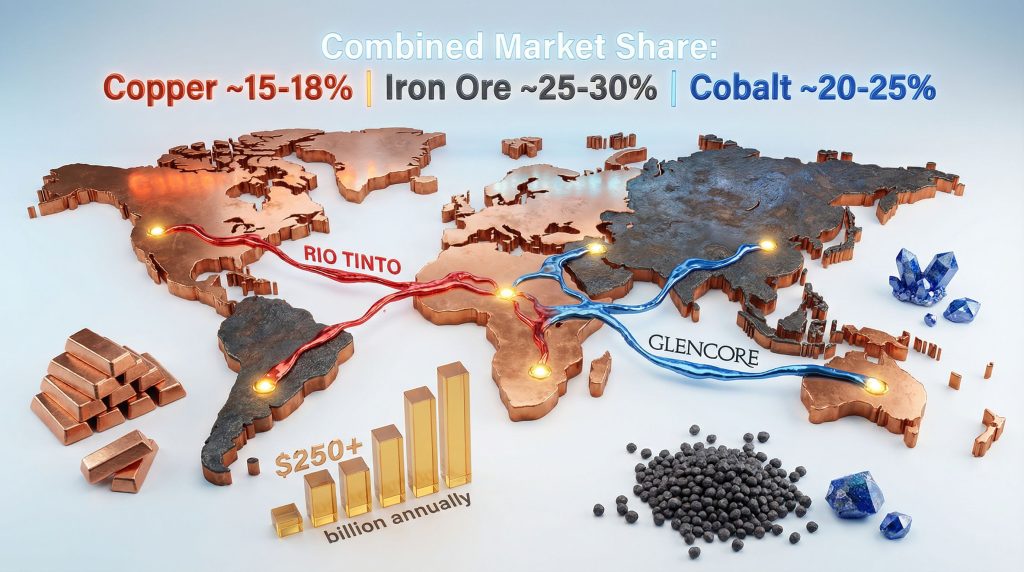
Combined revenue exceeding $250 billion annually reflects the unprecedented scale of this potential consolidation. Both entities described their engagement as preliminary and exploratory, emphasizing that discussions may involve some or all their businesses without established terms or certainty of outcome.
These developments align with broader industry evolution trends where independent operations face mounting pressures from regulatory complexity, capital intensity requirements, and customer demands for integrated supply chain solutions. European equities broadly reflected strength in the resources sector following confirmation, illustrating how markets interpret formal acknowledgment as material advancement beyond routine corporate speculation.
When big ASX news breaks, our subscribers know first
How Would a Combined Entity Reshape Global Commodity Markets?
Market Concentration Analysis
| Commodity | Estimated Combined Share | Global Ranking | Strategic Implications |
|---|---|---|---|
| Copper | 15-18% | Top position globally | Dominant influence in energy transition metals |
| Iron Ore | 25-30% | Leading global position | Unprecedented control over steel supply chains |
| Cobalt | 20-25% | Market leader | Critical battery materials supply concentration |
| Zinc | 12-15% | Top 3 position | Significant industrial metals influence |
Operational Scale Transformation
The potential combination would create unprecedented operational capabilities across:
- Global workforce integration: 210,000+ employees spanning 65+ countries
- Revenue consolidation: $250+ billion in annual combined revenues
- Asset diversification: Unmatched geographic and commodity portfolio spread
- Capital deployment capacity: Enhanced ability to fund mega-projects and technology initiatives
Portfolio Complementarity Advantages
One entity's strength in bulk commodities including iron ore and aluminum would merge with the other's diversified trading operations and energy metals portfolio. This combination creates synergies across multiple dimensions:
- Geographic optimisation: Reduced operational overlap while expanding market reach
- Supply chain integration: Vertical integration opportunities from mine to market
- Technology convergence: Combined research and development capabilities for autonomous mining
- Infrastructure sharing: Coordinated shipping and logistics across global operations
The first entity operates dominant iron ore assets in Australia alongside major copper and aluminum positions spanning North America, South America, and Europe. Annual revenues exceeded $50 billion in 2024, reflecting a portfolio weighted toward bulk commodities and industrial metals.
The second entity maintains mining, processing, and marketing activities with annual revenues exceeding $200 billion, underscoring extensive physical footprint and commercial reach across copper, cobalt, zinc, nickel, coal, and energy products. Consequently, this integration would benefit from advanced data-driven mining operations to optimise combined productivity.
Trading Operations Integration
The substantial difference in revenue scales reflects fundamentally different business models. One company generates revenue primarily through mining production, while the other includes significant commodity trading and marketing operations that create value through arbitrage and intermediation. This integration would provide unprecedented market access beyond traditional long-term customer contracts.
What Are the Key Strategic Drivers Behind These Merger Discussions?
Market Positioning Imperatives
Mining companies increasingly require scale advantages to compete in complex global commodity markets. The confirmed discussions reflect industry-wide recognition that traditional operational models face mounting challenges from regulatory complexity, capital intensity requirements, and customer demands for integrated solutions.
Consolidation pressures have intensified as companies seek portfolio diversification to reduce dependency on single-commodity price cycles. The combination would create enhanced pricing power during supply constraints while providing strategic stockpiling capacity during market volatility.
Technology and Innovation Synergies
Both entities maintain substantial investments in mining automation and processing technology. Combined research and development capabilities would accelerate deployment of:
- Autonomous mining equipment: Advanced extraction and transportation systems
- Processing optimisation: Integrated mineral processing and refining capabilities
- Digital integration: Coordinated data management and operational analytics
- Environmental technologies: Shared development of sustainable mining practices
Financial and Operational Efficiency
The potential combination addresses several strategic imperatives:
- Capital efficiency: Shared infrastructure development and maintenance costs
- Risk diversification: Geographic and commodity exposure balancing
- Customer relationship leverage: Enhanced negotiating position with steel producers and battery manufacturers
- Regulatory compliance: Coordinated approach to evolving environmental and safety requirements
However, companies must consider their capital raising strategies to fund such massive integration efforts effectively.
How Do Regulatory Frameworks Impact the Merger Timeline?
UK Takeover Panel Requirements
Under current regulations, the acquiring entity faces a February 5, 2026 deadline to either submit a formal acquisition proposal or publicly withdraw from discussions. This regulatory framework ensures definitive resolution within specified timeframes while protecting shareholder interests.
Multi-Jurisdictional Approval Process
| Jurisdiction | Regulatory Authority | Primary Concerns | Estimated Timeline |
|---|---|---|---|
| United Kingdom | Competition and Markets Authority | Market concentration analysis | 12-18 months |
| Australia | Competition & Consumer Commission | Domestic mining competition | 6-12 months |
| South Africa | Competition Commission | Employment and transformation requirements | 6-18 months |
| Canada | Competition Bureau | Resource sector consolidation | 8-14 months |
Antitrust Considerations
Regulatory authorities will scrutinise market concentration effects across multiple commodities. Combined market shares exceeding 20% in critical materials like cobalt and iron ore will trigger intensive competition analysis. Regulators may require asset divestments or operational remedies to address monopolisation concerns.
National Security Review
Strategic resource security represents a growing regulatory consideration. Multiple jurisdictions maintain foreign investment review processes that evaluate critical mineral supply chain implications. The combined entity's influence over battery materials and steel-making inputs will face enhanced scrutiny, particularly given recent critical minerals strategy developments globally.
What Historical Precedents Inform Potential Outcomes?
Major Mining Consolidation Case Studies
Glencore-Xstrata (2013): $62 billion
This transaction created one of the world's largest diversified commodities groups and stands as one of the largest takeovers in sector history. The deal demonstrated that large-scale mining consolidation can succeed while maintaining operational efficiency. Integration required three years for full operational merger, but commodity markets continued behaving according to global supply and demand rather than ownership changes.
BHP-Billiton (2001): $58 billion equivalent
The merger established a global mining behemoth whose scale and influence persisted through subsequent commodity cycles. This combination showed how geographic diversification reduces regulatory resistance while creating sustainable competitive advantages. The dual-listed company structure provided operational flexibility across multiple jurisdictions.
Anglo American-Teck (2025): $53 billion
This recent merger created a top-five copper producer with annual output exceeding 1.2 million metric tons. The transaction focused on copper assets specifically, demonstrating investor appetite for strategic commodity exposure. Market reception was positive, indicating continued support for mining consolidation when properly structured.
Integration Lessons
Historical precedents reveal several critical success factors:
- Regulatory preparation: Proactive asset divestment planning reduces approval timelines
- Cultural integration: Harmonising operational philosophies requires dedicated management attention
- Customer continuity: Maintaining service levels during transitions preserves market relationships
- Technology systems: Integrating disparate IT infrastructure demands significant resources
What Are the Primary Risk Factors and Mitigation Strategies?
Execution Risk Assessment
| Risk Category | Probability | Impact Level | Mitigation Approach |
|---|---|---|---|
| Regulatory rejection | Medium | High | Proactive competition remedy planning |
| Integration complexity | High | Medium | Phased combination strategy |
| Cultural misalignment | Medium | Medium | Dedicated change management programs |
| Market timing | Medium | Medium | Flexible deal structure and financing |
Valuation Challenges
Establishing fair exchange ratios presents substantial complexity due to:
- Asset diversity: Difficulty comparing bulk commodity operations with diversified trading activities
- Geographic distribution: Varying regulatory environments and operational risks across jurisdictions
- Commodity exposure: Different price cycle sensitivities and market dynamics
- Trading operations: Complex valuation of marketing and logistics capabilities versus pure mining assets
Operational Integration Risks
The scale and complexity of combining global operations creates multiple execution challenges:
- Workforce optimisation: Managing employment impacts across overlapping operations
- Technology systems: Integrating disparate data management and operational control systems
- Customer relationships: Preventing disruption to existing supply agreements during transition
- Environmental compliance: Coordinating sustainability commitments across combined operations
Moreover, recent developments including the critical minerals order add additional regulatory complexity to consider.
The next major ASX story will hit our subscribers first
How Would Market Dynamics Change Post-Merger?
Supply Chain Concentration Effects
The combined entity would control significant portions of global supply chains for critical materials, potentially leading to enhanced pricing power during supply constraints. This concentration creates both opportunities and regulatory challenges across multiple commodity markets.
Competitive Response Scenarios
Other major mining companies would likely respond through accelerated consolidation activity. Strategic partnerships between remaining independents could emerge as defensive measures against increased competitive pressure. Technology investment acceleration would become essential for maintaining operational efficiency advantages.
Customer Adaptation Strategies
Steel producers and battery manufacturers would face reduced supplier options, potentially driving:
- Long-term contract negotiations: Enhanced focus on supply security over price optimisation
- Vertical integration initiatives: Direct investment in mining assets or processing capabilities
- Alternative sourcing development: Geographic diversification of supply relationships
- Recycling capacity expansion: Increased focus on secondary materials to reduce primary supply dependency
Infrastructure and Logistics Optimisation
Combined operations would enable coordinated shipping and logistics across global networks. Shared processing facilities and transportation infrastructure could reduce operational costs while improving supply chain efficiency. However, this coordination might also trigger additional regulatory scrutiny regarding market access for competitors.
What Investment Implications Should Stakeholders Consider?
Shareholder Value Analysis
For Rio Tinto Shareholders:
- Portfolio diversification: Reduced dependence on iron ore price cycles through commodity variety
- Trading capabilities: Access to established marketing networks and global distribution systems
- Growth opportunities: Enhanced capital deployment across broader commodity portfolio
- Operational synergies: Cost reduction through shared infrastructure and processing facilities
For Glencore Shareholders:
- Premium realisation: Potential acquisition premium above current market valuations
- Financial strength: Access to stronger balance sheet and enhanced credit profile
- Operational scale: Increased mining production capacity and reserve base
- Integration benefits: Combined operational expertise across mining and trading functions
Market Sector Impact Assessment
| Stakeholder Group | Potential Impact | Likely Response |
|---|---|---|
| Competing miners | Consolidation pressure | Accelerated M&A activity |
| Steel producers | Reduced supplier options | Long-term contract focus |
| Battery manufacturers | Supply concentration risk | Vertical integration strategies |
| Commodity traders | Market access challenges | Alternative sourcing development |
Risk-Adjusted Return Considerations
Investors must evaluate multiple scenarios including successful integration, partial asset divestment requirements, and potential regulatory rejection. The substantial premium reflected in post-announcement share price movements indicates market expectation of successful completion, creating downside risk if negotiations fail.
Furthermore, the official statement from Rio Tinto provides additional clarity on their strategic rationale.
What Are the Critical Success Factors for Deal Completion?
Regulatory Approval Strategy
Success requires comprehensive preparation across multiple jurisdictions:
- Competition remedies: Proactive identification of assets for potential divestment
- Market access commitments: Supply guarantees for competing mining companies
- Employment protection: Workforce transition planning across overlapping operations
- Environmental compliance: Enhanced sustainability targets and transition planning
Integration Planning Requirements
Operational combination demands systematic approach to:
- Cultural alignment: Harmonising different corporate cultures and management philosophies
- Technology convergence: Integrating IT infrastructure and operational control systems
- Customer relationship management: Maintaining service quality during organisational transition
- Performance metrics: Establishing combined entity success measurements and accountability frameworks
Financial Structure Optimisation
Deal structure must balance multiple competing interests:
- Valuation methodology: Fair assessment of trading operations versus pure mining assets
- Exchange ratio determination: Appropriate shareholder value distribution between entities
- Financing arrangements: Optimal debt and equity balance for combined operations
- Dividend policy coordination: Sustainable cash distribution strategy for integrated business
The confirmed Rio Tinto and Glencore merger talks represent a watershed moment for global mining consolidation. Whether discussions advance beyond preliminary exploration depends on successfully navigating regulatory approval processes, establishing fair valuation parameters, and demonstrating sustainable operational integration capabilities. The February 5, 2026 deadline ensures resolution within defined timeframes while market dynamics continue evolving around this potential industry transformation.
Looking for the Next Major Mining Discovery?
Discovery Alert's proprietary Discovery IQ model delivers instant notifications on significant ASX mineral discoveries, empowering subscribers to identify actionable trading opportunities ahead of the broader market. Explore historic examples of exceptional discovery returns and begin your 30-day free trial today to secure your competitive advantage in the evolving mining sector.