June 13, 2026
Why the Mining Supercycle Debate Matters Now
Commodity markets rarely move in a straight line, but every few decades the industry enters a longer and more powerful phase where supply struggles to keep up with a major shift in demand. That is the essence of a mining supercycle: not a short-lived rally, but a prolonged period in which prices and asset valuations stay structurally elevated because the world needs more raw materials than the sector can quickly deliver.
This matters in 2026 because the demand story is no longer tied to one country or one building boom. Instead, multiple capital-intensive themes are colliding at once: power grid expansion, data centre construction, electric vehicle rollout, defence rearmament, energy security, and broader hard-asset rotation by institutional investors.
The result is a credible argument that the mining supercycle thesis has moved from fringe speculation into mainstream portfolio strategy. However, credibility is not certainty. Commodity markets remain volatile, politically sensitive, and heavily exposed to execution risk.
This article is for informational purposes only and should not be treated as financial advice. Commodity equities can be highly cyclical, and forward-looking scenarios depend on assumptions that may prove wrong.
When big ASX news breaks, our subscribers know first
What Is a Mining Supercycle?
A mining supercycle is an extended period, often lasting 5 to 17 years, in which commodity prices remain above long-run trend levels because structural demand growth outpaces the industry's ability to add supply.
That differs from a normal commodity upswing in several important ways:
- A standard cycle is often driven by inventory moves, temporary shortages, or macro sentiment.
- A supercycle usually starts with a deep supply shortfall after years of underinvestment.
- It is reinforced by large, multi-year economic shifts such as industrialisation, reconstruction, or electrification.
- The price impact tends to be broader and longer-lasting than a typical rebound.
At peak phases, historical supercycles have seen commodity prices hold roughly 10% to 33% above long-run trend averages, according to long-cycle commodity research commonly cited in macro market analysis.
Supercycle vs Ordinary Cycle
| Feature | Ordinary commodity cycle | Mining supercycle |
|---|---|---|
| Duration | Months to a few years | Often 5 to 17 years |
| Driver | Short-term demand or supply shifts | Multi-year structural demand shock |
| Supply response | Usually manageable | Often slow, capital-intensive, delayed |
| Price behaviour | Volatile but mean-reverting | Sustained elevation above trend |
| Investment impact | Tactical | Strategic and thematic |
The Historical Pattern
Over the past century, analysts commonly point to four major commodity supercycles, including post-war reconstruction phases and the China-led buildout of the 2000s. The exact dating varies by methodology, but the pattern is consistent: major economic transformations consume immense quantities of steel inputs, energy materials, and industrial metals before supply can rebalance. Furthermore, analysts at ICMM note that the emerging cycle looks structurally different from its predecessors in both demand composition and commodity mix.
How the Current Setup Differs From the China Boom
The last widely recognised mining supercycle ran through the 2000 to 2011 era, when China's urbanisation and infrastructure buildout drove extraordinary demand for iron ore, coal, oil, and base metals.
That cycle eventually broke because miners spent aggressively to expand production. When Chinese growth slowed and new capacity arrived, oversupply crushed prices and mining equities underperformed for much of the following decade.
The current thesis is different in both demand composition and supply starting point.
Side-by-Side Comparison
| Dimension | 2000 to 2011 cycle | Emerging 2026 cycle |
|---|---|---|
| Primary demand engine | China-led construction and urbanisation | AI infrastructure, electrification, defence, energy security |
| Commodity focus | Bulk materials such as iron ore, coal, oil | Copper, uranium, lithium, aluminum, rare earths, silver |
| Demand geography | Concentrated | More globally diversified |
| Supply backdrop | Heavy capex eventually caused oversupply | Underinvestment has constrained new supply |
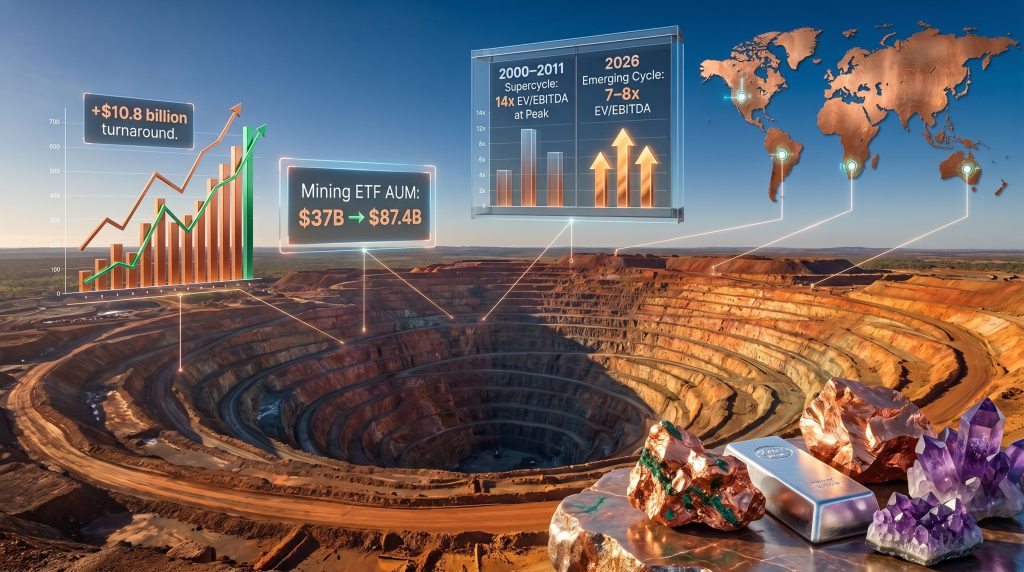
| Valuation setup | Around 14x EV/EBITDA at peak | About 7 to 8x EV/EBITDA for major miners |
| Cycle stage in 2026 thesis | Mature and peaked by 2011 | Often described as early-stage |
BlackRock portfolio manager Evy Hambro told Reuters that the current environment looked like the early stage of a commodity supercycle, adding that demand now appears more diversified across AI, electrification and defence than during the China-centric boom. Reuters also reported Hambro's view that the material intensity of GDP is rising as investment accelerates in grids, data centres, electric vehicles and charging networks.
That observation is central. The argument is not simply that commodities are going up. It is that the global economy is becoming more physically intensive again after a long period in which investors rewarded asset-light software businesses over asset-heavy producers.
What Is Driving Institutional Capital Into Mining in 2026?
The capital rotation into resources is being pushed by a mix of macro, industrial and behavioural factors.
1. Hard Assets Are Back in Favour
When interest rates stay elevated, inflation risk lingers, and expensive growth stocks wobble, investors often revisit sectors tied to the real economy. Reuters noted that Morningstar's US Technology Index fell 9% in the first quarter, which helped reinforce the case for rotation into hard assets. In addition, critical minerals demand is acting as a powerful structural tailwind for the broader resources sector.
2. AI Infrastructure Is Material-Intensive
AI is often discussed as a software revolution, yet its hardware footprint is enormous. Data centres need:
- Copper-heavy electrical systems
- Aluminum in power and cooling infrastructure
- Steel and cement for physical buildout
- Grid upgrades to supply higher power loads
This is why AI can act as a metals demand multiplier rather than just a digital trend.
3. Electrification Needs More Metal Per Unit of Growth
Electric vehicles, charging systems, renewable generation, transmission lines, and battery systems all consume more mineral inputs than their fossil-fuel-era equivalents. Consequently, copper market trends have moved to the forefront of supercycle discussions, given the metal's conductivity and broad use across wiring, motors, transformers and transmission systems.
4. Defence and Energy Security Are Creating Demand Floors
Reuters reported that Taosha Wang of Fidelity argued that a mining and energy-focused supercycle had already arrived, with geopolitical tensions pushing governments to prioritise supply security. That is an important distinction. Even if consumer demand weakens at times, strategic spending on power resilience, fuel security and defence manufacturing can sustain demand for key inputs.
5. Supply Chain Sovereignty Is Changing Capital Allocation
Critical minerals are no longer viewed only through an industrial lens. They are increasingly assessed as geopolitical assets. Furthermore, rare earth elements now matter to trade strategy as much as to manufacturing economics, alongside uranium conversion, refined lithium chemicals, and copper concentrate flows.
Investors are no longer assessing miners only on spot prices. They are also pricing optionality tied to long-life deposits, jurisdiction quality, refining access, and exposure to scarce minerals.
The ETF Data Shows a Sharp Turn in Sentiment
The cleanest evidence of institutional interest comes from fund flows.
Reuters, citing ETFGI data, reported that assets under management in mining ETFs climbed from $37 billion to $87.4 billion in the 12 months to March 31, 2026. That is an increase of more than 136% in a single year.
Net Flow Reversal
| Period | Net mining ETF flow |
|---|---|
| Q1 2025 | -$2.52 billion |
| Q1 2026 | +$8.24 billion |
| Sentiment swing | +$10.8 billion |
Reuters linked the earlier outflows to tariff concerns after wide-ranging US trade actions, while the 2026 rebound reflected a broad reallocation back into commodities and miners.
What the Flows Suggest
- Investors are treating mining as a macro theme, not just a stock-picking niche.
- Capital is moving beyond gold into industrial and energy-linked materials.
- The speed of the shift shows how under-owned the sector had become.
For investors considering exchange traded funds as a way to access this theme, the flow data highlights both the opportunity and the crowding risk that can accompany rapid sentiment shifts.
Industrial Metals vs Gold
Reuters reported that copper funds attracted $198 million in March, while the VanEck Gold Miners ETF saw a $710 million monthly outflow despite remaining up by almost $1 billion year-to-date.
That matters because it shows a preference for growth-sensitive materials over traditional crisis hedges. In other words, the market appears to be leaning toward an investment and infrastructure response, not merely defensive positioning. Reuters also reported that oil and gas funds drew almost $6 billion in net inflows in the first quarter, reinforcing the broader hard-asset rotation.
Which Commodities Sit at the Centre of the Mining Supercycle?
Not every mined material benefits equally from the same macro backdrop. The strongest supercycle candidates are those where demand growth is broad, substitution is difficult, and new supply is slow to develop.
Copper
Copper sits at the intersection of nearly every major industrial theme. It is used in:
- Grid expansion
- Electric vehicles and charging systems
- Renewable power infrastructure
- Data centres and backup power systems
- Industrial machinery and building electrification
Reuters reported that Charlie Aitken of Regal Partners sees copper as critically undersupplied relative to structural demand, with a view that copper prices could potentially double or triple over the next decade if deficits persist. That is a forward-looking opinion, not a certainty, but it explains why copper producers are often treated as high-conviction supercycle vehicles.
Uranium and Lithium
Uranium has a different demand profile than battery metals, but both are tied to long-run energy system change. Uranium market trends point to renewed interest in baseload nuclear generation, whilst lithium remains essential to most commercial battery chemistries even as pricing cycles remain volatile and sensitive to Chinese supply dynamics.
Rare Earth Elements
Rare earths matter because magnetic materials are essential for many advanced motors, electronics, and defence systems. The mining challenge here is not just geology. It is also separation, refining, environmental management, and downstream processing capability.
Aluminum
Aluminum is less discussed in retail mining narratives than copper, but it has major exposure to transport, transmission and industrial power systems. Reuters reported that Anix Vyas of Harding Loevner highlighted both copper and aluminum as in demand, particularly as infrastructure and industrial applications expand.
Silver
Silver has dual exposure to monetary demand and industrial use, particularly in solar and electronics. It is often overshadowed by gold in mainstream discussion, but its industrial profile can make it more sensitive to manufacturing and energy-transition trends.
The next major ASX story will hit our subscribers first
How Major Mining Companies Are Positioned
Large diversified miners are often the first stop for institutional capital because they offer scale, liquidity, and exposure to multiple commodities at once. Reuters reported that shares of BHP and Rio Tinto hit record highs in 2026, reflecting this renewed interest.
Why Diversified Miners Are Attracting Attention
- They combine established operations with balance-sheet strength.
- They often have exposure to copper and aluminum alongside legacy bulk commodities.
- They can redeploy cash flow into new developments, exploration, or acquisitions.
- They are easier for large funds to own than smaller single-asset developers.
Valuation Still Looks Moderate Relative to History
Reuters reported that major mining companies were trading at roughly 7 to 8 times EV/EBITDA, compared with about 14 times during the 2008 to 2010 boom period.
| Metric | Prior boom peak | Recent major miner range |
|---|---|---|
| EV/EBITDA | ~14x | ~7 to 8x |
This does not guarantee upside, but it suggests the sector has not yet reached the valuation extremes associated with a fully mature mania phase.
Where Differentiated Upside May Exist
- Copper-focused producers with long reserve life and expansion potential.
- Aluminum-linked miners with energy-advantaged operations.
- Uranium producers and developers if reactor demand expands faster than mine restarts.
- Rare earth and critical mineral companies with downstream processing relevance.
The Risks That Could Derail the Mining Supercycle
A mining supercycle is never a straight line. Even if the long-term thesis is correct, the path can be violent.
Small Markets Can Swing Hard
Reuters highlighted how small metals markets are compared with large equity futures markets.
| Market | Annual futures trading volume |
|---|---|
| LME copper and aluminum | ~$21 trillion |
| CME gold futures | More than $25 trillion |
| Nasdaq-100 futures | ~$85 trillion |
| S&P 500 futures | More than $135 trillion |
That size mismatch means relatively modest reallocations can create outsized price moves in commodities and mining shares.
Other Major Risks
- Capex lag: New mines can take many years to permit, finance, build and ramp up.
- Grade and geology risk: Higher strip ratios, lower ore grades, complex metallurgy and water constraints can limit project economics.
- Cost inflation: Diesel, labour, explosives, steel and power costs can erode margins even when commodity prices rise.
- Refining bottlenecks: Mining supply alone is not enough if concentrate cannot be processed efficiently.
- ETF crowding: Fast inflows can reverse quickly if macro sentiment shifts.
- Inflation feedback loops: Stronger commodity prices can worsen inflation and eventually slow demand.
- Geopolitical disruption: Trade fragmentation, sanctions, conflict and shipping disruption can all distort pricing.
Commodity investors must separate structural bullishness from short-term volatility. A valid long-run thesis does not prevent sharp drawdowns.
Why Mining's Small Market Weight Could Create Opportunity
One of the strongest structural arguments for the mining supercycle is simple: the sector remains tiny relative to its economic importance.
Reuters reported that the top five mining companies represent only about 0.4% of the MSCI All Country World Index, versus 16.8% for the top five technology companies. It also reported that metals and mining products account for just 0.57% of total equity ETF market share globally.
Why This Matters
- Many diversified portfolios remain structurally underweight miners.
- Even a small reallocation from tech or broad index exposures could have a large price impact.
- If institutional investors decide raw-material exposure is strategically necessary, the sector does not need massive inflows to rerate.
This underrepresentation is one reason the mining supercycle thesis can coexist with elevated volatility. The market is small enough to be overlooked, but also small enough to move quickly when sentiment changes. Indeed, Sprott's analysis of critical minerals reinforces this view, noting that structural scarcity in key materials could amplify price responses well beyond what historical precedent might suggest.
Three Scenarios for the Mining Supercycle Through 2030
Scenario A: Accelerated Transition
In the bullish case, AI infrastructure, grid investment, defence spending and electrification all remain strong. Copper deficits deepen, uranium markets tighten, and mining equity multiples rise closer to prior supercycle peaks.
Potential features:
- Copper prices move materially higher
- Major miners rerate above current valuation bands
- Critical mineral M&A accelerates
- Supply constraints persist despite new project approvals
Scenario B: Managed Expansion
This is the more balanced case. Demand remains robust, but not linear. Supply starts to respond in selected commodities, creating rallies interrupted by corrections.
Potential features:
- Commodity prices trend upward with volatility
- Large-cap miners outperform broader cyclicals
- Some battery materials remain oversupplied while copper stays tight
- Project pipelines slowly improve by decade end
Scenario C: Cycle Interruption
In the bearish case, inflation, weak industrial activity, tighter financial conditions or geopolitical fragmentation reduce demand before supply deficits fully emerge.
Potential features:
- ETF outflows reverse recent gains
- Mining equities de-rate despite long-term demand themes
- High-cost producers struggle
- Investment timelines stretch further out
Frequently Asked Questions About the Mining Supercycle
What Exactly Is a Mining Supercycle?
It is a prolonged period when commodity prices stay structurally elevated above long-run averages because supply cannot quickly match sustained demand growth.
Are We Definitely in a Mining Supercycle?
Not definitively. The evidence supporting the mining supercycle thesis has strengthened, especially through ETF flows, diversified demand drivers and constrained supply, but the label remains a market interpretation rather than a settled fact.
Which Commodities Matter Most?
The commodities most often associated with the current mining supercycle are copper, uranium, lithium, rare earths, aluminum, and silver.
Are Mining Stocks Still Cheap?
By recent Reuters-reported measures, major miners at roughly 7 to 8x EV/EBITDA remain below the ~14x valuation levels seen in the prior boom. That suggests room for rerating if the thesis strengthens, though valuation alone is not a buy signal.
What Is the Biggest Risk?
The biggest risk is assuming a powerful long-term narrative eliminates cyclical drawdowns. In reality, commodity markets can correct sharply even during structurally supportive periods.
Final Takeaways
The mining supercycle case in 2026 rests on a powerful combination of factors: multi-vector demand, constrained supply, revived institutional interest, and a sector that remains small within global portfolios.
The core bullish points are clear:
- Demand is being driven by more than one economy or one end market.
- Supply in many key commodities was underfunded for years after the 2011 peak.
- ETF and fund-flow data show a meaningful revival in institutional interest.
- Valuations for major miners remain below prior supercycle extremes.
However, a strong thesis is not the same as a straight-line outcome. The mining supercycle, if real, is likely to be uneven, politically noisy, and highly volatile. For investors, the challenge is not just identifying the right theme. It is distinguishing durable structural demand from temporary price surges, and quality assets from speculative excess.
In that sense, the most important lesson is simple: commodities may be reclaiming strategic importance in global portfolios, but success in the sector still depends on discipline, selectivity and respect for risk.
Want to Catch the Next Major Mineral Discovery Before the Market Does?
Discovery Alert's proprietary Discovery IQ model delivers real-time alerts on significant ASX mineral discoveries across copper, uranium, rare earths and other supercycle commodities — instantly converting complex geological data into actionable investment insights for both short-term traders and long-term investors. Explore historic discoveries and their exceptional returns, then start your 14-day free trial at Discovery Alert to position yourself ahead of the next major find.