
July 10, 2026
When Conglomerates Break Apart: The Strategic Logic Reshaping India's Resources Sector
Large diversified conglomerates have long been a defining feature of emerging market capitalism. For decades, the logic was straightforward: scale across sectors, share capital, and absorb cyclical shocks through diversification. However, investor behaviour has shifted meaningfully. Global institutional capital increasingly favours sector-pure businesses with transparent balance sheets and predictable earnings profiles over sprawling multi-industry groups that are notoriously difficult to value. This structural shift in how markets price complexity is at the heart of the Vedanta demerger power arm renamed Vedanta Power Limited, one of the most ambitious corporate separations India's resources sector has ever attempted.
Furthermore, the Vedanta demerger power arm renamed Vedanta Power Limited is just one chapter in a broader restructuring story, but it carries significant weight. It marks the formal legal consolidation of the group's thermal power business as a standalone entity, ready to compete independently in one of Asia's fastest-growing electricity markets.
When big ASX news breaks, our subscribers know first
Five Entities, One Strategic Vision
Vedanta Limited built its reputation as one of India's most influential natural resources conglomerates, with operations spanning primary aluminium, oil and gas, thermal power, ferrous metals, and zinc and silver production. Each of these businesses operates within a distinct capital cycle, faces unique regulatory environments, and attracts a different category of investor. Housing all of them under a single listed entity creates what fund managers often call a holding company discount, where the sum of the parts is worth considerably more than the consolidated whole.
The group's response to this structural undervaluation is a five-way demerger that will create independently listed, sector-focused businesses from a single parent. Notably, broader trends in mining industry consolidation suggest that corporate simplification is becoming a defining strategic priority across resources globally.
| Entity | Sector Focus | Listing Status |
|---|---|---|
| Vedanta (Residual Entity) | Diversified / Zinc & Silver | Parent entity retained |
| Vedanta Aluminium Metal Limited (VAML) | Primary aluminium production | Listing targeted June 15, 2026 |
| Vedanta Oil & Gas Limited (VOG) | Hydrocarbon exploration and production | Listing targeted June 15, 2026 |
| Vedanta Power Limited (formerly TSPL) | Thermal power generation | Listing targeted June 15, 2026 |
| Vedanta Iron & Steel Limited (VISL) | Ferrous metals and steel | Listing targeted June 15, 2026 |
Each entity will carry its own credit profile, management team, capital structure, and growth narrative. For institutional investors who previously avoided Vedanta due to its cross-sector complexity, the demerger removes that structural barrier and opens five distinct investment theses simultaneously.
Vedanta Power Limited: More Than a Name Change
The Significance of Rebranding Talwandi Sabo Power Limited
The renaming of Talwandi Sabo Power Limited to Vedanta Power Limited, approved by the Registrar of Companies under the Ministry of Corporate Affairs and effective June 3, 2026, is not merely an administrative formality. It represents the deliberate repositioning of a large thermal power asset under a unified group identity that each demerged business will carry into independent market life. You can find further details on the official demerger scheme published by Vedanta Limited.
Talwandi Sabo Power Limited operated for years as the group's primary power generation subsidiary, anchored by a large-scale coal-fired plant in Punjab, India. That plant forms the core of what will become Vedanta Power Limited's asset base as a publicly listed independent entity.
Brand consolidation in demerger structures serves a specific commercial purpose. By aligning all five entities under the Vedanta name, the group signals continuity of governance standards and institutional credibility to debt markets, power purchase agreement counterparties, and prospective shareholders unfamiliar with the TSPL operating history. For a business preparing for independent price discovery on the NSE and BSE, brand recognition shortens the due diligence curve for investors.
Market Position and Operational Scale
Following the restructuring, Vedanta Power Limited is positioned as India's 5th largest private sector thermal power generator. That ranking reflects the scale of the Talwandi Sabo plant in Punjab, a facility that contributes meaningfully to baseload electricity supply in a state with substantial agricultural and industrial energy demand.
In the context of India's power sector, baseload generation remains strategically important. While renewable energy capacity additions have accelerated rapidly, solar and wind generation are inherently intermittent. Coal-fired thermal plants provide the dispatchable, round-the-clock generation that grid operators rely on to maintain frequency stability and meet peak demand. Vedanta Power Limited enters independent life occupying precisely this role in the supply stack.
Shareholder Entitlements and the Demerger Timeline
Critical Dates Every Investor Should Track
The Vedanta demerger follows a structured timeline with specific implications for shareholders at each stage:
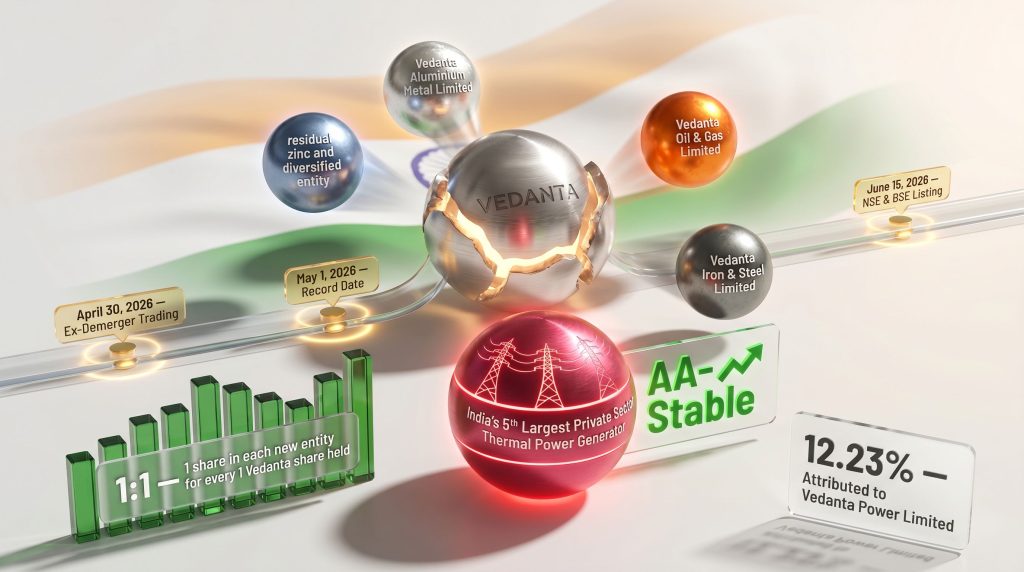
- Vedanta shares began trading on an ex-demerger basis from April 30, 2026, following a special price discovery session designed to establish the residual entity's standalone market value.
- The record date for shareholder entitlement was May 1, 2026, determining which holders qualify for shares in the four new entities.
- All four demerged businesses are scheduled to list simultaneously on the NSE and BSE on June 15, 2026, in the trade-for-trade segment.
- The renaming of Talwandi Sabo Power Limited to Vedanta Power Limited took effect on June 3, 2026, completing a key legal prerequisite ahead of listing.
Understanding the 1:1 Share Entitlement Structure
Shareholders who held Vedanta Limited shares on or before April 29, 2026 are entitled to receive shares in each of the four newly created entities. The entitlement ratio is straightforward: one share in each new entity for every one Vedanta share held. An investor holding 1,000 Vedanta shares will receive 1,000 shares each in Vedanta Aluminium Metal Limited, Vedanta Oil & Gas Limited, Vedanta Power Limited, and Vedanta Iron & Steel Limited.
This structure is notable because it does not dilute existing holders through a rights issue or preferential allotment. Instead, it redistributes value that was previously embedded within the consolidated entity into four independently tradeable instruments.
How Acquisition Cost Is Apportioned Across Entities
For tax purposes, the original cost of acquiring Vedanta Limited shares must be redistributed across all five entities. This apportionment is critical for calculating capital gains liabilities when shareholders eventually sell their demerged entity holdings.
12.23% of the original acquisition cost of Vedanta Limited shares is attributed specifically to Vedanta Power Limited. The remaining percentage is distributed across the other four entities. Investors and their tax advisors should recalculate cost basis using this framework before transacting in any of the newly listed shares, as the distinction between long-term and short-term capital gains treatment under Indian tax law can materially affect net returns.
Important Disclaimer: The tax implications described above are based on publicly available information regarding the Vedanta demerger cost apportionment structure. Individual tax circumstances vary, and investors should seek qualified professional advice before making decisions based on capital gains treatment.
ICRA's Credit Upgrade: A Structural Validation
What the Ratings Signal About the Demerger's Financial Logic
On May 29, 2026, ICRA announced a series of credit rating upgrades across the Vedanta group that served as an independent validation of the demerger's financial rationale. The upgrades were significant both in their magnitude and their timing, arriving weeks before the scheduled listing of four new entities.
| Entity | Previous Rating | Upgraded Rating | Outlook |
|---|---|---|---|
| Vedanta Limited | Below AA+ | AA+ | Stable |
| Vedanta Aluminium Metal Limited (VAML) | Below AA+ | AA+ | Stable |
| Vedanta Power Limited (formerly TSPL) | A+/Watch Developing | AA- | Stable |
Ratings assigned by ICRA, announced May 29, 2026.
Decoding the AA+ and AA- Rating Categories
For investors unfamiliar with Indian credit rating conventions, the distinction between these rating tiers carries practical consequence. Securities rated AA+ are considered to carry a high degree of safety in meeting financial obligations and are associated with very low credit risk. This is ICRA's second-highest domestic rating category, and its assignment to Vedanta Limited and VAML represents the first time in over a decade the group has achieved this level of credit recognition.
Vedanta Power Limited's upgrade to AA- Stable from the prior A+/Watch Developing designation is equally meaningful. The Watch Developing classification had reflected uncertainty about how the power business would perform as a standalone entity without the financial backing of a diversified parent. Consequently, the removal of that watch status and the upgrade to AA- Stable signals that ICRA now considers the independent power business creditworthy on its own terms.
The practical consequences of these upgrades include:
- Lower borrowing costs as lenders reprice credit facilities based on improved ratings.
- Expanded access to debt capital markets, including bond issuances at more competitive yields.
- Stronger counterparty confidence from power purchase agreement partners, fuel suppliers, and project financiers.
- Improved covenant headroom under existing financing arrangements that reference credit ratings.
Why Rating Agencies Reward Corporate Simplification
There is a broader principle at work in these upgrades that extends beyond Vedanta's specific situation. Credit rating agencies have consistently demonstrated a preference for standalone entities with focused balance sheets over complex conglomerates where cross-subsidisation between divisions can obscure true credit quality. When a diversified group separates its businesses, each entity's financial profile becomes transparent and independently assessable, which typically results in more accurate and often more favourable credit assessments.
Vedanta's experience supports this pattern. The anticipated structural efficiencies from the demerger, combined with improved operational performance metrics and better debt coverage ratios, formed the basis for ICRA's decision to upgrade across multiple entities simultaneously.
Trade-for-Trade Listing: What New Shareholders Need to Understand
The June 15, 2026 listing of all four demerged entities in the trade-for-trade segment introduces a specific market mechanic that shareholders should understand before the debut session. In addition, understanding how commodity prices and mining performance interact will be important context for evaluating these newly independent businesses post-listing.
In a trade-for-trade (T+0 settlement) environment:
- Every transaction must result in actual delivery of shares. There is no netting of buy and sell positions.
- Intraday speculation, where traders buy and sell the same stock within a session without taking delivery, is not permitted.
- This structure significantly reduces speculative volatility during the price discovery phase, when limited historical trading data makes valuation inherently uncertain.
- Liquidity is typically constrained in the trade-for-trade segment compared to normal continuous trading, meaning bid-ask spreads may be wider than shareholders are accustomed to.
The trade-for-trade designation is commonly applied to newly listed entities and reflects a regulatory preference for orderly price discovery rather than momentum-driven speculation. Once prices stabilise across all four entities and regulators are satisfied that a fair market value has been established, the entities are expected to transition to normal settlement segments.
Investor Note: Shareholders planning to trade demerged entity shares immediately after listing should factor in the liquidity constraints of the trade-for-trade segment. Initial pricing may not reflect long-term fundamental value while price discovery is still underway. This should not be interpreted as financial advice.
The next major ASX story will hit our subscribers first
Vedanta Power Limited's Standalone Growth Potential
India's Electricity Demand as the Structural Backdrop
India's electricity consumption trajectory provides a compelling backdrop for Vedanta Power Limited's independent market debut. Industrial expansion, rising household incomes, accelerating electric vehicle adoption, and the proliferation of data centres are collectively driving electricity demand growth at a pace that renewable energy additions alone cannot yet satisfy.
The International Energy Agency has consistently highlighted India as one of the world's fastest-growing electricity markets, with demand expected to more than double by 2040 under current growth trajectories. Within that demand structure, thermal baseload generation retains a critical role in maintaining grid stability as variable renewable capacity scales up. Vedanta Power Limited's large-scale coal-fired generation asset in Punjab is positioned squarely within this ongoing demand story.
Capital Allocation Advantages of Independence
One of the most consequential benefits of the demerger for Vedanta Power Limited is the removal of conglomerate-level capital competition. Within a diversified group, capital allocation decisions involve trade-offs between competing business units with different return profiles and risk characteristics. A power business competing for capital against an aluminium smelter or an oil and gas exploration programme will always face the risk of being underinvested during periods when other divisions offer higher near-term returns.
As a standalone entity, Vedanta Power Limited can:
- Pursue independent project financing for capacity additions without group-level approval bottlenecks.
- Structure its own debt facilities optimised specifically for power sector cash flow profiles.
- Establish dividend policies that reflect the power business's earnings characteristics rather than group-wide capital requirements.
- Attract specialist power sector investors and analysts who would previously have avoided exposure due to the group's diversified complexity.
The ICRA AA- Stable rating provides the financial foundation for accessing project finance at competitive rates, a significant advantage for a business entering an independent growth phase.
How the Vedanta Demerger Compares to Indian Corporate Restructuring Precedents
India's corporate history includes several high-profile restructuring exercises, but the simultaneous five-way separation attempted by Vedanta stands apart in its scale and ambition. For instance, comparable trends in critical minerals demand have accelerated the need for sector-focused corporate structures across the broader resources industry.
- The Tata Group has historically separated businesses over multi-year periods, with individual demergers and listings occurring sequentially rather than simultaneously.
- Reliance Industries' restructuring phases have involved strategic unlocking of specific verticals, but within a retained conglomerate structure rather than a clean separation.
- The Aditya Birla Group has pursued sector-focused listings for specific businesses while maintaining a diversified parent, a model closer to Vedanta's approach but still less comprehensive in scope.
What distinguishes the Vedanta demerger is the commitment to simultaneously listing four independently viable businesses on the same date, each with its own credit profile and sector identity. The execution risk is higher, but so is the potential value creation if all four entities successfully establish independent market presences within their respective sectors.
Post-listing price discovery patterns from comparable transactions suggest that newly demerged entities often trade at a discount to intrinsic value in the initial weeks as the market processes new information and liquidity builds. Shareholders with a longer investment horizon have historically benefited from holding through this initial adjustment period. However, context matters — for instance, the dynamics shaping Indian steel prices will be particularly relevant for evaluating Vedanta Iron & Steel Limited's independent performance alongside its demerged peers.
Frequently Asked Questions: Vedanta Demerger and Vedanta Power Limited
What was Vedanta Power Limited previously called?
Vedanta Power Limited was formerly known as Talwandi Sabo Power Limited (TSPL), the group's thermal power generation subsidiary operating primarily in Punjab, India. The renaming was officially approved by the Registrar of Companies on June 3, 2026. For more context on the power arm's renaming, a number of financial news outlets have covered the background to this development in detail.
When will Vedanta Power Limited be listed on the stock exchange?
Vedanta Power Limited, along with Vedanta Aluminium Metal Limited, Vedanta Oil & Gas Limited, and Vedanta Iron & Steel Limited, is scheduled to list on the NSE and BSE on June 15, 2026, in the trade-for-trade segment.
How many shares will existing Vedanta shareholders receive in the demerged entities?
Eligible shareholders (those holding Vedanta shares on or before April 29, 2026) will receive 1 share in each of the four new entities for every 1 Vedanta share held, on a 1:1 entitlement basis.
What percentage of the original Vedanta acquisition cost is attributed to Vedanta Power Limited?
12.23% of the original cost of acquisition of Vedanta Limited shares is apportioned to Vedanta Power Limited for tax and accounting purposes.
What is Vedanta Power Limited's current credit rating?
ICRA upgraded Vedanta Power Limited's long-term credit rating to AA- Stable in May 2026, reflecting improved financial metrics and reduced structural uncertainty following the Vedanta demerger power arm renamed Vedanta Power Limited restructuring process.
What is Vedanta Power Limited's market position in India's power sector?
Following the restructuring, Vedanta Power Limited is recognised as India's 5th largest private sector thermal power generator.
Key Takeaways From the Vedanta Power Rebranding and Demerger Progress
- The renaming of Talwandi Sabo Power Limited to Vedanta Power Limited is a legally and operationally substantive milestone, not a cosmetic adjustment, reflecting the formal emergence of an independently viable power business.
- ICRA's credit upgrades across multiple Vedanta entities provide third-party validation that corporate simplification genuinely reduces systemic risk and improves financial transparency.
- The 1:1 share allocation structure gives existing shareholders proportional exposure to five distinct sector growth stories without requiring additional capital commitment.
- The 12.23% cost apportionment to Vedanta Power Limited has direct tax implications that investors should address proactively before trading demerged entity shares.
- The June 15, 2026 listing date in the trade-for-trade segment marks the beginning of live price discovery for four new entities simultaneously, a process that is likely to take several weeks before valuations stabilise at levels reflecting underlying fundamentals.
- India's structural electricity demand growth provides a durable long-term backdrop for Vedanta Power Limited's independent market journey.
General Disclaimer: This article contains forward-looking statements, projected timelines, and financial analysis based on publicly available information as of the date of writing. Credit ratings, listing dates, and corporate structures are subject to change. Nothing in this article constitutes financial, tax, or investment advice. Readers should conduct their own due diligence and consult qualified professionals before making investment decisions.
Want to Identify the Next Major Resources Opportunity Before the Broader Market?
Discovery Alert's proprietary Discovery IQ model delivers real-time alerts on significant ASX mineral discoveries, transforming complex data across more than 30 commodities into clear, actionable insights — explore historic discoveries and their remarkable returns to understand the scale of opportunity, then begin a 14-day free trial to position yourself ahead of the market.