
July 10, 2026
Africa's Most Contested Province: Why Cabo Delgado Sits at the Centre of a Global Power Struggle
Few territories on the African continent concentrate as many overlapping strategic interests as Mozambique's northernmost province. Cabo Delgado is simultaneously a humanitarian crisis zone, a multi-billion-dollar energy frontier, and an emerging theatre of great-power competition. Russia security support for Mozambique Cabo Delgado has become one of the most closely watched diplomatic developments of 2026, drawing attention from energy investors, security analysts, and rival powers alike. Understanding why so many external actors are now positioning themselves in this province requires looking well beyond the headlines of any single diplomatic visit.
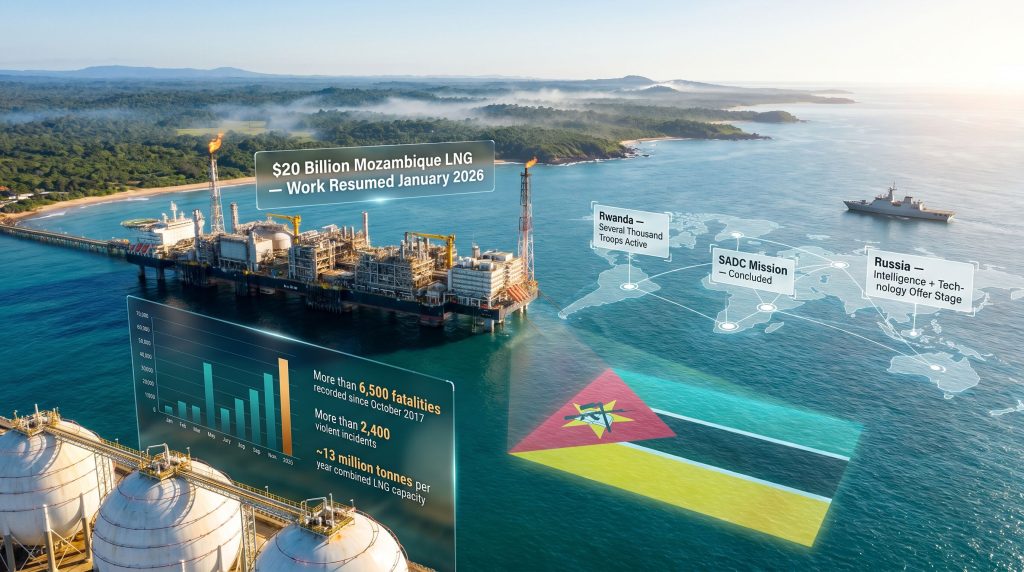
The province's insurgency in Cabo Delgado, which first erupted in October 2017 in the coastal town of Mocímboa da Praia, has now entered its ninth year with no clean resolution in sight. According to data compiled by the Armed Conflict Location and Event Data Project (ACLED), more than 6,500 people have been killed since the conflict began, with more than 2,400 violent incidents recorded across the province. These figures represent one of sub-Saharan Africa's most persistent and underreported security crises, and they sit directly on top of one of the world's most significant undeveloped natural gas reserves.
When big ASX news breaks, our subscribers know first
Russia's Security Offer: What Is Actually Being Proposed
When Russian Foreign Minister Sergey Lavrov visited Maputo on July 9, 2026, the diplomatic agenda covered economic modernisation, bilateral cooperation frameworks, and preparations for the next session of the Russia-Mozambique Intergovernmental Commission. Within that broader context, Moscow signalled its readiness to assist Mozambique in addressing the persistent threat posed by Islamic State-affiliated armed groups operating in Cabo Delgado.
Russia's offer is not framed as a conventional military deployment. Instead, it centres on three distinct pillars:
- Intelligence sharing, including access to databases of identified terrorist operatives active in the region
- Technology and equipment transfers tailored to the specific operational environment of Cabo Delgado, which combines dense coastal vegetation with maritime access points
- Bilateral diplomatic architecture, formalised through the Intergovernmental Commission as a standing mechanism for expanding cooperation across security and economic domains
Russia's engagement model in 2026 represents a significant repackaging compared to its previous involvement in the province. Rather than deploying combat personnel directly, Moscow is positioning itself as an intelligence and capability partner, lowering the political risk of entry while maintaining strategic relevance.
This framing matters because it distinguishes the current approach from the disastrous Wagner Group intervention of 2019 and 2020, which remains one of the most publicly documented private military failures in recent African history. Furthermore, this repositioning reflects lessons learned from prior operational shortcomings that proved costly to Moscow's broader African ambitions.
The Wagner Failure: What Went Wrong in 2019 and 2020
Russia's first attempt to establish a security foothold in Cabo Delgado ended badly. Wagner Group personnel, deployed in 2019 to assist Mozambican forces against the insurgency, encountered an environment they were structurally unprepared for. The use of Wagner Group as a tool of Russian foreign policy proved deeply problematic in this particular theatre. Several critical factors contributed to the operational collapse:
- The jungle and coastal terrain of Cabo Delgado was poorly suited to the conventional and semi-conventional tactics Wagner had applied in Libya and parts of the Sahel
- Seven Russian mercenaries were killed in insurgent ambushes, a casualty rate that exposed serious intelligence and situational awareness deficiencies
- Friction between Wagner commanders and Mozambican military leadership over tactical priorities created coordination failures that insurgent groups exploited
- By 2020, the deployment had been fully withdrawn, leaving Moscow without a foothold at precisely the moment when the insurgency was intensifying
The Africa Corps model that Russia is now advancing differs in its architecture. Rather than embedding combat personnel with frontline units, it emphasises advisory, training, and intelligence functions. However, whether this approach can overcome the same structural challenges that defeated Wagner remains genuinely uncertain.
Russia's Historical Relationship With FRELIMO
A less commonly understood dimension of Russia's positioning is the ideological and historical foundation it is drawing on. Moscow's relationship with FRELIMO, Mozambique's ruling party, dates to the independence struggle of the 1960s and 1970s, when the Soviet Union provided both arms and ideological backing to the liberation movement. This long-standing alignment gives Russian diplomats a legitimacy argument that newer entrants to the Mozambican security space simply cannot replicate.
Consequently, when considering Russia security support for Mozambique Cabo Delgado, this historical context shapes how Maputo weighs Moscow's offers against those of Western partners. The geopolitical mining landscape across Africa more broadly reflects similar dynamics, where historical allegiances continue to influence contemporary resource and security negotiations.
Mapping the Multi-Power Security Architecture
Russia's offer does not exist in isolation. Cabo Delgado already hosts one of the most complex multi-actor security architectures of any conflict zone in Africa. The table below captures the current landscape as of mid-2026:
| Actor | Deployment Scale | Primary Role | Current Status |
|---|---|---|---|
| Rwanda | Several thousand troops | Ground operations and district security | Active |
| SADC Mission | 2,000+ troops at peak | Regional stabilisation force | Mission concluded |
| Tanzania | Border forces in Nangade district | Northern border security | Active |
| Italy, Portugal, India | Naval and training advisors | Maritime security capacity building | Ongoing |
| UNODC | Technical assistance teams | Rule of law and maritime crime | Ongoing |
| Russia (proposed) | Intelligence and technology assets | Counterterrorism advisory | At offer stage |
Rwanda's contribution deserves particular analytical attention. Kigali deployed approximately 1,000 soldiers and police officers in 2021 and has since expanded its presence to several thousand personnel. Rwandan forces have achieved territorial gains that other security actors, including the SADC mission, struggled to consolidate.
Analysts have attributed Rwanda's relative effectiveness to several factors: disciplined command structures, prior experience in complex counterinsurgency environments, and a willingness to conduct sustained ground operations in difficult terrain. The conclusion of the SADC mission has left a residual security gap that Rwanda's continued presence only partially fills.
Tanzania's forces, concentrated in the Nangade border district, serve primarily a containment function, preventing insurgent groups from using Tanzanian territory as a staging or resupply corridor. Naval advisory missions from Italy, Portugal, and India address the maritime dimension of the conflict, where armed groups have demonstrated an ability to use the Indian Ocean coastline for movement and logistics.
The entry of a Russian intelligence and technology layer into this architecture would theoretically add counterterrorism targeting capability. In practice, however, it would also introduce coordination complexity and potential geopolitical friction with Western partners who are already operating in the same space.
The LNG Projects That Make Stability Non-Negotiable
The reason Cabo Delgado commands attention far beyond its population size or geographic footprint is straightforward: the province sits above one of the world's most significant natural gas discoveries of the past two decades. The Rovuma Basin, located offshore in the Indian Ocean adjacent to Cabo Delgado, contains reserves that have attracted major commitments from some of the world's largest energy companies. Furthermore, shifts in global LNG supply dynamics have made Mozambique's offshore resources increasingly critical to long-term energy security planning across Asia and Europe.
TotalEnergies Mozambique LNG
The flagship project, developed by TotalEnergies, carries an estimated investment value of approximately $20 billion. Work was suspended in April 2021 after insurgents attacked the town of Palma, located near the project's onshore infrastructure, forcing TotalEnergies to declare force majeure. After nearly five years on hold, the company resumed construction activities in January 2026, marking the most significant signal of returning investor confidence in the province.
The project comprises two liquefaction trains with a combined nameplate capacity of approximately 13 million tonnes of LNG per year. At full production, this would make Mozambique one of the world's top ten LNG exporters, transforming the country's fiscal position and foreign exchange earnings. The critical minerals demand driving the global energy transition has further elevated the strategic importance of such large-scale energy infrastructure projects.
Coral Norte and ExxonMobil's Rovuma LNG
The Coral Norte floating LNG facility represents the next tranche of offshore production capacity in the basin. A final investment decision on Coral Norte would add meaningful incremental export volume to Mozambique's growing LNG portfolio. Separately, ExxonMobil's Rovuma LNG project, which has yet to reach its final investment decision, represents an additional potential development that could further extend the country's export horizon.
Investment consideration: The combined pipeline of Mozambique LNG, Coral Norte, and Rovuma LNG represents a potential multi-decade transformation of Mozambique's economic base. However, each project's timeline remains contingent on demonstrated and sustained security progress in Cabo Delgado. A single high-profile insurgent attack near project infrastructure could reset investor confidence significantly. This is not investment advice. All projections involve material uncertainty.
Why Military Force Alone Has Not Ended the Insurgency
One of the most important and least publicised aspects of the Cabo Delgado conflict is the gap between military progress and structural stabilisation. Field research conducted by Mozambique-based analyst Borges Nhamirre, as reported in ADF Magazine, has consistently pointed to socioeconomic and political drivers of the insurgency that military operations are poorly equipped to address.
The structural factors sustaining insurgent recruitment include:
- Deep socioeconomic marginalisation of communities in northern Mozambique, who have historically received limited investment in education, infrastructure, and economic opportunity
- Political exclusion and governance deficits in Cabo Delgado, which create grievance structures that Islamic State-affiliated networks have proven adept at exploiting
- Local perception that the benefits of LNG development will flow primarily to Maputo and foreign companies rather than to Cabo Delgado communities themselves
- Limited civilian reconstruction spending relative to the scale of military operations, which has slowed the restoration of community trust in government institutions
President Daniel Chapo has acknowledged these dynamics and has raised the possibility of pursuing dialogue with insurgent groups alongside continued military operations, a dual-track approach that represents a departure from the purely kinetic strategy of previous administrations.
The next major ASX story will hit our subscribers first
Conflict by the Numbers
| Metric | Data Point |
|---|---|
| Conflict start date | October 2017, Mocímboa da Praia |
| Total recorded fatalities | More than 6,500 |
| Violent incidents since 2017 | More than 2,400 |
| TotalEnergies LNG suspension period | 2021 to January 2026 (approximately 5 years) |
| Combined LNG nameplate capacity | Approximately 13 million tonnes per year |
| Rwandan deployment initiated | 2021 |
| Wagner Group withdrawal | 2020 |
| Lavrov Maputo visit | July 9, 2026 |
Three Scenarios for Cabo Delgado's Security-Energy Future
Scenario One: Sustained Stabilisation and Full LNG Unlock
In this pathway, Russian intelligence integration proves complementary rather than disruptive to existing security arrangements. Rwandan forces maintain territorial gains across key districts, President Chapo's dialogue initiative reduces insurgent recruitment flows, and the combination of military and political progress allows LNG revenues to begin entering Mozambique's fiscal accounts before the end of the decade. This scenario requires a level of multi-actor coordination and domestic political progress that has not yet been demonstrated.
Scenario Two: Fragmented Architecture and Delayed Investment
Competing foreign security agendas produce coordination failures. Insurgent groups, which have shown considerable adaptability over nine years, adjust tactics to exploit gaps between security actors operating under different mandates and command structures. One or more LNG projects face additional force majeure events, investor confidence erodes, and the timeline for full commercial production extends further into the 2030s.
Scenario Three: Geopolitical Escalation and Western Investor Recalibration
Russia's deepening security role in Cabo Delgado creates political discomfort among Western partner governments. TotalEnergies and ExxonMobil, both operating under significant ESG and geopolitical scrutiny, face pressure regarding their exposure to a security environment partly shaped by Russian advisory infrastructure. Western governments begin favouring alternative LNG supply sources in procurement and diplomatic frameworks, complicating Mozambique's ability to lock in long-term offtake agreements.
Russia's Africa Corps in the Broader Continental Context
Moscow's renewed engagement in Mozambique sits within a larger pattern of Russian security expansion across Africa that accelerated after the formal dissolution of the Wagner Group brand and its reorganisation as Africa Corps. In Mali, Burkina Faso, Niger, and the Central African Republic, Russia has used a combination of military advisory personnel, arms supply, and media influence operations to displace or weaken Western security partnerships.
Mozambique presents a different geopolitical texture. Unlike the Sahel countries, where Russian engagement has coincided with the expulsion of French military forces, Mozambique has maintained broadly cooperative relations with Western partners and is the site of active Western commercial investment at a massive scale. This means Russia's entry point in Mozambique requires a more nuanced positioning, which may explain why the Russia security support for Mozambique Cabo Delgado offer is framed as intelligence and technology support rather than combat deployment.
The African mining finance environment is also shifting in response to these geopolitical currents, as investors weigh resource access against the political complexities introduced by competing foreign security presences. The Gulf states and China are also watching Cabo Delgado closely, though their engagement remains primarily commercial rather than security-oriented. Strategic minerals deals across the continent are increasingly tied to security arrangements, creating a template that Mozambique's government must carefully navigate.
Frequently Asked Questions
What Has Russia Specifically Offered Mozambique Regarding Security?
Moscow has offered intelligence sharing, including access to information on identified terrorist operatives, technology and equipment transfers suited to Cabo Delgado's environment, and expanded bilateral cooperation through the Russia-Mozambique Intergovernmental Commission.
Why Did the Wagner Group Fail in Cabo Delgado?
Wagner personnel were poorly adapted to the province's jungle and coastal terrain, suffered fatal ambushes due to inadequate intelligence, and experienced command friction with Mozambican military leadership, ultimately withdrawing fully by 2020 without achieving meaningful security improvements.
Which Foreign Forces Are Currently Operating in Cabo Delgado?
Rwanda maintains the largest foreign military presence with several thousand troops. Tanzania stations border forces in Nangade district. Naval and training advisors from Italy, Portugal, and India provide maritime security capacity building. Russia's involvement remains at the offer stage.
How Does the Insurgency Affect Mozambique's LNG Timeline?
Directly and materially. TotalEnergies suspended Mozambique LNG for nearly five years following the 2021 Palma attack. ExxonMobil has yet to reach a final investment decision on Rovuma LNG, and sustained security uncertainty remains the primary variable constraining the pace of full project development.
Is Russia's Security Offer Linked to Access to Mozambique's Natural Gas?
No explicit linkage between the security offer and resource access has been confirmed in public statements or official documents. However, the broader pattern of Russia's Africa Corps engagements in resource-rich countries is a factor that analysts and investors are right to monitor. Russia security support for Mozambique Cabo Delgado must therefore be assessed within this wider strategic framework.
Key Analytical Takeaways
- Cabo Delgado is now one of the most strategically watched provinces in Africa, sitting at the intersection of energy economics and great-power competition
- Russia's 2026 offer reflects a deliberate repositioning from the failed Wagner model toward a lower-visibility intelligence and technology partnership approach
- The combined LNG development pipeline in the Rovuma Basin represents extraordinary economic potential for Mozambique, but remains contingent on security conditions that have not yet been fully achieved
- Military progress without parallel investment in socioeconomic development and political inclusion is unlikely to produce lasting stability, as field research from the province consistently demonstrates
- The multi-actor security landscape creates both coordination opportunities and geopolitical friction risks that require active monitoring from investors, energy companies, and policymakers with exposure to the region
This article is intended for informational purposes only. Nothing contained herein constitutes investment advice. All projections and scenario analyses involve material uncertainty and should not be relied upon as predictions of future events.
Want to Stay Ahead of Major Mineral Discoveries Linked to Africa's Shifting Resource Landscape?
As great-power competition reshapes resource-rich regions like Cabo Delgado, the flow-on effects for ASX-listed mineral explorers and energy-adjacent stocks can move fast — Discovery Alert's proprietary Discovery IQ model delivers real-time alerts on significant ASX mineral discoveries, ensuring subscribers can identify actionable opportunities the moment they emerge. Explore historic examples of exceptional returns from major discoveries and start your 14-day free trial at Discovery Alert to position yourself ahead of the market.