May 19, 2026
The Invisible Bottleneck Costing Mining Billions Every Year
Most discussions about mining productivity focus on what happens above ground: equipment uptime, haulage efficiency, workforce deployment. Yet the most expensive inefficiencies in modern resource extraction are often invisible, embedded in the gap between what a mine knows about its orebody and when that knowledge becomes actionable. In operations where ore grades vary bench by bench and mineralogy shifts within a single blast block, decision-making based on week-old resource models is not merely imprecise. It is structurally incompatible with the precision economics that modern mining demands.
This is the operational reality that a cohort of researchers at the Australian Research Council Training Centre for Integrated Operations for Complex Resources (ARC IOCR), based within Adelaide University's School of Chemical Engineering, has spent five years trying to resolve. The result is a suite of four breakthrough mining technologies ready for industry deployment, each targeting a distinct pain point across the extraction and processing value chain.
These are not theoretical constructs or early-stage laboratory curiosities. According to Professor Peter Dowd, Director of the Training Centre and Professor of Mining Engineering at Adelaide University, the technologies have passed through rigorous development cycles and are actively seeking industry partners for live operational trials. The Centre, which received funding in 2019 and commenced operations in 2021, has completed 16 PhD projects and three postdoctoral research programs, all focused on automated, integrated, and optimised mining systems.
Understanding what these technologies do, and why their timing matters, requires looking at the structural forces making legacy mining workflows increasingly untenable.
When big ASX news breaks, our subscribers know first
Why Legacy Mining Workflows Are Reaching Their Limits
The Compounding Problem of Declining Ore Quality and Increasing Depth
Global copper ore grades have declined from approximately 1.5% in 1990 to around 0.6% by 2020, according to data compiled by the International Council on Mining and Metals. Average mining depths have increased by roughly 35% since 2000, with many operations now extracting material from below 1,000 metres. These two trends compound each other: lower grades require more precise extraction to maintain economic viability, while greater depths increase the cost of every tonne moved regardless of its quality.
The result is a shrinking margin environment where operational precision is no longer a competitive advantage but a survival requirement. Traditional resource modelling workflows, which typically generate updated orebody models on weekly or monthly cycles, were designed for a simpler geological era. They cannot keep pace with the spatial variability of complex, deep orebodies or the financial sensitivity of operations where small changes in ore grade directly determine project economics.
From Months to Minutes: The New Competitive Standard
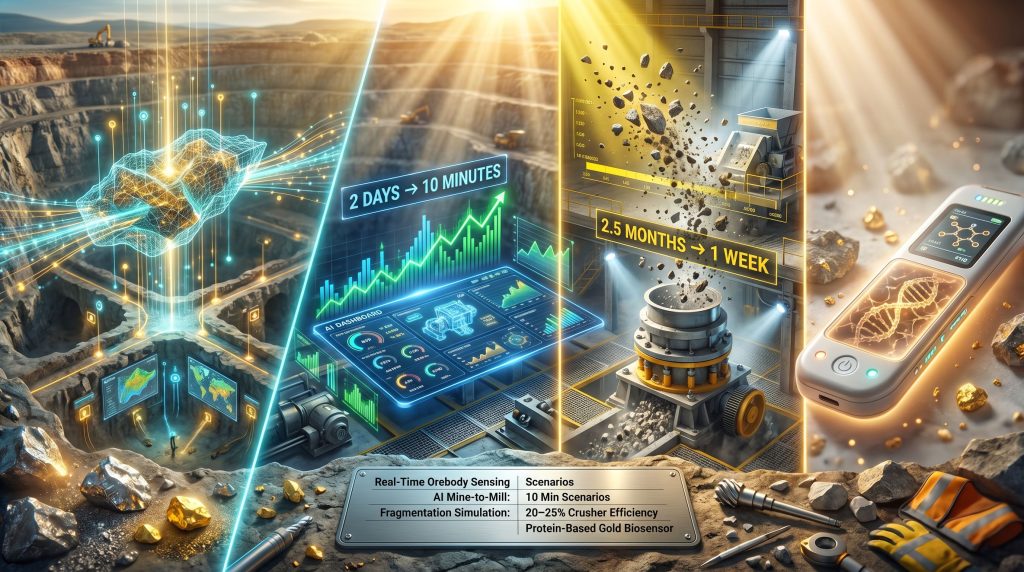
The most commercially significant aspect of the four breakthrough mining technologies ready for industry deployment is not any individual performance metric in isolation. It is the collective compression of decision-making timelines across the mining value chain:
- Resource model updates shifting from weekly cycles to real-time continuous updates
- Mine-to-mill scenario computation reducing from 48 hours to 10 minutes
- Fragmentation simulation timelines contracting from 2.5 months to one week
- Gold grade detection moving from days of laboratory turnaround to real-time point-of-extraction results
Each of these compressions independently represents a meaningful operational improvement. Together, they suggest the possibility of a fundamentally different mine management paradigm, one where shift-level decisions are informed by current data rather than historical approximations.
A Structured Overview of the Four Technologies
The four breakthrough mining technologies ready for industry deployment address four distinct but interconnected operational challenges. The table below summarises their core functions, primary efficiency gains, and development status:
| Technology | Developer | Core Function | Primary Efficiency Gain | Deployment Status |
|---|---|---|---|---|
| Real-Time Orebody Knowledge Updating | Dr Sultan Abulkhair | Sensor-integrated continuous resource model updating | Eliminates data-to-decision lag | Deployment-ready |
| AI Mine-to-Mill Optimization | Pouya Nobahar | AI-driven scenario computation linking ore to processing and revenue | 48 hours to 10 minutes for 1M scenarios | Deployment-ready |
| Fragmentation and Cave Draw-Point Sensing | Ahmadreza Khodayari | Physics engine simulation for particle size optimisation | 2.5 months to 1 week; 20-25% crusher energy efficiency gain | Deployment-ready |
| Protein-Based Gold Biosensor | Dr Akhil Kumar | Biological protein detection of gold presence and concentration | Replaces X-ray and off-site lab assay with real-time results | Deployment-ready |
Source: Canadian Mining Journal, April 28, 2026; ARC IOCR, Adelaide University.
Technology 1: Real-Time Orebody Knowledge Updating
Closing the Gap Between Geological Reality and Operational Response
Every decision made in an active mine, from which blocks to blast, which material to direct to the mill, and which ore types to stockpile, depends on the accuracy of the underlying resource model. When that model reflects conditions from a week or month ago, every subsequent decision carries an embedded error that compounds through the operational chain.
Dr Sultan Abulkhair's research addresses this problem at its source. His system fuses live sensor feeds with structural geological data to deliver continuously refreshed orebody models, effectively converting resource knowledge from a periodic snapshot into a dynamic, real-time operational input. Furthermore, interpreting drill results in real time becomes significantly more reliable when resource models are continuously updated rather than periodically refreshed.
The practical implications extend beyond improved grade control. Real-time orebody intelligence enables shift supervisors to make extraction decisions based on current geological conditions rather than anticipated ones. In highly variable orebodies, where grade and mineralogy can shift meaningfully within a single blast pattern, this distinction has direct financial consequences.
Why This Technology Is the Foundational Layer
Dr Abulkhair has noted that while the four research projects were developed independently, the team is now exploring integration pathways that combine their individual capabilities into unified operational systems. Real-time orebody updating is the natural foundation for this architecture. Without accurate, current resource knowledge, AI optimisation algorithms and fragmentation sensing systems are calibrating against outdated inputs.
This positions real-time orebody intelligence not merely as a standalone efficiency tool but as the enabling data layer for the broader technology stack. Its compatibility with digital twin architectures, 5G-enabled underground communication networks, and existing mine planning platforms from partners such as Maptek and Dassault Systèmes gives it a clear integration pathway in modern operations. In addition, 3D geological modelling platforms are increasingly complementary to this kind of continuous data architecture.
Technology 2: AI-Driven Mine-to-Mill Optimisation
What Mine-to-Mill Optimisation Actually Means
Mine-to-mill optimisation is the practice of aligning ore extraction decisions with downstream processing performance and financial outcomes. In theory, every tonne of ore directed to a processing facility should be matched to the mill's optimal feed characteristics. In practice, the computational complexity of modelling this relationship across variable ore types, equipment states, and commodity prices has historically made real-time alignment impossible.
Existing industry platforms require approximately two days to compute one million operational scenarios. Pouya Nobahar's AI-driven system reduces this to approximately 10 minutes, a compression of more than 99%. This is not an incremental improvement. It is a categorical change in what operational decision-making can look like. Broader AI mining efficiency tools are likewise reshaping how operations teams respond to fast-moving geological and market conditions.
The Financial Architecture Behind the Computation Breakthrough
The system's most distinctive feature is its ability to map ore characteristics, including hardness, grade variability, and mineralogy, directly to mill throughput projections and recovery rates, and then translate those projections into financial impact estimates. This creates a feedback loop that connects geological variability to revenue outcomes in near real-time.
The ability to model processing outcomes in 10 minutes rather than 48 hours is not merely a convenience. In complex orebodies where grade and hardness vary significantly across a single bench, it represents a fundamentally different operational paradigm, one where tactical adjustments can be made within a shift rather than after a planning cycle.
Consider the practical scenario: a blast produces ore with unexpected hardness characteristics. Under the legacy computational framework, the mill operator would not receive updated scenario modelling for two days, by which time significant volumes of suboptimally processed material may already have passed through the circuit. With 10-minute scenario computation, the response can be recalibrated before the ore reaches the crusher.
Pouya Nobahar has stated directly that his motivation is to give the industry the ability to trial this technology and demonstrate its value, emphasising that the existing two-day computational standard creates a structural bottleneck that the AI system is specifically designed to eliminate.
Technology 3: Cave Draw-Point Fragmentation Sensing and Physics Engine Simulation
Why Particle Size Is Mining's Most Undervalued Efficiency Variable
Fragmentation, the size distribution of rock particles produced by blasting or caving, is one of the most consequential and least precisely controlled variables in mining operations. Oversized fragments cause crusher blockages, increase energy consumption per tonne processed, and generate unplanned downtime. Excessive fines generation reduces throughput without adding recovery value.
Ahmadreza Khodayari's research targets this gap directly through two integrated innovations: cave draw-point fragmentation sensing that monitors particle size distribution in real time, and a physics engine simulation methodology that dramatically compresses the time required to model the relationship between fragmentation, material flow, and crusher performance. Moreover, AI in mining operations is increasingly being applied to blast design itself, making fragmentation optimisation a natural downstream companion to AI-driven drilling and blasting workflows.
The Physics Engine Methodology: Borrowed from Engineering Simulation
The most technically distinctive aspect of Khodayari's approach is the application of physics engine simulation, a methodology borrowed from advanced engineering and gaming simulation disciplines, to the mining fragmentation problem. Traditional simulation approaches for linking particle size to material flow are computationally intensive, requiring approximately 2.5 months to complete a full simulation cycle. The physics engine approach reduces this to approximately one week.
This is not simply a faster version of the same process. Physics engine methodologies simulate particle interactions and material flow dynamics using principles derived from rigid body physics, enabling more accurate modelling of real-world fragmentation behaviour at a fraction of the computational cost.
Quantifying the Energy Efficiency Opportunity
Optimising particle size distribution through advanced fragmentation sensing is projected to improve crusher energy efficiency by an estimated 20-25%. This improvement flows through four primary mechanisms:
- Reducing oversized material that requires secondary crushing passes, which consume disproportionate energy relative to their contribution to final product
- Minimising excessive fines generation that reduces throughput without adding material recovery value
- Enabling feed consistency that allows crushers to operate at optimal load settings for sustained periods
- Reducing unplanned downtime caused by blockages from irregular fragment sizes that interrupt steady-state crusher operation
For large-scale operations processing tens of millions of tonnes annually, a 20-25% reduction in crusher energy consumption translates to substantial cost savings, particularly in an environment of rising energy prices and increasing carbon accountability requirements.
Applicability Across Operation Types
While cave draw-point operations represent the highest-value initial deployment environment for this technology, the physics engine simulation methodology has broader applicability. Open-pit blasting optimisation, sublevel caving operations, and bulk ore handling systems all involve fragmentation variables that the sensing and simulation framework can address. The scalability of the approach across operation types strengthens the commercial case for adoption.
The next major ASX story will hit our subscribers first
Technology 4: Protein-Based Gold Biosensor Technology
A Biological Solution to a Chemical Problem
Gold detection in active mining environments has traditionally relied on two primary methods: X-ray fluorescence (XRF) analysis and off-site laboratory assay. Both carry significant limitations. XRF systems require substantial capital investment and specialist handling protocols. Off-site laboratory assay turnaround times range from days to weeks, meaning grade control decisions are routinely made on the basis of historical data rather than current ore characteristics.
Dr Akhil Kumar's protein-based biosensor technology approaches the detection problem from an entirely different direction. The system uses engineered biological proteins that selectively bind to gold particles or ions in ore samples. When binding occurs, the system generates a measurable signal indicating the presence and concentration of gold in real time, without X-ray equipment, laboratory infrastructure, or the associated environmental footprint of chemical reagent-based assay workflows. However, X-ray ore sorting continues to offer distinct advantages in bulk material classification where biosensor approaches may not yet be fully integrated.
The table below illustrates how the biosensor compares to legacy detection approaches:
| Detection Method | Speed | Capital Cost | Environmental Impact | Portability |
|---|---|---|---|---|
| X-Ray Fluorescence | Minutes to hours | High | Moderate (radiation handling protocols) | Limited |
| Off-Site Laboratory Assay | Days to weeks | High per-sample cost | High (transport logistics and reagents) | None |
| Protein-Based Biosensor | Real-time | Low operational cost | Minimal | High |
Source: ARC IOCR; Canadian Mining Journal, April 28, 2026.
The Economic Logic of Avoiding Dilution at the Source
Dr Kumar has articulated the core commercial proposition for the biosensor clearly: the technology enables miners to avoid processing non-gold-bearing ore. This is a more significant value driver than it might initially appear.
In gold operations where mill feed contains significant volumes of low-grade or barren material, every tonne processed carries reagent costs, energy costs, and equipment wear costs that are not recovered in the final product. Real-time grade detection at the draw-point or conveyor level allows operators to make diversion decisions before dilution material enters the processing circuit, reducing reagent consumption, lowering energy use per ounce recovered, and improving overall circuit economics.
The environmental credentials of the biosensor add a dimension that legacy detection methods cannot match. The elimination of chemical reagents, radiation handling protocols, and sample transport logistics represents a meaningful reduction in operational environmental footprint, increasingly relevant as mining operations face growing scrutiny over their environmental management practices.
Potential Expansion Beyond Gold Detection
The protein-based sensing platform is not inherently limited to gold detection. The underlying biological engineering methodology, designing proteins that selectively bind to specific mineral targets, is theoretically adaptable to other precious and critical minerals. As demand for precise grade control expands across lithium, cobalt, and rare earth element operations, the biosensor framework represents a platform technology with applications well beyond its initial gold-detection implementation.
How These Technologies Compare to the Broader Mining Innovation Landscape
Positioning Within the Full Innovation Ecosystem
The four breakthrough mining technologies ready for industry deployment do not exist in isolation. The broader mining innovation pipeline includes several categories of emerging technology, each addressing different segments of the operational value chain. For instance, ten major mining tech trends identified for 2026 reflect the depth and breadth of transformation now underway across the sector:
Autonomous Haulage Systems: Fully autonomous haul trucks represent the most commercially mature mining technology category, with Level 5 automation frameworks expanding beyond large open-pit operations. These systems address labour costs and safety metrics. The ARC IOCR technologies address data quality, processing efficiency, and resource intelligence, occupying a complementary rather than competing position.
Drone-Based Surveying: Unmanned aerial systems have achieved broad adoption across exploration, blast monitoring, and reclamation phases, compressing survey cycle times from weeks to hours. Drone technology generates raw spatial data. The orebody sensing and AI optimisation systems described here convert that data into actionable operational intelligence, positioning them as downstream complements to drone survey capabilities.
AI and Digital Twin Integration: AI platforms integrating digital twins for real-time 3D mine simulation are demonstrating measurable efficiency gains across underground operations. The AI mine-to-mill optimisation system represents a specialised application of broader AI capabilities, purpose-built for the ore-to-processing value chain rather than general mine simulation.
Bioleaching for Critical Mineral Recovery: Bacteria-based mineral extraction from tailings is approaching commercial viability, with pilot facilities demonstrating recovery of nickel, cobalt, copper, rare earths, and lithium. Currently operating at approximately 30 sites globally, bioleaching is projected to reach broader commercial deployment within 3-5 years. It addresses end-of-life resource recovery, a fundamentally different value chain position from the active extraction and processing optimisation focus of the ARC IOCR technologies.
The four deployment-ready technologies and the broader mining innovation categories are not competing solutions. They occupy different positions across the mining value chain and are most powerful when deployed as complementary layers within an integrated operational intelligence architecture.
The Real Barriers to Mining Technology Adoption
Why Validated Technologies Still Struggle to Scale
The existence of deployment-ready technologies does not automatically translate to industry adoption. Mining's structural and cultural resistance to change is well-documented, rooted in the risk economics of capital-intensive operations where the cost of a failed technology trial is not merely the trial budget but the potential disruption of active production systems.
Three categories of barriers consistently determine whether validated mining technologies reach commercial scale:
- Technical integration complexity: New sensing and AI systems must interface with legacy SCADA platforms, mine planning software, and ore processing control systems that were not designed for external data inputs. Integration architecture is frequently the decisive bottleneck.
- Workforce capability gaps: Operating and maintaining advanced sensing systems and AI optimisation platforms requires skill sets, specifically data science, systems integration, and sensor engineering, that are not uniformly available across mining operations.
- ROI calculation frameworks: Mining companies evaluate technology adoption decisions against payback periods, operational risk assessments, and capital allocation competition. Technologies with strong efficiency metrics but unclear integration pathways or uncertain payback periods often stall in the approval process regardless of their technical merit.
Building the Business Case
Translating the efficiency metrics of these four technologies into NPV-positive investment proposals requires connecting operational improvements to financial outcomes across full production cycles. The 20-25% crusher energy efficiency gain from fragmentation optimisation, the elimination of off-site assay costs through biosensor deployment, and the scenario computation compression from 48 hours to 10 minutes each carry quantifiable financial implications that can be modelled against specific operational contexts.
The ARC IOCR's industry partnership network, which includes BHP, Bureau Veritas, Dassault Systèmes, Magotteaux, Manta Controls, MZ Minerals, Orica, PETRA, Rockwell Automation, RoqSense, Scantech International, Maptek, Veracio, and MatrixGroup, provides a critical advantage in this process. Having major operators and technology providers embedded in the research program means that the technologies have been developed with real operational constraints in mind, not idealised laboratory conditions. Furthermore, faster adoption of new technologies has been identified as crucial as critical mineral demand continues to outstrip supply across global markets.
What Early Adopters Stand to Gain
The Window Between Validation and Widespread Deployment
The period between validated technology availability and broad industry adoption is historically where the most significant competitive advantages are established in mining. Early pilot participants gain disproportionate influence over technology customisation, commercial terms, and implementation architecture. They also generate proprietary operational data that compounds in value as the technology matures.
The ARC IOCR's funded research program is scheduled to formally conclude in August 2026, with technologies continuing to transition into industry trials and commercial deployment through ongoing partnerships beyond that date. This creates a defined engagement window for operators seeking to participate in the initial deployment phase rather than adopting commoditised solutions at a later stage.
Professor Dowd has been clear that the competitive imperative for engagement is immediate: the organisations that engage with these technologies during the trial phase will not only improve their own operational performance but will contribute to shaping the long-term competitive structure of the industry.
Building Toward an Integrated Mine-to-Mill Intelligence Architecture
The long-term vision articulated by the ARC IOCR research team is not simply the deployment of four individual tools. It is the construction of an integrated operational intelligence architecture in which real-time orebody knowledge feeds AI scenario optimisation, fragmentation sensing informs crush circuit management, and biosensor grade detection prevents mill dilution, all operating as interconnected layers within a unified data ecosystem.
Professor Bill Skinner, who leads the mineral processing research theme at the Centre, has noted that the Training Centre's integrated research structure, connecting PhD researchers directly with technology innovators and industry practitioners, has materially shortened the pathway from innovation to operational application. The next phase of that pathway is field validation, and the organisations that step into that phase earliest will define what integrated mine-to-mill intelligence looks like at industrial scale.
This article contains forward-looking statements regarding technology performance projections and efficiency estimates. All efficiency metrics and timelines are based on research outputs and developer statements as reported by the Canadian Mining Journal (April 28, 2026) and the Australian Research Council Training Centre for Integrated Operations for Complex Resources. Actual operational outcomes may vary depending on specific geological conditions, integration architecture, and operational context. This article does not constitute financial or investment advice. Readers seeking further context on emerging mining technologies can explore related reporting from the Canadian Mining Journal at canadianminingjournal.com.
Want to Stay Ahead of the Next Major Mineral Discovery?
While breakthrough technologies are reshaping mine-to-mill efficiency, the biggest gains for investors often come from identifying significant ASX mineral discoveries the moment they are announced — exactly what Discovery Alert delivers through its proprietary Discovery IQ model, turning complex geological data into actionable alerts in real time. Explore Discovery Alert's dedicated discoveries page to understand the historic returns major mineral discoveries have generated, and begin a 14-day free trial to position yourself ahead of the broader market.