July 28, 2026
The Hidden Economics Behind Africa's Most Ambitious Mine Electrification Program
There is a structural tension running through every large-scale mining operation in Africa that rarely surfaces in project announcements: the silent cost of diesel dependency. Fuel is not merely an operational input at mines like Moatize in Mozambique's Tete Province. It is a financial vulnerability, a supply chain risk, and increasingly, a barrier to accessing the capital that sustains long-term extraction at scale. Understanding why Vulcan Mozambique is committing approximately €140.6 million (around USD $155 million) to Moatize coal mine electrification in Section 3 of the open-pit operation requires examining that tension from the inside out, not from the press release outward.
When big ASX news breaks, our subscribers know first
What Is the Moatize Coal Mine and Why Does Scale Define the Opportunity?
Moatize sits in the northwestern corner of Mozambique, in Tete Province, and it is not a typical African mining asset by any standard measure. Spanning approximately 300 square kilometres, it holds an estimated 2 to 3 billion metric tonnes of metallurgical coal reserves, making it one of the most significant coking coal deposits on the continent. The distinction between metallurgical coal and thermal coal matters here: metallurgical coal, also called coking coal, is a feedstock for steel production rather than power generation, which means demand is structurally tied to global steel demand outlook rather than electricity market transitions.
Vulcan acquired the asset from Brazilian mining giant Vale in December 2021 and has since executed a significant production ramp-up, doubling annual throughput capacity from 22 million metric tonnes to 45 million metric tonnes per year. The export pathway for this volume is a dedicated 912-kilometre rail corridor connecting the mine to the deep-water Port of Nacala, one of the few rail-to-port logistics chains in sub-Saharan Africa purpose-built for bulk commodity export.
| Metric | Under Vale | Under Vulcan |
|---|---|---|
| Annual Production Capacity | ~22 million metric tonnes | ~45 million metric tonnes |
| Acquisition Date | Prior to Dec 2021 | December 2021 |
| Rail Corridor to Port | 912 km to Nacala | 912 km to Nacala (retained) |
| Estimated Coal Reserves | 2 to 3 billion metric tonnes | 2 to 3 billion metric tonnes |
| Mine Area | ~300 sq km | ~300 sq km |
The Real Cost of Running Diesel at Industrial Scale
To grasp the financial logic of the Moatize coal mine electrification program, it helps to first understand what diesel actually costs a large open-pit operation in operational terms. A single large mining haul truck consumes between 300 and 500 litres of diesel per hour under working conditions, according to Fuel Management Africa as cited by Mining Next. When dozens of these trucks run continuously across 24-hour shift cycles, fuel expenditure rapidly becomes one of the two or three largest line items on an operating budget.
Industry benchmarks consistently place fuel at 20% to 40% of total mine operating costs for diesel-dependent operations. At a mine of Moatize's scale, with 45 million metric tonnes of annual throughput, this translates into a fuel bill that represents an enormous lever on profitability. Any sustained rise in global oil prices, any supply disruption in a landlocked African corridor, or any weakening of the local currency against USD-denominated petroleum imports can materially compress margins without any change in production volumes.
The structural exposure to diesel is not merely a cost problem. It is a compounding risk: price volatility, logistics fragility, and foreign exchange dependency all converge in a single input that powers nearly every tonne of material moved at a conventional open-pit mine.
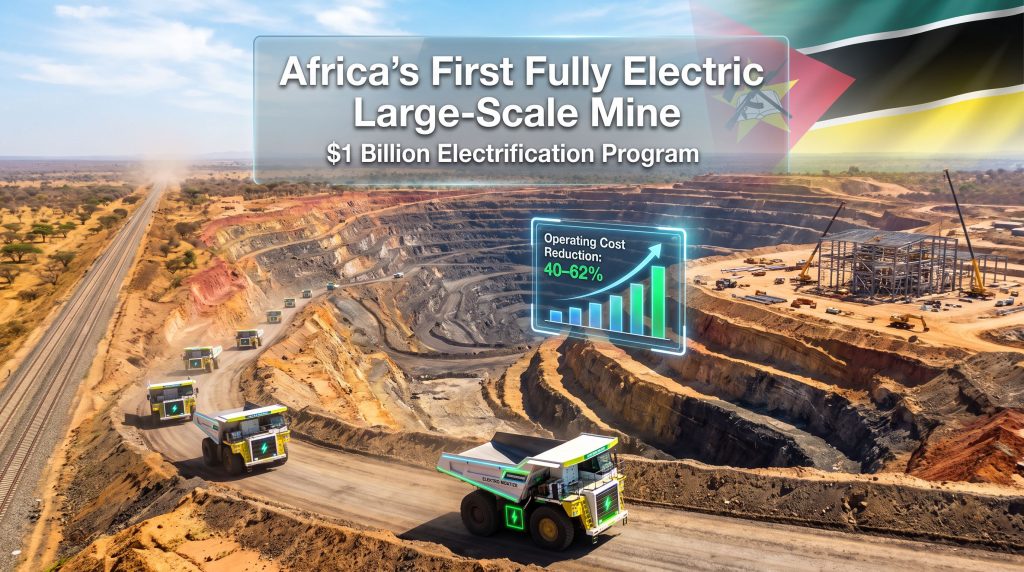
Furthermore, a 2025 study published in ScienceDirect modelling comparable open-pit operations found that transitioning to electric mining equipment can reduce total operating costs by 40% to 62%, with direct emissions reductions of 50% to 92% depending on the electricity source powering the fleet. These are not marginal improvements. They represent a structural repricing of the operational cost base.
How Does This Compare to Broader Industry Trends?
The mine electrification trend is accelerating globally, driven by these very cost dynamics. However, the scale and complexity of what Vulcan is undertaking at Moatize sets it apart from most comparable programmes. In addition, the mining decarbonisation benefits extend well beyond simple fuel savings, encompassing financing access, operational resilience, and long-term asset viability.
How the $155 Million Section 3 Investment Fits Into a $1 Billion Architecture
The Section 3 electrification is deliberately positioned as the opening phase of a far larger capital programme rather than a standalone initiative. Vulcan has outlined a broader electrification strategy valued at approximately $1 billion that integrates three interconnected layers of infrastructure transformation.
- Mine-site electrification across operational sections, beginning with Section 3 at a capital outlay of approximately $155 million, replacing diesel haul trucks and heavy equipment with electric alternatives.
- On-site power generation via a 300-megawatt thermal power plant that began construction in July 2024. This facility is designed to run on coal waste (tailings) generated by the mine itself, converting a waste liability into an energy input and solving the grid reliability problem that typically makes electrification impractical in remote African mining regions.
- Rail corridor electrification covering approximately 1,000 kilometres of logistics infrastructure, converting traction systems from diesel to electric along the supply chain connecting mine to port.
| Programme Component | Capital Allocation | Status (mid-2026) |
|---|---|---|
| Section 3 Mine Electrification | ~$155 million | Announced and commencing |
| 300 MW On-Site Power Plant | Part of broader $1B programme | Under construction since July 2024 |
| Rail Corridor Electrification (~1,000 km) | Part of broader $1B programme | Planned |
| Total Programme (Estimated) | ~$1 billion | Multi-phase rollout |
The on-site power plant deserves particular attention as a conceptual innovation. Grid reliability in Tete Province presents a genuine structural constraint for any large-scale electrification effort. By generating power from coal tailings that the mine produces as a byproduct, Vulcan sidesteps grid dependency entirely whilst simultaneously addressing a mine waste management challenge. The 300 MW facility was still under active development as of April 2026, according to Global Energy Monitor, and represents the critical enabling infrastructure without which fleet electrification cannot function at the intended scale.
Why Institutional Finance Is Reshaping the Strategy
The electrification programme serves a second strategic purpose that is less visible in operational terms but arguably equally important: it directly addresses the tightening environmental requirements of development finance institutions and multilateral lenders.
Development finance institutions have progressively raised the bar for fossil fuel sector borrowers over the past several years, requiring demonstrable improvements in direct emissions performance as a condition of access to concessional or blended finance instruments. For a coal mining operation, this creates a structural dilemma: the product itself carries significant Scope 3 emissions from downstream combustion, but Scope 1 emissions from the extraction process are within the operator's direct control.
Electrifying the operational footprint of a coal mine does not alter what happens to the coal after it leaves the mine gate. But it can materially shift how institutional lenders assess the borrower's environmental performance profile, which in practice determines financing access.
By reducing Scope 1 operational emissions by potentially 50% to 92% through fleet electrification, Vulcan positions Moatize to meet environmental thresholds that would otherwise exclude it from certain lending facilities. Consequently, this is not greenwashing in the conventional sense: it is a deliberate structural separation of operational emissions from product-use emissions, executed with the specific purpose of retaining access to institutionally funded capital. The energy solutions for mining sector are increasingly being assessed through this dual lens of operational efficiency and financing eligibility.
| Dimension | Cost Reduction Strategy | Finance Access Strategy |
|---|---|---|
| Primary Driver | Fuel cost elimination (20-40% of opex) | Meeting DFI environmental thresholds |
| Measurable Outcome | 40-62% opex reduction (ScienceDirect, 2025) | Access to green-linked debt instruments |
| Scope 1 Impact | 50-92% reduction in direct operational emissions | Improved institutional environmental rating |
| Scope 3 Impact | Unchanged (coal combustion downstream) | Unchanged |
| Risk Mitigated | Diesel price volatility, supply disruption | Financing exclusion, ESG investor withdrawal |
The Metallurgical Coal Distinction That Most Analysts Overlook
A detail frequently absent from coverage of Moatize is the specific nature of its coal reserves. The mine produces metallurgical coal, not thermal coal. This is a commercially significant distinction that affects the demand outlook in ways that energy transition narratives often miss.
Thermal coal faces structural demand erosion as electricity generation shifts toward renewables and gas in many markets. Metallurgical coal, by contrast, remains a necessary input for the blast furnace steelmaking process, which currently accounts for the majority of global steel production. No commercially viable large-scale substitute for metallurgical coal in blast furnace steelmaking has yet been deployed at the scale required to displace conventional demand. However, the green steel market dynamics are evolving rapidly, and green hydrogen-based direct reduction steelmaking is emerging, though it remains a fraction of total capacity.
This means Moatize's reserve base is not exposed to the same near-term demand risk as thermal coal assets. The reserve depth of 2 to 3 billion metric tonnes at a production rate of 45 million metric tonnes per year implies an operational lifespan measured in decades, which economically justifies the long-duration capital commitment of a $1 billion electrification programme.
The next major ASX story will hit our subscribers first
What Remains Unresolved: Risks That Electrification Cannot Address
The Moatize coal mine electrification programme is a sophisticated operational and financial strategy, but it does not eliminate all material risks facing the asset. Indeed, several significant challenges remain:
- Scope 3 emissions exposure remains entirely intact. The carbon intensity of steel produced using Moatize coking coal is unaffected by how the mine operates.
- Environmental compliance history at Moatize has included reported incidents in late 2024 related to pollution impacts, highlighting that operational efficiency improvements and broader environmental compliance are distinct categories of performance.
- Electric equipment supply chains in remote, landlocked African contexts introduce new dependencies on international manufacturers and complex logistics for maintenance and replacement parts.
- Rail electrification execution risk is considerable. Converting approximately 1,000 kilometres of rail traction to electric systems is among the most capital-intensive and technically demanding elements of the broader programme, with limited comparable precedent in sub-Saharan Africa.
- Power plant critical path dependency: mine electrification requires reliable electricity supply. Until the 300 MW coal waste power plant reaches full operational capacity, the fleet electrification programme faces a fundamental enabling constraint.
How Moatize Compares to the Global Electric Mine Movement
The global shift toward electric mining equipment is accelerating across multiple jurisdictions, driven by the same cost and financing dynamics visible at Moatize. Advanced electric mine deployments exist in Canada, Sweden, and Australia, where grid infrastructure and equipment availability have made earlier adoption feasible. Africa has historically lagged in this transition, primarily due to grid constraints, limited equipment availability in-country, and capital access challenges. Vulcan's integrated approach is consequently structurally distinctive, representing one of the most ambitious applications of the electric mine concept on the continent.
What differentiates Moatize from most comparable programmes globally is the combination of asset type and programme scale. Most electric mine initiatives to date have been implemented at critical minerals or precious metals operations, where ESG alignment with lender preferences is more straightforward. Applying the electric mine concept to a coal extraction asset at billion-dollar programme scale, with integrated power generation and rail electrification components, represents a less conventional application with fewer direct benchmarks.
The reserve depth and production capacity of Moatize also set it apart. With enough coal to sustain operations for decades at current rates, the economic case for long-duration infrastructure investment is fundamentally stronger than at smaller or shorter-lived assets. This scale argument may ultimately be the most compelling justification for the programme's ambition.
Frequently Asked Questions: Moatize Coal Mine Electrification
What is the Moatize coal mine electrification project?
It is a capital programme led by Vulcan Mozambique to replace diesel-powered equipment at the Moatize open-pit mine with electric machinery, beginning with Section 3 at an investment of approximately $155 million, as part of a broader approximately $1 billion electrification strategy encompassing mine operations, on-site power generation, and rail logistics.
Who owns the Moatize coal mine?
Vulcan Mozambique, which acquired the asset from Brazilian mining company Vale in December 2021.
Why is metallurgical coal different from thermal coal at Moatize?
Metallurgical coal is used as a feedstock in blast furnace steelmaking rather than power generation, meaning its demand profile is tied to global steel production cycles rather than electricity market transitions. This distinction affects the long-term commercial outlook for the asset.
How much can electrification reduce mining operating costs?
Research published in ScienceDirect in 2025 found that transitioning to electric mining equipment can reduce operating costs by 40% to 62%, with diesel typically accounting for 20% to 40% of total mine operating expenditure.
Does electrifying a coal mine make it environmentally sustainable?
Electrification reduces direct operational Scope 1 emissions by 50% to 92% depending on the power source, but leaves Scope 3 emissions from the downstream combustion of exported coal entirely unchanged. It improves the mine's operational carbon profile without altering the end-use carbon impact of the coal product itself.
What is the 300 MW power plant at Moatize?
A thermal power plant under construction since July 2024, designed to run on coal waste generated by the mine and supply electricity to support electrified mining operations. It was still under active development as of April 2026.
What is the total investment in Moatize's electrification programme?
Vulcan has outlined a broader electrification programme valued at approximately $1 billion, encompassing mine equipment electrification, on-site power generation, and the conversion of approximately 1,000 kilometres of rail logistics infrastructure.
Key Takeaways for Investors and Industry Observers
- The $155 million Section 3 investment is the entry point to a transformational capital programme that reframes the operating model for one of Africa's largest coal operations.
- The financial rationale is grounded primarily in fuel cost elimination, with peer-reviewed research supporting 40% to 62% operating cost reductions through electric fleet conversion.
- Institutional finance access is an equally material strategic driver, as development lenders increasingly require measurable Scope 1 emissions improvement from fossil fuel sector borrowers.
- The metallurgical coal classification of Moatize's reserves provides a demand durability argument that thermal coal assets cannot replicate in the current energy transition environment.
- Execution of the 300 MW on-site power plant is the single most important critical path dependency for the entire electrification thesis to function as designed.
- The programme's combination of scale, reserve depth, integrated logistics, and self-generated power positions Moatize as a potential structural benchmark for electric mine development across sub-Saharan Africa, subject to successful execution.
This article contains forward-looking assessments based on publicly available information and independent research. Readers should not rely on this content as financial advice. All investment and operational projections carry material execution, market, and regulatory risks.
Want To Stay Ahead of Major ASX Mineral Discoveries as They Happen?
Discovery Alert's proprietary Discovery IQ model delivers real-time alerts on significant ASX mineral discoveries, turning complex geological and market data into actionable investment insights for both short-term traders and long-term investors — explore historic examples of exceptional discovery returns to understand the scale of opportunity, then begin your 14-day free trial at Discovery Alert to position yourself ahead of the broader market.