
May 19, 2026
Understanding Modern Energy Infrastructure Vulnerabilities
Energy security concerns have reached unprecedented levels as global petroleum infrastructure faces increasingly sophisticated targeting methodologies. The interconnected nature of international oil supply chains creates cascading vulnerability patterns that extend far beyond individual facility boundaries. Modern aerial attack capabilities targeting refining infrastructure demonstrate how technological advancement in precision weaponry fundamentally alters the risk landscape for energy companies operating in geopolitically sensitive regions.
The strategic positioning of critical processing facilities in narrow geographic corridors amplifies potential disruption impacts across global markets. When examining the vulnerability matrix of Middle Eastern energy infrastructure, several key factors emerge that shape both immediate operational risks and long-term investment decision frameworks.
When big ASX news breaks, our subscribers know first
Strategic Importance of Regional Refining Networks
Saudi Arabia's refining infrastructure represents a critical nexus within global petroleum supply chains, with processing capacity distributed across strategically positioned coastal facilities. The SAMREF joint venture between Saudi Aramco and Exxon Mobil exemplifies the international partnership structures that characterise modern energy infrastructure development. This facility's location in Yanbu positions it as a fundamental component of Red Sea export corridor functionality.
The geographic concentration of refining capacity creates inherent systemic risks that extend beyond individual facility operations. Key vulnerability factors include:
• Coastal facility exposure to maritime-launched precision weaponry
• Joint venture complexity requiring coordinated international crisis response
• Export terminal dependencies linking processing to shipping infrastructure
• Alternative route limitations when primary corridors face disruption
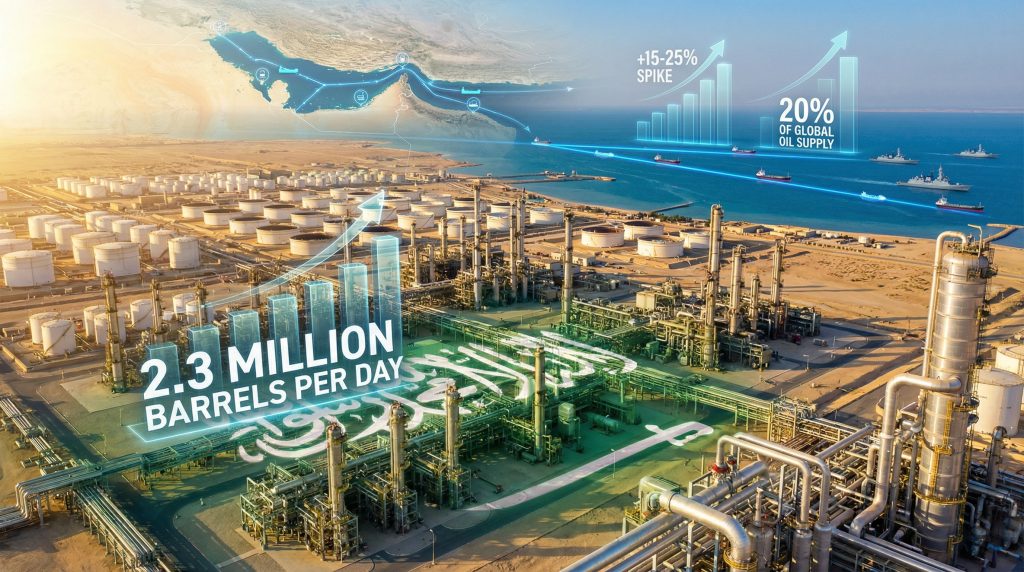
Current geopolitical tensions have effectively transformed Yanbu into the sole operational export outlet for Gulf Arab crude oil following Iran's closure of the Strait of Hormuz waterway. This strategic chokepoint normally facilitates transit for approximately 20% of global oil supplies, creating massive rerouting requirements when access becomes restricted.
The technical specifications of alternative export infrastructure reveal significant capacity constraints. Red Sea corridor limitations force increased reliance on facilities like Yanbu, which must handle substantially elevated throughput volumes during Persian Gulf route disruptions. This operational strain affects everything from loading schedules to storage capacity utilisation rates.
Economic Impact Assessment of Infrastructure Targeting
The March 19, 2026 aerial attack on a Saudi Aramco refinery demonstrates how targeted infrastructure strikes generate immediate market volatility regardless of actual physical damage sustained. Industry sources reported minimal direct impact from the attack itself, yet the strategic implications reverberated through global energy markets due to the facility's critical position within constrained supply networks.
Immediate Market Response Patterns:
| Impact Category | Short-term (0-7 days) | Medium-term (1-4 weeks) | Long-term (1+ months) |
|---|---|---|---|
| Crude Oil Prices | Volatility spikes | Risk premium persistence | Market stabilisation |
| Refining Margins | Capacity constraint premiums | Regional supply adjustments | Infrastructure recovery |
| Transportation Costs | Route optimisation surges | Security enhancement costs | Normalised operations |
The psychological market impact often exceeds immediate physical consequences when attacks target strategically significant infrastructure. Petroleum futures markets respond to perceived vulnerability rather than actual production disruption, creating price volatility that can persist long after operational normality returns.
Strategic petroleum reserve deployment mechanisms become activated during such incidents, though specific reserve utilisation data typically remains classified for operational security reasons. Alternative supply chain activation requires complex coordination between multiple national energy authorities and private sector operators.
Market psychology during infrastructure attacks reveals several consistent patterns. Energy traders immediately reassess regional risk premiums, while shipping companies recalculate insurance requirements for vessels transiting potentially contested waterways. These cost adjustments cascade through supply chains, affecting everything from refining margins to end-user pricing structures.
Regional Trade Route Transformation
Iran's effective closure of the Strait of Hormuz has fundamentally restructured global energy trade flows, forcing massive volumes of crude oil through alternative corridors with significantly different operational characteristics. The waterway's normal capacity to handle one-fifth of global oil supplies creates extraordinary rerouting pressures when access becomes restricted.
Critical Rerouting Challenges:
• Red Sea capacity limitations requiring extended transit times
• Alternative pipeline utilisation at maximum sustainable rates
• Port infrastructure strain from concentrated traffic volumes
• Insurance classification changes affecting vessel operational costs
Yanbu's transformation into the primary Gulf Arab export outlet illustrates how geopolitical conflicts reshape established trade patterns. The facility must handle cargo volumes substantially exceeding normal operational parameters while maintaining safety standards and processing efficiency.
Pipeline infrastructure becomes critically important when traditional maritime routes face disruption. East-west pipeline systems crossing Saudi Arabia provide alternative transport mechanisms, though their capacity remains limited compared to large tanker vessels that typically transit the Strait of Hormuz.
The ongoing regional tensions have created evacuation warnings issued by Iran's Islamic Revolutionary Guard Corps to facilities across Saudi Arabia, the UAE, and Qatar indicate coordinated targeting strategies affecting multiple export points simultaneously. This approach maximises regional disruption potential while demonstrating sophisticated understanding of energy infrastructure interdependencies.
Maritime security protocols require substantial adaptation when operating in contested waterways. Vessel routing decisions must balance security considerations against operational efficiency, often resulting in significantly longer transit times and elevated operational costs that ultimately affect global energy pricing.
What Regulatory Framework Evolution is Needed?
Energy infrastructure protection frameworks face continuous evolution as attack methodologies become increasingly sophisticated. Current regulatory structures must address both physical security requirements and cyber-physical system vulnerabilities that characterise modern petroleum processing facilities.
Key Regulatory Considerations:
• International maritime protection mandates for critical shipping lanes
• Facility hardening requirements addressing aerial and missile threats
• Emergency response coordination between government and private operators
• Insurance classification systems reflecting elevated regional risk levels
Coalition naval operations in contested waterways operate under complex international legal frameworks that define protective responsibilities and operational authorities. These arrangements must balance sovereignty concerns with collective security requirements while maintaining commercial shipping access.
Flag state responsibilities become particularly complex when vessels transit high-risk zones requiring enhanced security protocols. Insurance providers adjust coverage terms and premium structures based on evolving threat assessments, creating additional operational cost pressures for energy companies.
Emergency response protocols require seamless coordination between facility operators like Saudi Aramco and relevant government security agencies. These frameworks must address everything from immediate threat assessment to long-term recovery planning while maintaining operational continuity wherever possible.
Furthermore, the development of enhanced security standards for critical energy facilities reflects lessons learned from previous attack patterns. These requirements often involve substantial infrastructure investments in defensive systems, hardened control facilities, and redundant operational capabilities.
Investment Decision Framework Modification
Geopolitical conflict events like the Saudi Aramco refinery aerial attack fundamentally alter risk assessment methodologies used by energy companies for project evaluation and capital allocation decisions. Traditional financial models must incorporate elevated security considerations and operational uncertainty factors that previously received minimal weighting.
Risk Assessment Adaptations:
• Country risk premium calculations reflecting infrastructure vulnerability
• Political violence insurance cost escalations affecting project economics
• Security infrastructure requirements adding substantial capital expenditure
• Operational continuity planning requiring redundant facility development
Energy companies operating in contested regions must fundamentally reassess their exposure concentration strategies. Geographic diversification becomes a critical risk management tool, requiring careful analysis of regional correlation factors that might affect multiple facilities simultaneously.
Joint venture structures like the Saudi Aramco-Exxon Mobil partnership at SAMREF create complex risk-sharing arrangements during security incidents. These frameworks must address everything from immediate operational decisions to long-term capital investment strategies under elevated threat conditions.
Infrastructure hardening investments represent a new category of required capital expenditure for facilities operating in high-risk environments. These costs include advanced air defence systems, hardened control facilities, and redundant processing capabilities designed to maintain operations during security incidents.
Corporate strategy announcements following major security events often reveal shifting investment priorities toward geographic diversification and enhanced facility protection. These adjustments affect everything from new project location selection to existing facility upgrade scheduling.
The next major ASX story will hit our subscribers first
How Does OPEC Market Influence Affect Crisis Response?
The March 2026 infrastructure attacks will likely catalyse substantial policy evolution across international energy security frameworks. National governments and multilateral organisations must address vulnerabilities exposed by sophisticated targeting of critical petroleum infrastructure.
Policy Development Areas:
• Strategic reserve adequacy assessments following supply disruption scenarios
• International coordination mechanisms for emergency response and market stabilisation
• Infrastructure resilience standards addressing modern threat environments
• Public-private security partnerships defining shared protection responsibilities
International Energy Agency protocols for coordinated reserve releases face testing during actual crisis events. These mechanisms must balance national energy security concerns with collective market stabilisation objectives while maintaining strategic stockpile adequacy for extended disruption scenarios.
However, the OPEC market influence creates complex dynamics during crisis periods. Production adjustment mechanisms must consider both immediate supply replacement requirements and longer-term market stability objectives.
G20 energy security initiatives require updating to address contemporary threat patterns that combine conventional military capabilities with precision targeting of critical infrastructure nodes. These frameworks must address both immediate crisis response and long-term resilience building across global energy networks.
Regional security investment requirements may reach $50-75 billion for comprehensive infrastructure hardening across Middle Eastern energy facilities. These estimates encompass advanced defence systems, facility hardening, underground storage development, and redundant processing capabilities designed to maintain operations during extended conflict scenarios.
Historical Attack Pattern Analysis
Comparing the 2026 SAMREF incident with previous infrastructure attacks reveals evolving methodologies and escalating precision capabilities. The 2019 Abqaiq-Khurais attacks demonstrated vulnerability of even heavily defended facilities to sophisticated aerial assault techniques.
Attack Evolution Characteristics:
• Precision targeting advancement allowing selective facility component strikes
• Coordinated multi-facility warnings maximising psychological and market impact
• Strategic timing coordination with broader geopolitical escalation patterns
• Recovery timeline extension due to enhanced weapon effectiveness
The progression from area saturation attacks to precision targeting of specific facility components reflects substantial advancement in both weapon systems and intelligence capabilities. Modern attacks can selectively target critical processing units while leaving surrounding infrastructure largely intact.
Recovery timeline analysis reveals that even minimal physical damage can generate extended operational disruption when attacks occur during periods of elevated regional tension. Repair schedules become secondary to broader security assessments and protective measure implementation.
Consequently, international response coordination has evolved significantly since earlier incidents, with enhanced information sharing protocols and coordinated market intervention mechanisms designed to minimise global economic impact from regional infrastructure attacks.
Corporate Risk Management Adaptation
Energy companies must fundamentally restructure their operational risk management frameworks to address contemporary infrastructure targeting capabilities. Traditional security assessments prove inadequate when facing precision weapon systems capable of selective facility component targeting.
Operational Continuity Requirements:
• Multi-site backup systems ensuring processing capability redundancy
• Real-time threat assessment integration into operational decision-making
• Emergency protocols for rapid facility securing and personnel evacuation
• Supply chain flexibility enabling rapid alternative sourcing activation
Corporate crisis management protocols require updating to address scenarios where multiple facilities face simultaneous threat conditions. The Revolutionary Guard Corps evacuation warnings across Saudi Arabia, UAE, and Qatar demonstrate how modern conflicts can affect entire regional networks simultaneously.
Financial risk mitigation strategies must incorporate elevated insurance premiums and expanded political risk coverage requirements. Force majeure clause strengthening becomes essential for supply contracts operating in contested environments where infrastructure attacks represent foreseeable operational disruption.
For instance, the trade war market impact demonstrates how geopolitical tensions create cascading effects across global energy markets. Technology integration for real-time threat monitoring requires substantial investment in surveillance systems, intelligence analysis capabilities, and automated response mechanisms that can function during communication disruption scenarios.
International Organisation Response Frameworks
Multilateral organisations face pressure to develop enhanced coordination mechanisms for responding to systematic energy infrastructure targeting. Traditional diplomatic frameworks prove insufficient when dealing with precision attacks on critical petroleum processing facilities.
Organisational Coordination Requirements:
• International Maritime Organisation shipping protection guideline updates
• UN Security Council energy infrastructure protection resolution development
• Regional defence partnership activation for critical facility protection
• Diplomatic intervention frameworks for conflict de-escalation
Maritime protection protocols require substantial enhancement to address sophisticated threats targeting vessels and coastal infrastructure simultaneously. Current frameworks developed for traditional piracy concerns prove inadequate for state-sponsored precision attack capabilities.
Regional security cooperation agreements face testing when multiple countries experience coordinated infrastructure targeting. These frameworks must balance national sovereignty concerns with collective defence requirements while maintaining commercial energy trade functionality.
The development of energy infrastructure protection as a recognised category of international humanitarian law reflects growing recognition that petroleum facilities represent civilian infrastructure requiring special protection during conflict scenarios.
Future Infrastructure Architecture
Middle Eastern energy infrastructure development will likely undergo fundamental restructuring to address vulnerability patterns exposed by recent attack capabilities. Underground processing facilities, distributed storage systems, and hardened control centres represent emerging design priorities.
Infrastructure Evolution Priorities:
• Underground facility development reducing aerial attack vulnerability
• Distributed processing networks minimising single-point failure risks
• Advanced defence integration incorporating multi-layered protection systems
• Redundant export capabilities ensuring continued operational access
Investment in facility hardening reflects long-term strategic thinking about sustainable energy operations in contested environments. These projects require substantial capital commitments while offering limited immediate return on investment, creating complex corporate decision-making scenarios.
Technology transfer agreements for enhanced security systems represent a growing category of international energy cooperation. These arrangements must balance commercial considerations with strategic security requirements while maintaining operational effectiveness.
In addition, regional energy architecture may shift toward smaller, more distributed processing capabilities that reduce the impact potential of individual facility attacks. This evolution requires substantial coordination between government planning authorities and private sector operators.
Market Response Patterns and Future Implications
The Saudi Aramco refinery aerial attack demonstrates how modern conflicts create sustained market volatility that extends far beyond immediate operational disruption. These patterns reveal fundamental shifts in how energy markets respond to infrastructure targeting in an increasingly complex geopolitical environment.
Sustained Market Effects:
• Risk premium persistence lasting weeks beyond operational recovery
• Insurance recalibration affecting global energy project economics
• Supply chain diversification accelerating alternative route development
• Strategic reserve activation testing international cooperation mechanisms
The oil price rally potential during infrastructure attacks creates complex market dynamics that can either amplify or offset broader economic pressures. Furthermore, the potential for oil price stagnation following initial volatility demonstrates how markets eventually adapt to elevated baseline risk levels.
These evolving patterns suggest that future infrastructure targeting may become a normalised component of regional conflicts, requiring permanent adaptation of energy market structures rather than temporary crisis response mechanisms. Consequently, the integration of energy security concerns into long-term strategic planning becomes essential for sustainable global energy operations.
Disclaimer: This analysis is based on publicly available information regarding the March 19, 2026 attack on the SAMREF refinery and broader geopolitical developments. Investment decisions should consider multiple sources and professional financial advice. Geopolitical events create substantial uncertainty in energy markets, and actual outcomes may differ significantly from analytical projections. The evolving nature of regional conflicts requires continuous monitoring of developing situations that may affect energy infrastructure security and market stability.
Looking to Capitalise on Energy Market Volatility?
Discovery Alert's proprietary Discovery IQ model delivers real-time alerts on significant mineral discoveries across the Australian Stock Exchange, helping subscribers identify actionable trading opportunities during periods of market uncertainty. With geopolitical tensions creating substantial volatility in global energy markets, begin your 14-day free trial today to position yourself ahead of market-moving announcements and secure your competitive edge.