
August 22, 2026
Revolutionary advances in extraction methodologies are reshaping the economic viability of historically challenging mining operations worldwide. As commodity markets experience unprecedented volatility, mining companies increasingly leverage technological innovations, strategic partnerships, and capital efficiency models to unlock previously uneconomical resources. These operational transformations represent fundamental shifts from traditional deep-mining approaches toward mechanized, shallow-extraction systems that optimize capital deployment and operational risk management. Furthermore, the mining industry evolution demonstrates how companies are adapting to modern market demands through innovative operational strategies.
Understanding Modern Extraction Economics in the Witwatersrand Basin
Geological Advantages of Shallow Target Horizons
The transition from ultra-deep mining operations to shallow-target extraction represents a paradigm shift in west wits mining South Africa operational strategies. Modern operators achieve significant cost reductions by targeting geological horizons at depths substantially shallower than the 3,000+ meter depths characteristic of conventional South African operations. This depth advantage eliminates complex geotechnical challenges associated with extreme pressure conditions, ground stability risks, and sophisticated ventilation systems required for ultra-deep extraction.
Shallow-horizon targeting enables operators to leverage existing infrastructure while avoiding massive capital expenditure typically associated with shaft development, underground transportation systems, and specialized equipment designed for extreme-depth operations. The Witwatersrand Basin, historically responsible for producing approximately half of all gold ever mined globally, contains extensive shallow resources that remained undeveloped during periods of lower commodity prices.
Infrastructure Leverage and Capital Optimization
Strategic utilisation of existing mining infrastructure fundamentally alters project economics through dramatic capital requirement reductions. West Wits Mining demonstrates this approach through its Qala Shallows project, which achieves peak funding requirements of only US$44 million compared to hundreds of millions typically required for conventional deep-shaft developments.
This capital efficiency stems from accessing established infrastructure components including:
- Pre-existing shaft access systems
- Established power transmission networks
- Existing water management infrastructure
- Previously developed transportation corridors
- Established processing facility proximity
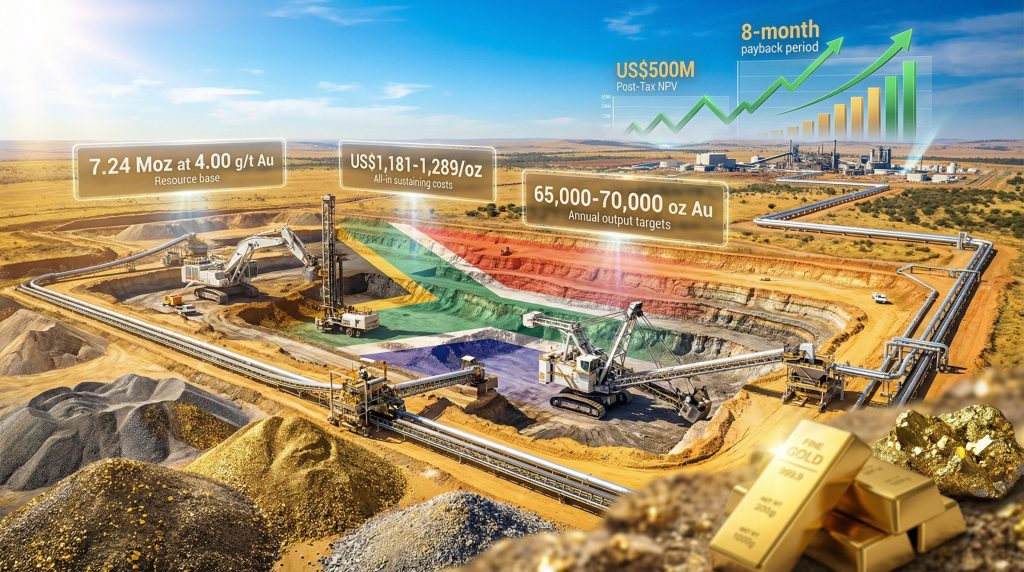
The operational model achieves an exceptional 8-month payback period, demonstrating rapid capital recovery that transforms investment risk profiles compared to multi-year payback timelines characteristic of traditional mining developments.
Technical Specifications and Production Parameters
| Operational Metric | Specification | Industry Benchmark Comparison |
|---|---|---|
| Total Resource Base | 7.24 Moz at 4.00 g/t Au | Above-average grade for SA operations |
| Phase 1 Reserve | 4.6 Mt at 2.60 g/t (384,000 oz) | Substantial initial development target |
| Annual Production Target | 65,000-70,000 oz Au | Significant new production capacity |
| All-In Sustaining Costs | US$1,181-1,289/oz | Competitive cost structure |
| Project Economic Life | 25-27 years | Extended operational timeline |
| Post-Tax Net Present Value | US$500 million | Strong economic returns |
When big ASX news breaks, our subscribers know first
Mechanisation and Operational Technology Integration
Hydropower Systems and Energy Optimisation
The implementation of hydropower-based extraction systems represents a significant departure from traditional compressed-air methodologies that have dominated South African gold mining for decades. This technological transition addresses multiple operational challenges simultaneously: energy cost reduction, operational complexity minimisation, and environmental impact mitigation. Additionally, these innovations align with broader decarbonisation benefits that mining companies are increasingly seeking to achieve.
Hydropower integration provides several critical advantages:
Energy Cost Reduction: Hydropower systems typically operate at lower cost per unit of extraction compared to compressed-air alternatives, though specific power consumption metrics vary based on geological conditions and water availability.
Operational Reliability: Water-based extraction systems experience fewer mechanical failures and require less specialised maintenance compared to complex compressed-air infrastructure.
Environmental Considerations: Reduced reliance on fossil fuel-powered compression systems aligns with increasingly stringent environmental regulations affecting South African mining operations.
However, hydropower implementation faces constraints in South Africa's water-scarce environment. Operators must carefully assess seasonal water availability, competing agricultural demands, and municipal water requirements when designing long-term extraction strategies.
Automation and Labour Productivity Enhancement
Mechanised extraction systems directly address South Africa's mining industry challenges including labour unrest, wage inflation, and skills shortages that have historically impacted operational stability. Automated equipment reduces dependency on large labour forces while improving safety outcomes through reduced human exposure to underground hazards. Moreover, these mining automation advances are revolutionising traditional operational approaches across the industry.
The labour productivity improvements stem from:
- Reduced Manual Processing: Automated ore handling systems eliminate labour-intensive material movement
- Enhanced Safety Protocols: Mechanisation reduces worker exposure to hazardous underground conditions
- Operational Consistency: Automated systems maintain consistent extraction rates regardless of labour availability
- Skills Optimisation: Focus shifts from manual labour to technical equipment operation and maintenance
Comparative Depth Analysis and Risk Mitigation
Traditional South African gold mines operate at extraordinary depths, with some operations extending beyond 4,000 meters below surface. These depths create substantial operational challenges including:
- Geotechnical Instability: Rock pressure increases exponentially with depth
- Thermal Management: Underground temperatures can exceed 60°C at extreme depths
- Ventilation Complexity: Massive air circulation systems required for worker safety
- Transportation Costs: Extended vertical and horizontal ore transport distances
- Emergency Response: Complex evacuation procedures for deep underground operations
Shallow-extraction operations eliminate many of these risk factors, enabling more predictable operational performance and reduced insurance costs.
Strategic Partnership Models and Toll Processing Economics
Sibanye-Stillwater Partnership Structure
The toll treatment agreement with Sibanye-Stillwater's Ezulwini plant exemplifies capital-efficient partnership models that enable rapid production commencement without substantial processing infrastructure investment. This partnership provides immediate access to established metallurgical capabilities while eliminating the multi-year development timeline typically required for processing facility construction. Furthermore, such collaborative arrangements reflect broader mining consolidation trends observed throughout the industry.
Partnership benefits include:
Immediate Processing Capacity: Access to proven processing infrastructure enables rapid transition from ore extraction to revenue generation
Metallurgical Expertise: Partnership with established operators provides access to specialised knowledge regarding ore processing optimisation and recovery maximisation
Risk Distribution: Shared processing responsibilities reduce technical and operational risks for the mining operator
Capital Preservation: Avoided processing infrastructure investment preserves capital for core extraction activities and expansion opportunities
Production Timeline and Stockpile Management
The operational timeline targets a 30,000-tonne stockpile by end-Q1 2026, with first gold pour scheduled for March 17, 2026. This phased approach enables operational optimisation before full-scale production while providing flexibility for market timing and quality control procedures.
Critical Milestone Achievement: The March 17, 2026 first gold pour target represents the culmination of South Africa's first new underground mine development in 15 years, marking a significant milestone for the country's mining sector recovery.
Stockpile management provides several strategic advantages:
- Quality Control: Accumulated ore allows for grade blending and metallurgical optimisation
- Market Timing: Stockpiled ore provides flexibility to optimise gold sales timing based on price movements
- Operational Buffer: Stockpiles enable continued revenue generation during temporary extraction interruptions
- Processing Efficiency: Consistent ore feed enables optimal processing plant utilisation
Risk Assessment and Contingency Planning
Toll processing arrangements create potential operational dependencies that require careful risk management. Key considerations include:
Processing Capacity Constraints: Ezulwini plant capacity may limit production scaling, particularly if Phase 2 expansion targets 200,000 ounces annually are achieved.
Alternative Processing Options: Development of backup processing arrangements ensures operational continuity if primary processing partnerships experience disruptions.
Transportation Logistics: Ore transportation from extraction site to processing facility creates logistical dependencies that require reliable coordination systems.
Capital Structure and Financial Engineering Analysis
Multi-Source Funding Architecture
The financing structure demonstrates sophisticated capital optimisation through diversified funding sources that balance cost of capital with operational flexibility:
| Funding Source | Amount | Strategic Function |
|---|---|---|
| Equity Raising (Sept 2025) | A$17.7 million | Core development capital |
| Nebari Loan Facility | US$12.5 million | Term debt financing |
| Syndicated Facility | ~US$50 million | Large-scale operational support |
| Total Estimated Funding | ~US$74.3 million | Comprehensive capital structure |
Ownership Structure and Dilution Management
The reference to increased ownership to 74% through strategic dilution management indicates sophisticated equity structuring that maintains controlling interest while accessing necessary capital. This ownership optimisation balances:
Control Maintenance: Retaining majority control enables strategic decision-making autonomy
Capital Access: Equity dilution provides access to growth capital without excessive debt burden
Partnership Integration: Strategic ownership sharing may facilitate operational partnerships and market access
Debt Facility Characteristics and Risk Management
The Nebari loan facility represents specialised mining finance designed for development-stage operations. While specific terms remain undisclosed, typical mining debt facilities include:
- Commodity Price Protection: Hedging requirements or collar arrangements to manage gold price volatility
- Production Milestones: Drawdown conditions tied to operational achievement targets
- Security Arrangements: Asset-based collateral including mining equipment and resource reserves
- Financial Covenants: Operational metrics requirements including debt service coverage and liquidity maintenance
The US$50 million syndicated facility indicates institutional confidence in the operational model, suggesting multiple financial institutions have conducted due diligence and committed capital based on project economics and management capabilities.
Industry Context and Sector Recovery Indicators
South African Mining Sector Decline Metrics
South Africa's gold mining sector has experienced catastrophic contraction over the past two decades, providing critical context for understanding the significance of new mine development:
Exploration Investment Collapse: Mineral exploration spending declined from $900 million in 2006 to just $43 million in 2025, representing a 95.2% reduction in exploration activity over approximately two decades.
Production Decline: Annual gold production has fallen from a 1970 peak of 1,000 tons to current levels of approximately 90 metric tons annually, reflecting a 91% decline from historical production capacity.
Infrastructure Underutilisation: Extensive existing mining infrastructure remains underutilised due to operational economics that favour shallow, mechanised extraction over traditional deep-shaft mining methodologies.
Comparative Operator Strategies
Major South African mining companies are pursuing parallel strategies that validate the shallow-mining approach. For instance, Mining Weekly reports on how west wits mining South Africa has secured additional permits to support its expanding operations:
Sibanye-Stillwater Strategic Focus: The company prioritises shallow, high-margin projects including the Burnstone development project, characterised as a low-cost, long-life operation. Additionally, growth opportunities through 50%-owned DRDGold demonstrate waste-treatment recovery as an alternative pathway to gold production.
Harmony Gold Waste Retreatment: Plans to potentially recover 5.7 million ounces through waste retreatment represent substantial resource recovery opportunities using existing processing infrastructure and accumulated waste materials.
Underground Expansion Reluctance: Industry executives express uncertainty regarding deep-mining expansion due to commodity price volatility and extended development timelines. As noted by Harmony Gold's finance director regarding expansion timing: development lead times of 2-3 years create substantial market risk exposure.
Multi-Commodity Development Potential and Resource Diversification
Uranium Resource Integration
Beyond primary gold production, west wits mining South Africa operations include potential uranium resource development through the Bird Reef uranium potential. This multi-commodity approach provides several strategic advantages:
Revenue Diversification: Uranium production creates additional revenue streams independent of gold price movements, reducing commodity price concentration risk.
Processing Synergies: Integrated extraction and processing operations may achieve cost efficiencies through shared infrastructure and operational expertise.
Market Timing Flexibility: Multi-commodity production enables operators to optimise production scheduling based on relative commodity price movements and market conditions.
Resource Base Expansion: Uranium resources may extend economic mine life beyond gold reserves, providing long-term operational sustainability.
Future Development Pipeline and Scaling Opportunities
The broader asset portfolio includes expansion opportunities that demonstrate long-term growth potential:
Phase 2 Expansion Targets: Scaling to 200,000 ounces annually represents a tripling of initial production capacity, requiring substantial operational and processing capacity expansion.
Mt Cecelia Project (Australia): International asset diversification through the Rio Tinto farm-in agreement provides geographical risk mitigation and additional resource base development.
Witwatersrand Basin Exploration: Additional exploration opportunities within the basin leverage existing geological knowledge and infrastructure while targeting extensions of proven mineralisation.
The next major ASX story will hit our subscribers first
Regulatory Framework and Compliance Architecture
Black Economic Empowerment Integration
The project maintains 33.4% Black Economic Empowerment ownership through Lilitha Resources partnership, demonstrating compliance with South African transformation requirements while facilitating sustainable development practices.
BEE compliance provides several operational advantages:
- Regulatory Approval: BEE compliance facilitates mining licence approvals and regulatory relationship management
- Local Community Integration: Partnership structures enable community engagement and local economic participation
- Skills Development: BEE requirements drive local training and capacity building initiatives
- Supply Chain Optimisation: Local procurement preferences support community economic development
Environmental and Social Impact Management
Modern mining operations face increasingly stringent environmental regulations and community expectations. Operational sustainability requires careful consideration of mine reclamation innovation practices to ensure long-term environmental stewardship:
Environmental Impact Minimisation: Shallow extraction methods typically create smaller environmental footprints compared to deep-mining operations requiring extensive surface infrastructure.
Community Partnership Development: Sustainable operations require ongoing community engagement and economic benefit sharing to maintain social licence to operate.
Water Management: Given South Africa's water scarcity challenges, hydropower systems require careful water resource management and environmental impact assessment.
Investment Implications and Market Psychology
Capital Market Confidence Signals
Successful capital raising in September 2025 during a period of declining exploration investment demonstrates renewed investor confidence in South African mining opportunities. This confidence reflects several key factors:
Operational Model Validation: Investor participation validates the shallow-mining, mechanised extraction approach as economically viable under current market conditions.
Management Execution Capability: Successful progression from concept to production demonstrates management capability to execute complex mining developments.
Strategic Partnership Value: Partnership with established operators like Sibanye-Stillwater reduces perceived investment risk through operational expertise access.
Risk Factors and Investment Considerations
Despite positive operational indicators, several risk factors require ongoing monitoring:
Commodity Price Volatility: Gold price movements significantly impact project economics, particularly given the US$1,181-1,289/oz all-in sustaining cost structure.
Regulatory Environment: Changes in South African mining regulations, taxation policies, or BEE requirements could impact operational economics and compliance costs.
Infrastructure Dependencies: Reliance on third-party processing facilities and existing infrastructure creates operational dependencies that require active risk management.
Water Availability: Hydropower systems depend on consistent water supplies that may be affected by drought conditions or competing water demands.
Technological Innovation and Industry Transformation
Geological Targeting and Resource Classification
Advanced geological targeting techniques enable precise resource definition and extraction optimisation:
Multi-Reef Targeting: The operation targets three distinct reef systems (Kimberley, Main, and Bird reefs), providing operational flexibility and resource optimisation opportunities.
Resource Classification: Measured and Indicated resources represent 55% of the total resource base, providing high confidence in reserve estimates and production planning.
Grade Control Systems: Selective mining techniques enable optimal grade management and waste minimisation through real-time geological assessment.
Processing Technology Integration
Modern processing approaches optimise recovery rates and operational efficiency:
Metallurgical Recovery Optimisation: Partnership with established processing facilities provides access to proven metallurgical techniques and recovery optimisation expertise.
Quality Control Systems: Ore stockpiling enables quality management through blending and grade control before processing.
Environmental Processing: Modern processing techniques minimise environmental impact through improved waste management and water recycling systems.
Conclusion and Industry Outlook
The emergence of west wits mining South Africa operations represents a fundamental transformation in South African gold mining methodology, demonstrating how technological innovation, strategic partnerships, and capital optimisation can unlock previously uneconomical resources. The successful transition from concept to production in one of the world's most challenging mining environments validates shallow-extraction approaches as viable alternatives to traditional deep-mining operations. As highlighted by recent industry coverage, this achievement marks a significant milestone for the sector.
The broader implications extend beyond individual project success to encompass South African mining sector recovery potential. With exploration spending having declined 95.2% since 2006 and production falling 91% from historical peaks, any successful new mine development provides crucial validation of investment opportunities within the country's mining sector.
The operational model's emphasis on capital efficiency, mechanisation, and strategic partnerships offers a replicable framework for other resource development opportunities throughout the Witwatersrand Basin and similar geological environments globally. As commodity markets continue evolving and traditional mining approaches face increasing economic and environmental constraints, innovative extraction methodologies will likely become increasingly important for unlocking global mineral resources.
Investment Disclaimer: This analysis contains forward-looking statements and projections that involve substantial risks and uncertainties. Actual results may differ materially from those projected due to commodity price volatility, operational risks, regulatory changes, and other factors beyond company control. Investors should conduct independent due diligence and consider professional financial advice before making investment decisions. Mining investments involve significant risks including total loss of capital.
Seeking Investment Opportunities in South African Mining Operations?
Discovery Alert's proprietary Discovery IQ model provides real-time alerts on significant ASX mineral discoveries, instantly identifying actionable opportunities as companies advance from exploration to production phases. Explore how major mineral discoveries have historically generated substantial returns by visiting Discovery Alert's dedicated discoveries page, then begin your 14-day free trial to position yourself ahead of the market.