June 20, 2026
What Makes Modern Iron Ore Processing Systems Revolutionary in the Pilbara?
Modern iron ore operations require sophisticated engineering solutions that integrate multiple extraction sites with centralised processing facilities. The Rio Tinto Western Range project exemplifies this complexity, moving millions of tonnes of material across challenging terrain while demanding innovative approaches to infrastructure design. Furthermore, operations must maintain consistent product quality while scaling production capacity to meet growing global demand.
Strategic Infrastructure Integration and Geological Advantages
The Pilbara region's Brockman Iron Formation represents one of Australia's most significant geological assets for high-grade hematite production. Within the Hamersley Basin, deposits containing iron ore concentrations suitable for premium steel production create opportunities for integrated mining operations that can leverage existing infrastructure networks.
Operations positioned near established processing hubs benefit from reduced capital expenditure requirements and accelerated development timelines. The proximity to existing rail corridors, power infrastructure, and processing facilities eliminates the need for duplicate systems. Consequently, this creates operational efficiencies that translate directly to improved project economics, demonstrating key industry leader advantages in the Australian mining sector.
Key Geological Characteristics of Pilbara Iron Ore:
- High-grade hematite concentrations exceeding 60% iron content
- Consistent mineralogy suitable for direct shipping ore applications
- Extensive deposit continuity supporting long-term extraction planning
- Favorable overburden ratios minimising waste rock handling requirements
Production Capacity and Integration Specifications
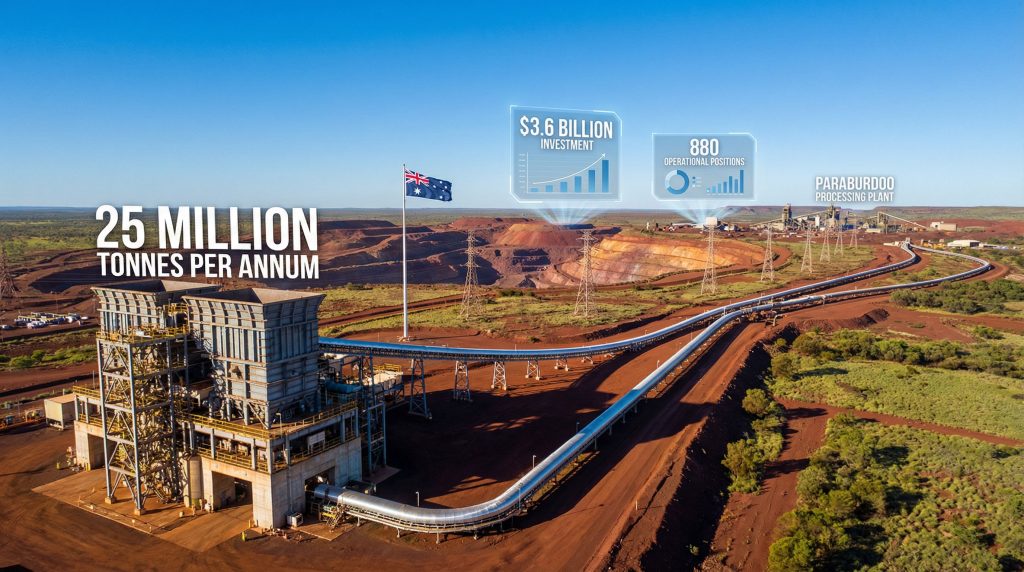
Large-scale iron ore operations in the Pilbara typically target annual production capacities between 20-30 million tonnes, supporting both domestic steel production and international export markets. These operations integrate multiple extraction areas through sophisticated materials handling systems designed to maintain consistent product specifications.
| Operation Type | Typical Capacity (Mtpa) | Infrastructure Requirements | Integration Benefits |
|---|---|---|---|
| Standalone Operations | 15-25 | Complete processing facility | Independent control |
| Hub-Integrated Systems | 20-35 | Conveyor/rail connections | Shared infrastructure costs |
| Brownfield Expansions | 10-30 | Minimal new infrastructure | Existing workforce utilisation |
The integration of new production capacity with established operations requires careful coordination of materials handling systems, quality control processes, and logistics networks. Successful integration depends on matching new production specifications with existing processing capabilities while maintaining overall system throughput.
When big ASX news breaks, our subscribers know first
How Do Multi-Billion Dollar Joint Venture Structures Function in Iron Ore Development?
Partnership Economics and Strategic Alignment
Modern iron ore developments frequently utilise joint venture structures that combine operational expertise with strategic market access. These partnerships typically involve majority operational control paired with minority strategic investment, creating alignment between production capabilities and end-user requirements.
The US$2 billion investment threshold represents a significant commitment level for Pilbara iron ore projects, reflecting the capital intensity required for modern mining infrastructure. Joint venture arrangements at this scale require sophisticated financial structuring that addresses both development risk and long-term operational returns. For instance, understanding surging iron ore demand insights becomes crucial for such large-scale investments.
Financial Structure Components:
- Equity contributions proportional to ownership stakes
- Development milestone payments tied to construction progress
- Long-term offtake agreements securing revenue streams
- Shared operational management responsibilities
Long-term Commercial Framework Development
Strategic partnerships in iron ore development extend beyond simple financial arrangements to encompass multi-decade supply relationships. The commitment to deliver 126.5 million tonnes over approximately 13 years represents a substantial portion of total mine life production, providing revenue certainty that justifies initial capital investment.
These commercial structures typically include pricing mechanisms that balance market exposure with revenue predictability. Partners benefit from dedicated supply access while operators gain financial stability through committed volume purchases.
Strategic Insight: Long-term supply agreements exceeding 100 million tonnes represent among the largest commodity purchase commitments in the global mining sector, reflecting the strategic importance of secure iron ore supply chains.
What Engineering Innovations Define Advanced Materials Handling Systems?
Conveyor System Design and Operational Efficiency
Extended conveyor systems spanning 18 kilometres represent significant engineering achievements in materials handling technology. These systems must navigate challenging topography while maintaining consistent throughput rates and minimising maintenance requirements across their operational lifespan.
The capacity to transport processed ore directly from primary crushing facilities to existing processing plants eliminates traditional truck haulage requirements. Consequently, this reduces both operational costs and environmental impact while incorporating mining innovation trends that define modern extraction operations.
Technical Specifications for Long-Distance Conveyor Systems:
- Belt speeds optimised for material characteristics and throughput requirements
- Intermediate drive stations managing power distribution across system length
- Weather protection systems maintaining operation through seasonal conditions
- Automated monitoring systems tracking belt condition and material flow
Primary Crushing and Processing Integration Capabilities
Modern primary crushing systems incorporate advanced automation technologies that optimise throughput while maintaining consistent product size distributions. These systems integrate with downstream processing facilities through sophisticated control systems that manage material flow based on real-time quality measurements.
The integration of new crushing capacity with existing processing infrastructure requires careful matching of throughput rates, product specifications, and operational scheduling. Successful integration maintains overall system efficiency while accommodating varying ore characteristics from different extraction areas.
Processing facilities designed for 25 Mtpa capacity incorporate multiple crushing stages, screening systems, and quality control mechanisms that ensure final product meets stringent customer specifications. These systems must accommodate ore variability while maintaining consistent output quality.
How Do Modern Mining Operations Address Workforce Development and Economic Impact?
Employment Structure and Skills Development
Large-scale mining operations create substantial direct and indirect employment opportunities across multiple phases of development and operation. The transition from construction to operational phases requires careful workforce planning to maintain employment continuity while adapting to different skill requirements.
Employment Impact Analysis:
| Development Phase | Direct Employment | Indirect Economic Impact | Duration |
|---|---|---|---|
| Construction | 1,600 positions | A$800M economic activity | 24-36 months |
| Operations | 800-880 positions | A$150M annual impact | 15-20 years |
| Maintenance/Expansion | 200-400 positions | A$50M annual impact | Ongoing |
Operational workforce structures typically combine residential employees with fly-in, fly-out arrangements, providing flexibility while supporting local community development. The integration of workers from existing operations facilitates knowledge transfer and maintains operational consistency.
Regional Economic Development and Business Participation
Major mining projects generate substantial regional economic impact through direct procurement, indirect business opportunities, and increased regional service demand. The commitment of approximately A$1 billion in contracts to local businesses demonstrates the significant economic multiplier effects of large-scale mining development.
Local business participation extends across multiple sectors including construction services, equipment supply, maintenance support, and professional services. These relationships often continue throughout operational phases, creating sustained regional economic benefits.
Regional Economic Multiplier Effects:
- Construction phase: 1.5x direct economic impact through indirect spending
- Operational phase: 2.2x direct employment through service sector growth
- Long-term: Sustained regional infrastructure and service capacity development
What Sets Advanced Indigenous Partnership Models Apart in Contemporary Mining?
Collaborative Heritage Management Development
Contemporary mining operations increasingly adopt collaborative approaches to cultural heritage management that involve Traditional Owners as active partners in project development and ongoing operations. The co-designed Social, Cultural and Heritage Management Plan represents an evolution from traditional consultation models toward genuine partnership structures.
These collaborative frameworks typically address multiple aspects of cultural heritage protection including site identification, impact assessment, ongoing monitoring, and benefit-sharing arrangements. The integration of Traditional Owner knowledge with technical mining expertise creates more comprehensive heritage protection systems.
Components of Collaborative Heritage Management:
- Joint development of heritage protection protocols
- Traditional Owner involvement in site monitoring and assessment
- Shared decision-making processes for heritage-sensitive areas
- Ongoing cultural education and awareness programs
Economic Participation and Capacity Development
Modern Indigenous partnership models extend beyond heritage protection to encompass economic participation, employment opportunities, and business development support. These comprehensive approaches create pathways for Traditional Owner communities to participate directly in mining sector economic benefits.
Partnership structures may include dedicated employment programs, business development opportunities, training and education support, and direct economic participation through equity arrangements or revenue sharing. These models recognise Traditional Owner rights while creating sustainable economic opportunities.
Industry Evolution: The transition from consultation-based heritage management to collaborative partnership models reflects broader changes in mining industry approaches to Indigenous engagement and community development.
How Does Strategic Mine Planning Address Resource Depletion and Replacement?
Replacement Mine Strategy and Production Continuity
Mature mining regions require systematic replacement mine development to maintain production capacity as legacy operations approach depletion. The Pilbara region's extensive mineral endowment supports multiple generations of mining development, requiring coordinated planning to optimise resource utilisation and infrastructure investment.
Replacement mine development typically focuses on maintaining product quality consistency while integrating new production capacity with existing processing and logistics infrastructure. This approach maximises the utilisation of sunk capital investments while ensuring continuity of supply to established customers.
Strategic Planning Considerations:
- Resource quality matching for consistent product specifications
- Infrastructure utilisation optimisation across multiple mine sites
- Workforce transition planning from depleted to new operations
- Market positioning maintenance through production continuity
Future Development Pipeline and Investment Allocation
The commitment to invest more than A$13 billion across the Pilbara between 2025 and 2027 represents one of the largest single-region mining investment programs globally. This investment level reflects both the strategic importance of the region and the capital requirements for maintaining competitive production capacity.
Future development projects including Rhodes Ridge, targeting 40 Mtpa capacity by 2030, demonstrate the continued expansion potential within established mining regions. These developments benefit from existing infrastructure while incorporating advanced technologies and operational practices.
| Development Project | Target Capacity | Expected Timeline | Infrastructure Integration |
|---|---|---|---|
| Rhodes Ridge | 40 Mtpa | First ore 2030 | New rail connection |
| Replacement Projects | 15-25 Mtpa each | 2025-2027 | Existing hub integration |
| Expansion Projects | 10-20 Mtpa additions | Ongoing | Brownfield development |
The next major ASX story will hit our subscribers first
What Environmental and Sustainability Considerations Shape Modern Mining Operations?
Resource Efficiency and Environmental Management Systems
Contemporary mining operations implement comprehensive environmental management systems that address water usage, air quality, biodiversity protection, and waste management throughout the operational lifecycle. These systems integrate regulatory requirements with voluntary sustainability commitments and stakeholder expectations.
Advanced materials handling systems, particularly long-distance conveyor networks, offer significant environmental advantages over traditional truck haulage through reduced fuel consumption, lower emissions, and decreased road infrastructure requirements. These systems support broader sustainability objectives while improving operational efficiency and showcasing mining decarbonisation benefits across the industry.
Environmental Performance Indicators:
- Water usage efficiency and recycling rates
- Dust emission levels and air quality monitoring
- Biodiversity offset program implementation
- Rehabilitation success rates for disturbed areas
Carbon Footprint Reduction and Climate Response Strategies
Mining operations increasingly focus on Scope 1, 2, and 3 emissions reduction through technology adoption, operational efficiency improvements, and supply chain collaboration. The integration of electric-powered conveyor systems with renewable energy sources demonstrates practical approaches to emissions reduction in heavy industry applications.
Collaboration between mining operators and steel producers on decarbonisation initiatives reflects the interconnected nature of supply chain emissions reduction. These partnerships address technical challenges while maintaining production efficiency and product quality requirements.
Sustainability Challenge: The steel industry's transition to low-carbon production methods requires coordinated action across the entire value chain, from iron ore extraction through final steel product manufacturing.
What Investment and Market Implications Emerge from Major Iron Ore Developments?
Market Positioning and Competitive Dynamics
Large-scale iron ore developments influence global market dynamics through their impact on supply availability, pricing mechanisms, and strategic relationships between producers and consumers. The integration of new production capacity requires careful market positioning to optimise returns while maintaining competitive advantages and understanding iron ore price trends across global markets.
Global Iron Ore Market Dynamics:
| Producer Category | Market Share | Strategic Advantages | Key Markets |
|---|---|---|---|
| Major Integrated Producers | 65% | Scale, quality, logistics | Global steel industry |
| Regional Producers | 25% | Proximity, flexibility | Regional markets |
| Specialty Producers | 10% | Quality premiums | Premium steel grades |
The commitment to long-term supply relationships provides revenue stability while potentially limiting exposure to spot market price volatility. This balance between contracted and merchant sales reflects strategic approaches to market risk management.
Investment Returns and Capital Allocation Efficiency
Multi-billion dollar mining investments require sophisticated financial evaluation that considers commodity price volatility, operational risk, and long-term market outlook. Joint venture structures distribute both investment requirements and returns while providing access to strategic market relationships.
The integration of new production capacity with existing operations typically generates superior returns compared to greenfield developments through reduced infrastructure requirements and accelerated cash flow generation. These efficiency gains support higher dividend yields and improved shareholder returns.
Investment Performance Metrics:
- Internal rate of return calculations exceeding cost of capital requirements
- Payback periods typically 3-5 years for integrated developments
- Net present value optimisation through infrastructure sharing
- Dividend sustainability through diversified production base
How Do Strategic Partnerships Shape Australia-China Resource Relations?
Long-term Partnership Evolution and Technology Transfer
The development of strategic partnerships spanning multiple decades reflects the mutual benefits created through sustained collaboration between resource producers and steel manufacturers. These relationships extend beyond simple buyer-seller arrangements to encompass technology sharing, operational optimisation, and supply chain innovation.
Historical partnerships dating back to the early 2000s provide frameworks for current developments while incorporating lessons learned from previous joint ventures. The evolution of partnership structures reflects changing market conditions, regulatory environments, and strategic priorities for both partners.
Partnership Development Timeline:
- 2002: Initial Eastern Range partnership establishment
- 2025: Rio Tinto Western Range project operational commencement
- 2030: Planned Rhodes Ridge development completion
- Beyond 2030: Continued expansion opportunities
Regulatory Framework and Political Stability Considerations
Cross-border mining investments require stable regulatory frameworks that support long-term capital deployment while addressing national security and economic sovereignty considerations. The evolution of foreign investment approval processes reflects the balance between economic benefits and strategic control maintenance.
The historical context of Australia-China resource relationships, extending back to the 1980s, provides a foundation for contemporary partnership development. Political leadership support for resource sector collaboration demonstrates the strategic importance of these relationships for both countries' economic development.
The Western Range iron ore project represents a significant milestone in this ongoing partnership, demonstrating the continued commitment to large-scale resource collaboration despite periodic geopolitical tensions.
Strategic Perspective: The continuation of major resource partnerships despite periodic political tensions reflects the fundamental economic complementarity between Australian resource endowments and Chinese industrial capacity.
This analysis contains forward-looking statements and projections that involve inherent risks and uncertainties. Actual results may differ materially from those projected. Readers should conduct their own research and seek professional advice before making investment decisions.
Ready to Capitalise on the Next Major Iron Ore Discovery?
Discovery Alert instantly notifies investors about significant ASX mineral discoveries using its proprietary Discovery IQ model, helping subscribers identify actionable opportunities ahead of the broader market. Explore how major mineral discoveries can generate substantial returns and begin your 30-day free trial today to position yourself ahead of market movements in the iron ore and broader mining sectors.