
June 16, 2026
Modern mining investment requires sophisticated understanding of how commodity values emerge from complex interactions between geological characteristics, market dynamics, and technological applications. Traditional approaches focusing solely on resource quantity miss critical factors that drive real-world pricing mechanisms across global mineral markets, including China demand trends and emerging technological applications.
Economic Foundations of Mineral Asset Valuation
The foundation of mineral valuation rests on understanding that geological rarity does not automatically translate to economic value. Market forces, industrial demand patterns, and extraction economics create a multifaceted framework where how is the value of a mineral determined becomes a question requiring comprehensive analysis rather than simple formulas.
Furthermore, technological advances continue to reshape the valuation landscape through lithium industry innovations and other breakthrough developments affecting commodity pricing structures.
Market-Driven Valuation Approaches
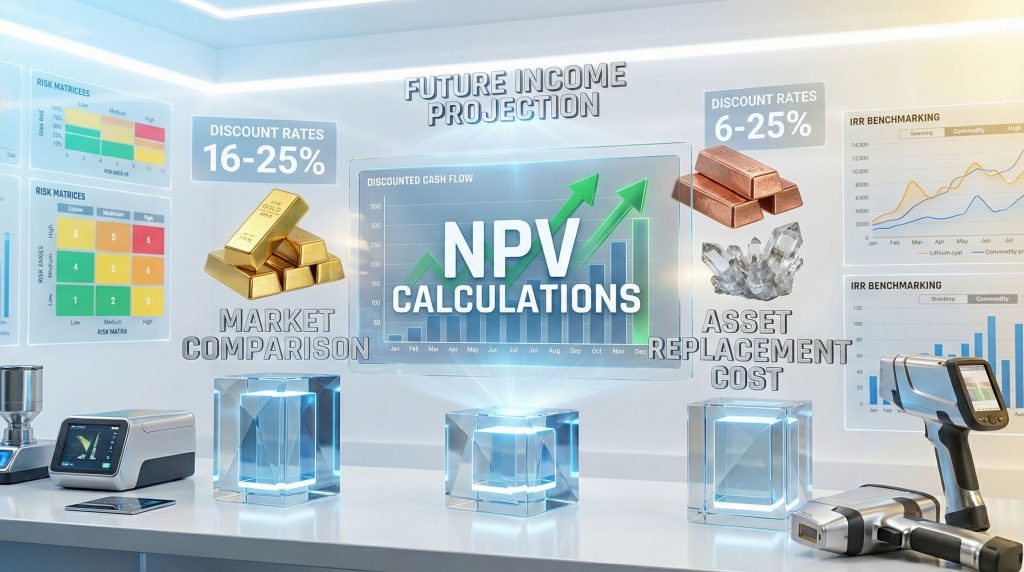
Professional mineral assessment employs three interconnected methodologies that address different aspects of value creation. The comparative market analysis examines similar properties and recent transactions to establish baseline valuations, while future income projections model anticipated cash flows from mineral extraction operations. Asset replacement cost calculations provide floor values by estimating what would be required to recreate equivalent mineral positions.
These approaches require risk-adjusted calculations incorporating discount rates that typically range from 8% to 30% depending on geological uncertainty levels, political stability, and market volatility factors. Monte Carlo simulations help model price volatility scenarios, while internal rate of return benchmarking against industry standards provides investment decision frameworks.
Industrial Demand as Value Driver
Contemporary mineral valuation increasingly reflects technological dependence rather than geological scarcity. Battery technology applications have transformed lithium from a niche industrial input to a strategic commodity commanding premium valuations. Similarly, semiconductor manufacturing demands have elevated rare earth elements beyond their traditional pricing models.
Electronic component requirements, aerospace industry specifications, and medical equipment applications create sustained demand patterns that support higher valuations. When industries become dependent on specific minerals, rapid value appreciation often follows technological adoption cycles, as evidenced by recent mineral value assessment guidelines published by industry experts.
When big ASX news breaks, our subscribers know first
Market Dynamics Shaping Commodity Pricing
Global commodity exchanges operate through supply-demand equilibrium mechanisms that incorporate substitution effects and industrial application diversity. Understanding these market forces requires analyzing how geopolitical factors, technology disruptions, and currency fluctuations influence international mineral trading patterns.
Additionally, comprehensive mineral exploration insights reveal how early-stage discoveries impact long-term market dynamics and pricing structures.
Supply Chain Risk Assessment
Supply chain disruptions significantly impact mineral valuations through availability constraints and production capacity limitations. Recent examples include:
- Lithium supply bottlenecks affecting battery manufacturing timelines
- Rare earth export restrictions influencing technology sector planning
- Transportation logistics constraints affecting bulk commodity pricing
- Processing facility capacity limitations creating regional price variations
Technology Substitution Effects
Technological innovation continuously reshapes mineral demand patterns through both replacement and enhancement mechanisms. Fiber optic communications reduced copper demand in telecommunications infrastructure, while electric vehicle adoption increased demand for battery-grade lithium, cobalt, and nickel.
Advanced materials research creates new applications that can rapidly increase mineral values. Quantum computing requirements, renewable energy infrastructure, and next-generation battery chemistry development represent emerging demand catalysts affecting long-term mineral valuations.
| Market Factor | Impact Timeframe | Valuation Effect | Assessment Method |
|---|---|---|---|
| Technology adoption cycles | 2-7 years | High volatility | Patent analysis, R&D investment tracking |
| Geopolitical supply risks | 6 months-3 years | Premium pricing | Political stability indices, trade policy monitoring |
| Environmental regulations | 1-10 years | Cost structure changes | Compliance expense modeling |
| Currency fluctuations | Daily-annually | Revenue variability | Multi-currency hedging analysis |
Technical Assessment Methodologies
Geological characterization provides the scientific foundation for economic modeling, though technical excellence alone cannot determine market value without commercial viability assessment. Modern resource estimation employs geostatistical modeling using ordinary kriging methods to predict mineral distribution patterns beyond directly sampled areas.
Advanced Analytical Technologies
Contemporary mineral assessment utilizes sophisticated analytical instrumentation to characterize ore quality and metallurgical properties. X-ray fluorescence (XRF) spectroscopy provides rapid elemental composition analysis with detection limits suitable for most commercial applications, while X-ray diffraction (XRD) identifies specific mineral phases affecting processing characteristics.
Automated mineralogy systems combine multiple analytical techniques to generate quantitative mineral composition data essential for metallurgical testing and process design. These technologies reduce uncertainty in resource estimates while providing data necessary for economic modeling.
Resource Classification Standards
International resource reporting standards require technical assessment data to support economic evaluations. The JORC Code, CRIRSCO guidelines, and similar frameworks establish minimum technical standards for public resource reporting, ensuring technical assessment quality meets investment decision requirements.
Block modeling techniques create three-dimensional resource representations incorporating grade distribution, geological continuity, and mining constraints. Variogram interpretation quantifies spatial correlation patterns essential for resource estimation accuracy and risk assessment.
Technical assessments provide essential data for economic modeling but require integration with market analysis and financial projections to determine commercial viability and investment attractiveness.
Financial Modeling Applications
Professional mineral property valuation employs sophisticated financial modeling techniques adapted to mining industry characteristics. Discounted cash flow (DCF) analysis remains the primary valuation method for producing properties, incorporating production forecasts, commodity price projections, and operational cost estimates over expected mine life.
Net Present Value Calculations
DCF modeling for mineral properties requires specialized consideration of:
- Production scheduling based on geological constraints and mining method limitations
- Commodity price volatility requiring scenario analysis and sensitivity testing
- Capital expenditure phasing reflecting development timelines and financing requirements
- Operating cost escalation incorporating inflation, labor cost increases, and regulatory compliance expenses
Sensitivity analysis examines how valuation changes with different commodity price assumptions, typically modeling scenarios ranging from current market prices to long-term historical averages and analyst consensus forecasts. Moreover, the gold price forecast demonstrates how how is the value of a mineral determined relies heavily on forward-looking price projections.
Comparable Transaction Analysis
Market-based valuation approaches analyze recent property transactions to establish valuation multiples applicable to similar assets. Key metrics include:
- Price per contained ounce for precious metal properties
- Price per pound of copper equivalent for base metal projects
- Enterprise value to resource multiples adjusted for development stage and location
- Transaction premiums reflecting strategic buyer motivations
Location-specific risk adjustments account for infrastructure accessibility, regulatory environments, and political stability differences between comparable properties and target assets.
Production Cost Impact Analysis
Mining economics fundamentally depend on the relationship between commodity prices and total production costs, including both capital expenditure (CAPEX) requirements and operating expense (OPEX) structures. Understanding these cost components enables accurate assessment of project economics and investment returns.
Capital Expenditure Categories
Mine development requires substantial upfront investments across multiple categories:
Infrastructure Development:
- Road construction and site access improvements
- Power transmission and distribution systems
- Water supply systems and waste management facilities
- Worker accommodation and administrative facilities
Processing Facilities:
- Mineral processing plant construction and equipment procurement
- Tailings storage facility development and environmental controls
- Laboratory facilities and quality control systems
- Maintenance workshops and spare parts inventory
Environmental Compliance:
- Environmental impact mitigation infrastructure
- Water treatment facilities and monitoring systems
- Rehabilitation bonding and closure cost provisions
- Community development and stakeholder engagement programs
Operating Cost Structure Analysis
Ongoing production costs significantly influence project economics and must be accurately forecasted across multiple operational areas:
- Mining costs varying by extraction method (open-pit vs underground operations)
- Processing expenses including reagents, power consumption, and maintenance
- Labor costs reflecting regional wage structures and skill availability
- Transportation logistics for product delivery to markets or processing facilities
Mining method selection dramatically affects cost structures. Open-pit operations typically offer lower operating costs per tonne but require higher initial capital investments, while underground mining involves higher ongoing costs but may access higher-grade ore bodies.
Geographic Location Value Factors
Mineral property location significantly influences valuation through infrastructure accessibility, regulatory environments, and operational cost variations. Infrastructure accessibility premiums reflect proximity to transportation networks, processing facilities, and skilled labor markets.
Infrastructure Accessibility Assessment
Transportation costs represent major operational expenses for bulk commodities, making proximity to rail networks, ports, and processing facilities valuable. Properties located within 50 kilometres of existing infrastructure typically command valuation premiums compared to remote locations requiring new infrastructure development.
Utility availability including reliable power supplies and water sources affects both development costs and operational feasibility. Regional power costs vary significantly, with some jurisdictions offering hydroelectric power at substantially lower rates than thermal generation regions.
Jurisdictional Risk Evaluation
Political stability and regulatory consistency significantly impact mineral property valuations through their effects on operational predictability and investment security. Mining policy frameworks vary substantially between jurisdictions, affecting taxation rates, environmental compliance requirements, and community engagement obligations.
Key jurisdictional factors include:
- Permitting efficiency and regulatory approval timelines
- Tax regime stability including royalty rates and profit-sharing arrangements
- Environmental regulation compliance costs and operational restrictions
- Community relations requirements and social licence considerations
- Currency stability and foreign exchange regulations affecting international investment
Resource nationalism policies in some jurisdictions create additional risks requiring higher discount rates in valuation models, while stable regulatory environments support lower risk premiums. Furthermore, understanding mineral royalty calculations becomes essential for accurate project economics modeling.
The next major ASX story will hit our subscribers first
Exploration-Stage Property Valuation
Early-stage mineral properties without established resources require specialised valuation approaches acknowledging higher uncertainty levels and limited technical data. Rule-of-thumb valuation methods provide preliminary estimates based on historical precedents and comparable transactions.
Expenditure-Based Valuation
Exploration expenditure multiples typically range from 0.1x to 0.8x total historical exploration spending, depending on:
- Geological prospectivity based on regional mineralisation patterns
- Exploration program quality including drilling density and analytical standards
- Management track record and technical team expertise
- Commodity focus with different multiples for precious metals versus base metals
Per-ounce in-situ resource valuations vary significantly by commodity type and development stage, with precious metal resources typically commanding higher per-unit values than industrial minerals.
Real Options Valuation Theory
Early-stage properties contain expansion optionality through additional exploration potential beyond currently defined prospects. Future drilling potential represents valuable options requiring specialised valuation techniques acknowledging uncertain outcomes.
Probability-weighted scenario modelling incorporates multiple potential outcomes including exploration success rates, resource size distributions, and commodity price scenarios. This approach recognises that exploration properties provide leveraged exposure to commodity price appreciation while maintaining downside protection through diversified prospect portfolios.
| Development Stage | Typical Valuation Multiple | Primary Risk Factors | Key Value Drivers |
|---|---|---|---|
| Grassroots exploration | 0.1x – 0.3x expenditure | Geological uncertainty | Regional prospectivity |
| Advanced exploration | 0.3x – 0.6x expenditure | Resource definition risk | Drilling results quality |
| Resource definition | 0.5x – 1.0x expenditure | Economic viability | Metallurgical testing |
| Pre-feasibility | DCF-based valuation | Development funding | Engineering study results |
Risk Factor Analysis in Mineral Valuation
Comprehensive risk assessment drives discount rate selection and scenario probability weighting in mineral property valuations. Geological risks include resource continuity uncertainty beyond drilled areas, metallurgical recovery rate variability, and geotechnical stability considerations affecting mining method selection.
Geological and Technical Risk Assessment
Resource estimation uncertainty affects valuation through grade continuity assumptions and tonnage estimates. Infill drilling programmes reduce geological uncertainty but require substantial investment, creating timing decisions affecting project economics.
Metallurgical testing results significantly influence processing cost estimates and recovery rate assumptions. Complex mineralogy requiring specialised processing techniques increases technical risk and capital requirements compared to conventional processing applications.
Mining method selection depends on orebody geometry, geotechnical conditions, and environmental constraints. Underground mining in challenging ground conditions requires higher risk premiums than straightforward open-pit operations.
Commercial and Regulatory Risk Factors
Environmental impact assessment outcomes affect development timelines and operational constraints. Complex environmental conditions requiring extensive mitigation measures increase both capital costs and operational complexity.
Community relations and social licence considerations increasingly influence project viability, particularly in regions with indigenous land rights or significant local stakeholder interests. Projects requiring comprehensive community benefit agreements face higher development costs and potential operational restrictions.
Commodity price correlation with economic cycles creates systematic risk affecting portfolio diversification benefits. Industrial minerals closely tied to construction cycles show different risk profiles compared to precious metals serving as store-of-value assets.
| Risk Category | Typical Probability Range | Potential Value Impact | Mitigation Strategies |
|---|---|---|---|
| Resource continuity | 20-45% uncertainty | 15-60% value variance | Additional drilling, geological modelling |
| Metallurgical recovery | 10-25% uncertainty | 10-40% value impact | Comprehensive testwork, pilot plant studies |
| Environmental approvals | 15-35% delay risk | 5-30% cost increase | Early stakeholder engagement, specialist consulting |
| Community acceptance | 10-40% opposition risk | 10-50% development delay | Transparent consultation, benefit sharing |
Emerging Technologies Reshaping Valuation
Digital transformation in mining operations affects both operational costs and revenue optimisation potential, influencing long-term asset valuations. Autonomous equipment deployment reduces labour costs while improving operational consistency and safety performance.
Consequently, understanding how is the value of a mineral determined increasingly requires analysing how data-driven mining operations impact traditional valuation methodologies through operational efficiency improvements.
Digital Mining Innovation
Internet of Things (IoT) sensor networks enable real-time production monitoring and predictive maintenance programmes reducing unplanned downtime. Artificial intelligence applications in resource estimation improve geological modelling accuracy while optimising production scheduling.
Remote operation capabilities allow centralised control of multiple mining operations, reducing site-based personnel requirements and improving operational coordination. These technologies particularly benefit properties in remote locations with limited local workforce availability.
Blockchain applications in mineral supply chain tracking create value premiums for responsibly sourced materials, especially in precious metals and conflict minerals markets.
Sustainability Integration
Environmental, Social, and Governance (ESG) compliance increasingly affects access to capital markets and premium pricing for responsibly produced minerals. Carbon footprint reduction initiatives require capital investment but create competitive advantages in carbon-constrained markets.
Circular economy principles in mineral processing enable waste stream monetisation and resource efficiency improvements. Water recycling systems and waste heat recovery reduce operating costs while improving environmental performance.
Renewable energy integration at mining operations reduces exposure to fossil fuel price volatility while supporting corporate sustainability commitments affecting investor relations and financing costs.
Investment Application Strategies
Professional mining investment requires systematic portfolio construction balancing commodity diversification across development stages, geographic distribution, and risk-return optimisation. Correlation analysis between different mineral types and broader market sectors influences portfolio allocation decisions.
Due Diligence Framework Implementation
Investment professionals apply standardised evaluation protocols including:
Technical Report Verification:
- Independent geological review of resource estimates and technical assumptions
- Metallurgical testwork validation and processing cost verification
- Environmental assessment review and regulatory compliance analysis
- Infrastructure requirement assessment and capital cost validation
Financial Model Testing:
- Sensitivity analysis across commodity price scenarios
- Operating cost benchmark comparison with industry standards
- Capital expenditure schedule review and funding requirement analysis
- Economic return calculations using appropriate discount rates
Management Evaluation:
- Track record assessment of key personnel and technical teams
- Corporate governance standards and stakeholder relations review
- Strategic planning capabilities and execution history analysis
- Financial management competence and capital allocation decisions
Market Position Analysis:
- Competitive positioning relative to other producers in the commodity sector
- Market access and customer relationship evaluation
- Product quality specifications and premium pricing potential
- Long-term supply/demand fundamentals affecting project economics
Portfolio Optimisation Strategies
Effective mineral investment portfolios balance development stage diversification from exploration through production phases, commodity diversification across precious metals, base metals, and industrial minerals, and geographic diversification managing political and regulatory risks.
Correlation management recognises that different commodities respond differently to economic cycles, with precious metals often providing portfolio protection during economic uncertainty while industrial minerals correlate more closely with economic growth.
Risk-adjusted return optimisation considers that higher-risk exploration investments may be balanced with lower-risk producing assets, creating overall portfolio risk profiles appropriate for investor objectives and time horizons.
In conclusion, answering how is the value of a mineral determined requires comprehensive analysis integrating technical assessment, market dynamics, financial modelling, and risk evaluation to create robust valuation frameworks suitable for investment decision-making.
Please note: This analysis is for educational purposes only and should not be considered investment advice. Mineral investment involves substantial risks including total loss of invested capital. Professional financial advice should be sought before making investment decisions. Market conditions, regulatory environments, and commodity prices can change rapidly, significantly affecting investment outcomes.
Looking to Capitalise on Mineral Discovery Opportunities?
Discovery Alert's proprietary Discovery IQ model instantly identifies significant ASX mineral discoveries, transforming complex geological data into actionable investment insights for both short-term traders and long-term investors. Explore historic examples of exceptional returns from major mineral discoveries on Discovery Alert's dedicated discoveries page and begin your 14-day free trial to secure your competitive advantage in the market.