
May 9, 2026
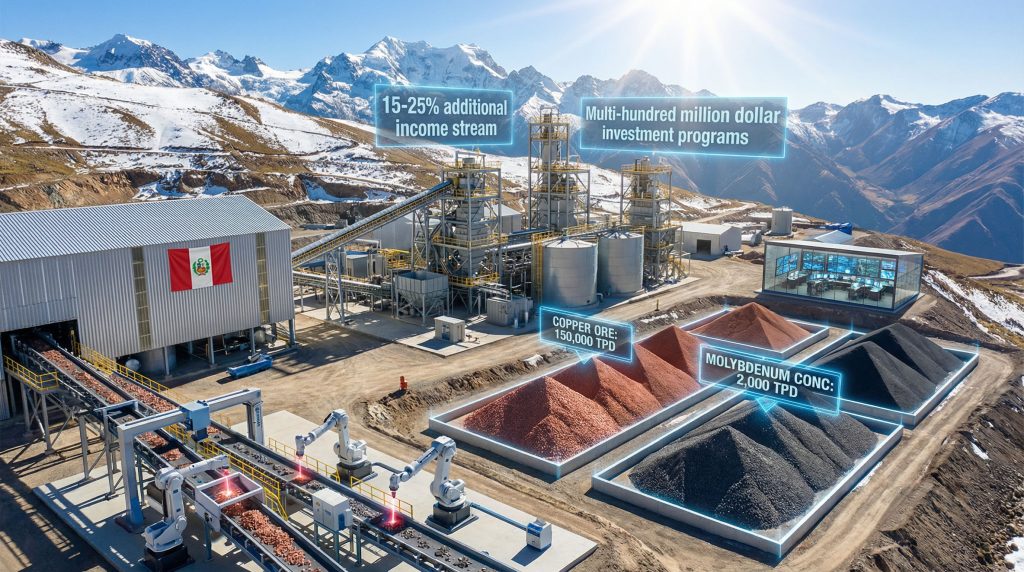
Strategic Value of Molybdenum Integration in Large-Scale Copper Operations
Advanced molybdenum processing technologies are fundamentally reshaping how data-driven mining operations approach resource extraction and revenue optimisation. The integration of secondary metal recovery systems within established copper facilities represents a strategic evolution from single-commodity production models toward diversified mineral processing architectures. Furthermore, this technological shift enables mining companies to capture additional value streams while maintaining existing operational frameworks, creating enhanced economic resilience against commodity price volatility.
The incorporation of molybdenum recovery capabilities at major copper operations fundamentally transforms the economic profile of mining facilities by creating multiple revenue streams from existing ore bodies. This integration approach enables operators to diversify their product portfolio whilst leveraging established infrastructure investments.
Economic Benefits of Dual-Metal Processing Systems:
• Revenue Diversification: Molybdenum typically contributes 5-15% of total revenue in integrated operations, providing significant buffer against copper price downturns
• Infrastructure Optimisation: Shared processing facilities reduce per-unit costs through economies of scale
• Market Access: Entry into specialty metals markets with premium pricing opportunities
• Operational Stability: Multiple commodity streams enhance cash flow predictability
The Chinalco Toromocho molybdenum project exemplifies this strategic approach through a US$700 million investment program designed to integrate molybdenum recovery without altering the facility's 170,000 tonnes per day processing capacity. Consequently, this transformation demonstrates how established operations can unlock additional value through metallurgical optimisation rather than infrastructure expansion.
| Investment Category | Typical Allocation | Strategic Impact |
|---|---|---|
| Processing Equipment | 40-50% | Enhanced throughput and recovery |
| Infrastructure | 25-35% | Improved operational efficiency |
| Technology Systems | 15-20% | Automation and optimisation |
| Environmental/Social | 10-15% | Regulatory compliance |
When big ASX news breaks, our subscribers know first
Processing Capacity Enhancement Through Operational Efficiency
The traditional approach to mining value enhancement through capacity expansion is being replaced by sophisticated efficiency optimisation strategies. Modern AI-enhanced mining operations are discovering that substantial value creation can occur through metallurgical improvements and processing route optimisation without requiring duplicate infrastructure investments.
The Toromocho transformation maintains its existing 170,000 tonnes per day processing capacity whilst implementing a three-year modernisation program. In addition, this approach prioritises extraction efficiency over volumetric throughput increases, enabling the operation to process both copper-only and copper-molybdenum ore streams through optimised metallurgical pathways.
Processing Efficiency Enhancement Framework:
-
Ore Classification Systems: Advanced sorting technologies differentiate between single-metal and multi-metal ore bodies
-
Stream Optimisation: Segregated processing routes maximise recovery rates for each commodity type
-
Quality Control Integration: Continuous monitoring systems ensure optimal metallurgical performance
-
Resource Sequencing: Strategic ore stockpiling enables consistent plant feed quality
The implementation timeline spans three years, with ore stockpiling scheduled for 2027 and enhanced processing beginning in 2028. However, this phased approach ensures operational continuity whilst upgrading processing capabilities, demonstrating how major mining transformations can occur without production interruptions.
"The Toromocho project utilises existing pit roads and operates within previously authorised limits, minimising additional environmental permitting requirements whilst maximising infrastructure reuse efficiency."
Dual-Metal Processing System Implementation
The technical implementation of simultaneous copper and molybdenum recovery requires sophisticated ore classification and processing route optimisation. Furthermore, the Chinalco Toromocho molybdenum project demonstrates advanced metallurgical engineering through its ore differentiation and processing strategy.
Ore Classification and Processing Architecture:
• Copper-Only Ore Streams: Direct processing through concentrator plant using established copper recovery circuits
• Copper-Molybdenum Ore Streams: Strategic stockpiling for specialised dual-metal processing campaigns
• Processing Route Selection: Automated systems direct ore streams to optimised metallurgical pathways
• Quality Assurance: Continuous monitoring maintains optimal recovery specifications for both commodities
The ore classification system enables real-time differentiation between ore types, allowing each stream to follow optimised processing routes that maximise metal recovery whilst minimising processing costs. This approach prevents molybdenum dilution in standard copper concentrates whilst enabling specialised molybdenum concentrate production.
Strategic Stockpiling for Enhanced Operational Continuity
The Toromocho project implements an advanced stockpiling architecture that includes:
• Westward Low-Grade Stockpile Expansion: Enhanced storage capacity for copper-only ore streams
• Northern Area Strategic Stockpile: New storage within authorised pit limits for copper-molybdenum ore
• Temporal Processing Optimisation: 2027 stockpiling enables 2028 specialised molybdenum processing campaigns
• Infrastructure Reuse: Existing pit roads facilitate ore transport without additional construction requirements
Investment Scale and Mining Transformation Economics
The US$700 million investment commitment at Toromocho represents the scale of capital required for comprehensive mining operation modernisation. For instance, this investment level enables fundamental operational transformations that position facilities for extended productive life and enhanced competitiveness.
Capital Allocation Strategy:
Based on industry-standard allocation patterns for major mining modernisation projects:
• Processing Equipment (40-50%): US$280-350 million estimated for metallurgical system upgrades
• Infrastructure (25-35%): US$175-245 million for operational support systems
• Technology Integration (15-20%): US$105-140 million for automation and optimisation systems
• Environmental and Social (10-15%): US$70-105 million for compliance and community programs
The Toromocho project contributes approximately 10% of Peru's copper production, making operational efficiency improvements strategically significant for international copper supply chains. Moreover, the facility's estimated productive life extending to 2042 provides a 16+ year timeline for capital cost recovery and return optimisation.
Digital Operations Integration and Performance Optimisation
Modern mining operations increasingly depend on integrated digital management systems that enable real-time performance optimisation across all operational parameters. The Toromocho facility implemented its Integrated Operations Management Center (GIO) in February, establishing centralised monitoring and control capabilities.
Digital Operations Center Capabilities:
• Real-Time Monitoring: Continuous tracking of processing performance, equipment status, and production metrics
• Predictive Analytics: Advanced algorithms identify optimisation opportunities and equipment maintenance requirements
• Fleet Management Integration: Partnership with Huawei Peru enables autonomous drilling systems and fleet optimisation
• Performance Optimisation: Data-driven decision making enhances operational efficiency and cost management
Consequently, the digital transformation enables operators to optimise metallurgical performance, equipment utilisation, and resource allocation through comprehensive data analysis and automated control systems.
How does modern technology enhance mining efficiency?
The integration of advanced mining innovation trends enables predictive maintenance, automated ore sorting, and real-time performance monitoring. These technological advances significantly reduce operational costs whilst improving safety and environmental compliance.
Peru's Strategic Position in Global Metal Supply Chains
Peru's mining sector plays a crucial role in global copper supply chains, producing significant percentages of international copper output. The country's strategic location provides proximity to major shipping routes and international markets, making operational efficiency improvements at major facilities strategically important for global metal supply security.
Peru's Mining Sector Contributions:
• Copper Production Leadership: Peru ranks among the world's top copper producers with substantial global market share
• Geographic Advantages: Strategic location enables efficient access to Asian and North American markets
• Resource Base: Extensive mineral reserves support long-term production stability
• Investment Framework: Established regulatory environment encourages international mining investment
The Toromocho operation, located in Junín department in central Peru, represents a high-altitude open-pit mining operation typical of Peru's copper mining sector. Furthermore, the facility's integration of molybdenum recovery enhances Peru's position in specialty metals markets whilst maintaining its copper production leadership.
Recent analysis from China's transition minerals strategy indicates that the Chinalco Toromocho molybdenum project represents significant Chinese investment in critical mineral supply chains.
The next major ASX story will hit our subscribers first
Environmental Certification and Regulatory Compliance
The implementation of major mining operation modifications requires comprehensive environmental assessment and regulatory approval processes. However, the Toromocho molybdenum integration project received environmental certification from Senace (Peru's environmental certifying authority), enabling the three-year implementation timeline.
Environmental Approval Framework:
-
Impact Assessment: Comprehensive evaluation of proposed operational changes and environmental implications
-
Stakeholder Engagement: Community consultation and regulatory authority coordination
-
Mitigation Planning: Environmental impact reduction strategies and monitoring protocols
-
Compliance Monitoring: Ongoing verification of environmental performance standards
The project's implementation within previously authorised pit limits minimises additional permitting and environmental compliance requirements whilst enabling substantial operational improvements. In addition, this approach demonstrates how strategic planning can accelerate project implementation timelines.
What environmental safeguards are required for molybdenum processing?
Molybdenum processing requires specialised water management systems, air quality monitoring, and waste containment protocols. These environmental controls ensure compliance with international standards whilst protecting local ecosystems and communities.
Mine Life Extension and Long-Term Investment Strategy
Extended mine life projections significantly influence investment decision-making by providing longer capital cost recovery periods. The Toromocho operation's estimated productive life through 2042 justifies substantial investments in processing optimisation and technology upgrades.
Mine Life Extension Benefits:
• Capital Recovery Timeline: Extended operations provide sufficient timeline for investment payback and return optimisation
• Technology Justification: Long-term operations support investments in advanced processing and automation systems
• Supply Chain Partnerships: Extended productive life enables stable long-term customer relationships
• Community Development: Long-term operations justify substantial community investment and development programs
The combination of extended mine life, substantial resource base, and strategic location positions Toromocho as a long-term anchor operation in Peru's mining sector. Consequently, the molybdenum integration enhances operational resilience whilst diversifying revenue streams for sustained competitiveness.
These developments align with broader mineral exploration insights that highlight the importance of resource diversification in modern mining operations.
Implementation Timeline and Project Coordination
Major mining transformation projects require careful coordination of construction, commissioning, and operational phases to maintain production continuity whilst implementing upgrades. The Chinalco Toromocho molybdenum project follows a three-year implementation timeline designed to optimise resource utilisation and minimise operational disruption.
Project Implementation Phases:
• Phase 1 (2026-2027): Planning, permitting completion, and initial construction activities
• Phase 2 (2027): Strategic ore stockpiling and infrastructure preparation
• Phase 3 (2028): Molybdenum processing commissioning and operational optimisation
• Ongoing: Continuous performance improvement and system optimisation
The phased implementation approach enables the operation to maintain its 170,000 tonnes per day processing capacity throughout the transformation whilst gradually implementing enhanced capabilities. Furthermore, this strategy minimises revenue disruption whilst positioning the operation for long-term competitiveness.
Disclaimer: This analysis contains forward-looking statements regarding mining operations, commodity markets, and investment performance. Actual results may vary significantly from projections due to commodity price volatility, operational challenges, regulatory changes, and market conditions. Investment decisions should consider comprehensive due diligence and professional financial advice.
Ready to Capitalise on the Next Major Mineral Discovery?
Discovery Alert instantly alerts investors to significant ASX mineral discoveries using its proprietary Discovery IQ model, turning complex mineral data into actionable insights. Understand why historic discoveries can generate substantial returns by exploring Discovery Alert's dedicated discoveries page, showcasing exceptional examples of major mineral finds that have delivered remarkable market outcomes.