August 5, 2026
Why Mining Infrastructure Spending Cycles Create Outsized Opportunities for Engineering Contractors
Australia's resources construction sector operates on a rhythm that differs fundamentally from the commodity markets it serves. While iron ore price trends fluctuate with global steel demand and Chinese industrial output, the engineering firms that build and maintain port infrastructure tend to benefit from a different and often more predictable dynamic: the capex commitment cycle of major mining operators.
When a tier-one miner like BHP allocates capital to infrastructure expansion, that spend flows through to a relatively small pool of specialist contractors who have demonstrated the technical capability, safety culture, and project delivery track record to handle complex, high-value scopes. This concentration of spend among proven incumbents is not accidental. It reflects the enormous execution risk embedded in large-scale mining infrastructure projects, where delays and cost overruns translate directly into lost export revenue measured in hundreds of millions of dollars.
It is within this context that Monadelphous wins $200m BHP contract carries strategic weight well beyond the headline figure.
When big ASX news breaks, our subscribers know first
Breaking Down the BHP Port Debottlenecking Project 2 Award
What the Contract Actually Entails
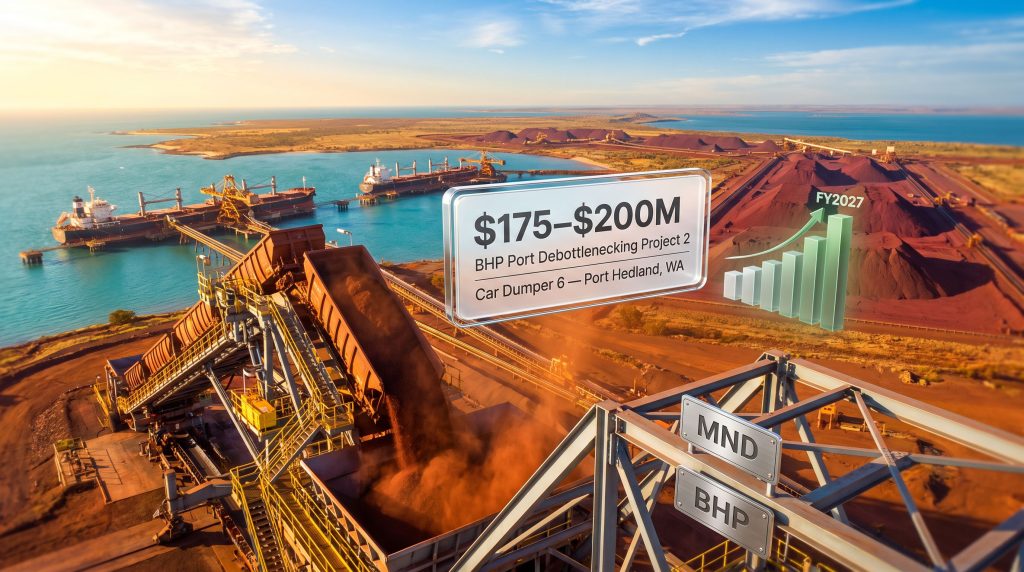
Monadelphous Group Ltd (ASX: MND) has secured a construction contract valued at approximately $175 to $200 million with BHP Group Ltd (ASX: BHP) for work at the Nelson Point Port Facility and Finucane Island in Port Hedland, Western Australia. The project forms part of BHP's Port Debottlenecking Project 2, commonly referred to as PDP2.
The scope of work centres on the construction of Car Dumper 6, a large-scale mechanical system used to invert loaded iron ore rail wagons and discharge their contents into receiving hoppers that feed ship-loading conveyor systems. This is not a simple civil or maintenance task. The construction involves the full suite of multidisciplinary engineering disciplines:
- Civil and structural works: Foundations, structural steel fabrication, and concrete placement for the dumper facility
- Mechanical installation: Assembly, alignment, and commissioning of the car dumper mechanism itself, along with associated materials handling systems
- Piping systems: Integration of process and utility piping across the facility
- Electrical and instrumentation (E&I): Power distribution networks, control and automation systems, and safety instrumentation loops
- Commissioning: Full functional testing, load trials, and operational handover to BHP's port operations team
Work has commenced immediately and is scheduled to run through to 2028, giving the project a construction horizon of approximately two to three years.
Why Port Hedland Matters at a Global Scale
Port Hedland is not merely Australia's largest bulk export terminal. It is, by annual tonnage, the single largest bulk commodity export port anywhere in the world. The facility handles the overwhelming majority of Australia's iron ore exports, primarily destined for steel mills across China, Japan, South Korea, and increasingly, India and Southeast Asia.
BHP's investment in debottlenecking works at this location reflects a nuanced but important strategic reality: as individual mine productivity improves and haulage systems become more efficient, the limiting constraint on total export volume often shifts to port-side infrastructure rather than mine-side production. Car dumpers, in particular, represent a critical throughput chokepoint. Each dumper unit can process a fixed number of wagon cycles per hour, and any mechanical downtime directly constrains the volume of ore that can be loaded onto vessels.
The construction of a sixth car dumper signals BHP's confidence that throughput demand will remain structurally elevated over the medium term, justifying significant capital commitment to iron export capacity expansion at the port-side handling level.
Understanding Car Dumpers: The Unsung Infrastructure of Iron Ore Exports
A Technical Deep Dive Into Materials Handling Infrastructure
Car dumpers are among the most mechanically demanding pieces of equipment in bulk materials handling. A single unit must rotate fully loaded rail wagons, each weighing in excess of 100 tonnes gross, at a controlled rate while simultaneously managing the flow of iron ore into hoppers below. The forces involved in this process place extraordinary demands on the structural integrity of the cradle, the drive systems, and the supporting civil infrastructure.
The precision required in car dumper construction extends beyond the mechanical assembly itself. The civil foundations must accommodate dynamic loading far exceeding static design loads, and the control systems must integrate seamlessly with the broader conveyor and ship-loading automation infrastructure across the port.
For an engineering contractor, car dumper construction represents one of the most technically complex and risk-intensive project types within the iron ore infrastructure universe. This complexity also explains why tier-one miners are reluctant to award such contracts to unfamiliar contractors, regardless of price. The consequences of a poorly constructed or poorly commissioned car dumper extend far beyond the immediate project, potentially disrupting entire vessel loading schedules and triggering contractual penalties under offtake agreements.
Monadelphous as a Business: Operational Profile and Competitive Positioning
Three Business Segments, One Integrated Capability Set
Monadelphous operates across three primary business segments, each contributing to a different part of the resources and infrastructure value chain:
| Segment | Core Delivery | Primary End Markets |
|---|---|---|
| Engineering Construction | Large capital project delivery | Iron ore, LNG, energy, minerals processing |
| Maintenance and Industrial Services | Sustaining capital, shutdowns, turnarounds | Mining, oil and gas, water utilities |
| Infrastructure | Civil and structural construction | Transport, utilities, social infrastructure |
This diversification across segments is strategically important. The maintenance and industrial services division, in particular, provides a counterbalance to the inherently lumpy revenue profile of large capital project wins. Maintenance contracts tend to be multi-year, cost-reimbursable arrangements that generate relatively stable earnings regardless of the project pipeline environment.
The Competitive Moat Built Through Incumbent Relationships
One of the least discussed but most commercially significant aspects of the ASX engineering contractor sector is the degree to which long-term client relationships function as a genuine competitive barrier. In the Pilbara iron ore corridor specifically, the combination of remote location, extreme operating conditions, and the concentrated ownership structure of major mines means that a small number of contractors hold disproportionately large market share.
For Monadelphous, its history of project delivery for BHP across multiple asset classes and construction types has created a form of institutional trust that is extremely difficult for new entrants to replicate. Furthermore, the company's familiarity with BHP's internal project management systems, safety management frameworks, and operational interfaces reduces execution risk for both parties. BHP picks Monadelphous for maintenance work consistently reflects this mutually reinforcing dynamic that tends to sustain long-term preferred supplier relationships.
In project-intensive industries, the value of knowing how a client operates, what they prioritise, and how they make decisions is often undervalued by outside observers but deeply appreciated by both parties to the relationship.
Revenue Recognition and Earnings Impact: What Investors Need to Understand
How Percentage-of-Completion Accounting Works in Practice
Engineering construction contracts of this type are typically accounted for under AASB 15 (Revenue from Contracts with Customers) using the percentage-of-completion method. This means that revenue is recognised progressively as project milestones are achieved and costs are incurred, rather than being recognised in a single period at contract completion.
For investors modelling the earnings contribution of the BHP PDP2 contract, this has a specific and important implication: the full $175 to $200 million in contract value will not appear in any single financial year's results. Instead, it will be spread across the project's duration, with the shape of recognition broadly reflecting the intensity of construction activity at each stage.
| Financial Year | Project Phase | Expected Revenue Contribution |
|---|---|---|
| FY2026 (partial) | Mobilisation, early civil works, procurement | Lower contribution, ramp-up phase |
| FY2027 | Peak construction activity, mechanical installation | Highest contribution window |
| FY2028 | Commissioning, testing, project close-out | Tapering contribution with final milestone payments |
Execution Risk Factors Investors Should Monitor
While a contract of this scale is unambiguously positive for Monadelphous' revenue pipeline, engineering construction projects of this complexity carry inherent execution risks that can affect margin outcomes. The most material risks for investors to track include:
- Labour availability and cost escalation in Western Australia's Pilbara region, where skilled trades workers remain in strong demand across multiple concurrent major projects
- Procurement lead times for specialised mechanical components, particularly the car dumper drive systems and cradle structures, which often require fabrication from a limited pool of international suppliers
- Shutdown coordination dependencies, given that some works may need to be performed during planned operational shutdowns of existing port infrastructure, requiring precise scheduling alignment with BHP's port operations calendar
- Scope change and variation management, which is a persistent feature of complex multidisciplinary projects and can affect both revenue recognition timing and contract profitability
- Subcontractor performance, as projects of this scale typically involve a network of specialised subcontractors whose performance directly affects the head contractor's delivery outcomes
MND Share Price: Understanding the 12-Month Re-Rating
A 50% Gain in Context
Monadelphous shares have delivered a gain in excess of 50% over the past 12 months, measured to August 2026. Over the same period, the S&P/ASX 200 Index (ASX: XJO) returned approximately 4.3%, meaning MND has outperformed the broader market by roughly 46 percentage points.
This degree of re-rating in a mid-cap industrial stock warrants careful examination. Share price performance of this magnitude is rarely driven by a single contract announcement. More typically, it reflects the market's progressive reassessment of a company's earnings trajectory as multiple positive signals accumulate over time. Consequently, the broader ASX market performance context is essential when evaluating whether MND's re-rating reflects company-specific fundamentals or sector-wide tailwinds.
For Monadelphous, the factors likely contributing to this re-rating include:
- A sustained improvement in resources sector capital expenditure intentions from major mining operators
- Contract pipeline momentum across multiple commodities and geographies
- Demonstrated ability to win and retain major client relationships in a competitive tender environment
- Broader investor rotation toward ASX industrial and engineering names as alternatives to technology and financial sector concentration
A 50% share price move in a well-established engineering contractor suggests the market has been pricing in a fundamental improvement in earnings visibility, not merely sentiment-driven speculation. The BHP PDP2 contract win reinforces and potentially extends that thesis.
The next major ASX story will hit our subscribers first
BHP's Capital Allocation Strategy: Reading the Signals
What a $200 Million Port Infrastructure Award Tells Us About BHP's Iron Ore Conviction
For BHP shareholders and iron ore market observers, the decision to advance the Port Debottlenecking Project 2 at this scale and timeline carries implicit signals about the company's medium-term demand expectations. Mining majors do not commit hundreds of millions of dollars to throughput expansion infrastructure unless internal planning assumptions support sustained export volume requirements over the asset's operational life.
The infrastructure investment cycle for iron ore port capacity typically operates on a five to fifteen year planning horizon, meaning BHP's commitment to Car Dumper 6 reflects demand expectations extending well into the 2030s. This stands in contrast to the more volatile short-term signals often embedded in spot price movements or quarterly production guidance. The dynamics of the China steel and iron ore market remain central to BHP's long-term planning assumptions across its Pilbara assets.
How BHP's Pilbara Infrastructure Activity Compares to Peers
| Mining Major | Recent Pilbara and Port Infrastructure Focus | Stated Strategic Rationale |
|---|---|---|
| BHP Group (ASX: BHP) | Port Debottlenecking Project 2, Car Dumper 6 | Throughput capacity expansion and export reliability |
| Rio Tinto (ASX: RIO) | Ongoing Pilbara port and rail upgrades | Autonomous systems integration and operational efficiency |
| Fortescue Ltd (ASX: FMG) | Iron ore infrastructure alongside energy transition projects | Volume growth and decarbonisation of operations |
The pattern across all three major Pilbara iron ore producers is consistent: sustained investment in port-side and rail infrastructure to protect and grow export throughput capacity. This creates a multi-year pipeline of engineering and construction opportunities that benefits the small group of contractors with the proven capability to deliver at this scale.
Investing in ASX Engineering Contractors: A Framework for Evaluation
Engineering Contractors as an Indirect Resources Sector Play
For investors seeking exposure to Australia's resources sector who are uncomfortable with the direct commodity price risk embedded in mining equities, ASX-listed engineering and construction companies offer a structurally different investment proposition. The key distinction is that contractors earn fees based on project activity and construction volume, not on the underlying price of the commodity being extracted or exported.
This creates a return profile that is:
- Leveraged to mining capex cycles rather than commodity spot prices, providing some insulation from short-term price volatility
- Partially defensive through maintenance revenues, which tend to be more stable across commodity cycles than capital project awards
- Exposed to execution risk rather than geological or commodity risk, requiring a different analytical framework than direct mining equities
Key Financial Metrics for Engineering Contractor Analysis
| Metric | What It Measures | Relevance to MND |
|---|---|---|
| Contract backlog and order book | Forward revenue visibility | Indicates earnings predictability over 12 to 36 months |
| EBITDA margin trajectory | Operational efficiency and contract mix quality | Reflects project execution capability and pricing power |
| Net cash position | Balance sheet strength and financial flexibility | Supports mobilisation costs and working capital on new project wins |
| Revenue per employee | Workforce productivity | Key efficiency indicator for a labour-intensive business model |
| Client concentration ratio | Revenue diversification risk | Measures dependency on any single mining operator |
| Dividend payout ratio and coverage | Capital return sustainability | Relevant to income-focused investors tracking yield consistency |
Sector-Specific Risks Every Investor Should Understand
- Capex cyclicality: Engineering contract awards are directly tied to mining sector investment cycles. During commodity downturns, major miners can suspend or defer capital projects rapidly, creating sharp revenue contractions for contractors
- Fixed-price contract exposure: Lump-sum contracts that are common in capital project delivery transfer cost escalation risk to the contractor. Labour cost overruns, material price increases, and productivity shortfalls can compress or eliminate margins on individual projects
- Client concentration: The Pilbara iron ore corridor is dominated by three major producers. Heavy reliance on this client group creates concentration risk that can amplify the impact of any single client's capex reduction decisions
- Skilled labour constraints: Western Australia's construction sector has operated in a persistent state of skilled labour scarcity, with direct implications for cost management and project scheduling on Pilbara-based projects
- Regulatory and safety compliance: WHS obligations in the Pilbara are among the most demanding in the Australian construction sector, adding compliance overhead and operational complexity. In addition, iron ore haulage operations across the region are subject to strict regulatory oversight that affects contractor scheduling and operational planning
Frequently Asked Questions: Monadelphous BHP Contract
What is the Monadelphous BHP contract for?
The contract covers the construction and commissioning of Car Dumper 6 and associated materials handling infrastructure at BHP's Nelson Point Port Facility and Finucane Island in Port Hedland, Western Australia. It is part of BHP's broader Port Debottlenecking Project 2 initiative, with work spanning civil, structural, mechanical, piping, electrical, and instrumentation disciplines through to 2028.
How much is the Monadelphous BHP contract worth?
The contract is valued at approximately $175 to $200 million, placing it firmly in the tier-one category for ASX mid-cap engineering contractors and representing a material addition to Monadelphous' forward revenue pipeline. Monadelphous adds $200m to workbook across its latest series of resource sector contract announcements, further reinforcing its position as a preferred tier-one contractor.
When Will the Contract Start Contributing to Earnings?
Revenue recognition under AASB 15 will be spread across the project duration from 2026 through to 2028, with the most significant earnings contribution anticipated during FY2027 when peak construction activity is underway.
Does This Contract Affect Monadelphous' Dividend Capacity?
The announcement did not include a direct update to earnings guidance or dividend policy. However, a materially stronger contract backlog generally supports the earnings visibility that underpins Monadelphous' historical dividend-paying track record. Investors should monitor future earnings guidance updates for any formal revision to distribution expectations.
What Does the Contract Signal for BHP Investors?
The award signals BHP's continued conviction in sustained iron ore export demand over the medium to long term, reflecting an internal planning view that justifies significant capital allocation to throughput capacity expansion at the world's largest bulk export terminal.
Key Takeaways for ASX Investors
The convergence of a tier-one client relationship, a technically complex project scope, and a multi-year revenue contribution window extending to FY2028 makes the BHP PDP2 award one of the more strategically significant contract announcements in Monadelphous' recent history. For investors evaluating the ASX engineering and construction sector, this contract reinforces the thesis that proven incumbent contractors in Australia's Pilbara iron ore infrastructure corridor are well-positioned to capture sustained mining capex investment.
Five key considerations for investors:
- Contract scale and classification: A $175 to $200 million single-project award is a genuine tier-one win for an ASX mid-cap engineering firm, providing meaningful revenue certainty through to 2028
- Relationship depth as a competitive advantage: Long-standing BHP engagement reflects preferred contractor status built through years of consistent project delivery, not simply price competition
- Earnings timing requires patience: Revenue will be recognised progressively across FY2026 to FY2028, with FY2027 representing the likely peak contribution year under percentage-of-completion accounting
- Engineering contractors offer differentiated sector exposure: The return profile is leveraged to mining capex cycles rather than commodity spot prices, providing a structurally distinct investment case compared to direct mining equities
- Share price momentum reflects improving fundamentals: A 50%-plus re-rating over 12 months against an ASX 200 return of approximately 4.3% over the same period suggests the market has been progressively pricing in a sustained improvement in contract pipeline quality and earnings visibility
This article contains general information only and does not constitute personal financial advice. Past share price performance is not indicative of future returns. Investors should consider their own financial circumstances and consult a licensed financial adviser before making investment decisions.
Want to Capture the Next Major ASX Mineral Discovery Before the Broader Market Does?
While engineering contractors like Monadelphous benefit from mining capex cycles, the most transformative investment returns in Australia's resources sector have historically come from significant mineral discoveries at the moment of announcement — and Discovery Alert's proprietary Discovery IQ model delivers real-time alerts on exactly these events, turning complex ASX announcement data across more than 30 commodities into a single, actionable insight. Explore historic discovery returns on Discovery Alert's dedicated discoveries page to understand the scale of opportunity, then begin a 14-day free trial to position yourself ahead of the market.