August 5, 2026
When Oil Prices Do the Heavy Lifting: Understanding Aramco's Earnings Architecture
Few financial metrics in the global energy sector carry the weight of a quarterly earnings result from the world's largest crude producer. When realised oil prices climb sharply, the earnings leverage available to an ultra-low-cost producer like Saudi Aramco becomes extraordinary. The Saudi Aramco Q2 profit jump on stronger oil prices illustrates precisely this dynamic: a combination of elevated crude realisations and disciplined OPEC+ supply management translated into a profit result that far outpaced what volume growth alone could have delivered.
Understanding why this happened, and what it signals about the broader oil market, requires looking well beyond the headline number. Furthermore, the result carries implications for OPEC's influence on oil markets and the broader geopolitical context in which state-controlled producers operate.
When big ASX news breaks, our subscribers know first
The Earnings Architecture Behind a 44% Profit Surge
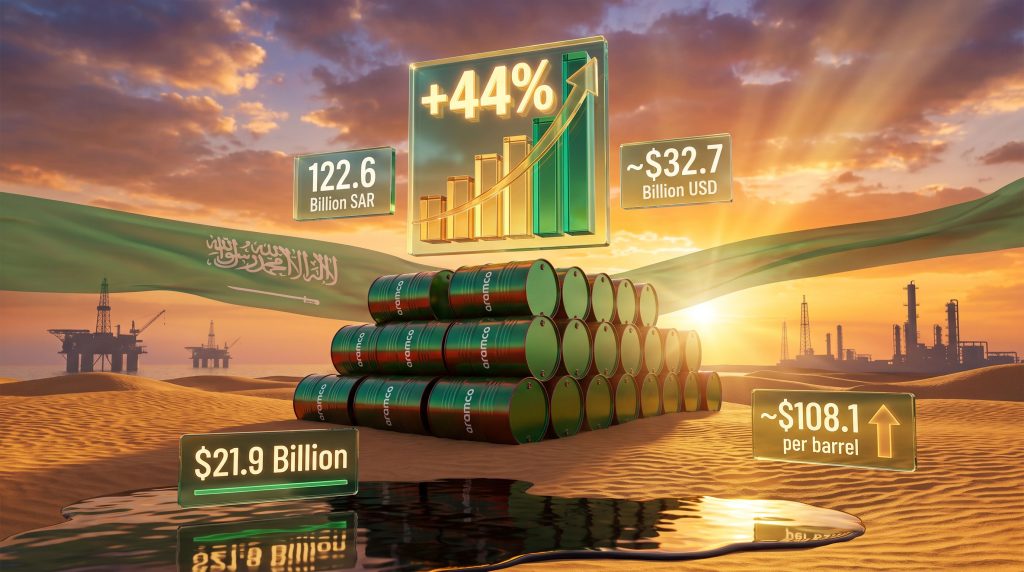
Saudi Aramco's Q2 2026 net income reached approximately 122.6 billion Saudi riyals, equivalent to roughly $32.7 billion USD, compared to an estimated 85 billion riyals in the same quarter of 2025. That represents a year-on-year increase of approximately 44% on a reported basis. On an adjusted net income basis, the figure came in at approximately $33.4 billion, reflecting closer to 33% year-on-year growth depending on which accounting methodology is applied.
The divergence between these two growth rates is worth pausing on. It reflects the treatment of one-off items, asset revaluations, and certain financial instruments that sit outside the core operational earnings picture. Neither figure is more accurate than the other in isolation; together they bracket the true earnings performance of the business during a period of strong price tailwinds.
Both the reported and adjusted net income growth rates confirm that Q2 2026 was a structurally strong earnings quarter, and critically, that strength originated from price appreciation rather than any meaningful expansion in production volumes.
What Drove the Profit Surge? Deconstructing the Revenue Mechanics
Crude Price Realisation as the Primary Earnings Engine
The central driver of the Saudi Aramco Q2 profit jump on stronger oil prices was the realised crude price environment during the quarter. Aramco's average realised crude price reached approximately $108.1 per barrel across Q2 2026, well above the range that prevailed in the corresponding period of 2025.
For context, current crude oil price trends placed Brent broadly within the $97 to $108 per barrel range across the quarter depending on the precise measurement window used. For a producer with upstream lifting costs estimated at below $3 to $4 per barrel, a sustained realised price in triple digits creates extraordinary margin leverage.
Every dollar of price appreciation above the breakeven point flows almost directly to the bottom line, compounding rapidly across millions of barrels of daily production. Critically, this profit surge occurred despite lower export and sales volumes compared to prior periods — a fact that deserves emphasis.
The OPEC+ Paradox: Less Volume, More Profit
This is one of the less intuitively understood dynamics of state-controlled energy economics. OPEC+ production discipline, which constrains Saudi Arabia's export volumes, simultaneously suppresses supply and elevates price. The net effect for a low-cost producer is that earnings increase even as output decreases, at least within a meaningful price range.
| Metric | Q2 2025 (Estimated) | Q2 2026 | Change |
|---|---|---|---|
| Reported Net Income (SAR bn) | ~85 billion | ~122.6 billion | +44% |
| Adjusted Net Income (USD bn) | ~$25.1 billion | ~$33.4 billion | +33% |
| Realised Crude Price (USD/bbl) | Lower range | ~$108.1 | Significant uplift |
| Export/Sales Volumes | Higher | Lower | Reduced |
| Quarterly Dividend | $21.9 billion | $21.9 billion | Maintained |
This asymmetric relationship between volume and profit is not unique to Aramco, but it is more pronounced there than at almost any other producer globally, given the company's unmatched cost structure. In addition, OPEC demand forecasts have continued to support the price environment that underpins these results.
Downstream Contributions and Refining Margins
Alongside crude price gains, higher realised prices across refined product outputs contributed to the overall earnings result. Aramco's integrated refining and chemicals capacity provides a degree of earnings insulation during periods of upstream volume restraint.
When crude prices rise, refined product margins typically expand in parallel, amplifying the upstream price signal rather than diluting it. This integration is a structural advantage that pure upstream producers cannot replicate.
Operating Costs and Sovereign Tax Headwinds
The earnings result was not without offsets. Rising operating expenditure partially reduced the impact of the price-driven revenue surge. More structurally significant is the Saudi government's fiscal architecture: as Aramco's profits rise, so too does the absolute quantum of royalties and income taxes flowing to the state.
For state-controlled energy producers operating under sovereign fiscal regimes, higher profits simultaneously trigger higher government revenue extractions. The investor-facing net income figure is the residual after the state has taken its share, not the total commercial gain.
The Dividend Signal: What $21.9 Billion Per Quarter Tells Investors
Fiscal Confidence or Fiscal Commitment?
Aramco maintained its quarterly dividend at $21.9 billion, consistent with prior quarters. On the surface, this signals management confidence in sustained earnings capacity. At a deeper level, it reflects the Saudi government's position as the dominant shareholder and the kingdom's reliance on dividend flows to fund Vision 2030 initiatives.
The distinction matters for investors. A commercially motivated dividend reflects earnings confidence and capital allocation discipline. A dividend that is at least partially anchored to sovereign fiscal requirements introduces a different kind of stickiness — it may be slower to reduce in a downturn, but it also may not increase as generously in an upswing.
Breakeven Oil Prices and Dividend Sustainability
Saudi Arabia's fiscal breakeven oil price has been estimated by the IMF at approximately $70 to $80 per barrel in recent years. With realised prices near $108 per barrel during Q2 2026, the kingdom was operating with a substantial fiscal surplus, creating ample room to sustain the dividend commitment while simultaneously funding non-oil sector expansion.
| Brent Price Scenario | Fiscal Position | Dividend Risk |
|---|---|---|
| Below $70/bbl | Deficit territory | High stress |
| $70 to $85/bbl | Near breakeven | Moderate pressure |
| $85 to $100/bbl | Comfortable surplus | Low risk |
| Above $100/bbl (Q2 2026 scenario) | Strong surplus | Fully sustainable |
Historical Benchmarking: Where Does Q2 2026 Sit in the Earnings Cycle?
The Q2 2026 result is strong, but context is essential. Aramco's peak earnings period came in 2022, when Brent crude exceeded $120 per barrel following the supply shock triggered by Russia's invasion of Ukraine. Q2 2026 represents a meaningful recovery from the lower-price environment of 2023 and parts of 2024, but it has not yet surpassed those record levels.
This places Q2 2026 within what analysts might characterise as a mid-cycle recovery phase, supported by sustained OPEC+ discipline and resilient Asian demand rather than the acute geopolitical supply shock that defined 2022's extraordinary earnings environment.
One structural nuance worth noting: the relationship between oil price and net income at Aramco is not linear. Above certain price thresholds, the government's share of incremental revenue rises, partially capping the earnings uplift available to shareholders. This distinguishes Aramco materially from Western integrated majors operating under straightforward corporate tax regimes.
Is the Earnings Recovery Structurally Durable or Cyclically Fragile?
The Bull Case: Structural Supports for Sustained Earnings Strength
Several factors support the view that Q2 2026's strong earnings environment may persist:
- Global upstream capital investment has remained below replacement levels since 2020, creating a structural supply deficit that provides a floor for crude prices even without active OPEC+ management
- Aramco's lifting cost advantage, estimated below $3 to $4 per barrel, means the company remains highly profitable across a wide range of oil price scenarios
- Chinese and Indian crude demand has demonstrated remarkable resilience, with both nations expanding refinery capacity and crude import volumes
- Geopolitical risk premiums embedded in oil prices have not structurally compressed in a market characterised by persistent Middle East tensions and fragile Russian supply pathways
The Bear Case: Risks That Could Erode Earnings Momentum
Counterbalancing the bull case are several credible downside scenarios:
- OPEC+ cohesion risk is real and historically recurring; if key members prioritise market share over price discipline, coordinated production cuts could unravel rapidly
- A synchronised global economic slowdown could meaningfully reduce crude demand and push Brent back toward the $70 to $80 per barrel range
- The trade war impact on oil markets remains a live concern, with tariff escalation capable of suppressing global trade volumes and energy demand simultaneously
- Long-term energy transition risks create an increasingly credible ceiling on future oil demand growth trajectories, even if near-term impacts remain modest
| Risk Factor | Probability (Near-Term) | Earnings Impact |
|---|---|---|
| OPEC+ production increase | Moderate | Moderate negative |
| Global recession or demand shock | Low to Moderate | High negative |
| Brent sustained above $100/bbl | Moderate to High | High positive |
| US shale supply surge | Low to Moderate | Moderate negative |
| Energy transition acceleration | Low (near-term) | Low (near-term) |
The next major ASX story will hit our subscribers first
The GCC Ripple Effect: How Aramco's Profits Fund Regional Economic Transformation
Petrodollar Recycling and Non-Oil Sector Expansion
The economic significance of the Saudi Aramco Q2 profit jump on stronger oil prices extends well beyond the company's own balance sheet. Saudi Arabia's non-oil sector has demonstrated consistent expansion momentum in 2026, with PMI data confirming new order growth and business activity increases through mid-year.
Government capital expenditure on infrastructure, tourism, entertainment, and technology sectors flows directly from the fiscal surplus generated by oil prices above breakeven. Each dollar Aramco earns above the government's budget requirements creates incremental capacity for Vision 2030 programme acceleration.
The Vision 2030 Paradox: Using Oil Profits to Escape Oil Dependency
Perhaps the most intellectually striking aspect of Saudi Arabia's current economic strategy is its inherent structural tension. Vision 2030 aims to diversify the kingdom's economy away from hydrocarbon dependency, yet the capital required to fund that diversification is derived almost entirely from hydrocarbon revenues.
The stronger Aramco's earnings, the more rapidly the transformation can proceed, yet every barrel of oil revenue also entrenches the very dependency the programme seeks to reduce. Strong quarters like Q2 2026 effectively expand the transformation window available to Saudi economic planners.
Frequently Asked Questions: Saudi Aramco Q2 2026 Earnings
What was Saudi Aramco's net profit in Q2 2026?
Saudi Aramco reported net income of approximately 122.6 billion Saudi riyals (equivalent to roughly $32.7 billion USD) for the second quarter of 2026, representing a year-on-year increase of approximately 44% compared to Q2 2025. On an adjusted basis, net income reached approximately $33.4 billion, reflecting around 33% year-on-year growth.
Why did Saudi Aramco's profits increase so sharply?
The primary driver was a significant uplift in realised crude oil and refined product prices, with Aramco's average realised crude price reaching approximately $108.1 per barrel during the quarter. This price appreciation more than offset headwinds from lower export volumes, higher operating costs, and increased tax and royalty obligations to the Saudi government.
Did Aramco's dividend change in Q2 2026?
No. Aramco maintained its quarterly dividend at $21.9 billion, consistent with prior quarters. This reflects both commercial earnings capacity and the Saudi government's ongoing fiscal requirements as the majority shareholder.
How does this result compare to Aramco's historical earnings?
Q2 2026 represents a strong mid-cycle recovery, but remains below Aramco's peak earnings periods of 2022 when Brent crude exceeded $120 per barrel following the post-Ukraine supply shock. The current result reflects sustained price strength rather than the acute crisis premium that defined 2022's extraordinary earnings environment.
What are the key risks to future earnings?
The principal near-term risks include a breakdown in OPEC+ production discipline, a synchronised global economic slowdown reducing crude demand, a sustained decline in Brent toward the $70 to $80 per barrel range, and longer-term structural demand erosion driven by the global energy transition.
Key Takeaways: What the Q2 2026 Result Reveals About Oil Market Fundamentals
- Price, not volume, was the dominant earnings lever in Q2 2026, confirming that OPEC+ supply management is functioning as intended and translating effectively into earnings uplift for member producers
- A 44% reported net income increase demonstrates the extraordinary earnings leverage available to ultra-low-cost producers when realised crude prices sustain above the $100 per barrel threshold
- Dividend maintenance at $21.9 billion reflects Saudi Arabia's fiscal confidence at current price levels and its continued reliance on Aramco as the primary engine of sovereign spending capacity
- The sovereign tax architecture creates a structural earnings ceiling that investors should understand: rising profits trigger rising government extractions, meaning the investor-facing net income is always the post-state residual
- Q2 2026 is a macro signal, not just a corporate one, reflecting the current equilibrium between OPEC+ discipline, Asian demand resilience, global upstream underinvestment, and an energy transition that has yet to meaningfully erode near-term crude demand
Readers seeking additional context on Saudi Aramco's financial reporting and broader GCC energy market dynamics can explore related coverage published by Zawya, which provides ongoing regional financial news and analysis.
Disclaimer: This article is intended for informational purposes only and does not constitute financial, investment, or legal advice. All financial figures, projections, and scenario analyses involve uncertainty and should not be relied upon as a basis for investment decisions. Readers should conduct independent research and consult qualified advisers before making any investment decisions. Past performance of commodity prices and corporate earnings does not guarantee future results.
Want to Identify the Next Major Commodity Discovery Before the Market Does?
While oil price dynamics drive earnings for the world's largest producers, significant wealth is also created at the exploration stage — and Discovery Alert's proprietary Discovery IQ model delivers real-time alerts on significant ASX mineral discoveries the moment they are announced, turning complex resource data into actionable investment insights. Explore historic examples of exceptional discovery returns and begin your 14-day free trial today to position yourself ahead of the broader market.