
June 10, 2026
The Economics of Dormancy: Why Low-Grade Gold Deposits Come Back to Life
In the global gold mining industry, deposit quality is rarely a fixed concept. A resource that sits economically inert for decades can transform into a compelling investment case almost overnight when the right combination of commodity prices and processing technology converges. This dynamic is precisely what underpins the broader wave of mine reactivations currently sweeping across northern Australia, and nowhere is this pattern more visible than at the Mount Todd gold mine restart unfolding near Katherine in the Northern Territory.
Understanding why Mount Todd sat idle for nearly 30 years, and why the calculus has now shifted so dramatically, requires looking beyond the headline gold price and into the specific technical and geological characteristics that made this deposit uniquely challenging, and uniquely rewarding, to develop.
When big ASX news breaks, our subscribers know first
Why Low-Grade, Hard-Rock Deposits Behave Differently to Other Gold Assets
Most gold investors are familiar with the concept of grade as a measure of deposit quality. Higher grades generally mean lower processing costs per ounce recovered, making mines more resilient across commodity price cycles. Mount Todd operates at the opposite end of this spectrum, with an average feed grade of just over one gram of gold per tonne of ore processed.
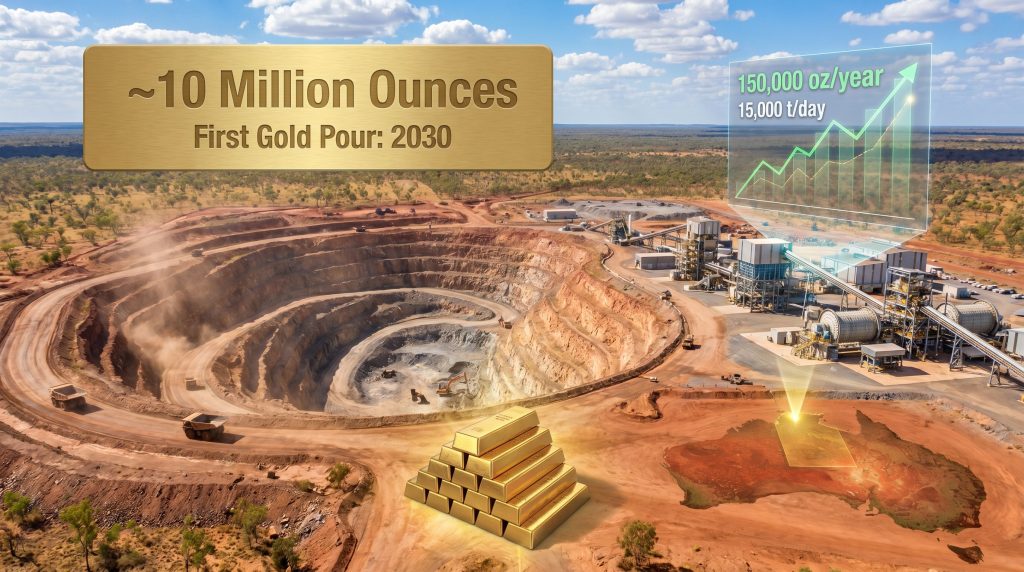
At that grade, profitability is not driven by richness but by throughput volume. To generate commercially meaningful output, the operation must move and process enormous quantities of rock continuously. This is what makes Mount Todd's planned processing rate of 15,000 tonnes per day so critical to its investment case, and why the deposit's estimated 10 million ounce reserve base is the number that matters most to project viability.
What Makes Mount Todd's Ore Body Particularly Difficult to Process
Beyond grade, Mount Todd presents a comminution challenge that defeated its previous operators. The host rock is exceptionally hard, meaning it resists grinding and consumes disproportionate energy in the milling circuit. In mining engineering, this characteristic is measured using the Bond Work Index and related hardness parameters, and high values translate directly into larger grinding machinery, greater power consumption, and higher per-tonne processing costs.
Three decades of improvement in large-format grinding technology, including advances in semi-autogenous grinding (SAG) mills and high-pressure grinding rolls (HPGR), have materially reduced the energy intensity of processing hard-rock ores. This technological evolution, combined with record gold prices that have sustained a bull run since 2020, forms the commercial foundation of Vista Gold's revised feasibility case.
The convergence of higher gold prices and improved grinding efficiency is not unique to Mount Todd. It explains a broader global pattern in which hard-rock, low-grade deposits that were technically unworkable in the 1990s are now being reassessed as genuine development candidates.
What the Revised Feasibility Plan Actually Involves
Vista Gold's current development blueprint represents a complete project redevelopment rather than a simple recommissioning of legacy infrastructure. The scale of the undertaking is substantial across every dimension.
| Parameter | Detail |
|---|---|
| Processing throughput | 15,000 tonnes per day |
| Target annual gold output | ~150,000 ounces |
| Planned mine life | 30 years |
| Average feed grade | ~1 gram per tonne |
| Construction workforce | ~450 workers |
| Ongoing operational workforce | 320 to 400 workers |
| Care and maintenance since | 2006 |
| On-site power requirement | Roughly equivalent to half of Darwin's current consumption |
One figure in this table deserves particular attention: the power requirement. The planned on-site gas-fired power station will need to generate energy roughly equivalent to half the current electricity consumption of Darwin. This single data point illustrates the industrial scale of energy demand involved in grinding hard, low-grade ore at 15,000 tonnes per day, and it is a cost line that will remain highly sensitive to gas price movements throughout the mine's projected 30-year life.
The Critical Path to First Gold in 2030
The Mount Todd gold mine restart timeline is well-defined but contingent on several sequential milestones being met. Delays at any stage would push the 2030 first gold pour target further into the future.
- Permit modification approvals secured from Northern Territory and federal regulators.
- Final Investment Decision (FID) formalised, currently targeted for early 2027.
- Detailed engineering and design phase commencing immediately post-FID.
- Construction and commissioning across an estimated 27-month window following FID.
- First gold pour targeted for 2030, representing the earliest realistic production date under the current schedule.
Vista Gold's site manager has publicly described the project as being on the verge of that final decision, with regulatory approval the single remaining gate before construction planning can formally begin. The company has also been assembling an Australia-based project execution team and conducting additional metallurgical drilling to refine processing parameters ahead of the engineering phase. Furthermore, the definitive feasibility study work completed to date underpins much of this critical path planning.
The Social Licence Challenge: FIFO vs. Local Employment
The technical and financial dimensions of the Mount Todd gold mine restart are complex, but it is arguably the social and community dimensions that will most directly test Vista Gold's capacity to execute. The project sits on Aboriginal freehold land within Jawoyn country, and the expectations of Traditional Owners carry both legal weight and moral significance.
Vista Gold and the Jawoyn Association have negotiated agreements covering royalty entitlements and preferential employment access for local Aboriginal people. The Jawoyn Association's position, articulated through its deputy chair Robert Friel, is that local Aboriginal people should receive priority consideration for available positions at the mine. Friel has a personal history with the site extending back to the 1990s and has spoken publicly about the importance of employment pathways that allow people to build skills and advance over time.
The tension between a predominantly FIFO workforce model and genuine local employment outcomes is one of the most consequential social licence questions Vista Gold must navigate before and during the construction phase.
Vista's own technical documentation indicates that approximately 90% of the initial workforce will operate on a fly-in, fly-out basis, housed in a planned 250-bed permanent accommodation camp near the mine. While the company has expressed an intention to grow the local workforce over the life of the operation, no binding employment quotas have been publicly disclosed.
Katherine's Housing Shortage as a Structural Constraint
Vista Gold has acknowledged that expanding the locally-based workforce proportion is directly constrained by Katherine's existing housing shortage. The company has indicated it is in active discussions with the Northern Territory Government on this issue and has committed to being part of addressing the housing deficit before scaling up operations rather than intensifying existing pressures.
This is a meaningful commitment, but it is not yet a funded program. Whether Vista's housing-related engagement translates into measurable outcomes before FID will be closely watched by community stakeholders and regional advocates.
Sacred Site Compliance and Cultural Heritage Risks
In 2025, Vista Gold entered a guilty plea in relation to damage caused to a sacred site during exploratory drilling activities at the project. This incident has elevated regulatory and community scrutiny of the company's cultural heritage management systems and reinforced the importance of robust site protection protocols throughout the upcoming engineering and construction phases.
Community voices at a recent site open day reflected a dual expectation that is common across resource projects on Aboriginal land: a genuine desire to see the mine succeed commercially, paired with an equally genuine insistence that customary law and culturally significant sites be respected and protected throughout operations.
Environmental Legacy and the Contaminated Water Challenge
Mount Todd's care-and-maintenance period since 2006 has not been environmentally clean. Multiple instances of contaminated water discharge have occurred, stemming from unremediated waste rock stockpiles left exposed when the mine originally closed in 2000. In early 2026, an unplanned but reportedly controlled release of polluted water into Horseshoe Creek was reported to the Northern Territory environment regulator during an unusually heavy wet season.
Vista Gold's position is that the contamination risk is fundamentally a legacy problem caused by exposed waste rock that was never rehabilitated by previous operators, and that full recommissioning will enable systematic encapsulation of that material in non-reactive compounds, effectively eliminating the source of ongoing leachate generation.
Whether independent environmental assessment of these commitments will satisfy regulators and community stakeholders is a question that the pending permit modification process will need to answer definitively.
How Mount Todd Compares Within the Northern Territory Gold Landscape
Contextualising Mount Todd's reserve scale against other NT gold operations clarifies both its significance and its limitations.
| Project | Location | Reserve Scale | Current Status |
|---|---|---|---|
| Mount Todd | Near Katherine | ~10 million oz | Pre-FID, redevelopment phase |
| Newmont Tanami | Central Australia | Major tier-one operation | Active underground production |
| Tennant Creek operations | Tennant Creek region | Various smaller deposits | Expanding |
Mount Todd's reserve base is genuinely significant. At an estimated 10 million ounces, it is broadly comparable in scale to the Newmont Tanami underground operation, which is one of Australia's premier producing gold assets. However, reserve scale and grade are different metrics, and Mount Todd's approximately one gram per tonne feed grade means its unit economics are considerably more sensitive to gold price movements than higher-grade operations would be.
A sustained gold price correction would meaningfully compress margins at Mount Todd in ways that would have less impact on higher-grade operations. In addition, understanding cut-off grade economics is essential for appreciating why this low-grade model carries heightened sensitivity to commodity price swings. This is the fundamental risk embedded in any low-grade, high-volume production model, and it is a factor that financiers, project insurers, and long-term offtake partners will scrutinise carefully during the FID financing phase.
Furthermore, current gold price forecasts and broader gold exploration trends across the Northern Territory suggest the macro environment remains broadly supportive of large-scale project development, though commodity price uncertainty is an ever-present consideration.
The next major ASX story will hit our subscribers first
Frequently Asked Questions About the Mount Todd Gold Mine Restart
When will Mount Todd start producing gold?
The first gold pour is targeted for 2030, subject to regulatory approvals being secured and a Final Investment Decision being made in early 2027.
Who operates the Mount Todd gold mine?
The project is operated by Vista Gold, a Canadian mining company that has maintained the asset in care and maintenance since 2006.
How large is the Mount Todd gold deposit?
The deposit contains an estimated 10 million ounces of gold, positioning it as one of the largest known gold reserves in the Northern Territory.
What is the gold grade at Mount Todd?
The average feed grade is approximately one gram of gold per tonne of ore, classifying it as a low-grade, high-volume deposit.
How many jobs will the mine create?
The construction phase is expected to require approximately 450 workers. Ongoing operations across the mine's planned 30-year life are projected to employ between 320 and 400 people.
What agreements exist with Traditional Owners?
Vista Gold and the Jawoyn Association have negotiated royalty arrangements and preferential employment access for local Aboriginal people, though specific binding employment targets have not been publicly disclosed.
Key Project Metrics at a Glance
- Reserve size: ~10 million ounces, one of the NT's largest known gold deposits
- Average grade: ~1 gram per tonne (low grade, high volume model)
- Processing rate: 15,000 tonnes per day under the revised feasibility plan
- Annual production target: ~150,000 ounces of gold
- Planned mine life: 30 years
- Construction workforce: ~450 workers
- Operational workforce: 320 to 400 workers
- Initial FIFO proportion: ~90% of workforce
- On-site accommodation: 250-bed permanent camp planned
- FID target: Early 2027
- First gold pour target: 2030
- Operator: Vista Gold (Canada)
- Land tenure: Aboriginal freehold land, Jawoyn country
Disclaimer: This article contains forward-looking statements regarding project timelines, production targets, and workforce projections. These are based on information publicly available at the time of writing and are subject to change pending regulatory approvals, financing outcomes, and commodity price movements. This article does not constitute financial advice. Readers should conduct their own independent research before making any investment decisions.
Want to Catch the Next Major Gold Discovery Before the Market Does?
Discovery Alert's proprietary Discovery IQ model scans ASX announcements in real time, instantly identifying significant mineral discoveries — including large-scale gold projects — and delivering actionable alerts to subscribers ahead of the broader market. Explore historic examples of major discoveries and their returns to understand the opportunity, then begin your 14-day free trial to position yourself at the forefront of the next significant find.