June 29, 2026
Africa's Critical Mineral Moment: Why Sovereign Resource Control Is Reshaping Investment Risk
For most of the twentieth century, the dominant model of mineral extraction in developing economies followed a straightforward logic: foreign capital and technical expertise would enter, extract, and export, while host governments collected royalties and taxes from the sidelines. That model is now undergoing its most significant structural revision in decades. Across Africa, governments with large endowments of battery-critical minerals are systematically redesigning their regulatory frameworks to capture a far greater share of the wealth generated beneath their soil. Mozambique's Mozambique 15% state stake mining law, signed by President Daniel Chapo in June 2026, represents one of the most consequential expressions of this shift to date.
Understanding what this legislation actually does, how it compares to the regulatory landscape it replaces, and what it means for the economics of mining investment requires moving beyond the headlines. The real story is not simply about a percentage. It is about a sovereign state using a carefully structured legal instrument to permanently reposition itself within the value chains of minerals that the world increasingly cannot do without.
When big ASX news breaks, our subscribers know first
Mozambique's Mineral Endowment and Its Global Strategic Weight
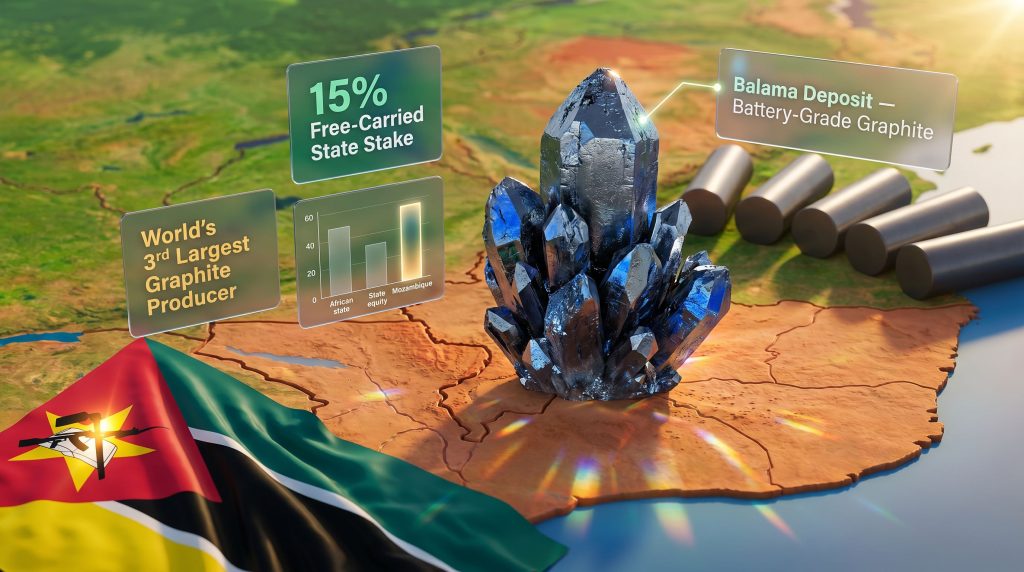
Mozambique is not a marginal player in the global critical minerals demand conversation. The country ranks among the world's top three graphite producers, sitting behind only China and Madagascar in annual output. Its Balama deposit, operated by Syrah Resources, is widely regarded as one of the largest known graphite reserves on the planet, with an orebody that has demonstrated the capacity to supply a significant share of global battery anode material demand as EV penetration accelerates.
Beyond graphite, Mozambique's mineral inventory includes:
- Thermal and coking coal concentrated in Tete Province, historically among the largest untapped coal basins in the southern hemisphere
- Rubies and coloured gemstones centred on the Montepuez deposit in Cabo Delgado Province, operated by Gemfields, which is considered one of the world's most productive ruby mining operations
- Heavy mineral sands along the northern coastline containing ilmenite, rutile, and zircon
- Emerging lithium and rare earth potential in the central belt, which remains underexplored relative to known geology
What elevates graphite above these other commodities for policy purposes is its centrality to lithium-ion battery chemistry. The anode of virtually every EV battery produced today contains graphite, and the volumes required per vehicle are substantial. Each electric vehicle requires roughly 10 to 15 times more graphite by weight than lithium in its battery pack. As global EV production scales toward tens of millions of units annually, the pressure on graphite supply chains outside of China has intensified dramatically.
Mozambique's graphite is not simply a commodity. It is a material that sits at the intersection of energy transition geopolitics, Chinese supply chain dominance, and Western industrial policy. The regulatory environment Mozambique creates now will shape its position in that intersection for a generation.
How the 15% Free-Carried State Stake Actually Operates
The core mechanism of the new legislation is the mandatory allocation of a minimum 15% equity stake to the state in all mining projects, channelled through the Empresa Nacional de Mineração (ENM), Mozambique's national mining company. Two legal characteristics define this stake in ways that carry significant implications for project economics.
First, the stake is free-carried, meaning ENM receives its ownership position without contributing capital to project construction, development, or operational costs. The burden of financing falls entirely on the private investor. Second, the stake is non-dilutable, meaning that subsequent capital raises, project expansions, or equity restructuring events cannot reduce the state's ownership below 15%.
The practical consequences for project economics flow through each stage of a mining project's lifecycle:
- Feasibility and financing: Project developers must build a non-contributing equity partner into all financial models from the outset, meaning the effective capital burden on the private equity base is 100% of costs for 85% of the economic returns
- Debt financing complexity: Commercial lenders and multilateral development finance institutions may treat the mandatory free-carried stake as an additional risk layer, potentially affecting loan terms, covenants, and coverage ratios
- Offtake and marketing: ENM's equity position may create governance requirements around how minerals are sold, to whom, and under what pricing arrangements
- Dividend distribution: All project cash flow distributions must permanently accommodate ENM as a co-owner, reducing the distributable pool available to private investors on an ongoing basis
| Parameter | Investor Implication |
|---|---|
| Free-carried equity | State receives ownership without contributing upfront capital |
| Non-dilutable structure | State's 15% cannot be reduced through future capital raises |
| Value chain coverage | Applies across exploration, extraction, and processing stages |
| Revenue share baseline | Separate from the 10% community development revenue requirement |
| Retroactive application | Unresolved for projects under existing stability agreements |
What Changed: The Old Framework Versus the New Legislation
The significance of the reform is best understood by examining what existed before. Mozambique's previous mining framework already enshrined the constitutional principle that the state holds sovereign ownership over mineral resources. However, the operative language governing equity participation was explicitly aspirational rather than prescriptive. The prior law directed the government to progressively intensify its participation in the mining sector, a standard that was discretionary, project-specific, and entirely dependent on negotiation.
In practical terms, this meant that state equity outcomes varied widely depending on the bargaining dynamics of individual project negotiations, the political environment at the time of licensing, and the leverage available to both parties. There was no floor, no standardised mechanism, and no institutional vehicle with a defined mandate to hold and manage state equity across all projects.
The new legislation fundamentally transforms that architecture:
| Policy Dimension | Previous Framework | New Legislation |
|---|---|---|
| State equity requirement | Discretionary / progressive | Minimum 15% (mandatory) |
| Equity structure | Negotiable per project | Free-carried, non-dilutable |
| Mineral export rules | Broadly permitted | Restricted without special authorisation |
| Local processing obligation | Encouraged | Required unless exempted |
| Community revenue allocation | Not codified at 10% | 10% of revenues mandated |
| Artisanal mining zones | Not formalised | Introduced under new framework |
| State equity vehicle | No designated institution | ENM as mandatory vehicle |
The conversion from a discretionary aspiration to a binding minimum with a specific percentage threshold is the structural heart of this reform. It removes negotiating ambiguity, standardises the entry cost for all incoming projects, and creates an institutional stakeholder with a permanent seat at the table of every mining operation in the country.
The Export Restriction Clause and the Industrial Upgrading Imperative
Alongside the equity mandate, the legislation introduces a prohibition on exporting unprocessed and semi-processed minerals without obtaining special government authorisation. This provision is analytically distinct from the equity requirement but closely related in its underlying logic: both are designed to capture more economic value within Mozambique rather than allowing it to flow offshore in the form of raw material exports.
The export restriction mirrors strategies implemented by a number of other resource-rich nations in recent years. Indonesia effectively banned raw nickel ore exports in 2020, forcing the development of domestic smelting capacity and fundamentally repositioning the country's role in global nickel supply chains. Zimbabwe introduced a raw lithium export ban in 2022. Furthermore, DRC cobalt export restrictions have similarly pursued local processing incentives across cobalt and copper industries.
The minerals most immediately exposed to Mozambique's export restriction are:
- Graphite at Balama: Currently produced primarily for direct export as flake graphite concentrate; local processing into spherical graphite or battery-grade material would require significant additional capital investment and technical infrastructure that does not currently exist at scale in Mozambique
- Tete Province coal: Bulk thermal and coking coal exports have historically dominated the logistics economics of this basin; processing requirements could affect the cost structure and competitive positioning of Mozambican coal in export markets
- Montepuez rubies: The export of uncut gemstones would now require authorisation, potentially incentivising local cutting, polishing, and value-addition activities
- Future exploration discoveries: Any new projects entering production would do so under the processing-first requirement from inception, eliminating the transitional pathways available to legacy operations
Implementation Risk: The policy's ambition is clear, but Mozambique currently lacks the processing infrastructure to absorb significant volumes of unprocessed minerals domestically. Without substantial capital investment in that infrastructure, the export restriction risks deterring new project development rather than catalysing industrial upgrading. This is the central execution challenge facing the legislation.
Graphite, Battery Anodes, and Why Mozambique's Geology Matters to EV Investors
A dimension of this policy debate that rarely receives sufficient attention is the specific technical role that graphite plays in battery technology, and why the quality of Mozambican graphite reserves makes this a genuinely consequential supply chain story.
Natural graphite used in battery anodes undergoes a multi-stage processing journey before it reaches a battery cell. Raw flake graphite concentrate must be refined, micronised, spheroidised, and purified to achieve the battery-grade specifications required by cell manufacturers. The process is technically demanding, energy-intensive, and currently dominated almost entirely by Chinese processors. Mozambican graphite in its raw flake form is not yet battery-grade material; it is a critical upstream feedstock for a processing chain that China controls.
This creates an important nuance for investors: the value capture opportunity that Mozambique is targeting through its export restriction is real in principle, but it requires building out midstream processing capability that is neither cheap nor straightforward. The Balama deposit produces large-flake, high-purity graphite concentrate that is well-suited to battery applications once processed, but the gap between mine gate and battery cell involves significant technical and capital requirements.
For Western governments seeking to diversify graphite supply chains away from Chinese dominance, the ideal outcome is a Mozambique that can supply both raw concentrates and increasingly processed intermediate products. The new legislation creates the regulatory framework that could incentivise that industrial trajectory. Whether investment capital follows is a separate question.
The next major ASX story will hit our subscribers first
Mozambique Within Africa's Resource Nationalism Landscape
The Mozambique 15% state stake mining law does not exist in isolation. It is part of a documented continental pattern in which African governments are asserting progressively stronger sovereign claims over their mineral wealth. This trend is driven by the intersection of rising commodity valuations, growing domestic political pressure, and the leverage created by global demand for battery-critical materials.
| Country | Mineral Focus | State Equity Policy | Export Restriction |
|---|---|---|---|
| Mozambique | Graphite, coal, rubies | 15% minimum via ENM | Yes, unprocessed minerals |
| Zimbabwe | Lithium | Mandatory state participation | Raw lithium export ban |
| DRC | Cobalt, copper | State co-ownership via Gécamines | Local processing incentives |
| Zambia | Copper | ZCCM-IH equity stakes | Processing requirements evolving |
| Guinea | Iron ore | State equity in Simandou project | Value-addition frameworks |
| Namibia | Uranium, lithium | Progressive state participation model | Selective processing mandates |
What distinguishes the current wave of resource nationalism from earlier cycles in the 1970s and 1980s is the specific commodity context. The materials now subject to assertive sovereign governance are not simply bulk commodities with mature, diversified supply chains. Consequently, strategic mineral supply chains have become a central concern for both producing and consuming nations, as these are materials for which global demand is expected to grow by multiples over the coming decade.
African governments therefore possess leverage that their predecessors in earlier resource nationalism cycles did not. This is particularly evident given that critical minerals and energy security have become increasingly intertwined in the strategic calculations of Western industrial economies seeking to reduce dependence on single-source supply chains.
How the 10% Community Revenue Mandate Reshapes the Social Licence Framework
Separate from the equity and export provisions, the legislation mandates that 10% of mining revenues be directed to a local development fund for communities in project areas. This is not a royalty, and it is not a corporate social responsibility commitment. It is a statutory revenue allocation that operates as a distinct financial obligation alongside the state's equity stake.
The distinction matters for project economics. A royalty is typically calculated on production value and is accounted for as an operating cost, reducing taxable income. A mandatory community revenue allocation structured as a percentage of revenues operates differently within a project's financial model and sits outside the standard royalty framework.
For communities that have historically seen mining operations generate wealth flowing largely to distant shareholders and national treasuries, this provision represents a structural change in how local populations engage with resource extraction. The governance question of who administers these funds, what accountability mechanisms apply, and how distribution decisions are made will determine whether this mandate delivers tangible development outcomes or becomes another layer of bureaucratic complexity.
Investor Risk Assessment: Modelling the Economic Impact
For investors evaluating Mozambican mining projects under the new regulatory framework, the combined effect of mandatory equity participation, export restrictions, local processing requirements, and community revenue obligations creates a materially different financial environment compared to the previous decade.
Consider a simplified scenario in which a foreign mining company develops a new graphite project in Mozambique with a projected capital cost of $500 million and an expected internal rate of return of 18% under the previous regulatory framework. Under the new legislation:
- ENM receives a 15% free-carried, non-dilutable equity stake, meaning the developer finances the entire project while receiving only 85% of equity returns
- Local processing infrastructure requirements could add an estimated 15 to 25% to total capital costs
- The 10% community revenue allocation reduces distributable cash flow on an ongoing basis
- Potential export restriction authorisation requirements introduce regulatory delay and compliance costs
The revised IRR under these conditions could compress to an estimated range of 11 to 14%, depending on the specific project configuration. For projects with marginal economics or high capital intensity, this compression may push returns below institutional investment hurdle rates, effectively removing them from consideration for development under the new framework.
For mining projects in jurisdictions with mandatory state equity, investors must distinguish between projects where the resource quality and scale provide sufficient margin to absorb the regulatory cost, and projects where the economics were already tight. The former category remains investable. The latter faces structural headwinds that the new framework has made significantly more challenging to overcome.
The Unresolved Retroactivity Question
Perhaps the most significant near-term legal and commercial risk embedded in the new legislation is the question of retroactive application. A number of foreign mining operators in Mozambique hold long-term development and stability agreements with the government, negotiated under the previous regulatory framework. These agreements typically contain provisions designed to protect investors against adverse legislative changes during the agreement period.
Whether the 15% mandatory equity requirement applies to these existing agreements has not been definitively resolved in the legislation as currently enacted. The ambiguity creates a material legal risk for operating companies and a significant uncertainty for investors attempting to model the regulatory exposure of existing Mozambican mining assets. Resolution of this question through regulatory guidance, court interpretation, or direct government clarification will be one of the most closely watched legal developments in the sector over the coming months.
Three Scenarios for Mozambique's Mining Sector Trajectory
The long-term outcomes of this legislative reform are genuinely uncertain, and analysts monitoring the sector have broadly identified three divergent pathways:
Scenario 1: Successful Industrial Upgrading
Foreign investors adapt project structures to accommodate the new framework. International development finance institutions provide capital for local processing infrastructure. ENM develops institutional competence as a project co-owner. Mozambique progressively captures more downstream value per tonne of mineral extracted, and the policy achieves its stated industrial objectives.
Scenario 2: Investment Contraction
The combined regulatory burden of mandatory equity, export restrictions, processing requirements, and community revenue obligations pushes a significant number of projects below viable investment thresholds. New project pipelines slow, and existing operators seek renegotiation of stability agreements. Mozambique's share of new critical mineral project announcements decreases relative to competing jurisdictions.
Scenario 3: Selective Compliance and Regulatory Adaptation
Large, strategically significant projects with substantial sunk costs and strong resource quality adapt to the new framework and continue operating. Smaller and earlier-stage projects are restructured, delayed, or redirected to neighbouring jurisdictions. The new framework effectively bifurcates the investment landscape between projects that can absorb the regulatory cost and those that cannot.
Key Structural Pillars of the Reform: A Summary Framework
For investors, analysts, and policymakers seeking to quickly navigate the architecture of Mozambique's new mining law, the legislation rests on four structural pillars:
- Mandatory state equity: A minimum 15% free-carried, non-dilutable stake held by ENM in all mining projects across the value chain
- Export restrictions: Prohibition on unprocessed and semi-processed mineral exports without special government authorisation, designed to incentivise domestic value addition
- Local processing requirements: A requirement that minerals be processed within Mozambique unless an exemption is obtained, creating the regulatory foundation for downstream industrial development
- Community revenue mandate: A statutory allocation of 10% of mining revenues to local development funds benefiting project-area communities, separate from royalties and equity returns
However, these pillars must be read alongside the broader context of global supply chain competition. China's export restrictions on critical materials have demonstrated how sovereign resource control can reshape international trade flows and accelerate investment decisions in competing jurisdictions, a dynamic that will inevitably influence how the Mozambique 15% state stake mining law is received by global capital markets.
The effectiveness of this framework in achieving its stated objectives will ultimately depend not on the legislation's text but on the institutional capacity, political consistency, and infrastructure investment that accompany its implementation. Furthermore, analysts tracking the reform note that the next three to five years will be decisive in determining whether the policy delivers genuine industrial transformation or simply redirects investment capital toward more permissive jurisdictions.
This article contains forward-looking analysis and scenario modelling for informational purposes only. It does not constitute financial or investment advice. Investors should conduct independent due diligence and seek professional guidance before making investment decisions related to the Mozambican mining sector or any of the companies operating within it.
Want To Stay Ahead of Major Mineral Discoveries as Resource Nationalism Reshapes Global Supply Chains?
As sovereign resource control tightens across Africa and critical mineral supply chains face increasing disruption, identifying the next significant ASX discovery before the broader market has never been more valuable. Discovery Alert's proprietary Discovery IQ model delivers real-time alerts on significant ASX mineral discoveries — transforming complex geological and market data into actionable investment insights — while its dedicated discoveries page showcases the historic returns that major mineral discoveries have generated for early-positioned investors. Begin your 14-day free trial today and secure a market-leading edge.