July 21, 2026
The Hidden Architecture Behind Europe's Most Expensive Security Bet in Africa
When energy economists map the global LNG supply chain, Cabo Delgado rarely appears at the top of the list. Yet buried beneath the turquoise waters off Mozambique's northern coastline lies one of the most consequential concentrations of untapped natural gas discovered anywhere on earth in the past two decades. The decisions being made right now, in European council chambers and Lisbon state rooms, about a relatively modest military training mission will shape whether that gas ever reaches European terminals, and whether billions in stranded capital finally generate the sovereign revenues Mozambique has been waiting nearly a decade to receive.
The Mozambique EU military mission extension debate is not simply a bureaucratic renewal process. It sits at the intersection of European energy security strategy, African counterinsurgency doctrine, and the fragile calculus of investor confidence in frontier markets. Understanding what is at stake requires stepping back from the immediate diplomatic headlines and examining the structural forces that have made Cabo Delgado both one of the most valuable and one of the most dangerous energy frontiers on the continent.
When big ASX news breaks, our subscribers know first
Cabo Delgado's Gas Basin: Scale, Value, and What's Actually at Risk
The sheer scale of the hydrocarbon endowment in Cabo Delgado's offshore Rovuma Basin is frequently underestimated in Western financial media. The basin hosts discovered recoverable gas reserves measured in the tens of trillions of cubic feet, placing it among the top tier of global LNG-capable discoveries made since 2010. Three major projects have been structured around this resource base, each representing a different stage of development and a different risk profile.
| Project | Operator | Estimated Capital Exposure | Status as of Mid-2026 |
|---|---|---|---|
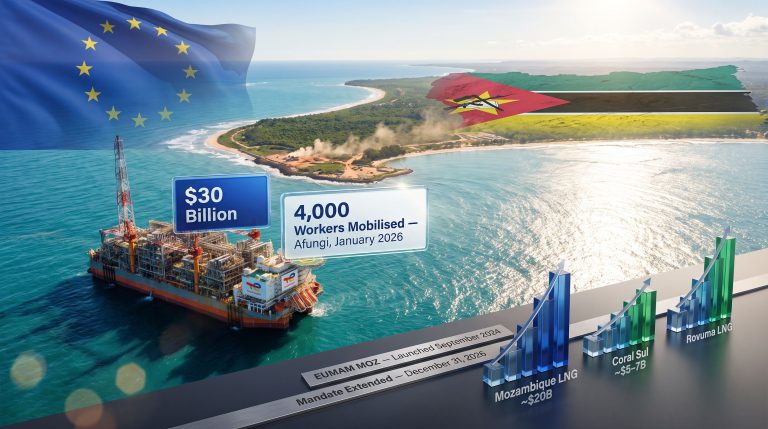
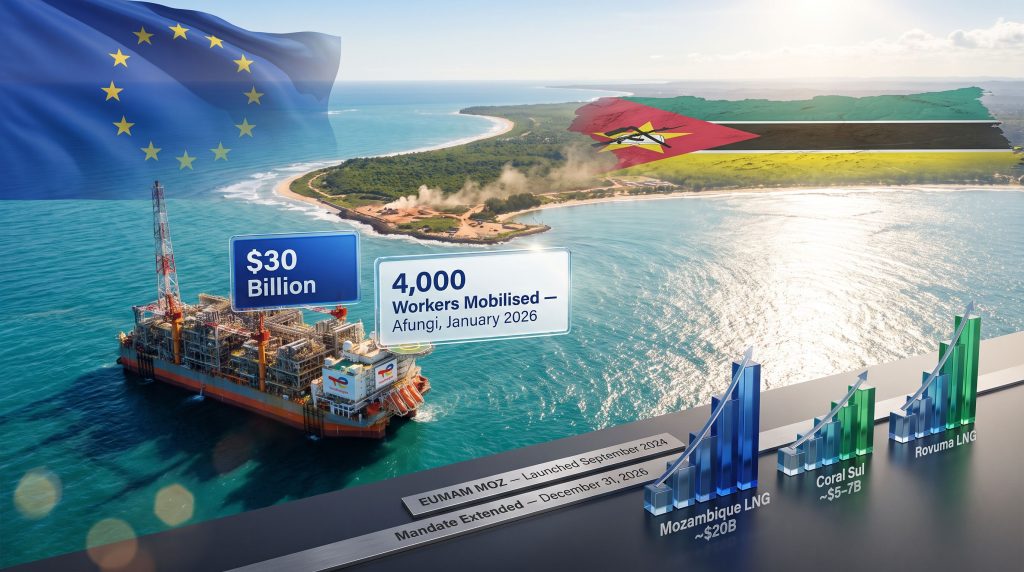
| Mozambique LNG (Afungi) | TotalEnergies | ~$20 billion | Construction resumed January 2026 |
| Coral Sul / Coral Norte | Eni | ~$5-7 billion combined | Coral Sul operational, Coral Norte under development |
| Rovuma LNG | ExxonMobil | Significant development-stage exposure | Pre-FID phase |
What is less commonly understood is how the three projects represent distinct risk layers. Coral Sul, operating as a floating LNG vessel moored offshore, carries a structurally lower onshore security exposure than the Afungi site. TotalEnergies' project, by contrast, requires sustained land-based construction activity in close geographic proximity to areas where insurgent activity has been recorded as recently as October 2025. ExxonMobil's Rovuma LNG project remains in a pre-final investment decision phase, meaning any deterioration in the security environment could defer a commitment worth tens of billions of dollars indefinitely.
Furthermore, the broader context of resource and energy exports from frontier markets illustrates how quickly investor sentiment can shift when security conditions change. The 2021 Palma attack demonstrated a principle that energy investors in fragile states ignore at enormous cost: a single security failure of sufficient severity can freeze capital, trigger force majeure clauses, and compress a decade of development progress into a suspension that lasts years. TotalEnergies' five-year pause is the most expensive proof of concept that principle has ever produced in sub-Saharan Africa.
What EUMAM MOZ Actually Does, and What It Cannot Do
The European Union Military Assistance Mission in Mozambique, launched in September 2024, operates under a classification that is frequently misunderstood in media coverage: it is a non-executive advisory mission. This distinction carries significant operational consequences that are worth unpacking carefully.
What the mission does:
- Trains and mentors Mozambique's Armed Forces (FADM) in counter-insurgency tactics and Quick Reaction Force doctrine
- Delivers structured training cycles designed to build institutional capacity rather than unit-level tactical proficiency alone
- Operates through a capacity-building model intended to produce self-sustaining FADM capability over time
- Provides Portugal, as lead nation, with a diplomatic platform to anchor EU-Mozambique security relations
What the mission cannot do:
- Conduct direct combat operations against insurgent networks
- Substitute for the site-specific protection currently provided by Rwandan troops at Afungi
- Accelerate FADM readiness faster than the institutional absorption rate of the forces being trained
- Resolve the political economy of conflict in Cabo Delgado, which has roots in marginalisation, illicit trade networks, and regional instability that predates the gas discoveries
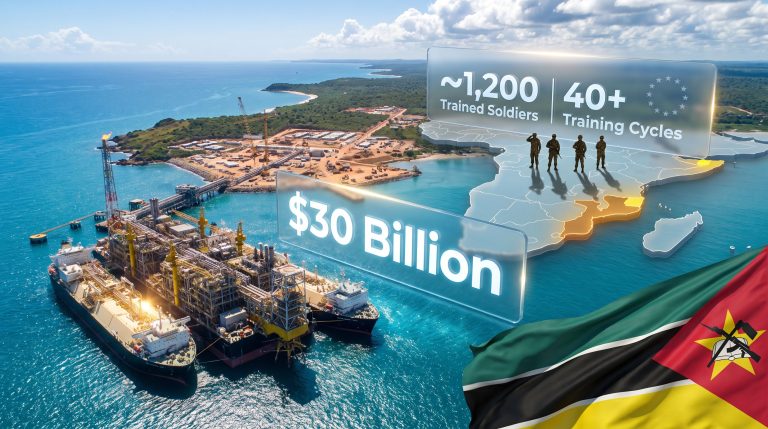
As of mid-2026, EUMAM MOZ has completed more than 40 training cycles involving approximately 1,200 Mozambican soldiers, according to official EU mission documentation. This represents meaningful progress, however the gap between trained soldiers and a fully self-sufficient counter-insurgency force capable of protecting a $20 billion construction site without external support remains substantial.
The Lisbon Request: Reading Chapo's Two-Year Extension Push
During his official state visit to Portugal in July 2026, President Daniel Chapo formally requested that Portugal support a minimum two-year extension of EUMAM MOZ, which would push the mission's mandate from its current December 31, 2026 expiry to at least 2028. The request was framed not purely as a security measure but as an economic protection mechanism, with Chapo explicitly linking the security architecture in Cabo Delgado to benefits that flow to the EU itself through protected energy investments.
The Lisbon meetings covered a four-point agenda that extended well beyond the military mission:
- EUMAM MOZ extension – the centrepiece of the security discussions
- Parliamentary relations strengthening between Mozambique and Portugal
- Inclusive National Dialogue advancement – Mozambique's internal political stabilisation process following post-election tensions
- CPLP reinforcement – deepening alignment within the Community of Portuguese Language Countries
The bundling of these agenda items is diplomatically significant. By embedding the military mission extension within a broader partnership framework, Mozambique is signalling that it views EU security engagement as one pillar of a multi-dimensional relationship rather than a purely transactional arrangement. Consequently, for EU Council deliberations, this framing could strengthen the case for extension by positioning approval as an investment in a wider African partnership architecture.
The Rwandan Force Factor: The Most Underappreciated Risk in the System
Why Rwandan Troop Funding Is the Most Time-Sensitive Variable
Perhaps the least discussed but most immediately consequential vulnerability in Cabo Delgado's current security model is the funding arrangement for Rwandan troops deployed to the province since 2021. Rwanda's forces operate under a Status of Forces Agreement with Mozambique and have provided the primary layer of site-specific protection for the Afungi peninsula, where TotalEnergies' LNG infrastructure is being built.
The EU contributed €20 million to support the Rwandan deployment, but that funding arrangement was set to expire in May 2026. A period of uncertainty followed, driven in part by U.S. sanctions imposed against Rwanda, which created complications for EU financial flows to Kigali. President Chapo confirmed in early July 2026 that the EU would resume financial support for the Rwandan forces, however the longer-term architecture of that funding arrangement had not been formally confirmed as of mid-2026.
In addition, the geopolitical risk landscape surrounding African deployments adds further complexity, as external political pressures can rapidly alter multilateral funding commitments. This creates a structural vulnerability that is qualitatively different from the EUMAM MOZ capacity-building timeline. FADM training is a multi-year process measured in capability development curves. Rwandan force protection is an immediate, site-specific security function. The two cannot substitute for each other in the near term, meaning any gap in Rwandan force funding directly exposes the Afungi site to elevated risk, regardless of how many FADM training cycles EUMAM MOZ has completed.
Security on the Ground: What the Data Actually Shows
The security picture in Cabo Delgado is genuinely contested, and the divergence between official government assessments and independent conflict monitoring data is one of the most important analytical variables for investors and policymakers tracking the region.
| Source | Assessment Period | Key Finding |
|---|---|---|
| President Chapo (official) | January 2026 | No district in Cabo Delgado remains under insurgent territorial control |
| Mozambique Conflict Monitor | October 2025 | Insurgent activity spreading in northern Cabo Delgado near Afungi |
| ACLED | Conflict period 2017-2026 | Over 6,000 deaths, approximately 1 million displaced |
| TotalEnergies (operational) | January 2026 | Resumed construction with 4,000 workers mobilised |
The divergence between these data sets reflects a well-documented pattern in post-insurgency environments: territorial control and operational security are not the same metric. A province can be free of fixed insurgent positions while still experiencing mobile cell activity, targeted assassinations, and supply chain interdiction. Independent conflict monitors typically capture this distinction more granularly than official government assessments, which have institutional incentives to emphasise gains.
TotalEnergies' return to Afungi with 4,000 workers is a meaningful signal of conditional confidence, but experienced frontier energy investors will note that construction resumption and project completion are very different milestones. The former requires manageable risk; the latter requires sustained stability across a multi-year horizon. For a detailed overview of Cabo Delgado as a resource-rich conflict zone, independent analysis provides valuable additional context beyond official statements.
The next major ASX story will hit our subscribers first
Three Scenarios for Cabo Delgado Through 2028
Scenario 1: Managed Stabilisation (Base Case)
The EUMAM MOZ extension is approved through 2028. EU financial support for the Rwandan deployment is formalised under a successor arrangement. Insurgent activity remains geographically contained and does not reach Afungi. TotalEnergies achieves initial construction milestones on schedule. ExxonMobil moves Rovuma LNG toward a final investment decision. Mozambique begins generating LNG export revenues that could fundamentally alter its sovereign debt profile.
Scenario 2: Funding Gap Deterioration (Downside Risk)
The Rwandan troop funding arrangement is not formalised in time, creating a protection gap at Afungi during a period when FADM capability has not yet reached self-sufficiency. Insurgent cells exploit the vacuum with targeted harassment that falls short of a Palma-scale attack but creates enough operational disruption to slow construction and re-trigger force majeure clauses. Investor confidence retreats, and ExxonMobil's FID is deferred again.
Scenario 3: Full Escalation (Tail Risk)
Combined funding uncertainty and renewed post-election political instability embolden insurgent networks operating across Cabo Delgado's northern districts. A high-profile attack on gas infrastructure or personnel triggers a second TotalEnergies suspension. The cascading effect on ExxonMobil's Rovuma LNG timeline and Mozambique's sovereign creditworthiness would be severe, with regional implications extending into Tanzania and broader Indian Ocean LNG supply chains.
The EU's Strategic Interest: Energy Security as the Real Driver
Understanding why the EU would sustain a military training mission in Mozambique requires following the energy logic rather than the humanitarian logic, even if both are present in the official framing. TotalEnergies is a French national champion with approximately $20 billion exposed in Cabo Delgado. Eni is an Italian state-adjacent energy major with several billion dollars committed across Coral Sul and Coral Norte. Together, these two EU-headquartered companies represent a combined exposure that dwarfs the cost of the EUMAM MOZ mission by several orders of magnitude.
| EU Strategic Input | Asset Protected |
|---|---|
| EUMAM MOZ training mission | $25+ billion in EU-headquartered energy company assets |
| €20 million Rwandan troop support | Immediate site security at Afungi during FADM capacity development |
| Portuguese diplomatic leadership | EU-CPLP partnership positioning across Lusophone Africa |
European energy policy after 2022 placed a structural premium on geographic diversification of LNG supply sources, reducing concentration in Russian pipeline gas and Middle Eastern supplies subject to transit risk. Mozambican LNG, at full development capacity, represents one of the few genuinely large-scale non-Russian, non-Gulf sources available to European terminal operators. The geopolitical risk landscape premium attached to that supply security justifies a level of diplomatic and security investment that pure commercial calculations alone might not.
Key Variables to Monitor in the Second Half of 2026
For analysts and investors tracking the Mozambique EU military mission extension process, the following indicators will provide the clearest signal of how the security architecture is evolving:
- EU Council deliberations timing on the two-year extension request, expected before the December 31, 2026 mandate expiry
- Formalisation of Rwandan troop funding under a confirmed successor arrangement, the single most time-sensitive security variable
- TotalEnergies construction progress at Afungi through the second half of 2026, which functions as a real-time ground-truth indicator
- Independent conflict monitor data from ACLED and the Mozambique Conflict Monitor, which provide the most reliable signals of insurgent activity patterns
- ExxonMobil's Rovuma LNG posture, where any movement toward a final investment decision would represent the strongest available market signal that the long-term security framework is considered credible by a major non-European energy operator
Furthermore, the commodity price impacts on regional energy investment decisions will also play a material role in shaping how aggressively operators pursue project milestones in this environment. In addition, trends in African mining finance demonstrate that institutional capital remains highly sensitive to security conditions when evaluating long-duration infrastructure commitments on the continent.
The outcome of these overlapping processes will determine whether Cabo Delgado fulfils its potential as a transformative revenue engine for Mozambique and a meaningful contributor to European energy supply diversification, or whether the province joins the long list of African resource frontiers where extraordinary geological endowment failed to translate into sustained economic development.
This article is intended for informational purposes only and does not constitute financial, investment, or legal advice. Scenario projections and forward-looking assessments involve inherent uncertainty and should not be relied upon as predictions of future events. Readers are encouraged to consult independent sources and conduct their own due diligence.
Want to Stay Ahead of the Next Major Resource Discovery Before the Market Moves?
Discovery Alert's proprietary Discovery IQ model scans ASX announcements in real time, instantly identifying significant mineral discoveries and translating complex data into actionable investment insights — ideal for investors tracking resource-rich frontier opportunities like those reshaping global energy supply chains. Explore how historic discoveries have generated substantial returns on Discovery Alert's dedicated discoveries page, and begin your 14-day free trial today to position yourself ahead of the broader market.