
July 21, 2026
The Hidden Cost of Security Failure in Frontier Energy Markets
When energy companies commit tens of billions of dollars to developing natural gas reserves in politically volatile regions, the single most underappreciated variable in their project models is rarely geological or financial. It is the cost of sustained security failure. Nowhere illustrates this principle more vividly than Mozambique's Cabo Delgado province, where an Islamist insurgency that began in 2017 forced a five-year construction halt on one of Africa's largest LNG projects, wiping out years of development momentum and reshaping the global calculus around frontier energy investment.
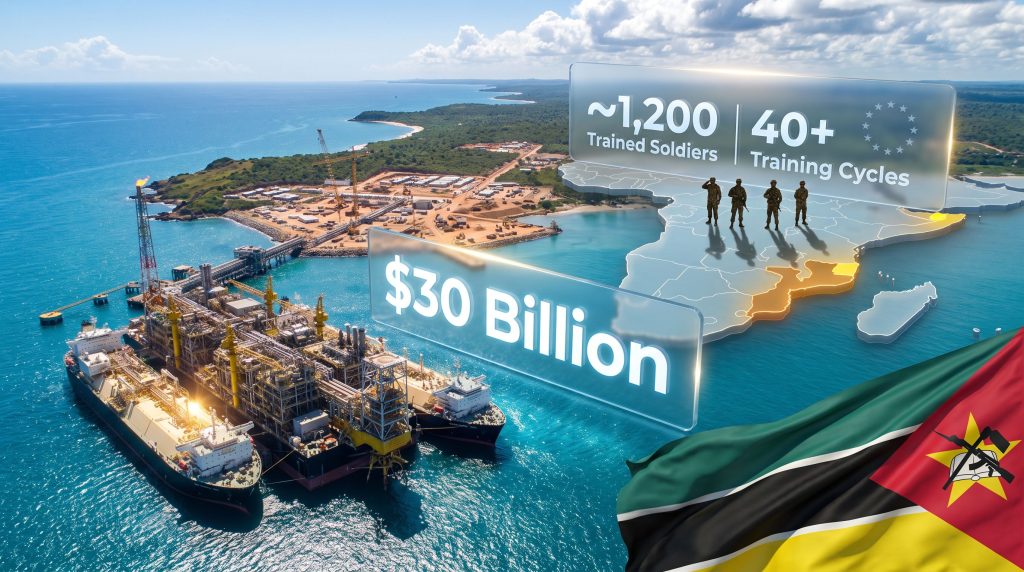
The decision by Mozambique's government to formally request a two-year extension of the Mozambique EU military mission extension is not simply a diplomatic footnote. It is a signal that the security architecture underpinning approximately $30 billion (€26.3 billion) in energy infrastructure remains a live and unresolved challenge, even as official statements project cautious optimism.
When big ASX news breaks, our subscribers know first
Understanding EUMAM MOZ: What the Mission Actually Does
A common misconception about the European Union's military presence in Mozambique is that it functions as a combat force. It does not. The EU Military Assistance Mission in Mozambique (EUMAM MOZ) is a non-executive, capacity-building operation focused entirely on advising, mentoring, and training the Mozambican Defence Armed Forces (FADM). Its core objective is to develop Quick Reaction Forces capable of independently securing Cabo Delgado without relying indefinitely on external military support.
The mission's evolution reflects a deliberate strategic transition. Between 2021 and 2024, the EU operated a predecessor initiative known as the EU Training Mission (EUTM Mozambique), which focused on a pure military training model. In September 2024, this was restructured into the current EUMAM MOZ framework, broadening the scope to include specialised operational mentoring alongside structured training cycles. The current mandate was extended by six months in May 2026 and now expires on December 31, 2026.
The Mission's Operational Timeline
| Phase | Mission Name | Period | Primary Focus |
|---|---|---|---|
| Phase 1 | EUTM Mozambique | 2021–2024 | Foundational military training |
| Phase 2 | EUMAM MOZ (Initial) | Sept 2024–June 2026 | Advising, mentoring, specialised training |
| Phase 3 | EUMAM MOZ (Extended) | July–Dec 2026 | Six-month mandate extension |
| Phase 4 (Proposed) | EUMAM MOZ (Renewal) | 2027–2028 | Two-year extension under negotiation |
Since September 2024, EUMAM MOZ has completed more than 40 training cycles, producing approximately 1,200 trained Mozambican soldiers. While this represents meaningful progress, independent security analysts note that the force capacity required for genuine operational self-sufficiency in a province the size of Cabo Delgado remains considerably larger than current training outputs suggest. For further context on the EU Training Mission structure, its foundational design reveals how the current mission's non-executive mandate was shaped by earlier operational learnings.
Cabo Delgado Gas Projects: The $30 Billion Equation
To understand why the Mozambique EU military mission extension matters beyond humanitarian or counterterrorism rationale, it is necessary to map the energy infrastructure concentrated within the conflict zone. Cabo Delgado is not merely a troubled northern province. It is the geographic centre of Mozambique's most consequential economic transformation.
Three major LNG developments anchor the province's economic significance:
- TotalEnergies Mozambique LNG (Afungi Peninsula): Valued at approximately $20 billion, this project suspended construction in March 2021 following the militant attack on the nearby town of Palma. TotalEnergies declared force majeure, triggering a five-year development halt. Construction formally restarted in January 2026 with roughly 4,000 workers mobilised at the Afungi site.
- Eni Coral Sul and Coral Norte: These offshore-anchored floating LNG operations benefit from a degree of physical separation from onshore insurgent activity, though they are not entirely insulated from broader provincial instability.
- ExxonMobil Rovuma LNG: A major offshore development with significant long-term production potential, though its timeline has also been affected by the broader security environment in the province.
Furthermore, the broader LNG supply outlook for 2025 and beyond reinforces just how consequential any sustained disruption to Cabo Delgado's output would be for global gas markets.
Strategic Insight: The five-year suspension of TotalEnergies' Afungi project is one of the most instructive case studies in frontier energy risk management. Force majeure declarations carry not just construction cost overruns but cascading consequences: renegotiated offtake agreements, strained relationships with project lenders, and lasting reputational damage to a host country's investment narrative.
The combined investment exposure across these projects is estimated at approximately $30 billion, a figure that contextualises why EU member states with direct commercial stakes, particularly France through TotalEnergies and Italy through Eni, have strong political incentives to maintain mission continuity. Indeed, the risks facing Mozambique's resource energy exports are emblematic of challenges confronting frontier producers more broadly.
The Extension Request: Diplomacy, Security, and Economic Survival
During an official state visit to Lisbon in July 2026, President Daniel Chapo formally asked Portugal, as the mission's lead nation, to back a two-year mandate renewal extending the mission through at least 2028. The request was communicated through Mozambique's national news agency AIM and later reported by Club of Mozambique.
Chapo's rationale was direct: the insurgency remains concentrated precisely where the gas infrastructure is located, and the economic transformation those projects represent carries material benefits not just for Mozambique but for European investors and energy consumers alike. His argument implicitly links European energy security interests to the operational continuity of EUMAM MOZ in a way that makes the extension request difficult for EU member states to dismiss as a unilateral aid request.
The Lisbon discussions covered four parallel diplomatic tracks:
- Security mission extension and mandate renewal terms
- Strengthening parliamentary cooperation between Mozambique and Portugal
- Advancing the Inclusive National Dialogue within Mozambique
- Deepening ties through the Community of Portuguese Language Countries (CPLP)
Portugal's leadership of EUMAM MOZ is grounded in historical and linguistic ties to Mozambique through the CPLP framework, giving Lisbon a degree of political credibility as mission lead that purely transactional security partners would not carry. Portugal's endorsement of the extension is widely considered a prerequisite for securing the broader EU Council consensus required for mandate renewal.
The Security Reality: Official Optimism vs. Independent Data
One of the most critical due diligence challenges for investors and policymakers evaluating Cabo Delgado is the persistent divergence between official government assessments and independent conflict monitoring findings.
| Source | Assessment Period | Key Finding |
|---|---|---|
| President Chapo (official statement) | January 2026 | No village in any Cabo Delgado district under insurgent control |
| Mozambique Conflict Monitor | October 2025 | Insurgent activity spreading in northern Cabo Delgado near Afungi |
| ACLED (Armed Conflict Location & Event Data Project) | Cumulative to 2026 | 6,000+ deaths; approximately 1 million displaced since 2017 |
This gap matters enormously for project financiers. Multilateral development banks and export credit agencies conducting sovereign risk assessments do not rely on official government statements alone. The persistence of sporadic attacks near the Afungi project zone through late 2025 and into 2026 suggests that while measurable progress has been made, the security environment remains fragile. Consequently, the geopolitical risk landscape confronting investors in resource-rich conflict zones warrants continued and careful monitoring.
The Rwandan Deployment: A Funding Variable Often Overlooked
A dimension of the Cabo Delgado security architecture that receives relatively little international attention is the role of Rwandan forces. Rwanda deployed troops to the province in 2021 under a bilateral security arrangement with Mozambique, providing a complementary ground force that operates alongside EUMAM MOZ rather than under its command.
This deployment faced a period of acute funding uncertainty after the United States imposed sanctions against Rwanda, creating complications for EU financial support of the Rwandan military presence. In early July 2026, President Chapo announced that the EU would resume financial support for the Rwandan deployment, resolving what had become a sensitive gap in the province's overall security coverage. Rwandan forces continued operating under a Status of Forces Agreement throughout this period, meaning boots remained on the ground even when funding logistics were unresolved.
Scenario Analysis: What Happens If the Extension Is Denied?
The EU Council decision on mandate renewal carries material consequences across multiple stakeholder groups. Three plausible scenarios emerge from the current negotiation trajectory:
Scenario A: Extension Approved (2027–2028). FADM capacity development continues without interruption. TotalEnergies and Eni maintain construction momentum at Afungi and offshore sites respectively. Mozambique LNG advances toward first production milestones on revised post-suspension timelines. EU commercial interests in the province are protected.
Scenario B: Extension Delayed. A gap of six to twelve months in mission continuity creates a window of uncertainty. Investor confidence wavers, insurance premiums on Cabo Delgado operations rise, and project financiers may introduce additional risk covenants into lending arrangements. Construction progress slows as security assurances weaken.
Scenario C: Extension Denied. FADM reverts toward pre-mission capacity levels without adequate Quick Reaction Force capability. Insurgent activity exploits security gaps. TotalEnergies faces a force majeure risk environment comparable to 2021. EU energy diversification strategy, which has increasingly pointed toward African LNG as a post-Russian gas alternative, suffers a material and politically embarrassing setback.
The next major ASX story will hit our subscribers first
How EUMAM MOZ Compares to Other EU Military Missions in Africa
| Mission | Host Country | Launch Year | Focus | Current Status |
|---|---|---|---|---|
| EUTM Mali | Mali | 2013 | Army training | Terminated 2023 |
| EUTM Somalia | Somalia | 2010 | National army capacity | Active |
| EUMAM RCA | Central African Republic | 2016 | Armed forces training | Active |
| EUMAM MOZ | Mozambique | 2021 (as EUTM) | QRF capacity, Cabo Delgado | Active; extension pending |
The contrast with EUTM Mali is instructive. That mission was terminated in 2023 following a series of military coups and the Malian government's pivot toward Russian private military contractors. EUMAM MOZ operates in a fundamentally different political context: the host government is actively requesting continuation, the commercial stakes for EU member states are explicitly identified, and the mission is tied to a defined geographic objective rather than a diffuse national stabilisation goal.
Key Data Summary: Cabo Delgado Security and Energy at a Glance
| Metric | Figure |
|---|---|
| Insurgency start date | 2017 |
| Conflict-related deaths (cumulative) | 6,000+ |
| Displaced persons | ~1 million |
| EUMAM MOZ training cycles completed | 40+ |
| Mozambican troops trained since Sept 2024 | ~1,200 |
| Current mission mandate expiry | December 31, 2026 |
| Proposed extension duration | Two years (through 2028) |
| Total gas investment value in Cabo Delgado | ~$30 billion (€26.3 billion) |
| TotalEnergies LNG project value | ~$20 billion |
| TotalEnergies construction restart | January 2026 |
| Workers mobilised at Afungi (2026) | ~4,000 |
The Longer Strategic Arc: Building Self-Sufficiency as an Exit Strategy
The ultimate objective of EUMAM MOZ is to make itself redundant. A military assistance mission that generates permanent dependency has failed by its own design logic. The 1,200 troops trained across 40-plus cycles since September 2024 represent a meaningful foundation, but independent security analysts broadly estimate that the force capacity required for full FADM operational independence in Cabo Delgado is considerably larger than current output levels.
The proposed two-year extension through 2028 would align mission continuity with critical construction milestones at the Afungi project site. For project financiers, export credit agencies, and multilateral development banks modelling sovereign risk on Mozambican LNG exposure, a confirmed mandate renewal effectively functions as a risk mitigation signal. It indicates that the EU remains institutionally committed to the province's security architecture at precisely the period when construction activity and workforce concentration are at their highest.
Beyond Mozambique, the EUMAM MOZ model may be establishing a replicable framework for EU engagement in resource-rich, conflict-affected African states. In addition, the evolution of African project finance trends suggests that security-linked investment structures are becoming a defining feature of how capital is deployed across the continent. However, supply chain disruption risks compounding these challenges, particularly for large-scale LNG developments operating across multiple international supply chains. Whether the EU Council formalises that framework through a two-year renewal will determine not just the trajectory of Mozambique EU military mission extension outcomes but the credibility of Europe's broader Africa security-investment strategy.
Readers seeking ongoing coverage of EU security engagement in Africa and developments across the continent's energy sector can follow related reporting at Ecofin Agency.
Ready to Spot the Next Market-Moving Discovery?
For investors tracking how geopolitics and project risk can reshape resource valuations, Discovery Alert delivers real-time ASX mineral discovery alerts powered by its proprietary Discovery IQ model, turning complex announcements into actionable insights. To see how major discoveries have historically driven exceptional returns, explore Discovery Alert’s discoveries page and start a 14-day free trial today.