
July 21, 2026
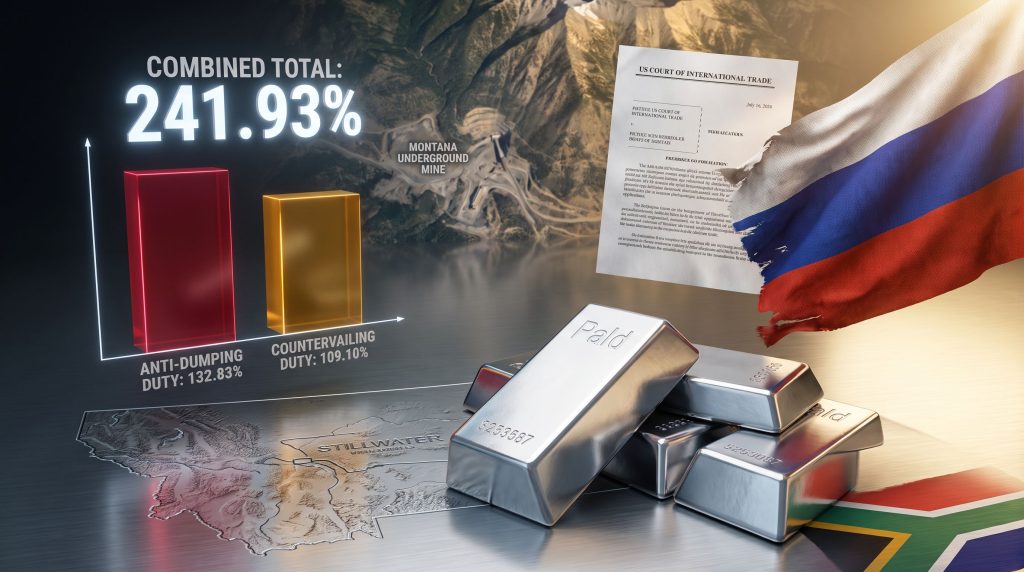
The Geological Rarity Behind America's Palladium Dilemma
Palladium is not simply scarce in an economic sense. It is geologically rare in a way that concentrates global supply within a handful of jurisdictions with almost no flexibility for rapid substitution. The Bushveld Igneous Complex in South Africa and the Norilsk-Talnakh deposits in Russia together account for the overwhelming majority of annual global palladium output. Outside these two formations, only one other primary source of meaningful scale exists: the J-M Reef, a layered igneous intrusion threading through the Beartooth Mountains of southern Montana.
That single geological anomaly on American soil underpins the entire US domestic palladium supply chain. It also explains why Sibanye-Stillwater appeals US decision over Russian palladium import dumping — a legal battle filed with the US Court of International Trade — carries implications that extend well beyond a single company's commercial interests.
When big ASX news breaks, our subscribers know first
Understanding the J-M Reef: America's Only Palladium Lifeline
The J-M Reef is exceptional by any global standard for platinum group metal (PGM) deposits. Its palladium-to-platinum ratio runs at roughly 3.5:1, which is the inverse of most South African reef deposits where platinum dominates. This makes the Stillwater complex uniquely palladium-rich, which is precisely why it holds such strategic importance to the United States. For broader context on the platinum and palladium market, global supply concentration remains one of the defining structural risks for downstream industries.
The Stillwater and East Boulder mines, both operated by Sibanye-Stillwater, extract ore from this reef at depths that require intensive underground mining methods. Unlike open-pit operations common in other critical mineral sectors, hard-rock underground mining in the J-M Reef environment carries extremely high fixed costs. Labour, ventilation, ground support, and materials handling costs persist regardless of what the palladium spot price is doing on any given trading day.
This cost structure creates a specific vulnerability: when palladium prices fall sharply, underground operations cannot simply scale back without incurring substantial fixed-cost penalties. This is the commercial backdrop against which Sibanye-Stillwater appeals US decision over Russian palladium import dumping, and it is essential context for understanding why the company considers judicial review worth pursuing.
A Timeline of Trade Action: From Petition to Court
The current legal situation did not emerge suddenly. It is the product of a multi-year sequence of regulatory filings, preliminary determinations, and finally a contested injury ruling.
| Milestone | Date | Outcome |
|---|---|---|
| Trade Petition Filed (with United Steelworkers Union) | July 30, 2025 | Formal investigation triggered |
| Preliminary Anti-Dumping Duty Announced | February 10, 2026 | 132.83% recommended |
| Preliminary Countervailing Duty Announced | March 6, 2026 | 109.10% recommended |
| Combined Preliminary Tariff Exposure | Both mechanisms | 241.93% on Russian unwrought palladium |
| ITC Injury Determination Hearing | May 19, 2026 | ITC found no material injury |
| Court of International Trade Appeal Filed | July 16, 2026 | Case escalated to judicial review |
The fact that Sibanye-Stillwater filed alongside the United Steelworkers Union is significant. It signals that this is not purely a corporate commercial dispute. Workers at the Montana mines have a direct stake in the outcome, and their union's participation strengthens the domestic industry standing argument that is central to the trade remedy framework. Reuters reported that the US Commerce Department gave initial backing to Sibanye-Stillwater's call for tariffs on Russian palladium, underscoring the seriousness with which federal investigators treated the pricing evidence.
What Dumping and Countervailing Duties Actually Mean in Practice
Trade remedy law uses technical language that can obscure straightforward economic realities. Breaking down the two mechanisms involved helps clarify what is actually being alleged.
Anti-dumping duties are applied when a foreign producer exports goods into another market at prices below what it charges domestically, or below its actual cost of production. The logic is that selling below cost in a target market is a deliberate strategy to undercut competitors and capture market share, with losses absorbed by the exporting producer or its government backers.
Countervailing duties address a different problem. They are applied when foreign governments subsidise their domestic producers in ways that create an artificial cost advantage, allowing those producers to price aggressively in export markets without actually bearing the full commercial cost of doing so.
In the Russian palladium context, both mechanisms are alleged to operate simultaneously. Nornickel, which dominates Russian palladium production, has complex ownership and financing structures with significant state-linked dimensions. Analysts have noted that quantifying the subsidy component of Nornickel's cost base using standard trade remedy methodology is genuinely difficult, because state support flows through multiple channels including energy pricing, infrastructure access, and financing conditions.
The preliminary combined tariff figure of 241.93% represents one of the most aggressive proposed duty structures ever applied to a critical mineral entering the US market, reflecting the seriousness with which Commerce Department investigators assessed the pricing evidence.
The original petition reportedly alleged dumping margins as high as 700% to 800% in certain transaction categories, which suggests Commerce's preliminary findings of 132.83% represent a moderated assessment, not an inflated one.
The Price Collapse That Triggered the Case
Palladium's price trajectory between 2022 and 2024 is central to understanding why this trade action was filed when it was. The metal reached record highs above $3,000 per troy ounce in early 2022, driven by supply disruption fears and surging automotive demand for catalytic converters. What followed was a sustained and severe correction.
By 2024, palladium had lost approximately 50% of its peak value, falling to levels that made high fixed-cost underground operations like the Montana mines economically precarious. Over the same period, Russian palladium export volumes into the US market grew by approximately 35%. The simultaneous occurrence of rising Russian import volumes and collapsing prices forms the statistical core of the dumping and price suppression argument.
The distinction between two specific legal concepts matters enormously here:
- Price undercutting means Russian palladium was sold below prevailing US market prices in individual transactions.
- Price suppression means the cumulative weight of Russian import volumes prevented US prices from rising to levels they would otherwise have reached, even if individual transactions did not always undercut on price.
Sibanye-Stillwater's position is that the ITC failed to apply the correct legal interpretation to the price suppression argument, which is the basis for the judicial appeal. Furthermore, the broader context of US tariffs global impact on critical commodity markets adds another layer of complexity to how trade remedy outcomes in this case may reverberate through supply chains.
Why the ITC and Commerce Reached Different Conclusions
The bifurcated structure of US trade remedy law is what created the gap between Commerce Department findings and the ITC outcome. Under this system, two independent determinations must both be affirmative for permanent tariffs to be imposed.
The Commerce Department examines pricing and subsidy structures. It concluded, on a preliminary basis, that Russian palladium entered the US market under conditions warranting combined duties of 241.93%.
The ITC performs a separate assessment: whether the domestic industry has suffered, or is threatened by, material injury as a result of those imports. The legal threshold for material injury is distinct from the pricing analysis Commerce conducts, and the ITC found it was not met.
In US trade law, a negative ITC injury finding blocks the tariff mechanism entirely, regardless of how strong the Commerce Department's pricing evidence appears. This is why Sibanye-Stillwater's appeal targets the ITC ruling specifically rather than the Commerce findings.
The appeal to the Court of International Trade focuses on whether the ITC correctly applied the legal framework in evaluating price suppression and the causal link between import volumes and domestic industry harm. The court reviews legal interpretation errors, not fresh factual evidence, which means the case turns on technical statutory questions rather than re-litigating the economic data.
The next major ASX story will hit our subscribers first
Competing Perspectives on the Strength of the Case
Not everyone in the PGM industry views the dumping allegation as straightforward. There are at least two credible analytical positions worth examining.
The case for the dumping argument:
- Russian palladium export volumes rose sharply into a falling-price environment, suggesting volumes were maintained regardless of market signals.
- Nornickel's state-linked cost structure means its production decisions may not respond to price signals the way a commercially independent producer's would.
- The Stillwater operation's high fixed costs make it uniquely vulnerable to sustained below-equilibrium pricing, even if individual Russian transactions did not consistently undercut US spot prices.
The counterargument from market observers:
- Some analysts have noted that trade data does not uniformly demonstrate Russian palladium being transacted below prevailing market prices.
- The stronger legal case may rest on the countervailing duty argument, which targets state subsidy structures, rather than the anti-dumping component.
- The World Platinum Investment Council has acknowledged complexity in the pricing evidence, suggesting subsidy-based arguments may carry more legal weight than direct below-market pricing claims.
A genuine tension exists between protecting America's sole primary palladium producer and maintaining competitive input costs for downstream US industries. Automotive manufacturers, electronics producers, and hydrogen technology developers all consume palladium, and tariffs of nearly 242% would meaningfully reshape their sourcing economics.
The Substitution Threat Complicating the Outlook
One of the less-discussed dynamics affecting this case is the long-term demand trajectory for palladium itself. The automotive industry, historically the dominant consumer of palladium in gasoline-engine catalytic converters, has been quietly accelerating the development of platinum-based catalyst formulations as a substitute.
This substitution trend carries a double-edged implication for Sibanye-Stillwater. On one hand, the Stillwater complex also produces platinum, meaning any demand shift toward platinum partially offsets palladium revenue losses. On the other hand, a sustained market perception that palladium demand will structurally decline over the medium term weakens the commercial case for protecting domestic palladium production capacity.
The J-M Reef's unusually high palladium-to-platinum ratio, which makes it exceptional by global standards, also means the mines cannot easily pivot their revenue mix toward platinum in the way that South African operations with different reef geometries might. Consequently, the critical minerals demand landscape will play a decisive role in how investors and policymakers weigh the long-term viability of Montana's operations.
What a Successful Appeal Would Mean for the Market
If the Court of International Trade determines that the ITC applied incorrect legal standards, the most likely outcome is a remand directing the ITC to reconsider its injury determination under the correct framework. If the ITC then finds material injury on remand, the Commerce Department's preliminary tariff structure of 241.93% could form the basis for permanent duty orders.
The market implications of that outcome would be substantial:
- Russian palladium would become effectively uncompetitive in the US market at any price close to current levels.
- US manufacturers consuming palladium would need to source from South African producers or from secondary and recycled sources.
- South African PGM producers could find redirected US demand supporting price recovery in a metal that has spent years in a structural bear market.
- Urban mining operations recovering palladium from spent catalytic converters would gain relative commercial importance in a tighter supply environment.
The geopolitical dimension also cannot be separated from the legal proceedings. Broader US-Russia trade relations and sanctions frameworks create a policy environment in which tariff protection for a critical mineral with national security implications may receive judicial sympathy, even if the legal standards for trade remedy law are applied strictly. In addition, critical mineral tariff exemptions granted in other sectors demonstrate how selectively trade policy can be applied when strategic interests are deemed sufficiently compelling.
Frequently Asked Questions
What exactly is Sibanye-Stillwater appealing?
The company filed a summons with the US Court of International Trade on July 16, 2026, challenging the ITC's conclusion that Russian palladium imports did not cause material injury to the domestic palladium industry.
What was the proposed tariff on Russian palladium?
US authorities issued preliminary findings recommending a combined duty of 241.93%, comprising a 132.83% anti-dumping component and a 109.10% countervailing duty on unwrought Russian palladium. Bloomberg reported that the US backed these preliminary levies, marking a significant escalation in the trade dispute.
Why does the US rely on a single palladium mining complex?
The J-M Reef in Montana is the only economically significant primary palladium deposit in the United States. Its geological characteristics, particularly its high palladium-to-platinum ratio, make it uniquely valuable but also irreplaceable within the domestic supply chain.
What does Nornickel's role mean for the subsidy argument?
Nornickel's production operates within a cost structure that benefits from state-adjacent pricing of energy, infrastructure, and financing. This creates subsidy conditions that are structurally difficult to price using commercial benchmarks, which is precisely why the countervailing duty mechanism exists as a separate legal instrument from anti-dumping law.
What happens if the appeal fails?
If the ITC's negative injury determination is upheld by the court, the tariff mechanism is blocked under current proceedings. Sibanye-Stillwater would need to evaluate whether changed market conditions or new import data create grounds for a fresh petition in the future.
Key Takeaways for Investors and Industry Observers
This case sits at the intersection of trade law, critical mineral policy, and the commercial survival of America's only primary palladium production operation. Several broader lessons emerge from its structure:
- The dual-track US trade remedy system, requiring both Commerce and ITC affirmative findings, creates procedural complexity that allows commercially meaningful pricing findings to be negated by a different legal test at the injury stage.
- The unusually high fixed-cost profile of underground PGM mining makes palladium producers structurally more vulnerable to sustained import competition than commodity producers with lower operational leverage.
- The combination of price collapse, rising import volumes, and state-linked producer economics creates a fact pattern that satisfies many of the analytical requirements for a dumping finding, even if the legal mechanics of proving material injury remain contested.
- For investors monitoring the PGM sector, the outcome of this judicial review will influence not only Sibanye-Stillwater's Montana operations but the broader question of whether the United States can sustain any meaningful domestic platinum group metals production capacity over the long term.
This article contains forward-looking analysis and references to ongoing legal proceedings. Outcomes of judicial reviews and trade remedy proceedings are inherently uncertain. Nothing in this article constitutes financial or investment advice. Readers should conduct their own due diligence before making investment decisions related to any securities or commodities mentioned.
Want To Stay Ahead of Major Mineral Discoveries Before the Broader Market Reacts?
As trade tensions reshape critical mineral supply chains — from palladium to platinum group metals — Discovery Alert's proprietary Discovery IQ model scans ASX announcements in real time, delivering actionable alerts on significant mineral discoveries the moment they emerge. Explore historic discovery returns on Discovery Alert's discoveries page and begin your 14-day free trial today to position yourself ahead of the market.