June 29, 2026
The Minerals Beneath the Geopolitical Chessboard
Every generation of commodity markets produces a moment when geology and geopolitics converge so completely that the rules of resource extraction must be rewritten. That moment has arrived for Africa's critical mineral sector, and Mozambique sits at its epicentre.
The country's Mozambique mining law critical minerals landscape shifted decisively on June 3, 2026, when President Daniel Chapo signed into law a reformed mining framework mandating automatic state equity participation across all mining projects. However, to understand why this matters beyond Maputo's borders, it is necessary to first understand what graphite, rare earths, and the structure of global battery supply chains actually mean for the economies that depend on them.
When big ASX news breaks, our subscribers know first
Why Graphite Is Not Just a Pencil Mineral Anymore
Most people associate graphite with pencils. The industrial reality is far more consequential. Natural graphite is the primary material used to manufacture anodes in lithium-ion batteries, which power everything from electric vehicles to grid-scale energy storage systems. Without refined, battery-grade graphite, the energy transition stalls. Furthermore, the graphite supply shortage facing Western manufacturers has only intensified pressure to secure alternative sources.
According to the U.S. Geological Survey (USGS), Mozambique ranks as the world's third-largest graphite producer, behind China and Madagascar. That statistic, however, understates the strategic significance of the country's position. China does not merely lead in graphite mining; it dominates the entire downstream processing chain. Converting raw graphite into spherical graphite suitable for battery anodes requires a series of chemical and mechanical processes that Chinese refiners have spent decades perfecting at scale.
This means Western battery manufacturers face a structural dependency: even graphite mined outside China often returns to Chinese processing facilities before it reaches an anode manufacturer. Mozambique's Balama deposit, operated by Australian company Syrah Resources, represents one of the few projects globally that can credibly challenge this dependency, producing at a scale large enough to justify dedicated non-Chinese processing infrastructure.
The Balama operation is not simply a mine. It is, in principle, the raw material foundation for an entirely alternative graphite supply chain serving Western EV manufacturers who cannot afford indefinite reliance on Chinese processing capacity.
Rare Earths: The Less Visible but Equally Critical Asset
Graphite attracts most of the headline attention, but Mozambique's rare earth endowment adds a second dimension to its strategic importance. Rare earth elements (REEs) comprise a group of 17 metals with unique magnetic, optical, and catalytic properties that make them indispensable in defence electronics, EV drivetrains, and wind turbine generators. Consequently, rare earth supply chains have become a central concern for governments across the Western world.
The Monte Muambe project, being advanced by British company Altona Rare Earths, represents one of Mozambique's most significant REE opportunities, with projected annual output of approximately 15,000 tonnes of mixed rare earth carbonate. In the context of global supply chains where China controls roughly 60% of mining output and an even larger share of processing, a project of this scale in a non-Chinese jurisdiction carries material geopolitical weight.
What is less commonly understood is that the specific composition of REE deposits matters enormously. Projects with higher concentrations of the so-called heavy rare earths (dysprosium, terbium, holmium) command significant premium interest because these elements are used in high-performance permanent magnets found in EV motors and wind turbines. They are considerably rarer even within REE deposits than the lighter elements (cerium, lanthanum). The strategic classification of any Mozambican REE asset would hinge partly on this compositional question, which pre-feasibility work is designed to answer.
What the 2026 Mining Law Actually Does
The reformed framework introduces two structural changes that reshape the investment calculus for every operator active in Mozambique. In addition, these changes reflect a broader pattern of government intervention in mining that has been accelerating across resource-rich developing nations.
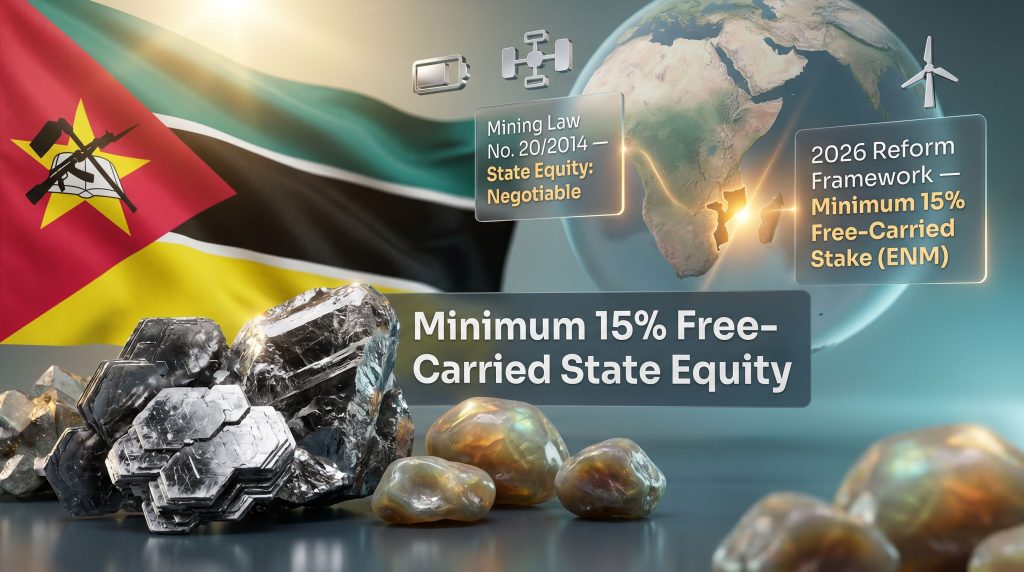
First, the state-owned mining company ENM receives a minimum 15% free-carried equity stake in all mining projects across every stage of the value chain, from exploration through to production. Critically, this stake is granted without ENM contributing capital at entry. In financial modelling terms, this means foreign investors bear the full cost of developing a project while delivering equity upside to the state from day one.
Second, the export of raw or semi-processed minerals is prohibited unless operators obtain ministerial approval supported by a documented domestic processing plan. This converts what was previously a voluntary aspiration toward in-country value addition into a binding legal condition of export. For further context on Mozambique's mining law reforms, including their wider implications, industry commentary has been extensive.
| Legal Dimension | Mining Law No. 20/2014 | 2026 Reform Framework |
|---|---|---|
| State equity participation | Negotiable; not mandatory | Minimum 15% free-carried stake (ENM) |
| Strategic mineral threshold | Case-by-case contract basis | Proposed 20% for classified strategic minerals |
| Raw mineral exports | Permitted with standard licensing | Banned unless ministerial approval + processing plan |
| State mining company role | Advisory/optional | Mandatory joint venture partner |
| Local processing requirements | Voluntary | Mandatory domestic processing component |
A proposed threshold of 20% for minerals classified as strategically significant has been flagged in legislative commentary, though precise application thresholds remain subject to ongoing regulatory interpretation. This distinction matters acutely for graphite and REEs, both of which could plausibly fall into a strategic classification under the Mozambique mining law critical minerals framework.
The U.S.-China Competition Embedded in Mozambique's Mineral Sector
The signing of this law did not occur in a vacuum. Both Washington and Beijing had already established meaningful financial and industrial positions in Mozambique's minerals sector before the ink dried on the new legislation.
Washington's Integrated Supply Chain Play
The U.S. International Development Finance Corporation (DFC) extended a $150 million loan to Syrah Resources' Mozambican subsidiary in November 2024, underwriting the Balama operation. A separate $102 million loan from the U.S. Department of Energy, awarded in 2022, supports Syrah's Vidalia anode processing facility in Louisiana, which transforms Balama's raw graphite into battery-ready anode material.
This two-node architecture — production in Mozambique and processing in the United States — represents exactly the kind of integrated non-Chinese graphite supply chain that Western battery manufacturers need. In March 2026, the DFC proposed converting a portion of its debt exposure into equity. If finalised, this would make the agency Syrah's second-largest shareholder with a stake approaching 20%, dramatically deepening Washington's commercial alignment with Mozambique's graphite output.
The U.S. Trade and Development Agency (USTDA) extended its reach further in February 2026, awarding a grant to support the pre-feasibility study for Monte Muambe. This signals American interest in Mozambique's REE assets as a parallel strategic priority, furthermore underlining how the critical minerals demand of the energy transition is reshaping foreign policy priorities.
China's Industrial Footprint on the Ground
China's approach has been characteristically industrial rather than financial. In January 2026, President Chapo inaugurated a graphite processing plant at Nipepe, owned by Chinese company DH Mining, representing a $200 million investment with annual processing capacity of 200,000 tonnes. This is not a speculative position; it is operational infrastructure.
Simultaneously, Shandong Yulong Gold, through its subsidiary NQM Gold 2, has been pursuing a 70% controlling stake in Triton Minerals' Ancuabe graphite project. A transaction initiated in 2024, it remains pending final government approval from Maputo — a process that now occurs under a materially different legal regime.
| Project | Mineral | Stage | Projected Output | Key Stakeholder |
|---|---|---|---|---|
| Balama | Graphite | Operational | Large-scale production | Syrah Resources (Australia) |
| Ancuabe | Graphite | Pre-production/acquisition pending | TBC | Triton Minerals / NQM Gold 2 |
| Nipepe | Graphite processing | Operational | 200,000 tonnes/year capacity | DH Mining (China) |
| Monte Muambe | Rare earths | Pre-feasibility | ~15,000 t/year REE carbonate | Altona Rare Earths (UK) |
The Investment Risk Landscape: Three Scenarios
Mozambique's reform introduces genuine ambiguity for investors — not manufactured uncertainty, but substantive legal questions that will require years to resolve through regulatory practice and potentially litigation.
The most critical unresolved question is retroactivity: the legislation does not explicitly clarify whether mandatory state participation applies to mines already operating under long-term agreements negotiated before the law's commencement. For Syrah's Balama operation, this creates a stabilisation clause question of significant financial consequence. The battery supply chain outlook for Western manufacturers consequently hinges partly on how Mozambique resolves this legal ambiguity.
Three outcomes are plausible:
-
Compliance and Adaptation — Large, well-capitalised operators absorb equity dilution, restructure project economics to incorporate ENM participation, and accelerate domestic processing investments to satisfy export approval conditions.
-
Negotiated Carve-Outs — Operators with legacy agreements invoke stabilisation clauses to shield pre-reform projects, creating a dual-speed regulatory environment where old and new projects operate under different rules, potentially for decades.
-
Investment Deterrence — Earlier-stage and smaller developers redirect capital to more predictable jurisdictions, causing a thinning of Mozambique's exploration pipeline precisely when the country's resource endowment is attracting peak strategic interest.
The irony embedded in resource nationalism at scale is that it tends to peak in strategic value at precisely the moment it is most capable of deterring the capital needed to realise that value. Mozambique's policymakers are navigating this tension in real time.
The next major ASX story will hit our subscribers first
Domestic Processing: Economic Logic vs. Infrastructure Reality
The economic case for in-country value addition is intellectually compelling. Raw graphite exports generate revenue at the lowest point in the processing chain. Processed outputs, particularly spherical graphite and battery-grade anode material, command prices that can be multiples of the raw material equivalent. Capturing that margin domestically rather than exporting it to Chinese or American processors represents a legitimate developmental aspiration.
The Nipepe plant demonstrates that industrial-scale graphite processing is not theoretically possible in Mozambique but actually operational. This is important evidence against the argument that processing mandates are disconnected from ground reality.
However, the infrastructure constraints are real. Reliable industrial-grade power, skilled technical labour, logistics connectivity, and access to reagents required for chemical purification of graphite are not uniformly available across Mozambique's mineral-rich regions. A processing mandate without parallel investment in these enabling conditions risks creating a regulatory bottleneck: operators unable to obtain export approvals because processing infrastructure cannot be constructed fast enough to satisfy ministerial conditions. For a detailed legal analysis of Mozambique's evolving regulatory framework, independent legal commentary provides useful additional context.
Africa's Shifting Political Economy of Mining
Mozambique is not rewriting the rules of mineral extraction in isolation. Rather, it is participating in a continent-wide renegotiation of the terms on which African sovereign resources are made available to foreign capital.
| Country | Sector | Resource Nationalism Measure | Investor Outcome |
|---|---|---|---|
| Mozambique | Graphite / REEs | 15% mandatory free-carried state stake + export ban | Pending investor response |
| Zimbabwe | Lithium | Export ban on unprocessed lithium ore | Significant foreign investment disruption |
| DRC | Copper / Cobalt | Increased royalties + domestic processing mandates | Ongoing operator disputes |
| Mali | Gold | New mining code; increased state asset share | Severe sector tension; operational disruptions |
| Guinea | Bauxite | Local processing requirements | Repeated government-operator disputes |
The pattern across these jurisdictions reveals a structural shift rather than coincidental policy convergence. Each reform has been catalysed by the same recognition: decades of raw mineral exports have generated foreign exchange without building domestic industrial capacity. Furthermore, the global energy transition has elevated the strategic value of African minerals at precisely the moment African governments are most motivated to extract greater economic returns from them.
Zimbabwe's lithium export ban offers the most cautionary recent precedent. The disruption to investor sentiment was significant and measurable, illustrating the execution risk embedded in Mozambique's approach. The difference, potentially, is that the Mozambique mining law critical minerals environment is being reshaped at a moment of even more intense geopolitical competition for access to its specific mineral assets, giving Maputo a degree of negotiating leverage that Harare did not possess to the same degree.
Frequently Asked Questions
What is the core change in Mozambique's 2026 mining law?
The legislation mandates a minimum 15% free-carried equity stake for ENM in all mining projects and prohibits export of unprocessed or semi-processed minerals without ministerial approval backed by a documented local processing plan.
Does the new law apply to existing operations?
The legislation does not explicitly address retroactive application to mines operating under pre-existing long-term agreements, creating material legal uncertainty for current project operators including Syrah Resources at Balama.
Why is Mozambique's graphite sector considered strategically critical?
Mozambique is the world's third-largest graphite producer (USGS), and graphite is the primary anode material in lithium-ion EV batteries. The Balama deposit represents one of very few projects globally capable of supporting a non-Chinese integrated graphite supply chain at industrial scale.
What is the Monte Muambe project?
Monte Muambe is a rare earth development project being advanced by Altona Rare Earths (UK) with potential annual output of approximately 15,000 tonnes of mixed rare earth carbonate. The USTDA awarded a grant in February 2026 to support its pre-feasibility study.
What is the status of the Ancuabe graphite acquisition?
Shandong Yulong Gold's proposed 70% acquisition of the Ancuabe graphite project through NQM Gold 2 remains pending final approval from the Mozambican government, which now administers a new regulatory framework with expanded mandatory state participation requirements.
How does the concept of free-carried equity work in practice?
A free-carried stake means ENM acquires its equity position without contributing development capital. The financial burden of exploration, feasibility, construction, and commissioning falls entirely on the foreign investor, while ENM participates in production economics from the point the mine generates revenue. This structure is common in African resource nationalism frameworks but transfers significant financial risk asymmetrically onto foreign capital. The Mozambique mining law critical minerals provisions make this dynamic especially consequential given the scale of projects currently under development.
This article is for informational purposes only and does not constitute financial or investment advice. All forward-looking statements and scenario analyses involve inherent uncertainty. Investors should conduct their own due diligence before making investment decisions related to any companies or projects mentioned herein.
Want to Stay Ahead of the Next Major Critical Minerals Discovery?
Discovery Alert's proprietary Discovery IQ model scans ASX announcements in real time, instantly identifying significant mineral discoveries across graphite, rare earths, and more than 30 other commodities — converting complex geological data into clear, actionable investment insights. Explore historic discoveries and their returns, then begin your 14-day free trial at Discovery Alert to position yourself ahead of the market before the next major find is announced.