June 19, 2026
The Quiet Restructuring of African Mining: How Resource Nationalism Is Reshaping Investment Terms
Across the African continent, a slow but unmistakable shift has been underway for more than a decade. Governments that once competed aggressively on fiscal terms to attract foreign mining capital are now recalibrating, moving from passive beneficiaries of resource extraction toward active co-participants in the value chain. This is not a sudden ideological turn — it is the maturation of a resource nationalism cycle that has played out repeatedly in commodity-rich economies from Latin America to Southeast Asia. What makes the current African wave distinctive is its timing: it is coinciding with an unprecedented surge in global critical minerals demand for the precise minerals that many African nations hold in abundance.
Mozambique sits at an unusually consequential intersection of this continental trend. Its legislative amendments to the mining law, which came into force in 2026, represent one of the most structurally significant regulatory shifts in sub-Saharan African mining in recent years — and the implications extend well beyond the country's borders for anyone tracking Mozambique mining ownership rules and their effect on foreign investment.
When big ASX news breaks, our subscribers know first
Mozambique's Strategic Mineral Position: Why the Stakes Are High
Before examining the mechanics of the new rules, it is worth appreciating precisely what is at stake geologically. Mozambique is not a marginal mining jurisdiction — it is home to some of the most strategically valuable mineral deposits on the planet.
Mozambique's Key Mineral Assets:
| Mineral | Operation | Operator | Global Significance |
|---|---|---|---|
| Graphite | Balama Mine | Syrah Resources | Among the world's largest graphite deposits |
| Rubies | Montepuez Mine | Gemfields | World's largest ruby mine |
| Coal | Former Rio Tinto and Vale assets | Various | Significant thermal and metallurgical reserves |
Graphite occupies a particularly critical position within this portfolio. As the primary material used in the anode component of lithium-ion batteries powering electric vehicles and grid-scale energy storage systems, natural graphite from deposits like Balama sits directly in the path of one of the most powerful structural demand trends in modern industrial history. The Balama operation in northern Mozambique is consistently cited among the largest-scale graphite production facilities globally, giving Mozambique an outsized voice in conversations about energy transition minerals and supply chain security.
The Montepuez ruby mine, operated by Gemfields, adds a further dimension to Mozambique's resource profile. Discovered in 2009 and developed through the early 2010s, Montepuez rapidly established itself as the world's most significant source of gem-quality rubies — a fact frequently overlooked in discussions dominated by the battery minerals narrative. Significant coal reserves, previously held by major global miners including Rio Tinto and Brazil's Vale before both exited the country, round out a resource endowment of genuine global consequence.
How the 2026 Mining Law Amendments Work in Practice
The 15% Free-Carry Mechanism Explained
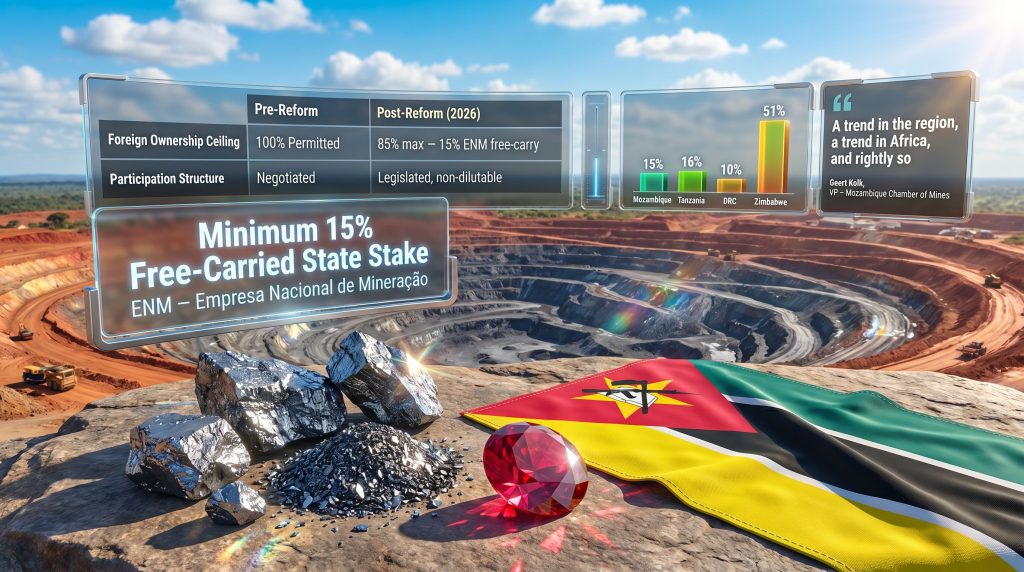
The cornerstone provision of Mozambique's amended mining legislation is a mandatory requirement for the state to hold a minimum 15% equity stake in every mining venture operating within the country. The precise structure of this participation carries significant financial implications that are easily underestimated by investors accustomed to simpler royalty-based frameworks.
This is a free-carried interest arrangement — meaning the government acquires its equity position without contributing capital to fund exploration, feasibility studies, construction, or commissioning. The entire financial burden of getting a mine into production is borne by the foreign investor, while the state participates in distributions from its protected ownership position from the point of first revenue.
Critically, the stake is structured as non-dilutable. This means that regardless of subsequent equity raises, convertible note conversions, or project restructurings, the state's 15% floor cannot be eroded. For investors who rely on staged capital raises to fund project development — a standard practice in junior and mid-tier mining finance — this creates a fixed constraint that must be modelled explicitly into every capital structure from day one.
The vehicle through which the state holds these interests is ENM (Empresa Nacional de Mineração), a newly designated state mining company established specifically to centralise and professionally manage the government's equity participation across the sector.
Summary of the Core Ownership Structure:
- Mandatory state equity floor of 15% applies universally to all mining ventures
- The interest is free-carried: no capital contribution required from the state
- The stake is non-dilutable: protected against reduction through future capital events
- State interests are consolidated and administered through ENM
- Maximum effective economic interest available to foreign investors is capped at 85%
Export Restrictions: The Second Structural Change
The ownership changes do not operate in isolation. The 2026 amendments simultaneously impose a default prohibition on the export of raw or semi-processed mineral products. This is not a targeted measure aimed at specific commodities — it applies across the board.
Operators seeking to export unprocessed material must obtain ministerial approval, and that approval is explicitly conditional on the operator presenting a credible plan for transitioning toward local processing. The ministerial discretion embedded in this mechanism is significant: approval is not an entitlement, it is a negotiated outcome contingent on forward-looking commitments to domestic value addition.
According to Mozambique's new mine ownership rules, industry bodies have raised concerns that the combined effect of these provisions could deter the very foreign investment the country needs to develop its mineral sector at scale.
Investor Implication: For graphite producers specifically, this creates a layered challenge. Graphite for battery-anode applications typically requires processing into spherical purified graphite (SPG) — a multi-stage thermal and chemical process. The infrastructure required for this does not currently exist at scale within Mozambique, meaning export restrictions effectively create a regulatory obligation to invest in processing capacity that the host economy cannot yet independently absorb.
Comparing Mozambique's Framework to Regional Peers
Mozambique's legislative direction is consistent with a broader continental consensus around mineral sovereignty, but its specific parameters deserve careful comparison against peer jurisdictions competing for the same pool of global mining capital.
| Country | State Participation Requirement | Export Restrictions | Local Processing Push |
|---|---|---|---|
| Mozambique | 15% free-carry (2026) | Yes — ministerial approval required | Active |
| Tanzania | 16% free-carry + 50% option | Yes | Active |
| Zimbabwe | 51% indigenisation (select sectors) | Partial | Active |
| Democratic Republic of Congo | 10% state stake (mining code) | Partial | Active |
| Zambia | Variable (royalty-focused model) | Limited | Moderate |
Tanzania's framework is arguably the closest regional comparator. The country introduced a 16% free-carry requirement alongside a government option to acquire up to 50% in certain projects — terms that generated significant investor anxiety when first legislated but which have since been partially accommodated through negotiated project-by-project structures.
Zimbabwe's indigenisation requirements in select sectors are considerably more aggressive at 51%, but their application has been inconsistent and subject to repeated revision, which introduces a different category of sovereign risk. The DRC natural resources framework, with its 10% state stake under the 2018 mining code, is less onerous in ownership terms but is accompanied by elevated royalty rates on strategic minerals.
Mozambique's position in this landscape is neither the most restrictive nor the most permissive. What distinguishes its approach is the combination of a universal free-carry structure, a non-dilutable protection mechanism, and export restrictions operating simultaneously — a package that is more comprehensive in its design than most regional equivalents.
The Investment Risk and Return Calculus
Quantifying the Impact of the Free-Carry on Project Returns
The financial arithmetic of a non-dilutable free-carry stake is straightforward in principle but often underweighted in preliminary project assessments.
| Project IRR (Pre-Reform) | Foreign Investor Economic Share | Estimated Adjusted IRR (Post-Reform) |
|---|---|---|
| 18% | 85% | ~15.3% |
| 22% | 85% | ~18.7% |
| 25% | 85% | ~21.3% |
Note: These figures are illustrative only, assuming all capital expenditure is borne by the foreign investor with no cost recovery mechanism applied to the free-carried portion. Actual returns will vary materially depending on project specifics, financing structure, and commodity price assumptions. This does not constitute financial advice.
Risks That Require Explicit Modelling
- Compressed equity returns: The 85% economic interest ceiling reduces the return on invested capital for every dollar deployed
- Capital structure complexity: Project finance lenders must accommodate a non-contributing state partner with protected equity rights — a structural feature that some lenders will treat as an elevated risk factor
- Processing infrastructure gap: Export restrictions tied to local processing plans create an obligation to invest in facilities that may require government infrastructure commitments to become viable
- Sovereign risk premium: The legislative pace of change signals potential for further reform cycles, warranting a higher country risk discount rate in project valuation models
- Ministerial discretion risk: The conditional nature of export approval introduces regulatory uncertainty that is difficult to hedge
Strategic Opportunities Within the New Framework
Furthermore, despite these headwinds, the reformed framework also creates genuine strategic opportunities for investors positioned to operate within it rather than against it:
- First-mover advantage in processing: Investors who establish credible downstream beneficiation capacity in-country early are likely to receive more favourable treatment on export approvals and project timelines
- ENM partnership potential: Constructive engagement with ENM from project inception could reduce friction, accelerate internal approvals, and position the state entity as a constructive co-participant rather than an adversarial stakeholder
- Critical mineral premium: The structural demand outlook for battery-grade graphite provides a commodity-level tailwind that may justify higher sovereign risk tolerance for strategic investors with long investment horizons
- Bilateral investment treaty protections: Investors from countries maintaining active BITs with Mozambique retain additional legal protections against arbitrary expropriation or discriminatory regulatory treatment — a material risk-mitigation layer
The Infrastructure Prerequisite That Governments Cannot Ignore
Industry representatives have been consistent and explicit on a point that is sometimes lost in the regulatory debate: export restrictions and local processing mandates cannot be delivered through policy language alone. Geert Kolk, Vice President of Mozambique's Chamber of Mines, articulated at the Victoria Falls mining conference that while the industry broadly supports the principle of in-country value addition as a legitimate development objective shared across the region, governments bear a reciprocal obligation to create the enabling conditions that make processing economically viable for operators.
The four foundational infrastructure prerequisites identified by industry:
- Reliable electricity supply — Mineral processing operations, particularly for graphite purification and base metal refining, are energy-intensive. Consistent, competitively priced power is a non-negotiable operating input that sub-Saharan Africa has historically struggled to provide at scale.
- Water infrastructure — Processing at industrial scale requires significant water supply alongside treatment and recycling systems to meet environmental standards.
- Logistics and transport connectivity — Refined products must reach export markets competitively. Road, rail, and port infrastructure capable of handling processed mineral volumes efficiently is a prerequisite for commercial viability.
- Skilled workforce development — Technical processing operations demand trained personnel across metallurgy, chemistry, and engineering disciplines, requiring sustained investment in vocational and tertiary education pipelines.
Without credible commitments on these enabling conditions from government, export restrictions risk becoming investment barriers rather than catalysts for the industrial development they are designed to promote.
These challenges are not unique to Mozambique. Indeed, resource export challenges faced by resource-rich nations globally underscore that regulatory ambition must be matched by infrastructure investment to translate policy intent into economic outcomes.
The next major ASX story will hit our subscribers first
Frequently Asked Questions on Mozambique Mining Ownership Rules and Foreign Investment
Can a foreign company still own a majority stake in a Mozambican mining operation?
Yes. Foreign companies can hold majority ownership through locally incorporated subsidiaries. Under the 2026 amendments governing Mozambique mining ownership rules, the effective ceiling for foreign economic interest is 85%, with ENM holding the remaining 15% on a free-carried, non-dilutable basis.
What exactly is a free-carry stake, and why does it matter?
A free-carry stake grants an equity interest to a party without requiring that party to contribute capital. In Mozambique's case, the state receives a 15% ownership position while the foreign investor funds all costs of exploration, development, and construction. The non-dilutable structure means this cannot be reduced through subsequent capital events — a material constraint on project finance architecture.
Does the new law apply only to graphite and strategic minerals?
No. The mandatory state participation requirement applies universally to all mining ventures in Mozambique regardless of the commodity. Its practical significance is greatest for commercially active sectors where foreign investment is concentrated, including graphite, coal, and gemstones.
What is the export restriction process under the new rules?
Exporting raw or semi-processed minerals is prohibited by default. Operators must obtain ministerial approval, which is conditional on presenting a credible transition plan toward local processing. Approval is discretionary, not automatic. Analysts tracking broader mining law reforms in the region note that this discretionary mechanism is among the most consequential and least predictable elements of the new framework.
Is Mozambique Still a Viable Destination for Foreign Mining Capital?
The central tension embedded in Mozambique's reformed mining framework is not unique to this jurisdiction — it is the defining challenge of resource nationalism in developing economies. The ambition to capture greater national value from mineral wealth is entirely legitimate. However, the practical constraint is that achieving this requires the same foreign capital, technology transfer, and operational expertise that the new rules make marginally more expensive to attract.
The answer to whether Mozambique remains viable is conditional, not absolute. For investors with long time horizons, tolerance for sovereign risk, and the operational capability to develop processing infrastructure, the country's mineral endowment — particularly its graphite reserves at a moment of accelerating battery-sector demand — provides a structural argument that partially offsets the regulatory headwinds. Australia's own critical minerals strategy offers a useful comparative lens, demonstrating how jurisdictions that balance investor protections with national interest provisions tend to attract more sustained capital commitments over time.
The trajectory of ENM's institutional development, the pace of infrastructure delivery by government, and the transparency of ministerial approval processes for export exemptions will collectively determine whether the Mozambique mining ownership rules introduced in 2026 are remembered as the moment the country strengthened its industrial development foundations — or the inflection point at which it began losing ground to peer jurisdictions in the competition for global mining capital.
This article contains forward-looking analysis and illustrative financial projections that should not be construed as financial or investment advice. All investment decisions carry risk and should be made in consultation with qualified financial and legal advisers.
Want to Spot the Next Major Mineral Discovery Before the Broader Market Does?
While global attention focuses on strategic mineral jurisdictions like Mozambique, Discovery Alert's proprietary Discovery IQ model scans ASX announcements in real time, instantly identifying significant mineral discoveries across more than 30 commodities and translating complex data into actionable investment insights — start your 14-day free trial today, or explore Discovery Alert's discoveries page to understand how historic ASX mineral discoveries have generated substantial returns for early-positioned investors.