July 27, 2026
The Hidden Architecture of Oil Route Risk: Why Chokepoint Exposure Is Reshaping Indian Refining Procurement
For decades, the dominant logic governing crude oil procurement in Asia was elegantly simple: buy the cheapest available barrel and let freight markets absorb the routing complexity. That calculus assumed, perhaps naively, that the world's critical maritime oil corridors would remain functionally open regardless of the geopolitical weather swirling above them. In 2026, the MRPL crude tender avoiding Red Sea and Strait of Hormuz routes has become the clearest signal yet that this assumption has collapsed, forcing India's state refining sector into a fundamental rethink of how it structures crude import contracts.
What has emerged from this rethink is something unprecedented in Indian refining history: a formal, legally embedded routing restriction clause in a spot crude tender, issued by Mangalore Refinery and Petrochemicals Ltd (MRPL), that explicitly prohibits suppliers from transiting oil through either of the two most strategically critical waterways on earth.
When big ASX news breaks, our subscribers know first
MRPL's Landmark Tender Clause: What It Actually Says and Why It Matters
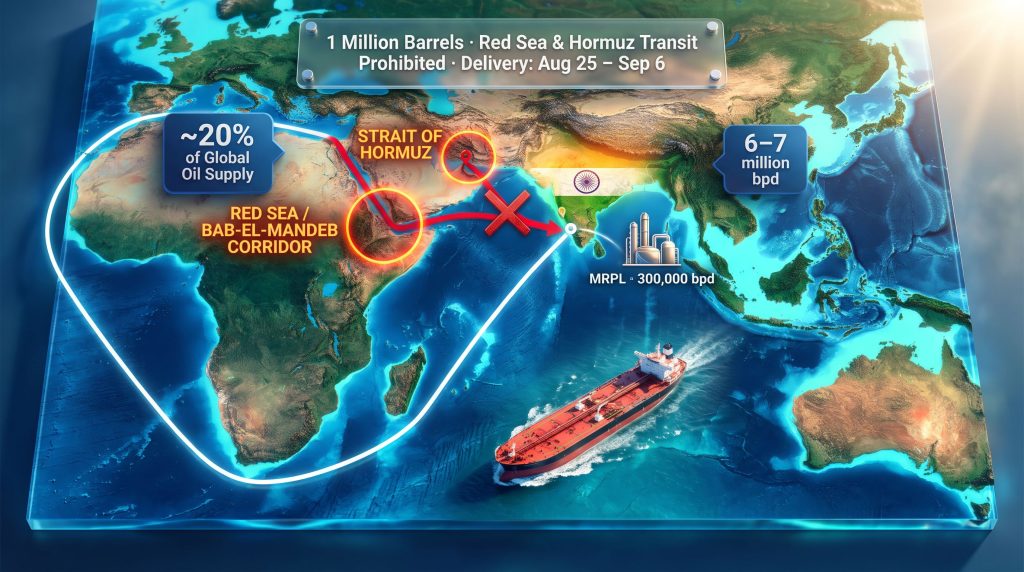
The MRPL crude tender avoiding Red Sea and Strait of Hormuz is not a footnote or an informal preference communicated through back channels. It is a binding contractual condition embedded directly into the tender documentation for a spot crude import covering up to 1 million barrels, targeting delivered arrival between August 25 and September 6, 2026.
The clause is unambiguous in its scope: crude loading or transit via the Red Sea route or the Strait of Hormuz is prohibited. Suppliers must demonstrate alternative delivery capability to qualify. This makes MRPL the first Indian state-owned refiner to formalise maritime route avoidance as a procurement qualification criterion, establishing a commercial precedent with potentially far-reaching consequences for how Indian buyers engage with Middle Eastern crude suppliers.
Critically, industry sources with direct knowledge of the matter have confirmed that this clause is not a one-off response to a temporary spike in tension. It is expected to appear in every subsequent MRPL import tender for as long as the geopolitical situation across the Middle East remains unresolved. That framing transforms the clause from a tactical workaround into a structural feature of MRPL's procurement architecture.
Furthermore, according to Reuters reporting on the tender, MRPL's previous crude import tender was not awarded, suggesting early-stage friction between emerging route requirements and supplier willingness or ability to comply at commercially viable freight rates.
Two Chokepoints, Two Distinct Threat Vectors
To understand the weight behind MRPL's decision, it is essential to examine the specific threat dynamics operating simultaneously across both restricted corridors. Understanding geopolitical oil risks of this nature requires looking at each corridor independently.
The Red Sea: Houthi Maritime Interdiction as a Strategic Weapon
The southern Red Sea and the Bab-el-Mandeb strait have become contested maritime territory. Tehran-aligned Houthi forces operating from Yemen have conducted an escalating campaign targeting commercial shipping in this corridor, with the stated objective of blockading Saudi Arabian crude exports. This campaign sits within the broader arc of US-Iran regional conflict, with commercial tanker operators caught between the operational realities of their contracts and the physical danger of transit.
The commercial consequences are measurable:
- Shipowners operating Very Large Crude Carriers (VLCCs) and Suezmax tankers have increasingly chosen to reroute around the Cape of Good Hope rather than risk interdiction
- The Red Sea corridor carries an estimated 6 to 7 million barrels per day of oil under normal operating conditions
- Rerouting via the Cape of Good Hope adds approximately 10 to 14 additional sailing days per voyage, depending on origin and destination ports
- Per-voyage operating costs for rerouted tankers are estimated to increase by 15 to 25% depending on vessel class and prevailing fuel prices
The Strait of Hormuz: The Iran Dimension and Its Asymmetric Risk Profile
The Strait of Hormuz presents a fundamentally different risk profile. Roughly 20 to 21% of globally traded oil passes through this narrow waterway annually, representing approximately 20 million barrels per day under normal conditions. Unlike the Red Sea, the Strait of Hormuz has no direct maritime bypass. Tankers carrying Gulf crude to Asian markets must either transit the strait or access overland pipeline alternatives of limited aggregate capacity.
Escalating US-Iran tensions have elevated the credible threat of deliberate interference with tanker movements through the strait. Moreover, the oil price movements associated with Hormuz disruption events have historically been among the most acute in global energy markets. Industry reporting indicates that MRPL and at least one other Indian state refiner had already suspended Iraqi crude loadings due to Hormuz-related security concerns prior to issuing this tender, signalling that operational caution had been building for some time before the clause was formally codified.
| Chokepoint | Estimated Daily Oil Flow | Primary Risk Actor | Maritime Bypass Available |
|---|---|---|---|
| Strait of Hormuz | ~20 million bpd | Iran-linked forces | No direct bypass |
| Red Sea / Bab-el-Mandeb | ~6-7 million bpd | Houthi forces (Yemen) | Cape of Good Hope |
The Bypass Infrastructure Reality: Partial Solutions to a Structural Problem
For suppliers attempting to comply with MRPL's routing restriction, two principal alternatives exist, both carrying meaningful limitations.
Cape of Good Hope Circumnavigation
The dominant maritime response to Red Sea closure has been routing tankers around the southern tip of Africa. This adds substantial voyage time and cost but eliminates exposure to both the Bab-el-Mandeb strait and, depending on origin, reduces proximity to Hormuz risk zones. For West African, US Gulf Coast, and Latin American crude suppliers, this routing is already their natural path to Indian ports, which is precisely why these grades are becoming more commercially attractive under current conditions.
Pipeline Bypass Infrastructure in the Gulf
Two overland pipeline systems offer partial Hormuz avoidance for Gulf producers:
- Saudi Arabia's East-West Pipeline moves crude from Eastern Province fields to the Yanbu terminal on the Red Sea coast. However, Yanbu is located north of the Bab-el-Mandeb bottleneck, meaning that if the entire Red Sea corridor is compromised, this bypass loses significant practical utility.
- The UAE's Abu Dhabi Crude Oil Pipeline connects Abu Dhabi fields directly to the Fujairah terminal on the Gulf of Oman, entirely circumventing the Strait of Hormuz. Its operational capacity is approximately 1.5 million barrels per day, which represents meaningful but ultimately insufficient relief given the volume of Gulf crude exports dependent on maritime routing.
The Fujairah terminal has evolved into a critical strategic buffer point precisely because of Hormuz risk scenarios. However, its pipeline-fed capacity represents only a fraction of the total Gulf export volume that would require rerouting in a sustained Hormuz closure event, meaning supply gaps would emerge rapidly at scale.
India's Structural Crude Dependency: The Amplifying Factor
India's exposure to chokepoint disruption is not incidental. It is structurally embedded in the country's refining geography. India is the world's third-largest crude oil importer, processing approximately 5 million barrels per day across its national refinery network. The crude oil market dynamics of Middle Eastern supply mean that roughly 60 to 65% of total crude imports in a typical year flow from that region, reflecting decades of supply relationships built on geographic proximity and price competitiveness.
Iraq alone accounts for approximately 20 to 22% of India's total crude imports, making it the single largest supplier nation. All significant Iraqi export volumes to Asia transit the Strait of Hormuz, creating a direct and acute vulnerability should that corridor face sustained interference.
Key alternative crude sources available to Indian refiners under MRPL's routing restrictions include:
- West African grades such as Nigerian Bonny Light and Angolan crude, naturally routed via the Atlantic or Indian Ocean with no Gulf chokepoint exposure
- US Gulf Coast crude including WTI Midland and Eagle Ford grades, which transit the Atlantic Basin entirely independently of Gulf waterways
- Brazilian pre-salt grades, with growing export volumes offering Indian refiners a non-Gulf diversification option
- East African supplies, an emerging category with routing advantages for southern Indian coastal refineries including MRPL's Mangalore facility
The freight premium embedded in sourcing from these alternative origins will vary, but the directional cost increase is real and must be factored into refinery margin calculations.
Scenario Analysis: What Sustained Dual-Chokepoint Disruption Would Mean
The following scenarios represent analytical projections based on historical chokepoint disruption analogues and current geopolitical trajectories. They are not forecasts and should not be interpreted as investment advice.
Scenario A: Partial Disruption (Approximate Current Baseline)
The Red Sea remains operationally constrained by Houthi activity; the Strait of Hormuz remains technically open but carries an elevated geopolitical risk premium. Indian refiners absorb incremental freight cost increases of 10 to 15%; Cape of Good Hope rerouting becomes standard for risk-averse tanker operators; Middle Eastern crude differentials widen modestly.
Scenario B: Escalated Hormuz Closure
Iranian interference leads to a temporary or partial Hormuz closure. Global oil prices spike sharply. UAE Fujairah pipeline capacity becomes overwhelmed by competing demand. Indian refiners face acute supply gaps for Iraqi and Kuwaiti grades. Emergency spot procurement at significant premiums becomes necessary, and strategic petroleum reserve drawdowns emerge as a probable policy response.
Scenario C: Simultaneous Full Disruption
Both corridors are effectively closed to commercial tanker traffic. Based on historical chokepoint disruption analogues, an estimated 25 to 30% of globally traded seaborne crude would face rerouting or direct supply interruption. Price shock scenarios in this range have historically corresponded to oil price spikes in the order of $20 to $40 per barrel above prevailing baseline, depending on duration and strategic reserve deployment dynamics.
The next major ASX story will hit our subscribers first
MRPL Refinery Profile at a Glance
| Metric | Detail |
|---|---|
| Refinery Capacity | 300,000 barrels per day |
| Location | Mangalore, Karnataka, Southern India |
| Parent Company | Oil and Natural Gas Corporation (ONGC) |
| Tender Volume | Up to 1 million barrels (spot) |
| Delivery Window | August 25 to September 6, 2026 |
| Routing Restriction | Red Sea and Strait of Hormuz transit prohibited |
| Tender History | Previous tender not awarded |
MRPL's southwestern coastal position makes it a natural recipient of Arabian Sea crude deliveries, which is precisely why the convergence of Red Sea and Hormuz risk hits its supply chain with particular intensity. The refinery processes a significant proportion of Middle Eastern grades, and any prolonged restriction on those supply corridors creates direct operational pressure on throughput and margin planning.
Procurement as Policy: What the Clause Signals Beyond Operational Caution
The deeper significance of this MRPL crude tender avoiding Red Sea and Strait of Hormuz restrictions lies not in the mechanics of a single procurement document, but in what it reveals about the shifting philosophy of energy security management within India's state refining sector.
For most of the past two decades, Indian state refiners operated procurement strategies optimised primarily around price. Geographic and geopolitical risk was treated as a secondary consideration, manageable through market mechanisms and short-term spot purchasing flexibility. The formalisation of a routing restriction clause inverts this hierarchy, placing supply chain resilience above cost optimisation as the primary procurement variable, at least in the current risk environment.
Several broader implications follow from this shift:
- Supplier qualification standards are rising. The ability to guarantee chokepoint-free delivery is now a commercial capability that suppliers must demonstrate, not merely assume.
- Cost structures for compliant cargoes will carry permanent freight premiums. These premiums will flow through refinery economics and, ultimately, into domestic fuel pricing dynamics.
- A procurement template is being established. Other major Indian state refiners, including Indian Oil Corporation (IOC), Bharat Petroleum (BPCL), and Hindustan Petroleum (HPCL), are likely monitoring the outcomes of MRPL's tender process closely. A successful award under these conditions could accelerate sector-wide adoption of similar routing clauses.
- Supplier relationships with Gulf producers face structural reassessment. Long-standing supply partnerships with Iraqi, Kuwaiti, and other Gulf exporters remain commercially viable in principle, but depend increasingly on those exporters' ability to offer Hormuz-free or Red Sea-free delivery mechanisms.
The institutionalisation of route avoidance in tender documentation represents a shift from reactive risk management — which responds to specific incidents — toward anticipatory risk architecture, which embeds resilience assumptions directly into procurement design before disruptions occur. This is a meaningful evolution in how sovereign energy buyers think about supply chain risk.
What the Market Should Watch Next
The immediate question hanging over MRPL's current tender is whether a sufficient pool of compliant suppliers exists to generate a competitive award. The previous tender's non-award suggests the market is still calibrating around these new conditions. As reported by the Economic Times, the trade war impacts on global energy flows are adding further complexity to an already strained supply environment. Key indicators to monitor include:
- Whether the current tender receives sufficient bids from suppliers offering Cape of Good Hope or pipeline-routed deliveries
- The freight differential that ultimately clears between compliant and non-compliant cargoes, which will establish a real-time price for geopolitical risk avoidance in Indian crude procurement
- Whether other Indian state refiners begin inserting equivalent clauses into their own spot tender documentation in subsequent procurement cycles
- The degree to which Red Sea Houthi activity and US-Iran Hormuz tensions show any signs of de-escalation that might prompt MRPL to revise its clause in later tender rounds
Monitoring current crude oil prices alongside these developments will be essential for understanding how markets are pricing the cumulative risk premium embedded in dual-chokepoint disruption scenarios. The MRPL crude tender avoiding Red Sea and Strait of Hormuz routes is, in isolation, a single procurement document covering one million barrels and a twelve-day delivery window. In context, it is an early indicator of a structural realignment in how India, the world's third-largest oil importer, is beginning to price and manage the geopolitical risk embedded in its energy supply chains.
Want to Stay Ahead of Resource Discoveries Reshaping Global Commodity Markets?
As geopolitical disruption rewires energy supply chains and redirects commodity flows, Discovery Alert's proprietary Discovery IQ model scans ASX announcements in real time, instantly identifying significant mineral discoveries before the broader market reacts — explore historic discovery returns on Discovery Alert's discoveries page to see what early positioning can mean, then begin a 14-day free trial at Discovery Alert to secure an actionable edge in today's rapidly shifting resource landscape.