July 27, 2026
The Hidden Fragility Behind the Numbers: What Jamaica's Bauxite and Alumina Earnings Trajectory Really Tells Us
Global aluminium supply chains depend on a web of raw material flows that most end-users never consider. At the very foundation of that web sits bauxite, the reddish sedimentary ore that must first be refined into alumina before it can be smelted into primary aluminium used in everything from aircraft frames to beverage cans. Caribbean producers, and Jamaica in particular, have supplied that foundational layer for decades. Understanding the current state of the Jamaica bauxite and alumina export earnings forecast for 2026 requires looking beyond the headline recovery figure and examining what the numbers actually reveal about sector resilience, pricing dynamics, and structural vulnerabilities that no short-term rebound can fully address.
When big ASX news breaks, our subscribers know first
Why Jamaica's Position in the Aluminium Value Chain Is Easy to Underestimate
The aluminium value chain moves through three distinct stages before a finished metal product exists: bauxite mining, alumina refining, and primary smelting. Each stage represents a significant transformation in both physical form and economic value. Jamaica operates primarily at the first two stages, exporting crude bauxite and processed alumina rather than finished metal.
What Makes Jamaican Ore Distinctive?
What distinguishes Jamaican bauxite within the global supply picture is its mineralogical composition. The island's deposits are predominantly gibbsite-type bauxite, a form that requires less energy to refine compared to boehmite-dominant ores found in parts of Australia and Guinea. This characteristic makes Jamaican ore attractive to refiners managing energy cost pressures, particularly in markets where electricity prices are elevated.
The ore's relatively low reactive silica content also reduces caustic soda consumption during Bayer process refining, which has a direct positive impact on operating costs per tonne of alumina produced. Trends across the bauxite and alumina market continue to highlight these quality differentials as a meaningful competitive factor for Caribbean producers.
Despite these quality advantages, Jamaica's absolute scale remains modest relative to dominant global producers. Guinea, Australia, and Brazil collectively account for the majority of world bauxite trade. Jamaica competes not on volume but on quality consistency and geographic proximity to certain refining markets, particularly in North America.
This niche positioning means that pricing power is constrained by what the broader market sets, while any disruption to Jamaican supply still carries disproportionate significance for the specific refineries that have built their procurement around Caribbean-origin material.
The Jamaican government discloses export earnings data through its annual Form 18-K filing with the U.S. Securities and Exchange Commission, a reporting obligation that provides an unusually transparent window into sovereign-level commodity earnings. This disclosure mechanism makes Jamaica's earnings trajectory one of the most trackable in the Caribbean mining sector.
What Do the Numbers Actually Show? A 2024 to 2026 Earnings Trajectory
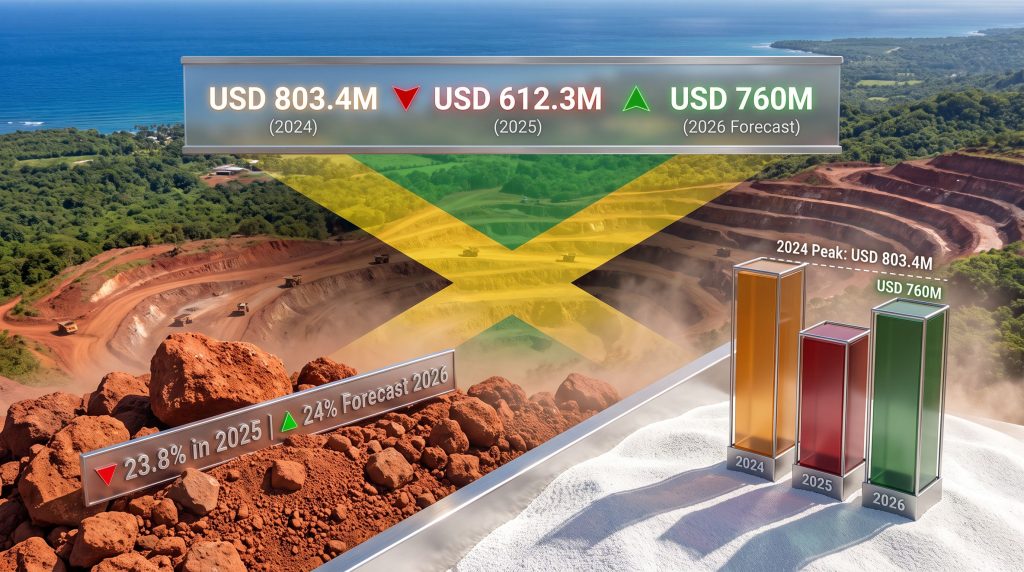
The three-year earnings picture for Jamaica's bauxite and alumina sector tells a story of peak, contraction, and partial recovery, with the current trajectory best described as a stabilisation rather than a genuine return to prior strength.
Jamaica Bauxite and Alumina Export Earnings: Three-Year Snapshot
| Year | Export Earnings (USD) | Year-on-Year Change |
|---|---|---|
| 2024 | USD 803.4 million | Baseline |
| 2025 | USD 612.3 million | -23.8% (-USD 191.1 million) |
| 2026 (Forecast) | USD 760 million | +24% |
Even achieving the full-year 2026 forecast of USD 760 million would leave Jamaica approximately USD 43 million below its 2024 earnings peak, confirming that the current trajectory represents a recovery phase rather than a return to previous highs.
The 2025 contraction of USD 191.1 million, or 23.8 percent, was driven by a convergence of pricing weakness and volume declines that compounded each other across the reporting period. Alumina earnings fell to USD 546.3 million as the average realised price dropped to USD 385.50 per tonne and export volumes declined roughly 9 percent to approximately 1.42 million tonnes.
When both the price per unit and the number of units sold fall simultaneously, the earnings impact is multiplicative rather than additive. This explains why the revenue decline appears disproportionate relative to either metric individually.
Crude bauxite provided a partial offset to the alumina weakness. Export earnings from crude bauxite rose 18 percent to USD 66 million, supported by a 16.7 percent increase in average price to USD 38.20 per tonne. This divergence between the crude bauxite and alumina segments highlights an important structural feature of the Jamaican export mix: the two products are priced according to different mechanisms and serve different buyer categories.
Total bauxite production in 2025 declined 4.4 percent to approximately 5.62 million tonnes, a modest volume reduction that, combined with weak pricing, produced the outsized earnings contraction observed at the sector level.
Q3 2025 Context: The Weight of the First Half
Through the first three quarters of 2025, the sector had accumulated approximately USD 512.52 million in export earnings. Quarter-on-quarter performance through Q3 2025 was broadly flat compared to the equivalent period in 2024, which implies that the full-year shortfall was concentrated in the second half of the year, when pricing weakness and volume headwinds were most acute.
This timing pattern is significant because it means the entering baseline for 2026 is a sector already trending weaker into the new year, a context that makes the Q1 2026 disruption from Hurricane Melissa even more consequential.
How Hurricane Melissa Reshaped Jamaica's Mining Output in Q1 2026
Natural disasters impose costs on extractive industries that extend well beyond the immediate destruction of physical assets. When mining and processing infrastructure is damaged, the production losses are not simply deferred; in many cases they are permanently foregone because the ore that would have been extracted during the downtime cannot be recovered after the fact. Hurricane Melissa illustrated this dynamic with unusual severity in Q1 2026.
Q1 2026 Production Data: Quantifying the Disruption
| Metric | Q1 2026 | Q1 2025 | Change |
|---|---|---|---|
| Alumina production | 267,060 tonnes | ~383,000 tonnes (est.) | -30.3% |
| Crude bauxite production | 415,143 tonnes | ~563,900 tonnes (est.) | -26.4% |
| Alumina exports | 319,600 tonnes | 358,070 tonnes | ~-10.7% |
| Crude bauxite exports | 384,276 tonnes | ~546,500 tonnes (est.) | -29.7% |
A 30.3 percent year-on-year decline in quarterly alumina production and a 26.4 percent decline in crude bauxite output represent one of the sharpest single-quarter contractions in Jamaica's recent mining history. The export figures, while somewhat smaller in percentage terms, reflect the partial buffer provided by inventory drawdowns and pre-existing shipment commitments fulfilled from stockpiles rather than fresh production.
A 30 percent production decline in a single quarter is not simply a statistical event. For refineries that depend on consistent Jamaican alumina supply, it triggers procurement contingency planning, which may mean activating alternative supplier contracts, drawing down strategic inventories, or accepting higher spot prices from other origins.
The government has indicated that repair and rehabilitation work at mining and processing facilities will continue throughout 2026, with bauxite production targeted at approximately 6.4 million tonnes for the full year. Achieving that figure from a base of 5.62 million tonnes in 2025 requires a 14 percent production increase, most of which must materialise in the second half of the year given the Q1 deficit already recorded.
Is the 24 Percent Earnings Recovery Forecast Realistic?
The USD 760 million projection for 2026 is a government forecast, not a guaranteed outcome, and it rests on a set of assumptions that deserve explicit examination.
Core Assumptions Behind the Forecast
- Hurricane-damaged infrastructure is repaired and returns to operational capacity within the projected timelines.
- Alumina pricing recovers from the USD 385.50 per tonne average recorded in 2025, which was a cyclically weak level relative to historical ranges.
- Export volumes recover toward 2024 levels as processing capacity is restored and output ramps through H2 2026.
- No further major weather disruptions, shipping route interruptions, or geopolitical events materially affect export flows.
Furthermore, commodity export market pressures affecting global trade flows remain a relevant consideration for Jamaican export planners. It is worth noting that alumina is typically priced as a percentage of the London Metal Exchange aluminium price rather than as an independently quoted commodity.
When LME aluminium prices are soft or when the percentage basis narrows due to oversupply in the alumina market, realised prices per tonne can fall sharply even if LME aluminium itself remains relatively stable. The 2025 average of USD 385.50 per tonne suggests that both the percentage basis and the underlying aluminium price were working against Jamaican producers simultaneously.
Scenario Analysis: Upside and Downside Pathways
Factors that could support the recovery:
- A tightening of global alumina supply driven by production disruptions elsewhere, particularly in West Africa or Australia
- Faster-than-expected completion of infrastructure repairs enabling H1 2026 volumes to partially recover before Q2 ends
- Increased demand from Asian aluminium smelters diversifying their alumina procurement away from dominant regional suppliers
- A recovery in LME aluminium prices that mechanically lifts alumina spot prices through the percentage-of-metal pricing linkage
Factors that could prevent the recovery:
- Repair timelines extending further into H2 2026, reducing the available window for volume recovery
- Continued alumina price softness if major global refineries maintain high operating rates and the market remains oversupplied
- Additional weather events during the Atlantic hurricane season that compound existing infrastructure vulnerabilities
- Currency and freight cost movements that reduce net realised earnings even where gross export values improve
If alumina prices recover by 10 to 15 percent above the 2025 average and production reaches the targeted 6.4 million tonnes, the USD 760 million forecast is mathematically achievable. However, given the Q1 production deficit already locked in, the margin for execution error in Q2 through Q4 is narrow.
Jamaica's Competitive Position Within Global Bauxite Market Dynamics
Supply Concentration and the Caribbean Differentiation Story
Global bauxite production is heavily concentrated among a small number of countries. Guinea has emerged as the dominant force in seaborne bauxite trade, having expanded exports rapidly over the past decade and now accounting for a substantial share of global bauxite shipments. Australia remains the world's largest producer by volume, with its Northern Territory operations supplying integrated alumina refineries both domestically and internationally.
Jamaica occupies a differentiated position in this hierarchy. While it cannot compete on volume with Guinea or Australia, its gibbsite-dominant ore chemistry offers operational advantages to refiners managing specific cost profiles. Crucially, Jamaica's geographic position reduces shipping distances and transit times for buyers in the eastern United States and parts of Europe, providing a logistical cost advantage that partially offsets its inability to compete on scale.
The competitive risk for Jamaica comes from two directions simultaneously. West African producers, particularly in Guinea, continue to expand capacity at a pace that pressures global bauxite pricing. Among the leading bauxite mines, those in Guinea have consistently demonstrated the capacity to ramp output quickly, creating sustained pricing headwinds for smaller producers.
At the same time, Australian alumina refineries, which have among the highest operating cost structures globally due to energy prices, periodically curtail output in ways that tighten the alumina market and benefit Jamaican producers through higher prices.
Understanding How Alumina Is Priced
A less commonly understood feature of the alumina market is its pricing mechanism. Unlike most industrial commodities that trade on established exchanges with real-time price discovery, alumina is most commonly priced through bilateral contracts that reference a percentage of the prevailing LME aluminium price. This percentage, sometimes called the alumina-to-aluminium ratio, has historically ranged between approximately 12 and 20 percent of the LME price, though it has been subject to significant variation depending on market conditions.
When the ratio compresses during periods of alumina oversupply, producers receive a smaller share of the final metal value for their intermediate product, squeezing margins without any change in physical volumes. This is precisely the dynamic that contributed to Jamaica's 2025 earnings decline. Understanding this linkage is essential for interpreting the Jamaica bauxite and alumina export earnings forecast because it means a recovery in earnings does not require Jamaica to produce more bauxite; it can be achieved entirely through pricing normalisation even at current output levels.
The next major ASX story will hit our subscribers first
Long-Term Structural Challenges the Earnings Forecast Cannot Resolve
Climate Exposure as a Recurring Operational Risk
Hurricane Melissa is not an isolated event in Jamaican mining history. The island sits within the Atlantic hurricane belt, and the frequency of major storm events in the Caribbean has been increasing in recent decades as ocean surface temperatures rise. Mining and alumina processing infrastructure requires significant capital investment to build, and the economics of upgrading legacy facilities to withstand higher-category storm events are challenging given the sector's cost structure.
The practical implication is that weather-related production disruptions should be treated as a recurring cost of operating in Jamaica rather than a one-off shock. Investors, buyers, and analysts who model Jamaican supply without incorporating a meaningful probability of periodic weather disruption will systematically overestimate the sector's production consistency.
Reserve Quality and the Long Runway Question
Jamaica's bauxite reserves, while still substantial in absolute terms, have been mined for over seven decades. The highest-grade, most accessible deposits were prioritised in earlier periods of production, meaning that remaining reserves in some areas require more complex mining methods and carry higher stripping ratios. This dynamic gradually increases per-unit production costs over time, compressing the margin between market prices and extraction costs even when prices are stable.
The case for expanding domestic alumina refining capacity has been discussed periodically by policymakers and industry participants. Moving further down the value chain would increase the economic return per tonne of bauxite mined and reduce Jamaica's direct exposure to raw material price swings.
However, such investments require significant capital commitments, reliable energy supply at competitive cost, and long-term offtake agreements with smelters. In addition, major aluminium producers have their own strategic procurement considerations that influence whether such offtake arrangements can be secured on commercially viable terms.
Key Takeaways: Reading Jamaica's 2026 Earnings Outlook Clearly
- The Jamaica bauxite and alumina export earnings forecast for 2026 stands at USD 760 million, a 24 percent recovery from 2025's USD 612.3 million, but approximately USD 43 million below the 2024 peak of USD 803.4 million
- The 2025 contraction was driven by dual headwinds of lower alumina prices (USD 385.50 per tonne) and a 9 percent decline in alumina export volumes
- Crude bauxite provided a partial counterweight, with earnings rising 18 percent to USD 66 million on price strength
- Hurricane Melissa caused alumina production to fall 30.3 percent and crude bauxite output to drop 26.4 percent in Q1 2026 relative to the same period the prior year
- The 2026 recovery forecast requires bauxite production to reach 6.4 million tonnes, a 14 percent increase over 2025, with the majority of that growth needing to materialise in H2 2026
- Alumina pricing recovery above the 2025 average is a necessary condition, not merely a helpful tailwind, for achieving the earnings target
- Structural risks including recurring hurricane exposure, gradual reserve grade evolution, and competitive pressure from high-volume producers in Guinea and Australia represent factors that extend well beyond the 2026 forecast horizon
Disclaimer: This article contains forward-looking projections sourced from publicly available government filings. These figures represent forecasts subject to material change based on market conditions, weather events, pricing movements, and operational developments. Nothing in this article constitutes investment advice. Readers should conduct independent research before making any financial decisions.
Want to Track the Next Major Mineral Discovery Before the Broader Market Does?
Discovery Alert's proprietary Discovery IQ model delivers real-time alerts on significant ASX mineral discoveries, turning complex commodity data into clear, actionable insights for both short-term traders and long-term investors — explore the historic returns major discoveries have generated and begin your 14-day free trial today to position yourself ahead of the market.