
July 27, 2026
The Hidden Architecture of a Metal Market Under Stress
Most commodity price dislocations begin not with a headline, but with a quiet erosion of the buffers that market participants take for granted. Warehouse inventories are among the least glamorous metrics in commodities trading, yet they function as the circulatory system of physical metal markets. When those buffers compress rapidly, the implications extend far beyond the exchange floor, touching manufacturers, procurement managers, investors, and geopolitical risk analysts alike.
The aluminium market entered the second half of 2026 facing precisely this kind of structural stress. LME aluminium stocks fall to lowest this century is not an abstract statistical curiosity. It reflects a convergence of geopolitical disruption, supply chain fragility, and a market that may have been lulled into complacency by medium-term surplus forecasts that rest on assumptions increasingly difficult to defend.
When big ASX news breaks, our subscribers know first
Understanding LME Warehouse Inventories as a Real-Time Market Signal
What the Numbers Actually Represent
The London Metal Exchange operates a global network of licensed warehouses where primary aluminium can be deposited and withdrawn against exchange contracts. The total tonnage held within this system at any given moment represents the most transparent, independently verified measure of immediately accessible physical metal available to market participants worldwide.
Two inventory categories carry particular analytical weight:
- On-warrant stocks represent metal that remains within the LME system and is available for trading and physical delivery. These are the units a buyer can claim against a futures contract.
- Cancelled warrants represent metal that has been earmarked for physical removal from LME warehouses. Once a warrant is cancelled, that tonnage is effectively leaving the exchange system and is no longer available to other market participants.
The ratio of cancelled warrants to total on-warrant stock is one of the most reliable short-term leading indicators of further inventory declines. A spike in cancellations signals that physical buyers are pulling metal out of the system, typically because they anticipate either tighter availability or rising prices ahead.
Why Absolute Tonnage Figures Require Contextual Scaling
A critical but frequently overlooked dimension of LME inventory analysis is that raw tonnage figures mean very little without being scaled against current market size. Global aluminium consumption has grown dramatically over the past 25 years, driven by expanded use in automotive lightweighting, packaging, construction, and increasingly in battery and energy transition applications.
Duncan Hobbs, research director at Concord Resources, noted that the aluminium market today is vastly larger than it was in the late 1990s, meaning that LME stock levels which may have appeared adequate a quarter-century ago now represent a fraction of a single day's global consumption (Reuters, July 2026). This scaling effect makes the current inventory reading structurally more severe than any direct tonnage comparison to historical lows would suggest.
How Far Have LME Aluminium Stocks Actually Fallen?
The July 2026 Data in Full
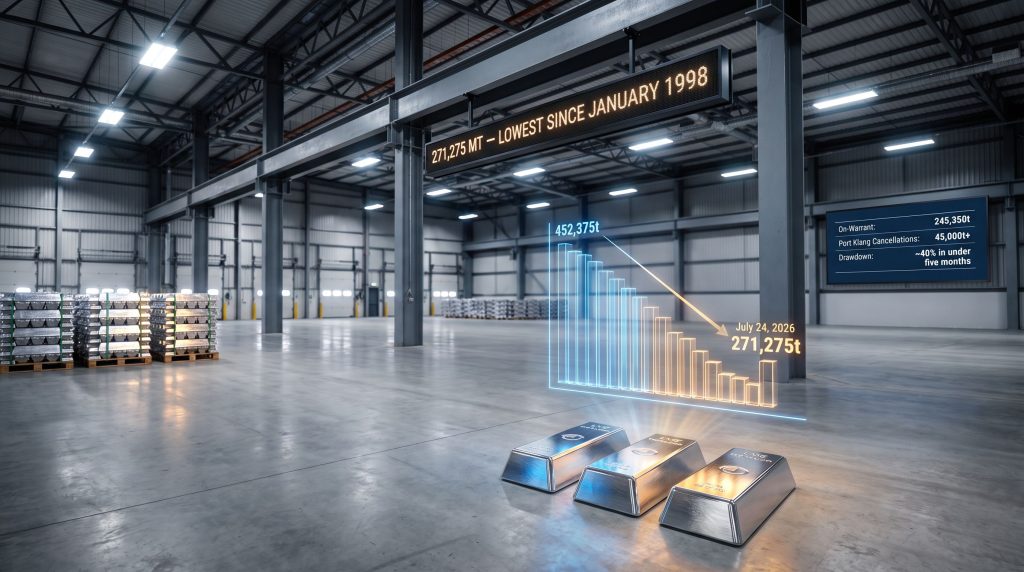
On July 24, 2026, total LME aluminium warehouse stocks stood at 271,275 metric tons, according to data published by the exchange. This represents the lowest total inventory reading in LME records extending back to January 1998, a span of nearly three decades. Furthermore, when this figure is viewed in context of broader aluminium tariff impacts reshaping global trade flows, the structural fragility of current supply becomes even more pronounced.
On-warrant stocks, the subset of that total that remains genuinely available within the system, stood at 245,350 tons on the same date, the lowest reading since April 2025.
To contextualise this figure against actual market demand: 271,275 metric tons equates to less than one full day of global aluminium consumption, a ratio that underscores just how thin the exchange-accessible buffer has become.
The Speed of the Drawdown
The scale of the inventory decline is matched by its velocity. The following table traces the trajectory of LME aluminium stocks across the first seven months of 2026:
| Period | Total LME Aluminium Stocks | Key Context |
|---|---|---|
| Late January 2026 | ~452,375 tons | Pre-drawdown baseline |
| March 2026 | ~452,375 tons | Port Klang cancellations begin |
| Early July 2026 | ~295,550 tons | Down 40%+ since late January |
| July 24, 2026 | 271,275 tons | Lowest in LME records since 1998 |
| End-2022 | Near century-low at the time | Previous benchmark low |
The decline from approximately 452,375 tons in late January to 271,275 tons by late July represents a fall of roughly 40% in under five months. This is not the gradual drift of a softening market; it is a rapid compression that reflects acute physical demand outpacing exchange-deliverable supply.
In March 2026 alone, over 45,000 tons of aluminium cancellations were recorded at Port Klang warehouses in Malaysia, a concentration of regional warrant cancellations that foreshadowed the broader drawdown. This pattern is consistent with Asian industrial consumers aggressively securing metal ahead of anticipated tightness, a behaviour that itself accelerates the very scarcity it anticipates.
The Geopolitical Engine Behind the Drawdown
Strait of Hormuz Disruption and Gulf Smelter Constraints
The primary driver of the 2026 drawdown is not a collapse in aluminium supply chains broadly, but a highly specific and geographically concentrated disruption. Gulf-region aluminium smelters, which collectively represent a significant share of global primary aluminium production, rely on the Strait of Hormuz as their principal maritime corridor for both inbound raw material flows and outbound finished metal exports.
Ongoing conflict in the Middle East has materially disrupted shipping through this chokepoint. The consequences for Gulf smelters are twofold:
- Inbound raw material constraints: Alumina, the refined precursor to primary aluminium, must be imported by Gulf smelters. Restricted shipping lanes limit their ability to maintain full operational throughput.
- Outbound export bottlenecks: Even where smelters can maintain production, the ability to move finished metal to global buyers is constrained, reducing the effective supply available to international consumers.
As Hobbs noted via Reuters, the disruption in the Strait of Hormuz is making it genuinely difficult for Gulf smelters to bring in raw materials and ship out their metal. This is a geopolitically-induced supply shock, not a demand-side phenomenon, and that distinction matters enormously for how the market should interpret current inventory levels and price signals.
How Smelter Constraints Translate to Warehouse Drawdowns
When primary aluminium producers in a major supply region cannot deliver reliably to global buyers, those buyers turn to the next available source of physical metal: exchange-held inventories. LME warehouses function as the market's buffer stock, and a sustained drawdown of this nature is the clearest possible signal that physical consumption is running ahead of exchange-deliverable supply.
The fact that the drawdown has continued for five months without meaningful reversal suggests this is not a short-term logistical disruption. It points to a structural supply deficit that the market's medium-term outlook may not be adequately capturing. Concerns around metals supply security have consequently intensified across both public and private sector planning frameworks.
The Complacency Problem: Surplus Projections vs. Physical Reality
The Disconnect Between Paper Forecasts and Physical Tightness
Perhaps the most strategically important dimension of the current situation is the divergence between what financial market models are projecting and what physical inventory data is showing. Consensus forecasts for the aluminium market project surpluses in both 2027 and 2028, a forward outlook that might reasonably lead investors and procurement teams to adopt a wait-and-see posture.
However, those surplus projections rest on a critical assumption: that Gulf smelter output normalises and that Strait of Hormuz shipping lanes return to unrestricted operation. With no confirmed resolution to the underlying geopolitical disruption, these assumptions remain highly uncertain.
Hobbs characterised this as a market that may be too complacent about supply risks (Reuters, July 2026), a warning that the comfortable medium-term outlook embedded in forward curves may be underpricing the probability of continued physical tightness. In addition, ongoing debates around steel and aluminium tariffs further complicate the supply and pricing outlook for the year ahead.
Scenario Analysis: Four Pathways from Here
| Scenario | Assessment | Inventory Trajectory | Price Implication |
|---|---|---|---|
| Rapid Hormuz normalisation | Low-to-moderate probability | Recovery toward 400,000+ tons | Bearish near-term |
| Prolonged disruption (6-12 months) | Moderate probability | Breach of 200,000-ton threshold | Strongly bullish |
| Partial recovery with firm demand | Moderate probability | Stabilisation at 250,000-300,000 tons | Neutral-to-bullish |
| Full restoration plus surplus realisation | Low near-term probability | Rebuild toward 500,000+ tons | Bearish medium-term |
The scenario matrix illustrates why this is an asymmetric risk environment. The downside case for prices requires a relatively swift and complete resolution of a complex geopolitical situation. The upside case for prices requires only that the status quo persists.
Implications Across the Value Chain
Industrial Consumers: Procurement Risk Is Materially Elevated
For manufacturers across the automotive, aerospace, packaging, and construction sectors, sub-300,000-ton LME inventory levels represent a procurement risk threshold that demands active management. Historically, inventory readings at this level correlate with tightening physical premiums, meaning the cost of sourcing metal outside of long-term contracts rises sharply.
Procurement strategies worth evaluating in this environment include:
- Accelerating strategic stockpiling while exchange stocks remain accessible
- Locking in long-term offtake agreements at current price levels before a further tightening cycle
- Diversifying supplier relationships away from Gulf-origin metal
- Incorporating geopolitical risk premiums into raw material cost modelling
Non-Gulf Producers: A Structural Tailwind
Primary aluminium smelters operating outside the conflict-affected region are the clearest beneficiaries of the current supply dislocation. Producers in Australia, Canada, Norway, and Iceland face no equivalent shipping constraints and are positioned to capture higher physical premiums as Gulf supply remains restricted.
The current environment may also accelerate aluminium sector investment in smelting capacity outside geopolitically exposed zones, as buyers increasingly seek to diversify their supply chains away from regions vulnerable to maritime disruption.
Investors and Traders: Navigating an Asymmetric Setup
For commodity market participants, the combination of record-low LME aluminium stocks fall to lowest this century readings, an identified geopolitical supply driver, and uncertain but potentially bullish duration creates a high-volatility, asymmetric risk profile. Long positions in aluminium futures are supported by physical tightness but remain exposed to rapid reversal if Gulf supply normalises unexpectedly.
The most reliable leading indicators to monitor in real time are:
- On-warrant stock trends: The critical available-metal figure within the LME system
- Cancelled warrant volumes: The forward-looking signal of imminent further drawdowns
- Gulf smelter operating rate data: The source of the supply disruption
- Strait of Hormuz shipping traffic: The geopolitical chokepoint at the heart of the story
Furthermore, monitoring real-time aluminium pricing data alongside LME inventory movements provides a more complete picture of market stress as it develops.
The next major ASX story will hit our subscribers first
Frequently Asked Questions
What does it mean when LME aluminium stocks fall to their lowest this century?
It means the quantity of primary aluminium held in LME-registered warehouses and available for exchange delivery has reached its lowest level in nearly three decades of recorded data. Given that global aluminium consumption is substantially larger today than it was in 1998, the effective coverage ratio, measured in days of global consumption, is likely at its most extreme on record.
Why does on-warrant stock matter more than total stock?
Total stock includes cancelled warrants, metal that has already been earmarked for physical removal and is no longer available to the broader market. On-warrant stock, at 245,350 tons as of July 24, 2026, is the more meaningful figure because it represents the metal actually accessible within the system. A high cancellation ratio signals that the effective buffer is thinner still.
Could inventories fall below 200,000 tons?
If Gulf smelter constraints persist without meaningful resolution, and if Asian industrial demand continues to draw down regional inventories as observed in Port Klang, the trajectory toward a sub-200,000-ton reading is plausible. There is no mechanical floor preventing further declines other than a reversal of the underlying supply disruption. Among leading aluminium producers, this prospect is being watched with considerable attention.
What would reverse the current trend?
A recovery in LME aluminium inventories would most likely require: resolution of Middle East conflict reducing Strait of Hormuz shipping disruptions, restoration of Gulf smelter raw material access and export capacity, or a meaningful softening in global aluminium demand. The projected 2027-2028 surpluses could materialise if supply chains normalise, but that assumption is currently doing significant heavy lifting in consensus forecasts.
Key Takeaways
- LME aluminium stocks reached 271,275 metric tons on July 24, 2026, the lowest level since records began in January 1998
- On-warrant availability of 245,350 tons represents less than one day of global consumption, an historically unprecedented tightness ratio
- The drawdown of approximately 40% in under five months reflects a geopolitically-driven supply shock centred on Strait of Hormuz disruption, not a demand collapse
- Port Klang cancellations exceeding 45,000 tons in a single month in March 2026 provided an early warning of the accelerating drawdown
- Projected surpluses for 2027 and 2028 may be overstating supply recovery assumptions given the persistence of Gulf smelter constraints
- The market may be under-pricing supply risk, creating an asymmetric opportunity for investors with conviction on continued disruption duration
Disclaimer: This article is provided for informational and educational purposes only and does not constitute financial or investment advice. Commodity markets are subject to rapid and unpredictable change. Readers should conduct independent research and seek qualified professional advice before making any investment or procurement decisions. Scenario projections and probability assessments presented in this article are analytical frameworks, not forecasts, and involve inherent uncertainty.
Want to Track the Next Major Mineral Discovery Before the Market Catches On?
Discovery Alert's proprietary Discovery IQ model delivers real-time alerts on significant ASX mineral discoveries, cutting through complex data to surface actionable opportunities the moment they are announced — explore historic discoveries and their extraordinary returns to understand what early positioning can mean, then begin your 14-day free trial at Discovery Alert to stay ahead of the market.