July 27, 2026
The Hidden Fault Lines in Global Aluminium Supply Chains
Commodity markets have a well-established relationship with uncertainty: they price it aggressively, then unwind it almost as fast. The pattern is familiar to anyone who has watched crude oil spike on Middle East headlines only to retrace within weeks. What makes the 2026 aluminium cycle genuinely instructive is not the initial surge itself, but the structural questions it has exposed about where global supply actually comes from, who holds the backup inventory, and whether Asia can reliably function as the world's swing producer when Gulf output disappears.
The LME aluminium price Middle East crisis dynamic of 2026 offers a rare case study in how geopolitical shocks interact with industrial supply chains that took decades to build and cannot be rebuilt overnight.
When big ASX news breaks, our subscribers know first
How the Crisis Repriced Aluminium From the Ground Up
From Baseline to Four-Year High: The Price Timeline
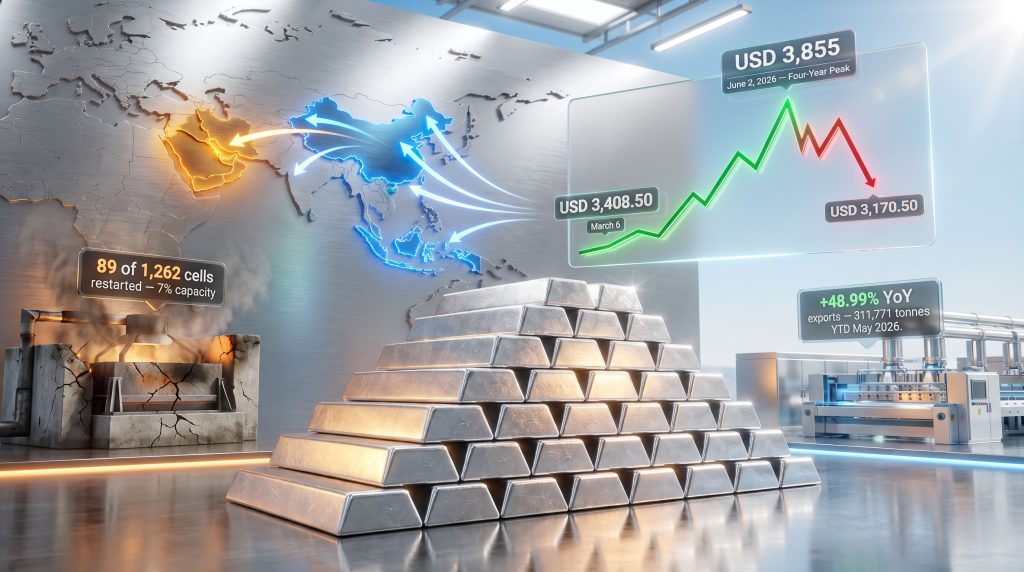
The LME three-month aluminium contract was trading at approximately USD 3,408.50 per tonne on March 6, 2026, when markets began to factor in the implications of intensifying conflict in the Middle East. Within three sessions, intraday prices touched USD 3,544 per tonne. By March 30, a single-day move of 3.85% signalled that trading desks were treating this as a structural supply event rather than a passing headline risk.
The peak arrived on June 2, 2026, when the contract closed at USD 3,855 per tonne, a level not seen in four years. By late July 2026, the same contract had retreated to approximately USD 3,170.50 per tonne, erasing nearly all of the geopolitical premium accumulated since late February. Furthermore, the aluminium tariffs impact on global trade flows had already created a fragile baseline before geopolitical pressures compounded the volatility.
| Date | LME Aluminium Price (USD/tonne) | Market Event |
|---|---|---|
| March 6, 2026 | ~3,408.50 | Crisis pricing begins |
| March 9, 2026 | ~3,544.00 (intraday) | Near four-year high |
| March 30, 2026 | ~3,423.00 | +3.85% single-day move |
| June 1-2, 2026 | 3,685-3,855 | Four-year peak reached |
| Late July 2026 | ~3,170.50 | Return toward pre-crisis range |
Why 9% of Global Output Moved the Entire Market
Gulf-region producers collectively supply roughly 9% of global primary aluminium output. That proportion sounds modest, but in a market where marginal supply and demand shifts of 1-2% routinely drive double-digit price moves, losing nearly a tenth of global production in a compressed timeframe is a seismic event.
Iranian missile strikes on March 28, 2026 caused confirmed physical damage to major Gulf smelting facilities. The International Aluminium Institute subsequently reported that Gulf aluminium output fell 20% during H1 2026, representing approximately 5% of annualised global supply removed from active production chains. In absolute tonnage terms, an estimated 2 million tonnes of annual capacity was disrupted.
Beyond the direct smelter damage, traders priced in a second layer of risk: the Strait of Hormuz. This narrow waterway is the primary export corridor for Gulf aluminium shipments and simultaneously the import route for alumina feedstock and petroleum coke, both essential inputs for smelter operations. When logistics risk compounds production risk, price responses tend to overshoot what confirmed supply data alone would justify, which is precisely what occurred.
According to Fast Markets, aluminium climbed sharply as Middle East conflict fuelled supply disruption risks, with the metal responding swiftly to both confirmed and anticipated logistical threats. Analysts at both ING and Citi characterised the initial rally as headline-driven risk pricing rather than a reflection of verified, sustained supply loss. Citi identified a potential pathway to USD 4,000 per tonne contingent on prolonged disruption and insufficient alternative supply emerging at scale.
Why the Futures Market Reversed Course
China's Export Surge: The Numbers Behind the Narrative
The speed and magnitude of the price reversal reflects the market's evolving assessment of one core question: could China and Indonesia collectively fill the void left by Gulf producers? The data suggests the answer, at least in aggregate terms, is partially yes.
According to International Trade Administration data, China's total aluminium product exports across all categories reached 2.68 million tonnes in YTD May 2026, up 10.46% year-on-year from 2.43 million tonnes in the equivalent 2025 period. The primary aluminium component is the more striking figure: primary exports jumped 53% year-on-year to 247,118 tonnes, compared with 161,505 tonnes in YTD May 2025.
Monthly shipments hit 595,000 tonnes in May 2026, the highest single-month volume since November 2024. Chinese smelters have been operating at close to 99% capacity utilisation, supported by lower alumina input costs and improved downstream margins, giving them both the incentive and the operational headroom to maximise output.
What is less widely appreciated is the structural reason Chinese smelters can respond this rapidly. Unlike Gulf facilities that depend on gas supply agreements and specific infrastructure configurations, many Chinese operations maintain flexible power arrangements and inventory buffers that allow output ramp-ups within relatively short windows. This operational agility is a meaningful differentiator when supply shocks require fast responses.
Indonesia's Structural Transformation Is Not Just a Crisis Story
Indonesia's contribution to the supply rebalancing deserves particular attention because it represents a decade-long structural shift rather than a temporary crisis response. Primary aluminium exports from Indonesia climbed to 311,771 tonnes in YTD May 2026, up 48.99% year-on-year from 211,935 tonnes in the same period of 2025.
| Metric | YTD May 2025 | YTD May 2026 | Change |
|---|---|---|---|
| Indonesia primary aluminium exports | 211,935 tonnes | 311,771 tonnes | +48.99% YoY |
| China total aluminium exports (all categories) | 2.43 million tonnes | 2.68 million tonnes | +10.46% YoY |
| China primary aluminium exports | 161,505 tonnes | 247,118 tonnes | +53.0% YoY |
Two specific capacity additions are driving near-term export growth. The 480,000-tonne-per-year Hua Chin Aluminium smelter, a joint venture between Huafon Group and Tsingshan Holding Group, has ramped up operations and begun contributing to export volumes. Separately, Alamtri Resources Indonesia is adding 1 million tonnes of annual capacity with export shipments already underway.
The longer-term picture is even more significant. Indonesia has a development pipeline encompassing up to 11 new smelter projects with a combined nameplate capacity of approximately 13 million tonnes per year. To put that in context, current global primary aluminium production runs at roughly 70 million tonnes annually. Indonesia is positioning to eventually account for a transformative share of global supply, which would fundamentally reshape the geographic concentration risk that the 2026 LME aluminium price Middle East crisis so sharply exposed.
One aspect that is less commonly discussed in mainstream coverage is the bauxite and alumina dimension of Indonesia's ambitions. Smelting capacity requires consistent alumina feedstock, and understanding global bauxite supply chains underscores why Indonesia's domestic reserves provide a vertically integrated advantage that Gulf producers, which import their alumina, do not possess to the same degree.
The Uneven Reality of Gulf Recovery
EGA's Phased Restart: Progress That Puts the Scale Into Perspective
Emirates Global Aluminium's Al Taweelah complex has been operating to a structured restart programme following damage sustained in the March 28 strikes. By early July 2026, 89 of 1,262 reduction cells had been restarted, representing approximately 7% of total cell capacity. EGA's alumina refinery was targeting a return to production within the same quarter.
These figures deserve careful interpretation. The restart trajectory is described as ahead of schedule, which is operationally encouraging. However, 89 cells out of 1,262 also means that roughly 93% of Al Taweelah's reduction capacity remains offline. Full restoration to pre-crisis production levels within the near term is structurally difficult given the sequential nature of cell restarts, which require careful thermal and electrochemical stabilisation before moving to adjacent units.
Aluminium smelter reduction cells are not switched on like light bulbs. Each cell must be carefully prebaked, ramped through controlled temperature profiles, and stabilised before reaching rated amperage and productivity. Attempting to restart too aggressively risks anode effects, cell instability, and damage that sets recovery back further. This technical constraint means Gulf output recovery will be measured in quarters, not weeks.
Alba and Qatalum: The Uncertain Variables
While EGA is operating to a disclosed restart schedule, the situation at other regional producers is less transparent. In addition, efforts to pursue an aluminium operations repower in other global regions highlight how producers are rethinking energy resilience in the wake of the crisis.
- Aluminium Bahrain (Alba) remains operationally uncertain, with its current production status unclear.
- Qatalum continues to run at only 60% of nameplate capacity due to constrained natural gas supply, a constraint that is not purely a war-damage issue but reflects underlying infrastructure vulnerability.
- The divergence between EGA's structured recovery and the more opaque situations at Alba and Qatalum means the Gulf is not recovering as a single coordinated unit, but as a collection of facilities with different damage profiles, different shareholder structures, and different restoration timelines.
This fragmentation is important because market models that assume uniform Gulf recovery will systematically overestimate how quickly regional supply returns.
The Physical Premium Signal That Futures Markets Are Ignoring
Why Spot Premiums Tell a More Honest Story
There is a critical distinction between LME futures pricing and physical market premiums that many observers conflate. LME futures reflect the aggregate view of a diverse global participant base, including financial traders, hedge funds, and macro investors who may never take physical delivery of a single tonne of metal. Physical premiums, however, reflect the procurement reality of actual buyers who must source specific grades of metal, in specific locations, on specific timelines.
The divergence between these two signals in mid-2026 is arguably the most important piece of information the aluminium market is currently generating.
| Region | Premium Movement | Current Level |
|---|---|---|
| European duty-unpaid aluminium | +65% since conflict onset | Significantly elevated |
| Japanese quarterly premium | 11-year high | USD 395/tonne |
The Japanese Q3 2026 premium reaching USD 395 per tonne is a particularly instructive signal. Japanese buyers negotiate quarterly contracts based on genuine physical availability assessments, drawing on established relationships with producers and real logistical data. When Japanese buyers are pricing in an 11-year premium high, they are communicating something more grounded than a speculative futures position.
The CBAM Complication for European Buyers
European importers accumulated Indonesian aluminium inventory ahead of the EU's Carbon Border Adjustment Mechanism (CBAM) implementation in late 2025, which provided a temporary buffer against Gulf supply disruption. However, the CBAM dynamic introduces a subtlety that straightforward supply substitution analyses tend to miss.
CBAM costs are calculated based on the embedded carbon intensity of imported metal. Gulf aluminium produced at gas-powered smelters carries a relatively lower carbon footprint compared with coal-heavy production in some alternative supply regions. This means that not all tonnes of substitute supply are economically equivalent once CBAM compliance costs are applied. A European buyer replacing Gulf metal with high-carbon alternative supply faces a cost differential that partially offsets the supply availability gain.
As CBAM compliance costs become more material through 2026 and beyond, European buyers may discover that their universe of cost-competitive, low-carbon alternative suppliers is meaningfully smaller than the raw export volume statistics suggest. Consequently, the top aluminium producers with lower-carbon operations stand to gain a meaningful commercial advantage in this evolving environment.
Three Scenarios for LME Aluminium Through the Remainder of 2026
Scenario 1: Continued Asian Supply Offset (Base Case)
If Chinese smelters maintain near-99% utilisation and Indonesian export ramp continues on its current trajectory, the market's working assumption that Asian supply can absorb Gulf losses at the aggregate level holds. Under this scenario:
- LME aluminium consolidates between USD 3,100 and USD 3,300 per tonne
- Physical premiums gradually compress as Gulf restarts accumulate
- No return to the June 2026 peak absent a fresh supply shock
Scenario 2: Gulf Recovery Stalls or Conflict Escalates (Bull Case)
If EGA's cell restart pace slows materially, Alba remains offline, and Qatalum fails to recover beyond 60% capacity, the supply deficit widens. Any renewed Strait of Hormuz shipping disruption would layer logistics risk back onto production risk. Furthermore, as Argus Media reports, price forecasts have already hit USD 4,000 per tonne in analyst projections tied to this scenario. This scenario supports:
- A rebuilt risk premium toward USD 3,500-3,700 per tonne
- Citi's previously identified USD 4,000 per tonne bull-case would require this scenario combined with a shift in Chinese export policy
Scenario 3: Chinese Export Policy Shift or Demand Softening (Bear Case)
If Chinese authorities introduce export tariff adjustments or domestic demand incentives that redirect primary metal away from export markets, the current supply offset thesis weakens significantly. Combined with softening end-use demand across automotive, construction, or packaging:
- Downside risk toward USD 2,900-3,000 per tonne is plausible
- Physical premiums could persist even as LME futures decline, widening the futures-physical spread further
In addition, an aluminium sector joint venture activity in key producing regions could shift competitive dynamics further, particularly if new capacity agreements alter the trajectory of Chinese or Indonesian export volumes.
Disclaimer: The scenario projections above represent analytical frameworks based on publicly available data and industry commentary. They do not constitute financial advice. Commodity prices are subject to rapid change driven by geopolitical, macroeconomic, and policy factors beyond the scope of any forecast model.
The next major ASX story will hit our subscribers first
FAQ: LME Aluminium Price and the Middle East Crisis
Why did LME aluminium prices surge so sharply when the crisis began?
Gulf producers supply approximately 9% of global primary aluminium. Confirmed smelter damage, combined with fears of Strait of Hormuz shipping disruption, drove traders to price in significant supply risk. The LME aluminium price Middle East crisis response pushed the three-month contract to a four-year high of USD 3,855 per tonne by June 2, 2026.
Why have prices retreated despite ongoing Gulf smelter damage?
Markets reassessed the supply gap as China's primary aluminium exports rose 53% year-on-year and Indonesia's exports grew nearly 49% through YTD May 2026. Traders concluded that Asian supply could broadly offset Gulf losses at the aggregate level, consequently compressing the futures risk premium.
What do elevated physical premiums signal?
Japan's 11-year premium high of USD 395 per tonne and Europe's 65% premium increase indicate that actual physical buyers remain concerned about regional supply tightness that macro-level substitution figures do not fully capture.
How much Gulf production has actually been lost?
The IAI reported a 20% decline in Gulf output during H1 2026, equivalent to roughly 5% of global annualised supply. Approximately 2 million tonnes of annual capacity has been disrupted across the region.
What is Indonesia's long-term significance to aluminium supply?
Indonesia has a development pipeline of up to 11 new smelter projects with combined capacity of approximately 13 million tonnes per year. Combined with domestic bauxite resources that enable vertical integration, Indonesia is positioned to become a structurally significant counterweight to Gulf supply concentration over the coming decade.
Want to Position Yourself Ahead of the Next Major Commodity Discovery?
Discovery Alert's proprietary Discovery IQ model scans ASX announcements in real time, transforming complex mineral data into actionable insights across more than 30 commodities — so investors can act on significant discoveries the moment they emerge. Explore historic examples of exceptional discovery returns and begin a 14-day free trial to secure a market-leading edge before the broader market catches on.