July 27, 2026
The Mid-Chain Gap That Is Costing Britain Its Aluminium Advantage
Industrial competitiveness is rarely lost all at once. It erodes through a series of structural misalignments, each one appearing manageable in isolation but collectively forming a pattern that is difficult to reverse. In the UK aluminium recycling sector, that erosion is now visible in the trade data, in the investment pipeline, and in the widening gap between the raw material the country generates and the finished value it retains.
The central problem is not a shortage of aluminium scrap. It is not a lack of demand, nor an absence of recycling infrastructure at the collection end of the chain. The problem sits squarely in the middle: the processing, sorting, and remelting capacity that converts collected scrap into specification-grade secondary aluminium for domestic manufacturers. Without sufficient investment in that middle segment, the UK's aluminium recycling system functions as a feedstock generator for other countries' industries rather than a value-creation engine for its own.
Understanding why this has happened, and what it would take to shift the trajectory, requires looking at the economics, the policy environment, the trade flows, and the competitive dynamics that together shape where aluminium value is created and where it ultimately lands.
When big ASX news breaks, our subscribers know first
Secondary Aluminium as a Strategic Industrial Asset
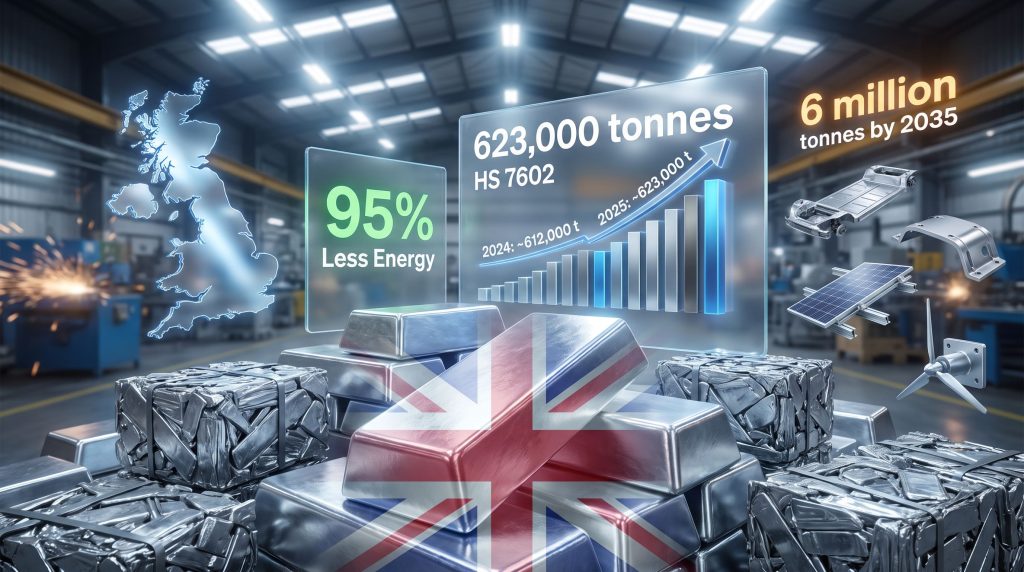
The environmental case for recycled aluminium is well established. Secondary production requires approximately 95% less energy than primary smelting from bauxite ore, a structural efficiency advantage that should, in theory, translate directly into cost competitiveness. In practice, the UK has not fully converted that thermodynamic advantage into economic output, and the reasons why illuminate the deeper structural challenges facing UK domestic aluminium recycling competitiveness.
What is less commonly understood is that secondary aluminium is not simply a lower-carbon version of primary metal. It is a materially different product category with distinct quality parameters, alloy-specific processing requirements, and supply-chain dynamics that do not map neatly onto primary aluminium frameworks. This distinction matters because generic recycling policy, designed to handle the full spectrum of recoverable materials, routinely fails to address the technical precision that aluminium circularity demands.
Aluminium's performance characteristics are determined at the alloy level. A 6000-series extrusion alloy and a 3000-series sheet alloy are chemically incompatible in a recycling stream, and mixing them without proper separation degrades the resulting secondary metal to a lower specification that may only be suitable for casting rather than wrought applications. This is the concept of alloy downcycling, and it represents one of the least-discussed barriers to genuinely high-value aluminium recycling in the UK.
"The difference between bulk scrap remelting and closed-loop alloy-specific recycling is not merely technical. It is the difference between recovering commodity value and retaining premium manufacturing value. For sectors like automotive and aerospace, only the latter is acceptable."
Where the Trade Data Reveals the Value Leak
The most direct evidence of the UK's mid-chain processing gap is visible in its aluminium scrap trade flows. In 2025, total UK exports of aluminium scrap under HS Code 7602 reached approximately 623,000 tonnes, up from around 612,000 tonnes in 2024. That incremental rise tells only part of the story.
The more striking figure is the surge in exports to the United States specifically, which climbed from approximately 2,000 tonnes in 2024 to more than 23,000 tonnes in 2025. This is not a gradual trend. It represents a step-change in trade flow direction that reflects real shifts in relative processing economics and market demand. Furthermore, aluminium tariff impacts from US trade policy have played a measurable role in redirecting these material flows.
| Trade Flow | 2024 Volume | 2025 Volume | Change |
|---|---|---|---|
| Total HS 7602 Scrap Exports | ~612,000 t | ~623,000 t | +~11,000 t |
| Exports to United States | ~2,000 t | ~23,000 t | +~21,000 t |
| UK Scrap Imports | Not disclosed | ~90,000 t | — |
The import figure is equally revealing. The UK brought in roughly 90,000 tonnes of aluminium scrap during 2025, meaning Britain is simultaneously exporting large volumes of raw scrap and importing processed or specification-grade material. This circular inefficiency is not a sign of a functioning global market operating in the UK's favour. It is a signal that domestic processing infrastructure is mismatched with the material flows the country generates.
Compounding this, the UK imported around 68,000 tonnes of primary aluminium from Gulf Cooperation Council countries including the UAE, Bahrain, Oman, Qatar, and Saudi Arabia in 2025. Given that geopolitical instability and energy disruption in those regions creates genuine supply-chain exposure, the case for substituting imported primary metal with domestically processed secondary aluminium is both economic and strategic. These dynamics mirror broader industrial metals market pressures being felt across global supply chains.
The Five Structural Barriers Holding Back UK Processing Capacity
Identifying the barriers to stronger UK domestic aluminium recycling competitiveness requires separating symptoms from causes. Export leakage and import dependency are symptoms. The causes are more specific.
Barrier 1: Industrial Energy Costs
UK industrial electricity prices remain among the highest in Europe. For secondary smelters and remelting operations, energy is typically the largest single operating cost. When that cost is structurally elevated relative to competing markets, exporting unprocessed scrap becomes commercially rational even though it destroys domestic value. Energy cost compensation schemes that apply to energy-intensive industries have not been consistently or comprehensively extended to secondary aluminium processors, creating an asymmetry that rewards export over domestic processing.
Barrier 2: Mid-Chain Processing Capacity Shortfall
The UK's collection infrastructure is mature. Its downstream manufacturing demand for aluminium is substantial and growing. What sits between those two endpoints — advanced sorting, alloy-specific separation, and closed-loop remelting capacity — has not received commensurate investment. The result is a capacity bottleneck that forces material out of the country rather than through it.
Barrier 3: Export Leakage as a Self-Reinforcing Dynamic
Once scrap export markets are established and logistics networks are built around them, reversing the flow becomes progressively harder. Exporters develop commercial relationships, pricing mechanisms, and operational efficiencies that make overseas sales the path of least resistance. Breaking that pattern requires domestic processing to be meaningfully more competitive, not merely equivalent.
Barrier 4: Fragmented Data and Skills Deficits
Industry analysis from 2026 identifies gaps in material flow data as a significant obstacle to investment decisions. Without reliable information on scrap volumes, alloy composition distributions, and regional generation patterns, the business case for new processing facilities is difficult to construct and harder to finance. Skills gaps in alloy-specific processing and quality management further limit the sector's ability to scale.
Barrier 5: Global Subsidy Distortions
State-backed aluminium processing in parts of Asia and the Middle East creates competitive conditions that UK recyclers cannot match without equivalent policy support. When competing markets subsidise energy costs or processing infrastructure, the effective price floor for aluminium scrap in global trade is artificially low relative to what UK domestic processors can offer. For context, aluminium industry leaders globally are increasingly shaping these subsidy dynamics in ways that affect smaller domestic recycling economies.
The Demand Horizon That Makes This Urgent
The strategic case for resolving these barriers is reinforced by the demand trajectory facing UK industry. Projections suggest that British industry could require up to 6 million tonnes of aluminium scrap for recycling by 2035, driven by intersecting growth forces across multiple sectors:
- Automotive electrification: Electric vehicle architectures are significantly more aluminium-intensive than conventional platforms. Battery enclosures, structural components, and thermal management systems all depend on lightweight, high-strength aluminium alloys. Closed-loop recycling is essential for maintaining the alloy quality specifications these applications require.
- Defence and aerospace: Domestic production ambitions in both sectors depend on traceable, domestically sourced aluminium supply chains. Import dependency creates strategic vulnerabilities that defence procurement increasingly seeks to eliminate.
- Clean energy infrastructure: Solar mounting systems, offshore wind components, transmission infrastructure, and grid hardware all consume aluminium at scale. The UK's net-zero commitments will generate sustained aluminium demand that secondary production is well positioned to serve.
- Digital infrastructure: Data centre construction and expansion, telecommunications hardware, and advanced electronics represent a growing and underappreciated aluminium demand segment that is often overlooked in recycling strategy discussions.
Meeting a 6 million tonne demand scenario by 2035 would require annual sector growth of approximately 25%, sustained over the coming decade. That is not an incremental improvement. It is a structural transformation of the secondary aluminium economy.
How the UK Compares to European Competitors
The UK's position in the European aluminium recycling landscape is instructive. Germany and the Netherlands have invested significantly in advanced sorting technologies and alloy-specific processing infrastructure, driven partly by EU circular economy policy and partly by proximity to major automotive manufacturing clusters that demand specification-grade secondary aluminium.
| Competitiveness Dimension | UK Status | EU Comparison | Gap |
|---|---|---|---|
| Energy cost per tonne remelted | High, structural barrier | Lower in key member states | Significant |
| Domestic processing capacity | Below scrap generation volumes | Expanding under policy pressure | Moderate to large |
| Scrap retention rate | Export-heavy | EU tightening internal retention | Growing |
| Alloy-specific sorting infrastructure | Underdeveloped | Advanced in Germany, Netherlands | Moderate |
| Policy framework specificity | Broad metals approach | Aluminium-specific circularity targets | Emerging |
The EU's Circular Economy Action Plan is progressively tightening material retention within the bloc. Europe's critical raw materials strategy is accelerating this shift, with aluminium increasingly recognised as a strategic resource requiring domestic supply chain protection. If those regulatory frameworks evolve to restrict aluminium scrap flows out of European markets, and the UK has not built sufficient domestic processing capacity in the interim, Britain faces an accelerating risk of becoming a raw material supplier to higher-value processing economies rather than a competitor within them.
According to research on aluminium scrap as a strategic resource, the commercial and policy case for treating aluminium scrap with the same strategic seriousness as primary raw materials has never been stronger.
The next major ASX story will hit our subscribers first
What Industry-Government Collaboration Looks Like in Practice
The Aluminium Federation (ALFED) has been explicit that its preferred policy approach is not export restriction. Aluminium operates within a global trade system, and preventing scrap exports would create its own market distortions. The preferred mechanism is improving domestic competitiveness so that processing in the UK becomes the commercially rational choice rather than a regulatory obligation.
Through the UK Aluminium Alliance (UKAA), the federation is working collaboratively with industry and government to map capability gaps, assess existing processing capacity, and construct the evidence base that can support investment decisions. This approach recognises that investment follows evidence, and that evidence requires data infrastructure that currently does not exist at the level of granularity the sector needs.
Key policy instruments that could materially shift the competitiveness equation include:
| Policy Instrument | Mechanism | Expected Impact |
|---|---|---|
| Energy cost compensation for secondary smelters | Reduce operating cost gap vs. export | High |
| Aluminium-specific material flow data systems | Enable investment-grade evidence base | Medium |
| Closed-loop procurement in public contracts | Create guaranteed domestic demand signal | Medium to high |
| Workforce and skills development investment | Address alloy processing capability gaps | Medium, long-term |
| Strategic material designation for secondary aluminium | Unlock industrial strategy financing | High |
Furthermore, the Alcoa recycling joint venture model demonstrates how strategic partnerships between major industry players can accelerate closed-loop recycling investment in ways that individual operators cannot achieve alone — a model that UK industry may increasingly look to replicate.
Industry bodies such as Make UK have also published strategic analysis on the aluminium scrap challenge, reinforcing the cross-sector consensus that inaction carries a measurable competitive cost.
The 2035 Vision: What a Competitive UK Recycling Economy Requires
A genuinely competitive UK aluminium recycling economy by 2035 would look substantially different from today's configuration. The infrastructure requirements are specific:
- Scaled alloy-specific sorting and separation facilities positioned near major industrial scrap generation zones, including automotive manufacturing hubs and construction demolition corridors.
- Expanded secondary remelting capacity integrated with downstream fabrication and casting operations, enabling closed-loop supply chains that meet automotive and aerospace quality specifications.
- Digital material tracking systems that provide chain-of-custody data for recycled aluminium content, meeting emerging regulatory transparency requirements in export markets and enabling premium pricing for verified low-carbon secondary metal.
The supply-chain resilience benefits of this infrastructure extend beyond the aluminium sector itself. Reducing dependence on primary aluminium imports from geopolitically sensitive regions, building domestic feedstock security for advanced manufacturing, and insulating British industry from commodity price volatility all represent measurable strategic gains.
"If the UK were to process an additional 100,000 tonnes of aluminium scrap domestically rather than exporting it as raw material, the downstream value multiplication through remelting, alloying, casting, and fabrication could generate three to five times the economic contribution of raw scrap export revenues alone."
| KPI | 2025 Baseline | 2030 Indicative Target |
|---|---|---|
| Domestic scrap processing rate | Below capacity potential | Materially higher |
| HS 7602 export volume | ~623,000 t | Reduced via capacity growth |
| Primary import dependency (Gulf) | ~68,000 t | Reduced via secondary substitution |
| Annual sector growth rate | Below 25% trajectory | On track for demand forecasts |
Frequently Asked Questions: UK Aluminium Recycling Competitiveness
Why does the UK export so much aluminium scrap rather than processing it domestically?
The answer is primarily economic. When domestic energy costs are high and mid-chain processing capacity is insufficient to absorb available scrap volumes, exporting raw material becomes the most commercially viable option for scrap collectors and traders. Improving UK domestic aluminium recycling competitiveness requires addressing the energy cost structure and the capacity gap simultaneously, since fixing one without the other will not shift the commercial logic that currently favours export.
What makes aluminium recycling technically more complex than other metals?
Aluminium's mechanical properties and chemical compatibility are determined at the alloy level. A 2000-series aerospace alloy and a 5000-series marine alloy cannot be co-mingled in a recycling stream without degrading the output material. This alloy sensitivity means that bulk collection and remelting — which is sufficient for many metals — produces only downgraded secondary aluminium suitable for lower-specification casting applications. High-value recycling requires alloy-specific sorting, which demands more sophisticated and capital-intensive equipment than conventional metals recycling.
Is there a risk that the UK becomes permanently locked into a low-value position in the aluminium supply chain?
Yes, and it is a risk that compounds over time. As export logistics networks mature and overseas processing capacity expands to absorb UK scrap, reversing those trade flows becomes progressively more difficult. The window for building competitive domestic processing capacity is not indefinitely open, and the demand growth projected toward 2035 creates a specific timeline within which the investment case is strongest.
What does ALFED actually want from government?
The federation's position is focused on improving the conditions for domestic processing rather than restricting trade. Specific asks include aluminium-targeted energy cost support, investment in material flow data infrastructure, skills development for alloy-specific processing, and recognition of secondary aluminium as a strategic industrial raw material within the UK's broader industrial strategy.
Key Takeaways
- UK domestic aluminium recycling competitiveness is constrained by a mid-chain processing gap, not by scrap shortage or downstream demand weakness.
- In 2025, the UK exported approximately 623,000 tonnes of aluminium scrap while simultaneously importing around 90,000 tonnes and approximately 68,000 tonnes of primary aluminium from Gulf states.
- Exports to the United States alone surged from around 2,000 tonnes to more than 23,000 tonnes between 2024 and 2025, reflecting a step-change in trade flow direction.
- The 95% energy saving of secondary versus primary aluminium production is a structural advantage that UK industrial energy pricing is currently preventing from translating into competitive domestic processing economics.
- Demand projections suggest UK industry may require up to 6 million tonnes of recycled aluminium annually by 2035, requiring sustained sector growth of approximately 25% per year.
- Alloy downcycling — the degradation of secondary aluminium through mixed-alloy recycling streams — is one of the least-discussed but most consequential barriers to high-value domestic recycling.
- The UKAA's evidence-building and capability mapping work represents the most viable near-term mechanism for constructing the investment case that domestic processing expansion requires.
Disclaimer: Demand projections and growth rate figures cited in this article are indicative industry estimates and should not be interpreted as guaranteed outcomes. Readers should conduct independent research before making investment or strategic decisions based on sectoral forecasts.
Want to Identify the Next Major ASX Mineral Discovery Before the Broader Market?
Discovery Alert's proprietary Discovery IQ model delivers real-time alerts on significant ASX mineral discoveries — including those spanning the full aluminium and industrial metals supply chain — instantly converting complex announcement data into actionable investment insights for both short-term traders and long-term investors. Explore historic discoveries and their exceptional market returns to understand the opportunity, then start your 14-day free trial at Discovery Alert and position yourself ahead of the market.