July 27, 2026
When Global Oil Markets Sneeze, Indian Futures Catch a Cold
Commodity markets operate on a principle of interconnected sentiment. When the world's two dominant crude oil benchmarks move sharply in the same direction within a single trading session, the ripple effects reach every futures exchange on the planet, including India's Multi Commodity Exchange. Understanding why crude oil futures fall on weak global cues requires more than reading a price ticker. It demands an appreciation of how macro forces, trader psychology, currency dynamics, and physical demand signals converge to produce coordinated selling pressure across geographically separate markets.
When big ASX news breaks, our subscribers know first
What "Weak Global Cues" Actually Signals in Oil Markets
The phrase "weak global cues" is frequently used in commodity market reporting, but it obscures a more complex reality. It is not a single data point. It is a composite of deteriorating signals arriving simultaneously from multiple directions: softening economic data out of major consuming nations, USD strength compressing the purchasing power of oil-importing economies, demand forecast downgrades from energy agencies, and a broader risk-off mood that pushes institutional traders toward cash and away from commodity exposure.
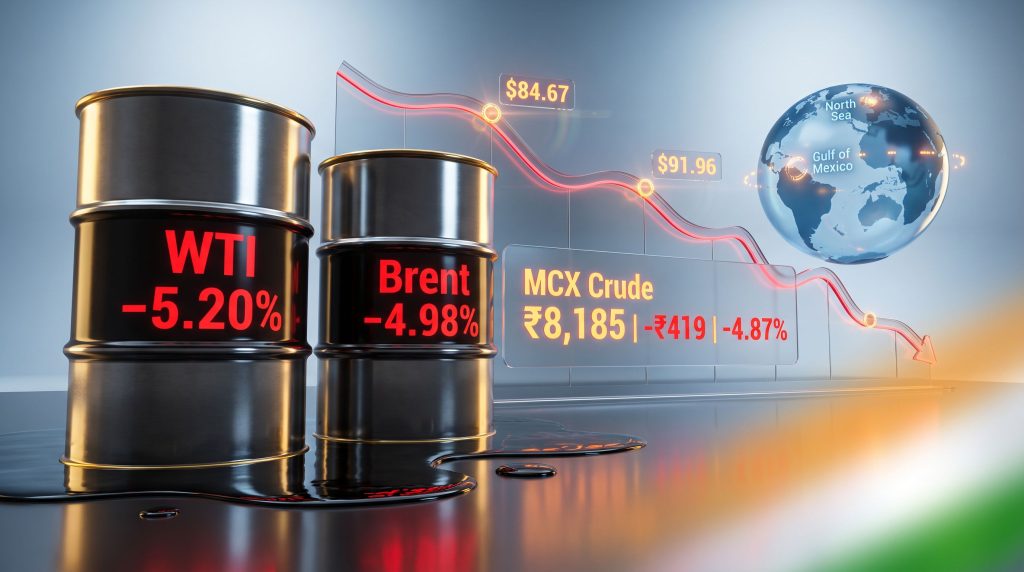
When market analysts attributed the sharp MCX crude oil futures decline to weak global cues, they were pointing to a convergence event. WTI crude fell 5.20% to $84.67 per barrel, while Brent crude dropped 4.98% to $91.96 per barrel, and the MCX August delivery contract slipped ₹419, or 4.87%, to ₹8,185 per barrel on turnover of 10,482 lots. The near-symmetrical magnitude of decline across all three instruments is analytically significant. Furthermore, as crude oil price trends demonstrate, such synchronised moves rarely occur in isolation.
When WTI, Brent, and a rupee-denominated domestic futures contract all fall by approximately the same percentage within the same session, the evidence strongly points toward a systemic macro event rather than a regional supply disruption or India-specific factor.
How Spot Market Weakness Amplifies Futures Declines
A less-discussed but critical dynamic in commodity futures pricing is the feedback loop between spot market demand and futures positioning. When physical buyers in spot markets pull back, either because industrial activity is slowing or because procurement managers are delaying purchases in anticipation of further price softness, this reduced physical buying pressure registers in futures markets almost immediately.
Traders monitoring spot market activity interpret subdued physical demand as a leading indicator of weaker forward demand. This triggers pre-emptive position offloading, where participants close out long contracts to avoid holding depreciating assets. The mechanical result is that futures prices fall faster and further than the underlying fundamental shift in supply-demand balance would strictly justify. Spot market weakness, in this sense, does not merely reflect the bearish trend but actively accelerates it.
How MCX Crude Oil Futures Are Structured and Why It Matters
Understanding the MCX framework is essential for interpreting the data correctly. MCX crude oil futures are rupee-denominated contracts tied to WTI crude as the underlying international benchmark. Each lot represents 100 barrels, and contracts are available across multiple delivery months, with the near-month contract carrying the highest liquidity and price sensitivity.
The 10,482 lots of business turnover recorded during the session represents meaningful market participation. High volume during a sharp price decline is particularly instructive: it confirms that the move was not driven by thin liquidity or a handful of large transactions, but by broad-based participant activity. This is the difference between a technically driven price spike and a fundamentally or macro-driven correction.
Because MCX contracts are priced in Indian rupees but benchmarked against a dollar-denominated commodity, exchange rate movements introduce an additional layer of complexity. A strengthening US dollar exerts dual pressure on MCX crude prices. It suppresses the dollar price of oil globally while simultaneously increasing the import cost burden for rupee-based buyers, creating a complex offsetting dynamic that traders must continuously recalibrate.
Key Price Snapshot: MCX and Global Benchmarks
| Metric | Value | Change |
|---|---|---|
| MCX Crude (August Delivery) | ₹8,185 per barrel | -₹419 (-4.87%) |
| WTI Crude (Global) | $84.67 per barrel | -5.20% |
| Brent Crude (Global) | $91.96 per barrel | -4.98% |
| MCX Business Turnover | 10,482 lots | Session volume |
The Macro Architecture Behind This Selloff
To fully decode why crude oil futures fall on weak global cues, it is worth examining the structural forces that tend to generate these coordinated declines. In addition, understanding oil price movements during trade disputes provides useful context for interpreting the scale of these macro-driven events.
Demand Destruction Signals From Major Economies
Global oil demand is disproportionately driven by industrial activity. Manufacturing PMI contractions, weak freight volumes, and declining power consumption in large economies all compress forward demand projections. China, as the world's largest crude oil importer, functions as a swing factor for global demand. When Chinese industrial data disappoints, energy traders systematically revise down their demand models, and futures prices adjust accordingly.
Similarly, recessionary signals from Western economies, whether through inverted yield curves, declining consumer confidence indices, or central bank policy tightening, prompt energy analysts to lower their demand growth forecasts. These revisions feed directly into futures pricing through algorithmic models that adjust positioning automatically when threshold triggers are crossed.
The USD-Oil Price Inverse Relationship
One of the most structurally important and often under-appreciated dynamics in oil markets is the inverse relationship between US dollar strength and crude prices. Because oil is globally priced in US dollars, a stronger dollar makes oil more expensive for buyers holding other currencies. This reduces effective demand from non-dollar economies, which together account for the majority of global oil consumption.
Federal Reserve monetary policy signals therefore ripple directly through to crude oil futures. When the Fed signals tighter-for-longer rate conditions, the dollar strengthens, and commodity markets including oil typically reprice lower. For emerging market importers like India, this creates a compounding challenge: dollar-denominated oil prices may fall, but the depreciation of the rupee partially offsets the benefit when calculating actual import costs.
OPEC+ Supply Discipline Under Demand Pressure
A critical tension that shapes crude market dynamics during demand-weakness episodes is how OPEC+ responds to falling prices. Member nations have fiscal breakeven prices, the oil price at which their government budgets balance, that typically range from $60 to over $90 per barrel depending on the country. Consequently, when spot prices approach these breakeven thresholds, the incentive to cheat on production quotas increases significantly, threatening collective output discipline.
The influence of OPEC on global markets means that the market's awareness of this tension can amplify demand-driven selloffs through speculation about whether individual members will quietly raise output to defend revenue. This uncertainty adds a volatility premium to what might otherwise be a more orderly price correction.
India's Specific Exposure to Global Crude Price Movements
India imports approximately 85% of its crude oil requirements, making it one of the world's most import-dependent major economies for energy. This structural dependency creates a direct transmission mechanism between international benchmark prices and domestic economic outcomes. Furthermore, the impacts of trade tensions on energy add another layer of complexity to how these price movements ultimately affect Indian consumers and businesses.
Short-Term and Long-Term Impact Framework
| Dimension | Short-Term Impact | Long-Term Implication |
|---|---|---|
| Import Bill | Reduced forex outflow | Current account improvement |
| Retail Fuel Prices | Potential downstream relief | Subject to government pricing policy |
| Consumer Inflation | Downward pressure on CPI | Supports monetary policy flexibility |
| Energy Sector Stocks | Refinery margin expansion | Upstream investment uncertainty |
| Trade Balance | Narrowing deficit | Improved macroeconomic stability |
A critical nuance that retail consumers frequently misunderstand is the transmission lag between falling international crude prices and lower prices at the petrol pump. India's fuel pricing mechanism involves administered pricing components, excise duties, and dealer margins that absorb international price movements before they reach the retail level. Sustained crude price weakness of several weeks is generally required before downstream fuel price adjustments become politically and economically viable.
Reading Futures Market Signals as a Macro Barometer
For traders and investors, a coordinated multi-market selloff of this magnitude serves as a diagnostic instrument rather than simply a price event. However, navigating commodity market volatility effectively requires more than monitoring price levels alone; it demands a systematic approach to understanding the underlying drivers.
Key Indicators to Monitor During Oil Price Weakness
- US EIA weekly inventory reports: Rising crude stockpiles signal weakening downstream demand and typically precede further price pressure
- Baker Hughes rig count data: Declining active rig counts indicate producers are adjusting to lower price expectations, which can tighten future supply and eventually support prices
- Futures curve structure: A shift from backwardation (near-term prices above forward prices, indicating tight supply) to contango (forward prices above near-term, indicating oversupply expectations) is a bearish structural signal
- Refinery utilization rates: Low utilization indicates weak downstream demand for crude feedstock, reinforcing bearish price outlook
- OPEC+ compliance monitoring: Any deviation from stated production quotas, either above or below, can shift price direction rapidly
Position Offloading: The Mechanical Amplifier
When the market narrative turns bearish, the mechanics of futures trading can turn a moderate fundamental shift into a sharp price decline. Participants holding long positions face a choice: hold through the volatility and risk further losses, or close positions and accept the current loss. When a critical mass of traders chooses to offload simultaneously, their selling creates additional downward price pressure, triggering stop-loss orders for other participants, which in turn generates further automated selling.
This cascade dynamic explains why single-session declines of 4-5% in crude futures are not uncommon during macro risk-off events, even when the underlying fundamental supply-demand shift is more modest. As reported across major financial outlets, crude oil futures fall on weak global cues in a pattern that reflects both genuine fundamental bearishness and self-reinforcing technical momentum. The price decline becomes, in part, a self-reinforcing technical event layered on top of the underlying macro concerns.
Disclaimer: This article is intended for informational purposes only and does not constitute financial or investment advice. Commodity futures markets carry significant risk, and past price movements are not indicative of future performance. Readers should conduct independent research and consult qualified financial advisers before making trading or investment decisions.
The next major ASX story will hit our subscribers first
Frequently Asked Questions
Why do crude oil futures fall when global cues are weak?
Crude oil futures are globally interconnected instruments. When leading international benchmarks decline due to deteriorating demand outlooks or macro risk-off sentiment, domestic exchanges like MCX mirror these movements as traders respond to the same macro signals by offloading long positions, creating compounding downward momentum. Analysts at Outlook Business have similarly noted how these coordinated declines reflect broader systemic forces rather than localised disruptions.
What is the difference between WTI and Brent crude oil?
WTI (West Texas Intermediate) is a US-produced light sweet crude benchmark traded primarily in New York. Brent is a North Sea benchmark that serves as the global pricing reference for roughly two-thirds of internationally traded crude. Both function as leading sentiment indicators for global oil markets, though Brent carries greater international weight.
Is a 4-5% single-session crude oil price decline considered significant?
Yes. A 4-5% intraday move in crude futures is considered a large-magnitude event and typically reflects a major macro shock, a sharp downward revision in demand expectations, or a coordinated risk-off event across global financial markets. Such moves warrant careful analysis of driving factors before any trading decisions are made.
How does a crude price drop translate into benefits for India?
A sustained reduction in crude prices lowers India's import bill, reduces pressure on the current account deficit, and creates disinflationary conditions that give the Reserve Bank of India more flexibility in managing interest rates. However, retail fuel price relief is not automatic and depends on government pricing policy and excise duty structures.
What does position offloading mean in a futures market context?
Position offloading refers to the act of closing existing long (buy) positions in futures contracts, typically to limit losses or lock in remaining value during a declining market. When many participants offload simultaneously, the collective selling pressure accelerates price declines beyond what underlying fundamentals alone would produce.
Want to Stay Ahead of the Next Major Commodity Market Move?
Discovery Alert's proprietary Discovery IQ model delivers real-time alerts on significant ASX mineral discoveries, transforming complex commodity data into actionable investment insights for both short-term traders and long-term investors. Explore Discovery Alert's dedicated discoveries page to see how historic mineral discoveries have generated substantial market returns, and begin your 14-day free trial today to secure a market-leading advantage.